Super Mario World
- This article is about the Super Nintendo Entertainment System game. For other uses, see Super Mario World (disambiguation).
- "Super Mario Bros. 4" redirects here. For other uses, see Super Mario Bros. 4 (disambiguation).
- "SMW" redirects here. For other uses, see SMW (disambiguation).
- Not to be confused with Super Mario Land, Super Mario 3D World, or Super Mario's World.
| Super Mario World | |||||||||||||||
|---|---|---|---|---|---|---|---|---|---|---|---|---|---|---|---|
 For alternate box art, see the related gallery. | |||||||||||||||
| Developer | Nintendo R&D4 | ||||||||||||||
| Publisher | Nintendo | ||||||||||||||
| Platforms | Super Famicom/Super Nintendo Entertainment System, Nintendo Super System, LodgeNet, Virtual Console (Wii, Wii U, New Nintendo 3DS), Super NES Classic Edition, Nintendo Classic Mini: Super Famicom, Super Nintendo Entertainment System – Nintendo Classics | ||||||||||||||
| Release dates | Super Famicom: November 21, 1990[1] November 21, 1990[1]Super Nintendo Entertainment System:  1991[2] 1991[2] August 23, 1991[3] August 23, 1991[3] April 11, 1992[4] April 11, 1992[4] July 3, 1992[5] July 3, 1992[5] August 30, 1993[6] August 30, 1993[6]Nintendo Super System: 1991[7]Virtual Console (Wii): December 2, 2006[8] February 5, 2007[9] February 9, 2007[10] February 9, 2007[11] April 26, 2008[12]Virtual Console (Wii U): April 26, 2013[13] April 27, 2013[10] April 27, 2013[14] April 27, 2013[15]Virtual Console (New 3DS): March 3, 2016[16] March 3, 2016[10] March 3, 2016[17] March 4, 2016[18] March 4, 2016[19] March 4, 2016[19]Super NES Classic Edition: September 29, 2017[20] September 29, 2017[21] September 30, 2017[22]Nintendo Classic Mini: Super Famicom: October 5, 2017[23]Super Nintendo Entertainment System - Nintendo Classics: September 5, 2019[24] September 6, 2019[25] September 6, 2019[26] September 6, 2019[27] September 6, 2019[?] September 6, 2019[?] September 6, 2019[?] September 6, 2019[?]Give the world a whole new look! March 30, 2022[28][29] March 31, 2022[30] March 31, 2022[?] March 31, 2022[?] | ||||||||||||||
| Languages | English Japanese | ||||||||||||||
| Genres | Platformer, action-adventure | ||||||||||||||
| Ratings |
| ||||||||||||||
| Modes | Single player, multiplayer | ||||||||||||||
| Format |
 Cartridge Cartridge Cartridge CartridgeSNES:  Game Pak Game PakWii:  Digital download Digital download Digital download Digital download Digital download Digital download Digital download Digital downloadBuilt-in
| ||||||||||||||
| Input | SNES: Wii:  Joy-Con (horizontal) Joy-Con (horizontal) | ||||||||||||||
| Serial codes | SHVC-MW SNSN-MW-KOR SNS-MW-USA SNS-MW-CAN SNS-MW-CAN SNSP-MW-UKV SNSP-MW-UKV SNSP-MW-FAH SNSP-MW-FAH SNSP-MW-NOE SNSP-MW-AUS SNSP-MW-NOE SNSP-MW-AUS | ||||||||||||||
 - Everyone
 - All ages
 - Three years and older
 - All ages
 - General audience
 - All ages
 - General





Super Mario World is a 2D action-adventure platform game developed by Nintendo R&D4 for the Super Famicom in 1990 and the Super Nintendo Entertainment System in 1991, with the Nintendo Super System release coming out in the same year. It is a direct sequel to Super Mario Bros. 3 and the sixth entry in the Super Mario series. In Japan, it is recognized as the fifth.[33][34] This game was one of two launch titles for the Super Famicom, the other being F-Zero.[35] As the sequel to Super Mario Bros. 3, Super Mario World retains many of the elements that debuted in that game, such as the world map and Koopaling boss fights, while introducing a large variety of new gameplay mechanics, such as an expanded and less linear world map and the ability to save the game. Super Mario World introduces Mario's sidekick, Yoshi (and his species that shares his name), who serves as a playable mount for the Mario Bros. with his own unique abilities and gameplay style. The overall game was meant to be modeled after an action movie franchise, as can be inferred by the Japanese version of the Koopaling defeat scenes as well as the summary on the back of the Japanese box.
The game was released to best-selling status on the Super Nintendo Entertainment System, received large amounts of critical acclaim, and is commonly seen on Nintendo's best games of all time on various critic listings. Many of its introduced characters, game mechanics, and artistic themes influenced later titles in the Super Mario franchise, and the character Yoshi was popular enough to receive a franchise starring him. The game was followed in 1995 by a prequel, Super Mario World 2: Yoshi's Island, set during Mario's infancy. Super Mario World has spawned various non-game media such as a cartoon series based on it, which debuted on September 14, 1991, one month after the American release. Various manga adaptations of the game have sprung up, one notable series being Super Mario-kun, which has its first volumes based on Super Mario World released in 1991 and is still ongoing today.
Super Mario World is included in the Super Mario All-Stars + Super Mario World compilation title released in December 1994. A reissue of Super Mario World was later released on the Game Boy Advance as part of the Super Mario Advance series, titled Super Mario World: Super Mario Advance 2. The original version was also rereleased on the Wii's Virtual Console in 2006, the Wii U's Virtual Console in 2013, and the New Nintendo 3DS's Virtual Console in 2016. Super Mario World is one of the included titles in the SNES Classic Edition and Super Nintendo Entertainment System – Nintendo Classics, the latter of which also includes a version titled Super Mario World: Give the world a whole new look!, which was initially released on March 30, 2022, and begins in Fall with 99 lives and a Cape Feather in the Item Stock.
Story[edit]
From the instruction booklet:
After saving the Mushroom Kingdom from Bowser and the rest of the Koopas in Super Mario 3, Mario and Luigi needed to recuperate from their adventures. Together they agreed that the best place to vacation was a magical place called Dinosaur Land.
But while Mario and Luigi reclined on the beach for a relaxing nap, Princess Toadstool disappeared, apparently seized by evil forces. After searching for hours for their missing friend, Mario and Luigi came upon an enormous egg in the forest.
Suddenly the egg hatched, and out popped a young dinosaur named YOSHI, who proceeded to tell Mario and Luigi a sad tale of how his dinosaur pals were sealed in similar eggs by a group of monstrous turtles.
"Monstrous turtles!,[sic]" exclaimed Luigi. "Bowser and his bunch have returned!" Mario slowly nodded his head in agreement and, along with Luigi and Yoshi, set off across Dinosaur Land to find the Princess and to free Yoshi's friends. As they began their journey, Yoshi handed Mario a beautiful cape. "This may help you," Yoshi said. "Some say it has magical powers."
With a little luck (and help from a magic cape), our hearty crew can defeat the seven worlds of Bowser's Krazy Koopa Kritters. Many locations are well-hidden so explore everywhere and try everything. Not all locations have to be explored to rescue the dinosaurs and save Princess Toadstool, but there are many "starry" treasures to be found in far-reaching places. You'll need to search all areas to find what kinds of treasures are there... in Super Mario World.
Super Mario World is the only sequel in the Super Mario series to take place directly after the events of a previous entry. After Bowser's previous defeat, Mario, Luigi, and Princess Toadstool decide to recuperate in Dinosaur Land. Meanwhile, in Dinosaur Land, Bowser and his Koopalings trap Yoshi and his friends in enchanted eggs, eliminating the opposition as they secretly rebuild their forces. Shortly upon their arrival, the Mario Bros. realize that Toadstool is missing. While searching, they find the Koopa Troop. Upon the Mario Bros. freeing the friendly Yoshi, he exclaims that the Koopas have invaded, confirming that Bowser has indeed returned and taken the opportunity to claim the princess.
As Mario and his friends travel through Dinosaur Land, they uncover the Valley of Bowser, where Bowser is fought on his castle roof in his Koopa Clown Car, holding Toadstool hostage. Upon his defeat, he gently drops the princess and retreats. Toadstool rewards Mario or Luigi with a kiss as fireworks celebrate freedom, signifying that their vacation can resume with their new good friends. The reunited team returns to Yoshi's House, where the team and three other Yoshis watch the eggs hatch into babies, removing the spell.
Gameplay[edit]

As the game is a 2D platformer, the object of every level is to get to the Giant Gate at the end to advance to the next level before the timer runs out. Mario (or Luigi) can jump over and on top of various platforms and obstacles and stomp on various enemies to defeat them. In addition to the basic jump, Mario can spin-jump to destroy certain types of blocks and enemies, whereas  or
or  lets Mario dash if held down. When the player presses either of those buttons when Mario is next to some items, he can pick them up and carry them through the level as the buttons are held. Mario can now hold objects underwater; when he does, he can swim quickly when the player uses only
  without pressing the jump button. When Mario hits the Giant Gate at the end of the level, if he touches the vertically moving tape between the gate, he gets awarded Bonus Stars depending on how high the tape is when he touches it. If he collects 100 Bonus Stars, Mario can play a bonus game that helps him earn extra lives. Some levels contain a Midway Gate, which not only powers Mario up to Super Mario when touched but also serves as a checkpoint for Mario to respawn near if he gets defeated in the level.
Mario can transform with power-up items, mostly found in blocks. The basic Super Mushroom, which turns Mario into Super Mario, causes him to grow bigger and allows him to sustain an extra hit. When Super Mario hits a block, usually a more powerful item spawns in the Super Mushroom's place, such as a Fire Flower or the newly introduced Cape Feather. Introduced in Super Mario World is the Item Stock, where Mario can hold on to one extra item should he find it while in powered-up forms; players can manually drop their reserve item by pressing  . If Mario gets damaged and turns into regular Mario, the reserve item automatically deploys. A newly introduced character and power-up in Super Mario World, Yoshi, also appears from certain blocks. Mario can jump on Yoshi to ride him and receive more special abilities, the most prominent one being using his tongue to eat enemies and carry items.
If Mario gets touched by an enemy or a damaging obstacle while he is in his small form, he loses a life. If he gets damaged by an enemy while in a power-up form, he reverts to his normal form. If Mario loses all of his lives, the player receives a Game Over and is prompted to continue from their last save with five more lives. Some obstacles defeat Mario instantly regardless of what power-up he has, such as falling into pits or lava, getting crushed, and not making it to the goal in time. Every time Mario gets defeated, he gets sent back to the world map.
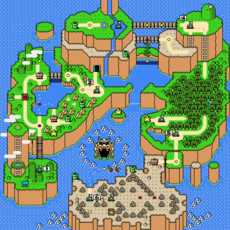
Super Mario World retains the world map system from Super Mario Bros. 3 with more expanded features. Rather than having levels and worlds segmented, most worlds and levels are seamlessly connected to each other, with a heavier focus on multiple paths per level clearance, and thus creating a less linear map, with a few exceptions. Typically, prior to entering new areas, Mario has to defeat a castle boss, usually one of Bowser's seven children, the Koopalings. Once they are defeated, the castles they reside in are destroyed and cannot be replayed, though in international versions of the game, they can be replayed if players hold  and
and  on the castles' remains.
Two-player mode returns, where players take turns playing through the game; Player 1 controls Mario, while Player 2 controls Luigi. Players can opt to use the same controller or two controllers to play the mode. If one player fails to clear a course, the other player takes a turn, and if a Midway Gate is touched, the other player starts at the Midway Gate. Players can also hand each other lives on the map screen if they press or .
After the player beats every special level in the Special Zone, a game aesthetic change called Fall occurs, where the world map obtains a different palette and some enemies get their sprites changed. Once Fall is activated, these changes cannot be reversed unless the save file is deleted and a new game is started.
Controls[edit]
The Wii U and Nintendo Switch versions' controls can be customized; their respective columns display the default mappings.
| Action(s) | SNES | Wii (Classic Controller) | Wii (GameCube Controller) | 3DS | Wii U | Switch (Dual Joy-Con / Pro Controller) | Switch (Single Joy-Con) |
|---|---|---|---|---|---|---|---|
| Move | Left/right
|
 / /  Left/right Left/right
|
 / /  Left/right Left/right
|
 / /  Left/right Left/right
|
 / /  Left/right Left/right
|
 / /  / /  Left/right Left/right
|
 Left/right Left/right
|
| Crouch / climb | Down
|
 / Down / Down
|
 / Down / Down
|
 / Down / Down
|
 / Down / Down
|
 / /  / Down / Down
|
Down
|
| Look up / climb | Up
|
 / Up / Up
|
 / Up / Up
|
 / Up / Up
|
 / Up / Up
|
 / /  / Up / Up
|
Up
|
| Spin Jump | 
|

|

|

|

|

|

|
| Jump | 
|

|

|

|

|

|

|
| Dash / Interact / Special ability | /
|
 / / 
|
 / / 
|
 / / 
|
 / / 
|
 / / 
|
 / / 
|
| Screen Scroll Option[36] left (does not work in auto-scrolling levels, at Yoshi's House, in the Top Secret Area, or in Boss Rooms) |
|

|

|

|

|

|

|
| Screen Scroll Option right (does not work in auto-scrolling levels, at Yoshi's House, in the Top Secret Area, or in Boss Rooms) |
|

|

|

|

|

|

|
| Pause | 
|

|

|

|

|

|
 + +
|
| Use item in Item Stock / Return to map from a completed level (when paused) |
|

|

|

|

|

|
+
|
Worlds and levels[edit]