
Hotel Mario
- "HM" redirects here. For the 2025 game for the Nintendo Switch and smart devices with the same abbreviation, see Hello, Mario! (game).
| Hotel Mario | |
|---|---|

| |
| Developer | Fantasy Factory |
| Publisher | Royal Philips Electronics |
| Platform | Philips CD-i |
| Release dates |  July 1994[1] July 1994[1] September 1994 or earlier[2] September 1994 or earlier[2] 1995[3] 1995[3] |
| Languages | English French (Europe) |
| Genres | Platform, puzzle |
| Rating | N/A |
| Mode | 1–2 players |
| Format |
 Optical disc Optical disc |
| Input | |
Hotel Mario is a puzzle/platform game released on the Philips CD-i. It was published by Royal Philips Electronics, which had acquired the rights to produce Super Mario and The Legend of Zelda games after initial plans to make a CD-ROM add-on for the Super Nintendo Entertainment System fell through. Released in June 1994 in North America to little fanfare, the game had low sales partially due to a lack of interest in the CD-i system and received mainly negative reviews, but has since gained a cult following over time for its cutscenes.
In the game's plot, Bowser and his seven Koopaling children (Morton, Roy, Larry, Lemmy, Ludwig, Wendy, and Iggy) have taken over the Mushroom Kingdom and turned it into Klub Koopa Resort, where they have claimed seven Koopa hotels and have kidnapped the princess, hiding her in one of them. After Mario and Luigi are informed of this, they set out to rescue her.
The general goal in each stage is to close all the doors on every floor. However, various enemies will interfere and reopen them at times. Elevators are needed to travel between floors. The first six hotels have ten stages, while the seventh has fifteen.
Plot
From the enclosed instruction book:
THE STORY
It's a dark day in the Mushroom Kingdom. Mario and Luigi have come to visit their friend Princess Toadstool, only to discover that the Princess has been kidnapped by Bowser, King of the evil Koopaling clan!
Bowser has turned the beautiful Mushroom Kingdom into a personal resort for himself and his seven Koopaling children. Each Koopaling has taken over a hotel in the Kingdom. To top it off, Bowser has challenged Mario and Luigi to save the princess from the Koopalings' clutches.
Beware of the Koopalings and their nasty pals as they try to stop Mario and Luigi from searching the seven hotels. Mario and Luigi have to use their ability to jump and stomp—and throw fireballs—to avoid or defeat these enemies. It's up to Mario and Luigi to outsmart the Koopalings' clever traps.
Are you ready to check in to Hotel Mario?

Mario and Luigi head to the Mushroom Kingdom after being invited to a picnic by the princess. However, soon after arriving, Mario finds a letter on the front door to a gate, which has a board with the words "Klub Koopa Resort" on it. The letter is from Bowser, who claims that he and the Koopalings have turned the Mushroom Kingdom into their personal resort and have each taken over a hotel. It also states that the princess is being held hostage in one of them, and challenges them to find her.
The brothers come across the first hotel, the Wood Door Hysteria Hotel. With Luigi's help, Mario is able to leap inside the hotel through a window. After conquering the hotel, Morton and the brothers leap out of the tree-hotel, which then sprouts fruit. Mario notices the princess on one of the branches, but it snaps underneath her. She lands in Roy's open arms, and he takes her to his hotel, the HardBrick Hotel. However, the lights continuously flicker on and off inside. Luigi is concerned as to how they will find her, but Mario assumes that there may be a switch somewhere. Inside the hotel itself, Mario finds the cause of the hotel's light problem: a room with several toasters plugged in, toasting Bowser's Sourpuss Bread. He unplugs all the toasters, which returns the hotel's electricity to normal.
After defeating Roy, the Mario brothers condemn the hotel. The princess is standing on a Warp Pipe, but she is sucked down into it. Mario wonders where she is, but Luigi points out the cave in the distance. This cave turns out to be the Chillton Hotel. It is dark inside, and they do not have a light. Nevertheless, they journey inside.
After Larry is conquered, the cave explodes, with the princess flying out of it. Mario and Luigi prepare to catch her, but find that she is not falling. Mario realizes that she is in the clouds, and the High-ate Regency Hotel is revealed. Luigi kicks a nearby ! Block, which causes a vine to sprout out of it and into the sky above. In the hotel, there is a cloud which diverts Mario. He finds a room where he turns on a fan which blows the cloud away. Once Lemmy is defeated, Mario, Luigi, and the princess escape. Lemmy also tries to flee, but a massive fan blows both him and the hotel away before he can reach them. However, the princess suddenly magically vanishes. Back on the ground, Mario and Luigi take sight of another one of the Koopalings' hotels, this time the Thump Castle Hotel. Just as they are about to enter, the entrance disappears, but reappears near instantly after. In the hotel, there are vanishing doors. Mario finds a room with a liquid that stops the doors from vanishing.

After Ludwig is beaten, the Mario Brothers escape as the entire hotel crumbles, leaving only a frame. However, the princess is nowhere in sight. Luigi then points out the location of Wendy's hotel, the Blitz Snarlton Hotel. When they conquer the hotel, the brothers escape and the hotel vanishes. The princess runs over and greets them, but vanishes once again as well, with Bowser's laughter heard in the background. Mario then takes notice of a plume of smoke heading their direction, and finds the Seizures Palace Hotel. When Iggy (who works at Bowser's hotel as opposed to running his own) and Bowser are defeated, Mario, Luigi, and the princess flee as the hotel falls to rubble, the landscape transforming back to its previous form. The princess thanks the Mario Brothers for defeating Bowser and freeing the kingdom from the Koopaling clan, giving them both a kiss, and they all thank the player for their contributions.
Gameplay

The player controls Mario through a number of stages in order to rescue Princess Toadstool from the clutches of Bowser and the Koopalings. The gameplay takes place over several stacked hallways taking up a single screen which must be traveled between to defeat enemies and complete the objective, similar to Mario Bros. and Wrecking Crew. The goal of each stage is for Mario to close each door using elevators to reach each floor (though the purpose of closing the doors is left unexplained[4]), within a fixed time limit of 200 seconds. Enemies may interfere with the progress, opening doors that may have been closed already and even opening doors from inside the room of which they have been closed. Touching an enemy or other hazard will cause Mario to lose a life, though he can also lose a life by running out of time, falling off the edge of a floor, or by allowing all of the doors to open.
By opening a few doors, Mario can find coins in the rooms; he obtains an extra life once he collects thirty coins. He may also obtain a Super Mushroom to become Super Mario and take an extra hit, a Fire Flower to become Fire Mario and use fireballs to take out practically all enemies within range, and a Toad that grants him an extra life. On rare occasions, Star Men may also exit open doors, which turn Mario invincible. Yet other doors can warp Mario to later stages, or reveal rooms which mitigate the gimmick of a certain hotel.
The game also has a two player mode, allowing a second player to control Luigi. As with previous titles, Mario and Luigi take turns playing during a two-player game.
Controls
 – Move
 – Jump
 – Open/close door
- + – Hurl fireballs (as Fire Mario)
Hotel startup screen text
The "HERE WE GO!" screen when loading a game or starting a new one will vary if played in a specific region and on a specific day.[5]
Multiregional text
- HAPPY NEW YEAR
Displays both on December 31 and January 1, the dates for New Year's Eve and New Year's Day, respectively.
- Names in other languages
| Language | Name | Meaning | Note(s) | Ref. |
|---|---|---|---|---|
| French | BONNE ANNEE | HAPPY NEW YEAR |
- HAPPY VALENTINES DAY
Displays on February 14, the date for Valentine's Day.
- Names in other languages
| Language | Name | Meaning | Note(s) | Ref. |
|---|---|---|---|---|
| French | C'EST LA SAINT VALENTIN | IT'S VALENTINE'S DAY |
- DO NOT FORGET MOTHERS DAY
Displays on a certain Sunday of May depending on the region, alluding to Mother's Day.
- Names in other languages
| Language | Name | Meaning | Note(s) | Ref. |
|---|---|---|---|---|
| French | BONNE FETE MAMAN | HAPPY MOTHER'S DAY, MOM |
- SCHOOLS ALMOST OUT
Displays on May 31, the date in which most schools in the Northern Hemisphere let out for summer vacation at the time.
- Names in other languages
| Language | Name | Meaning | Note(s) | Ref. |
|---|---|---|---|---|
| French | L'ECOLE EST BIENTOT FINIE | SCHOOL IS ALMOST OVER |
- HAPPY FATHERS DAY
Displays on a certain Sunday of June depending on the region, alluding to Father's Day.
- Names in other languages
| Language | Name | Meaning | Note(s) | Ref. |
|---|---|---|---|---|
| French | BONNE FETE PAPA | HAPPY FATHER'S DAY, DAD |
- READY TO GO BACK TO SCHOOL
Displays on August 31, the date in which most schools went back into session at the time.
- Names in other languages
| Language | Name | Meaning | Note(s) | Ref. |
|---|---|---|---|---|
| French | PREPAREZ VOS CARTABLES | PREPARE YOUR SCHOOL BAGS |
- HAPPY HOLIDAYS
Displays at a certain time in December depending on the region, and alludes to the holiday season.
- Names in other languages
| Language | Name | Meaning | Note(s) | Ref. |
|---|---|---|---|---|
| French | JOYEUX NOEL | MERRY CHRISTMAS |
English-exclusive text
- ITS HOLLIES BIRTHDAY
Displays on February 17. Likely refers to Hollie S. Lohff, the game's play consultant.[5]
- HAPPY FOURTH OF JULY
Displays on July 4, and alludes to American Independence Day.
- BOOOOOOOOO
Displays on October 31, and alludes to Halloween.
- HAPPY TURKEY DAY GOBBLE GOBBLE
Displays on the fourth Thursday of November, and alludes to Thanksgiving.
French-exclusive text
- ALLONS CHERCHER LA FEVE
Displays in late January, and alludes to king cake, which is sold in most French bakeries during said month. The text roughly translates to, "LET'S GO FIND THE FEVE".
- ON SE DEGUISERA POUR LE MARDI GRAS
Displays in late February or early March, and alludes to Mardi Gras, a festive holiday immediately preceding Ash Wednesday. The text roughly translates to, "WE'LL DRESS UP FOR MARDI GRAS".
- OU SONT CACHES LES OEUFS
Displays sometime in April, and alludes to Easter. The text roughly translates to, "WHERE ARE THE EGGS HIDDEN".
- ALLONS ENFANT DE LA PATRIIIIEEE
Displays on July 14, and alludes to Bastille Day. The text roughly translates to, "ARISE, CHILDREN OF THE FATHERLAND", and is taken from the French national anthem, "La Marseillaise".
Main characters
| Image | Name | Description |
|---|---|---|

|
Mario | The main playable character in one-player mode who works with Luigi to find and save Princess Toadstool. Before entering each hotel, he gives a hint about its gimmick. |

|
Luigi | Mario's cautious but courageous brother, and the other playable character in two-player mode. He plays through his own instances of the stages. |

|
Princess Toadstool | The princess of the Mushroom Kingdom who Bowser kidnaps and puts in his Koopa hotels to prevent her from ruling. It is Mario and Luigi's goal to find and save her so that she can rule again by looking through each of the seven Koopa hotels. After beating each of the first 6 hotels, she is brought to the next one. |

|
Bowser | The antagonist who works with the Koopalings to keep control over the Mushroom Kingdom and thwart the Mario Brothers from finding and saving Princess Toadstool. |
Hotels
Hotel Mario takes place in Klub Koopa Resort, which is the result of Bowser and the Koopalings having conquered the Mushroom Kingdom. There are seven hotels, and a total of 75 stages. Each hotel, save Morton's Wood Door Hysteria Hotel and Bowser's Seizures Palace Hotel, introduces a gimmick as described in the cutscenes that acquaints the player through the duration of said hotel, and can be mitigated if one of the rooms is entered. Each hotel has a total of ten stages except for Bowser's Seizures Palace Hotel, which has fifteen instead. The last stage of each hotel features a boss fight against a Koopaling. Most of the names of the Koopalings' hotels are puns on real world hotels. Roy's HardBrick Hotel, however, is more likely a pun on the song "Heartbreak Hotel."
| # | Image | Hotel | Name reference | Description | Stages |
|---|---|---|---|---|---|
| 1 | 
|
Morton's Wood Door Hysteria Hotel | Waldorf Astoria New York | A hotel based in a tree. Being the first hotel in the game, it features no special gimmick. | 1 • 2 • 3 • 4 • 5 • 6 • 7 • 8 • 9 • Morton's Tree House o' Pain |
| 2 | 
|
Roy's HardBrick Hotel | Heartbreak Hotel | A hotel in a building where power surges occur frequently. Mario must enter the toaster room (denoted by lightning effects coming from a certain door during a power surge) to normalize the power. | 1 • 2 • 3 • 4 • 5 • 6 • 7 • 8 • 9 • Roy's Rowdy Rooftop |
| 3 | 
|
Larry's Chillton Hotel | Hilton Hotel | A hotel in a cave. As such, Mario can only view the floor he is currently situated on until he defeats a specific Koopa (denoted by flashing eyes) and collects the "light" hinted at in the level's introductory cutscene. | 1 • 2 • 3 • 4 • 5 • 6 • 7 • 8 • 9 • Larry's Scary Lair |
| 4 | 
|
Lemmy's High-ate Regency Hotel | Hyatt Regency | A hotel in the clouds, where clouds with faces may obstruct Mario's sight. He must enter a room with a button labeled "I'M YOUR BIGGEST FAN" (denoted by a smaller cloud emanating from the door) to get rid of the clouds. | 1 • 2 • 3 • 4 • 5 • 6 • 7 • 8 • 9 • Lemmy's Sky-Hideout |
| 5 | 
|
Ludwig's Thump Castle Hotel | Trump's Castle | A hotel where doors occasionally disappear for seconds at a time, preventing Mario from opening or closing them. Mario must enter the room with Bowser's Ghost Cologne (from a hidden door in the center of Stage 9) to neutralize the magic. | 1 • 2 • 3 • 4 • 5 • 6 • 7 • 8 • 9 • Ludwig's Frantic Lab |
| 6 | 
|
Wendy's Blitz Snarlton Hotel | Ritz-Carlton Hotel | A hotel where all of the evil coins are disguised as real coins, tasking Mario to be careful when collecting them. Mario must enter a room with a piggy bank (denoted by a cash register sound cue from an unopened door on the same floor as a recently defeated evil coin) to unveil the real coins. | 1 • 2 • 3 • 4 • 5 • 6 • 7 • 8 • 9 • Wendy's Sweet Suite |
| 7 | 
|
Bowser's Seizures Palace Hotel | Caesars Palace | The final hotel in the game. As such, it features several enemies from previous hotels. | 1 • 2 • 3 • 4 • 5 • 6 • 7 • 8 • 9 • 10 • 11 • 12 • 13 • 14 • Bowser's Barbecue Room |
Enemies
Much of the new enemies in the game are simply modified versions of others.
| Image | Name | Description |
|---|---|---|

|
Banzai Bill | Banzai Bills fire at diagonal intervals towards Mario. They sometimes spawn after a Flying Goomba is defeated. |

|
Bellhop Goomba | Bellhop Goombas are uniform-wearing Goombas that can turn around at will, unlike their counterparts. They can be defeated by jumping or throwing fireballs. |

|
Big Boo | Big Boos are large Boo Buddies that move toward Mario or Luigi when they turn their backs, but cover their eyes when looked at. |

|
Boo Buddy | Boo Buddies are ghosts that are normally translucent and move around aimlessly, but become opaque and move toward Mario or Luigi when they spot them. |
 .png)
|
Buzzy Beetle | Buzzy Beetles behave like Goombas, except they wander towards Mario when he takes an elevator to their floor. They can be defeated by jumping or throwing fireballs. |

|
Cloud | Clouds fly around loosely in Mario or Luigi's direction. They are not harmful and instead serve to obstruct the player's view. They can be removed if the hidden fan area is found in one of the doors. |

|
Evil coin | Evil coins move fast along a corridor, replacing the coins found normally exiting from the doors in Wendy's Blitz Snarlton Hotel. Though they can be defeated by jumping, the only way they can actually be permanently stopped is if Mario smashes a piggy bank in one of the rooms. |

|
Fire | Fires appear at one end of a floor and shoot horizontally towards the other end. If a fireball defeats one, they will no longer spawn. |

|
Flying Goomba | Flying Goombas fly around aimlessly, and can be defeated by jumping or throwing fireballs. They can sometimes summon Banzai Bills when they are defeated. |

|
Flying Koopa | Flying Koopas fly around aimlessly, and can be defeated by jumping or throwing fireballs. |

|
Goomba | Goombas wander around aimlessly and bump into walls and can be defeated by jumping or throwing fireballs. |
 
|
Koopa | Koopas wander around aimlessly, much like Goombas, and easily reopen closed doors. They can be defeated by jumping or throwing fireballs. |

|
Mecha Koopa | Mecha Koopas wander around aimlessly, much like Goombas. They are resistant to stomps, but can be defeated with fireballs. |

|
Mini Ninja | Mini Ninjas slowly jump around aimlessly. They can be defeated by jumping. |

|
Monty Mole | Monty Moles emerge from the ground and chase after Mario in relation to his horizontal position. They can be defeated by jumping or throwing fireballs. |

|
Parabomb | Parabombs float down to a random floor and become regular Bob-ombs, exploding after a given amount of time or if Mario stomps on them. |

|
Pat the Bat | Pat the Bats fly in a vertical zigzag pattern, easily opening closed doors. They can be defeated by jumping or throwing fireballs. |

|
Rhinestone Goomba | Rhinestone Goombas are Elvis Presley impersonators that move faster than their counterparts and occasionally jump. They can be defeated by jumping or throwing fireballs. |

|
Skeleton Koopa | Skeleton Koopas are undead Koopas that can only be stunned when stomped on, but can be defeated with fireballs. |

|
Spiny | Spinies damage Mario if he attempts to stomp on them, but they can be defeated with fireballs. |

|
Wiggler | Wigglers usually exit out of already-closed doors, and turn around at will. Mario must attack a Wiggler's head to make the front segment form a new head, then repeat this process until there are no remaining segments. They can be defeated with fireballs. |

|
Z Koopa | Z Koopas are stronger variants of Flying Koopas that occasionally travel from one horizontal edge to another in a zigzag fashion. They can be defeated by jumping or throwing fireballs. |
Bosses
The bosses in this game consist of the Koopalings and Bowser. The goal is to close all of the doors like in other stages while continuing to defeat them to prevent them from opening the doors. Bosses that use elevators will instantly defeat Mario or Luigi if they occupy one together.
| Image | Name | Description |
|---|---|---|

|
Morton | Morton chases Mario while occasionally opening doors. |

|
Roy | Roy's battle takes place when the power in the hotel is going out. He is capable of climbing on the walls and attempts to drop down onto Mario. |

|
Larry | Larry continuously rolls bowling balls. After defeating him, he respawns on the floor Mario is currently on. |

|
Lemmy | Lemmy flies around the stage and uses paper airplanes to try to attack Mario. Unlike the other Koopalings, he comes back by flying from the bottom of the screen. |

|
Ludwig | Ludwig shoots bolts of lightning diagonally at Mario and can teleport to other areas in the stages. |

|
Wendy | Wendy summons levitating kisses and flying hearts to attack Mario, the latter of which take longer to vanish. After hitting her once, she quickly chases Mario if they are on the same floor. |

|
Iggy | Iggy wears a Bowser mask and can summon a single vertical bolt of lightning at a time to attack Mario. He can also jump between floors after he gives off a roar. |
|
|
Bowser | Bowser can have several bolts of lightning rain down at once which sometimes leave fires, jump from floor to floor, and breathe fire diagonally, which leaves fireballs that fall down and leave fire on the ground. He is taller than one floor, so Mario needs to be on the floor above him to defeat him through jumping. After defeating him, he comes back by landing on the top floor. |
Items
All of the items in the game are items that have appeared in previous Super Mario platformer games. They all exit out of open doors, and their occurrences depend on the player's current form.
| Image | Name | Description |
|---|---|---|
 
|
Coin | Coins are the main collectible in the game, and collecting thirty of them grants the player an extra life. An unnamed rainbow variant also grants ten coins. |

|
Super Mushroom | Super Mushrooms exit out of open doors when Mario is Small Mario and turn him into Super Mario. |

|
Fire Flower | Fire Flowers exit out of open doors when Mario is Super Mario and turn him into Fire Mario. |
|
|
Toad | Toads exit out of open doors when Mario is Fire Mario. They look identical to Super Mushrooms, with the only difference being they move faster, and grant the player an extra life. |

|
Star Man | Star Men exit out of open doors on any random occasion. They grant the player temporary invincibility. |
Staff
- Main article: List of Hotel Mario staff
Nintendo licensed Philips Fantasy Factory to develop the game and Philips Interactive Media to release it, allowing them rights to some of the Super Mario characters, like with the Legend of Zelda CD-i games. The executive producer and designer was Stephen Radosh, the producer was Michael Ahn, the people in charge of product engineering were Kevin Goldberg, Thomas Lohff, Stephen Martin, and Kevin Va. Hunt, and the audio producer was Lisa Brenneis. This is the first Super Mario game to have extensive voice acting and full dialogue; Marc Graue provided the voices for Mario, Luigi, and Bowser, and Jocelyn Benford voiced Princess Toadstool.
Art director Jeff Zoern would later go on to be the lead technical character artist on Luigi's Mansion 3, another game whose plot involves Luigi rescuing Princess Peach (among other characters) from a hotel.
Development
Following Nintendo walking back on their deal with Sony to create a CD-ROM add-on for the Super Nintendo Entertainment System, they turned to Philips to work on the add-on. Plans for it would eventually be abandoned but Philips still retained licensing rights to five Nintendo characters, including Mario, Luigi, and Princess Toadstool.[6]
Both Hotel Mario and Super Mario's Wacky Worlds were developed at around the same time, but in the end only the former was ever released. The games were given little time to be developed and on a low budget. As with other CD-i games, Nintendo themselves gave minimal input throughout the development, largely on the characters' appearances.[7]
Much of the backgrounds were developed by Trici Venola after she became visually unimpressed with the game's initial version, calling it "mechanical and cold", and the scrapped cheese hotel in particular "awful". She, along with sprite artist Jeff Zoern, instead took cues from Walt Disney and J.R.R. Tolkien to create the hotel backgrounds, most of which survived into the final game. For example, Bowser's Seizures Palace Hotel was given a gothic design.[8]
The animated cutscenes were outsourced to Ocatillo Pictures, a video production company studio based out of California.[9]
Pre-release and unused content
- Main article: List of Hotel Mario pre-release and unused content
Several unused audio files are stored in the game, including dialogue from a placeholder voice actor explaining how to play, suggesting that the game was planned to have a tutorial. Additionally, the way the game's files are set up suggests that Iggy was going to have his own hotel, rather than appearing in Bowser's.[10]
Notable mistakes and errors
- In the first scene, Mario and Luigi are walking through the gate to the Mushroom Kingdom, with the gate being open. However, after Bowser laughs, the Mario Bros. are suddenly much farther back on the path, with the gate now being closed. A note also appears on the gate, which is not present when Mario and Luigi are walking through it.
- When Bowser laughs from behind a mushroom, his hands are colored green instead of yellow, while his horns are much smaller than normal.
- Additionally, in the French dub, his original voice is left in.
- As Lemmy runs after Mario, Luigi, and Princess Toadstool after being defeated, he suddenly freezes in midair for a moment, halfway to Mario and his friends' cloud. In the v0.09 prototype, this does not happen, as the cutscene timing was presumably altered to better match the sound mixing.[11]
- In the French dub:
- Most reverb effects from the original version are absent in the dub.
- All instances of Bowser's name are mispronounced as "Boswor".
Regional differences
- During the ending cutscene of Morton's Wood Door Hysteria Hotel, Mario and Luigi can be heard saying, "Hey, Princess!" In the original version, only Mario says the line.
Quotes
- Main article: List of Hotel Mario quotes
Mario
- "Nice of the princess to invite us over for a picnic, eh Luigi?"
- "Aha! Here's the problem: too many toasters! You know what they say: All toasters toast toast!"
- "It's hard to see through those clouds. I hope we can get rid of 'em! Get the hint?"
- "Be careful! When you pinch Wendy's pennies, they pinch back!"
- "So this is where Wendy hid the real coins!"
Luigi
- "I hope she made lotsa spaghetti!"
- "And YOU gotta help us!"
- "Looks are deceiving, when Koopas are involved!"
- "How are we gonna find the princess with the power going out?"
- "Maybe a Koopa will lend us his, if we persuade him!"
- "That's that creepy Bowser's laugh!"
Reception
Upon its release, Hotel Mario received mixed to somewhat positive reviews. Eric Nakamura, while writing for the sixty-sixth issue of Video Games: The Ultimate Gaming Magazine, gave the game a 7/10, mainly praising the soundtrack while being more critical of the controls and the art style, writing, "Hotel Mario plays as a strategy game disguised as a platform adventure. It's not as easy as it looks, so beware, you'll have to use your noodle to figure out how to slam the doors. This is a challenging Mario game–it's tough and can burn the clock quickly."[12] The "Review Crew" of Electronic Gaming Monthly, while writing for the fifty-ninth issue of the aforementioned gaming magazine, gave the game an average of 6.6/10, stating that it was simple yet addictive.[13] "Lawrence of Arcadia", while writing for the sixty-second issue of GamePro, gave the game's graphics a 3.5/5, its sound a 4/5, its controls a 4/5, and its fun factor a 2.5/5. While he was praising of the soundtrack and the full-motion cutscenes, he was critical of the music and the level design, stating that Hotel Mario's concept would eventually bore players.[14]
Retrospectively, Hotel Mario is generally considered one of the worst Super Mario games ever made, topping most "worst Super Mario games" lists by several content producers, with most criticism of the game going toward its cutscenes.[15][16] Contrary to their previous review,[13] Electronic Gaming Monthly, while otherwise praising of Mario, listed Hotel Mario as being Mario's "most embarrassing moment."[17] Levi Buchanan of IGN, while he thought Hotel Mario was better than Link: The Faces of Evil and Zelda: The Wand of Gamelon, called the door-closing mechanic "dull" and the cutscenes "unfortunate guests that really stink up the joint", adding, "The brothers look not entirely unlike the Mario Bros. cartoon, but the animation is even worse. It's like looking at a bad flip-book of images printed out of Microsoft Paint. From 1987."[18] Chris Kohler of Wired called the game "a puzzle game with no puzzles" and "one of the biggest mistakes Nintendo ever made", assuming it was the reason Nintendo was not entirely on board with the CD-ROM pitch.[19] Mikel Reparaz of GamesRadar called the game "craptastic" in his list of worst opening cutscenes,[20] and Dan Whitehead of Eurogamer claimed that Phillips had "shoveled out this steaming mess", claiming "Buried under reams of clunky FMV animation sequences, the game itself was little more than a really rubbish version of Elevator Action, since the CD-i proved laughably incapable of matching the SNES processing power".[21]
Despite the game's negative reception, Hotel Mario has amassed a cult following over time for the alleged "so bad it's good" nature of its animation and voice acting; many Internet memes, specifically YouTube Poops, were created because of the perceived poor quality. Marc Graue, the game's voice actor for Mario, Luigi, and Bowser, has been known to actively encourage and participate in the game's ironic fandom, even reprising these roles for a parody dub.[22]
| Reviews | |||
|---|---|---|---|
| Release | Reviewer, Publication | Score | Comment |
| Philips CD-i | Eric Nakamura, Video Games: The Ultimate Gaming Magazine | 7/10 | "Hotel Mario is one tough game to play and beat. You might never solve it. This game is one to check out if you like the action/strategy genre. It's one of the toughest Mario games." [Issue 66 (July 1994), p. 79] |
| Philips CD-i | "Review Crew", Electronic Gaming Monthly | 6.6/10 (average) | "The game sounds simple enough: go through several levels while banishing Koopa Troopas and other enemies. However, this is quite addictive stuff and it is strongly recommended you use the joypad for max. enjoyment." [Issue 95 (June 1994), p. 40] |
| Philips CD-i | Lawrence of Arcadia, GamePro | Graphics: 3.5/5 | "The game is fun, but you'll soon be bored. Younger kids will need some adult guidance to overcome the tough challenges. Mario maniacs might want to check out this Mushroom Kingdom, even if they just end up watching the cartoons." [Issue 62 (September 1994), p. 108] |
| Sound: 4/5 | |||
| Controls: 4/5 | |||
| Fun factor: 2.5/5 | |||
| Aggregators | |||
| Compiler | Platform / Score | ||
| No aggregators have posted scores for this game. | |||
Gallery
- For this subject's image gallery, see Gallery:Hotel Mario.
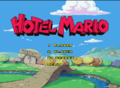 Title screen


Multimedia
- For the complete list of media files for this subject, see Multimedia:Hotel Mario.
 Reading the Letter - Plays when Mario reads Bowser's letter Reading the Letter - Plays when Mario reads Bowser's letter | File info |
| Main Menu and Map - Plays on the main menu and map screen | File info |
| Hotel 1 (Variation 1) - The first level theme in Morton's Wood Door Hysteria Hotel | File info |
| Hotel 4 (Variation 1) - The first level theme in Lemmy's High-ate Regency Hotel | File info |
| Credits - Plays during the credits | File info |
Names in other languages
| Language | Name | Meaning | Note(s) | Ref. |
|---|---|---|---|---|
| French | Hotel Mario | - | [23] |
Notes
- The box art features a modified version of the Super Mario Bros. 2 artwork featuring Mario jumping while holding a turnip, with the color of his shirt and overalls being reversed to reflect his current color scheme.
- The main theme appears to be based on the main theme from the 1933 film Little Women.
References


- ^ June 1994. CDi Magazine (UK) Issue 06. Haymarket Publishing. Page 20. Retrieved March 10, 2026.
- ^ September 1994. GamePro Issue 62. IDG Communications. Page 108. Retrieved March 24, 2026.
- ^ The latest files on the French disc are from December 8, 1994, which suggests a release in early 1995.
- ^ Fletcher, J.C. (August 7, 2008). Virtually Overlooked: Hotel Mario. Engadget (English). Retrieved July 13, 2024.
- ^ a b Hotel Mario Special Days. The Cutting Room Floor (English). Retrieved April 18, 2018.
- ^ March 27, 2004. SNES-CD Profile. N-Sider (English). Archived January 8, 2009, 18:10:52 UTC from the original via Wayback Machine. Retrieved July 13, 2024.
- ^ Link: Faces of Evil. Zelda Elements (English). Archived October 11, 2007, 06:41:24 UTC from the original via Wayback Machine. Retrieved May 7, 2018.
- ^ Interview with Trici Venola. The Black Moon Project (English). Archived December 18, 2007, 15:45:51 UTC from the original via Wayback Machine. Retrieved May 1, 2018.
- ^ Ocatillo Pictures Credits. Retrieved April 18, 2025.
- ^ MundyC (July 15, 2025). The Lost Hotel. Aypo's Library. Retrieved October 16, 2025.
- ^ Game Pak Rat (March 16, 2024). Hotel Mario Beta Version - ALL CUTSCENES! (Opening through Final Hotel Intro). YouTube (English). Retrieved March 23, 2024.
- ^ July 1994. CD-i Action: Hotel Mario - Video Games: The Ultimate Gaming Magazine issue 66. English. Page 79.
- ^ a b "June 1994. "Major Mike's Game Roundup" - Electronic Gaming Monthly issue 59 (PDF). English. Page 40.
- ^ Lawrence of Arcadia (September 1994). "ProReview: CD-i" - GamePro, issue 62 (PDF). English. Page 108.
- ^ rabbidluigi (March 25, 2018). Top Ten Worst Mario Games [with NintendoLife]. YouTube (English). Retrieved July 13, 2024.
- ^ Copycat. Top Ten Worst Mario Games. YouTube (English). Retrieved July 13, 2024.
- ^ November 28, 2005. Top Ten: Video game Characters. 1UP.com (English). Archived February 11, 2006, 23:33:01 UTC from the original via Wayback Machine. Retrieved July 13, 2024.
- ^ Buchanan, Levi (August 14, 2008). The Other Mario Games, Vol. 3. IGN (English). Retrieved July 13, 2024.
- ^ Kohler, Chris (March 24, 2008). The Video, #7: Nintendo and CD-i. Wired (English). Archived May 1, 2008, 14:52:23 UTC from the original via Wayback Machine. Retrieved July 13, 2024.
- ^ Reparaz, Mikel (May 4, 2007). The 10 worst game intros of all time. GamesRadar (English). Page 9. Retrieved February 12, 2019.
- ^ Whitehead, Dan (September 11, 2007). The History of Mario. Eurogamer (English). Page 3. Retrieved February 12, 2019.
- ^ July 31, 2008. Marc Graue: the voice-over of Mario in Hotel Mario. Interactive Dreams (English). Archived June 17, 2019, 07:20:51 UTC from the original via Wayback Machine. Retrieved July 13, 2024.
- ^ Hotel Mario (Philips CD-i) // DÉCOUVERTE D'UN DES PIRES SUPER MARIO
| Hotel Mario | ||
|---|---|---|
| Protagonists | Mario • Luigi • Princess Toadstool | |
| Bosses | Koopalings (Morton · Roy · Larry · Lemmy · Ludwig · Wendy · Iggy) • Bowser | |
| Objects | Items | Coin (rainbow variant) • Super Mushroom • Fire Flower • Star Man • Toad |
| Miscellaneous | Bowser's Ghost Cologne • Bowser's Sourpuss Bread • Letter | |
| Hotels | Morton's Wood Door Hysteria Hotel • Roy's HardBrick Hotel • Larry's Chillton Hotel • Lemmy's High-ate Regency Hotel • Ludwig's Thump Castle Hotel • Wendy's Blitz Snarlton Hotel • Bowser's Seizures Palace Hotel | |
| Enemies | Banzai Bill • Bellhop Goomba • Big Boo • Boo Buddy • Buzzy Beetle • Cloud • Evil coin • Fire • Flying Goomba • Flying Koopa • Goomba • Koopa • Mecha Koopa • Mini Ninja • Monty Mole • Parabomb • Pat the Bat • Rhinestone Goomba • Skeleton Koopa • Spiny • Wiggler • Z Koopa | |
| Miscellaneous | Gallery • Media • Pre-release and unused content • Quotes • Staff | |


