List of Super Paper Mario pre-release and unused content
This is a list of pre-release and unused content for the game Super Paper Mario.
This section needs Paper Mario improvement. Specifically:
- Various variants of characters which are only used in cutscenes have leftover assets, and possibly leftover animations from their original counterparts.
- Princess Peach's wedding outfit in the prologue.
- Bowser's wedding outfit from the prologue.
- Various alternate variants of Mimi, which are normal only seen in the intermissions at Castle Bleck and never encountered in proper gameplay.
- Count Bleck's tattered appearance after his is defeated in his boss fight and the Chaos Heart emerges from him.
- Conversely, Count Bleck's standard appearance also has unused animations which are normally only played with his tattered appearance.
- Screenshots of the unused maps in the game mentioned on the page.
- Add images for the various unused subjects documented on this page without visual accompaniment, including:
- Images of Spinias and Spunias
- Images of the following Goomba variants:
- Spiked Gloombas and Paragloombas,
- Headbonk Paragoombas and Spiked Headbonk Goombas,
- Hyper Goombas and their variants.
- The Paragoomba and Spiked Goomba variants of the unused black-colored Goomba.
- Allegedly, internal data explicitly calls this black-colored Goomba "kamikaze kuribo" in his animation files. Is there a verifiable source for this claim?
- Images of the unused Gold Fuzzies.
- Assembled sprite of Mario, displaying the leftover textures for Mario's "evil" form when having his body stolen by Doopliss in the previous game.
- Mr. L has these unused eyes in his data as well.
- Sprite, screenshot, or a video clip of the still-unused Dark Atomic Boo. Unlike the previous game, it is fully functional, and this should be documented more thoroughly.
- Bombshell Bills and their blasters exist in the files with full functionality. (Albeit at an abnormal size, and seemingly invincible.)
Early iteration[edit]
This game was originally announced for release on the Nintendo GameCube, and was at one point considered for release on both the Nintendo GameCube and the Wii (like The Legend of Zelda: Twilight Princess[1]), but by summer of 2006, Super Paper Mario was a Wii exclusive.[2]
Previews of the GameCube build showed icons for interacting with objects, characters, and items which resembled Nintendo GameCube controls before being reworked for the Wii Remote's button layout; all characters' special abilities would be activated with the  button rather than the different buttons they had on the final Wii version.[3] Most Pixls (initially named "Fairens") would be activated with the
  Button,[1] and all Pixls but Tippi seemed to be one Pixl who would morph into others to use "Fairy Abilities" (such as Fairy Toss, Thoreau's predecessor, and Fairy Hammer, Cudge's predecessor).[3] The function to scroll text descriptions in the menu was mapped to the
  stick, and some items used the
  and
and  buttons or the
  as shown in the descriptions for their action commands. Both actions were changed to use the
  D-Pad or
  motion controls on the Wii Remote. Standing still for a moment revealed GameCube D-Pad inputs which accessed specific parts of the menu, specifically:
 - Characters
 - Fairens
 - Items
This Quick menu selection resembles a similar feature from Paper Mario: The Thousand-Year Door, and was reworked to involve pressing  and
and  simultaneously.
Early builds[edit]

An early version of the game had a different, darker-looking version of the Whoa Zone from Chapter 4, with Mario still wearing a helmet, when he is not in the final product. Also, an early screenshot shows Mario under the effects of the Mega Star, but is colored very differently (giving his current colors rather than the initial ones seen in Super Mario Bros.). Oddly, he is shown in his proper colors in the official trailer that was released at the same time, which may imply that the screenshot's release was simply delayed.
In a screenshot featuring Big Blooper, there is a Pixl which somewhat resembles a ladder. It never actually appears in the final game, but it is present in an early version of the title screen found in the game files.[4] Also, in the same screenshot, Tippi is present, but in the final release, she is kidnapped by Francis prior in the game, and by the time she is rescued, Big Blooper cannot be fought again. Finally, the scene depicting Bowser and Princess Peach's wedding at the beginning of the game was also slightly different in pre-release versions; there were no flowers decorating the columns, the rising of the Chaos Heart appears to use different visual effects, and Count Bleck raises his cloak up earlier than he does in the final version. Additionally, in the screenshot, Princess Peach is standing instead of having been knocked over, and Bowser looks normal rather than shocked.
A screenshot featured in E3 2006 show differences in Lineland Road, specifically in the second area with two bricks surrounding a ? block: a green Koopa Troopa is standing on the platform, the smaller trees are missing, and the equations detailing the sky have symbols not seen in the final game such as the Σ summation/sigma symbol.
A picture taken during the 2006 World Hobby Fair in Tokyo also reveals that Thudley initially had a transparent body, much like most of the other Pixls.[5]
E3 2006[edit]
 Early logo
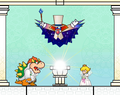 An early depiction of Bowser and Princess Peach's wedding.
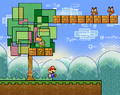 Early screenshot of Lineland Road.
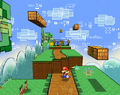 Early screenshot of Lineland Road in 3D.
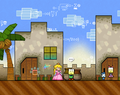 Princess Peach in an early version of in Yold Town.
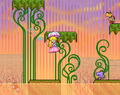 Princess Peach in an early version of Gloam Valley.
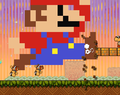 Mega Mario in Gloam Valley, with different colors, resembling his pixel form from the previous game. The particles from the broken Brick Blocks appear to be reused from their appearances in the previous game as well.
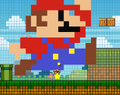 Mega Mario in The Bitlands, with different colors
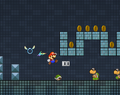 Mario in the World 1-2 section of The Bitlands.
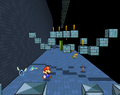 Mario exploring the World 1-2 section of The Bitlands in 3D.
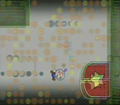 An earlier version of Whoa Zone from the E3 2006 trailer.


Unused data[edit]
Due to being built on the same engine, various leftovers from Paper Mario: The Thousand-Year Door are present in the game's files.
Characters[edit]
Mario[edit]
Mario contains several unused animations and graphics in his data, including a side view of Mario climbing a ladder. Using a glitch, the player can activate Mario's normally unused ladder animation.[6]
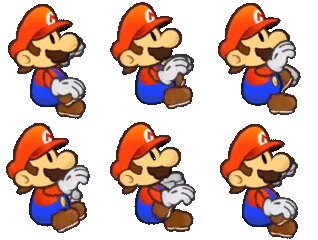 Mario climbing a sideways ladder, which cannot be seen normally.
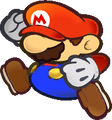 An unused sprite of Mario, presumably meant to be used when striking a Block, a similar animation also goes unused in the previous two Paper Mario games.
 A hatless sprite of Mario which also went unused in Paper Mario: The Thousand-Year Door.
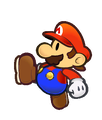 A unused kicking animation for Mario. In the final game, characters generally retain their walking animation when kicking Koopa Shells.
 A direct copy of Mario's graphics from PMTTYD, which are contained in the files for Big Blooper, possibly to be used as reference.


Leftover textures for Mario's "evil" form when having his body stolen by Doopliss in the previous game still exist in the files for Mario's graphics.
Princess Peach[edit]
Princess Peach has an image in her files for an incomplete version of the alternate hairstyle she receives after speaking with Bleu. Internal data appears to suggest this was a leftover from the game's development period on the Nintendo GameCube.
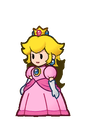 A placeholder image of Princess Peach's alternate hairstyle.

Peach's wedding dress contains various leftover pieces from her normal counterpart.
Bowser[edit]
In the data for Bowser's model, an early version of his death animation exists, based on the one seen in the sidescrolling intermissions of the previous game. The final game redraws this animation with updated graphics for the face and arms, as well as different posing.
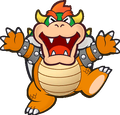 Bowser's early death animation, reused from PMTTYD.
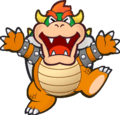 Final version


Like Princess Peach, Bowser's wedding outfit contains various leftover pieces from his normal counterpart.
Luigi[edit]
Like Mario, Luigi has an unused section of his jumping animation, which was presumably intended for the same purposes as Mario's.
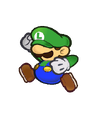 Unused section of Luigi's jumping animation.

NPCs[edit]
An early simplified variant of Tippi exists in the files under the filename "n_gid_tyou" It is rendered as white in the data, but displays as pitch black in-game.
 The unused version of Tippi.

The original designs for the residents of Yold Town still exist in the files with most of their functionality intact.
 The male Yold Town resident.
 The female Yold Town resident, somewhat resembling the appearance of Mimi.
 The child Yold Town resident.
 The fourth Yold Town resident.


Nastasia contains unused data depicting an earlier version of her design, and two sprites depicting a Nintendo DS-like device, and its accompanying stylus. The green-tinted hands seen on this early Nastasia design are also used on her sprites from the Forget Me Not minigame, despite her appearance in that game otherwise reflecting her final design.
 Early mockup of Nastasia. Note her differently colored hands, and extra tuft of hair.
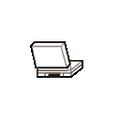 The unused DS-like device.
 A stylus which would've likely been used alongside the unused DS.


An unused Merlee-like Shaman exists in the files under the name "rebear".
 The unused, Merlee-like character.

Enemies[edit]
In the graphics for Gloombas are leftover sprites for Spiked Gloombas, and Paragloombas, which do not appear in this game. Similar unused sprites also exist for Spiked Headbonk Gooombas, and Headbonk Paragooombas. There are also leftover sprites for Hyper Goombas and their variants, which do not appear in any capacity in the final release, as well as a dark-colored Goomba known internally as e_kami_kuribo.
 The black Goomba.

Various enemies previously seen in Paper Mario: The Thousand-Year Door are present in the files, with slight revisions. This includes enemy variations such as Green Fuzzy, Spinia, Spunia, Cleft, and Hyper Cleft, and Smorgs. Notably, this also includes the Gold Fuzzy, which has reused artwork on the back cover of the official Nintendo Power guide and the Prima strategy guide. The Gold Fuzzy's filename was renamed from c_chorobon_k to e_chorobon_y, Spinia's filename was renamed from c_hannya_n to e_hannya_g, and Spunia's filename was renamed from c_hannya_t to e_hannya_p, suggesting that they were in the process of being retooled.
 Unused sprites for a Smorg

There are sprites for multiple variants of Shy Guys which do not appear in the final game. In the final game, Shy Guys only appear in the audience when performing a Stylish move, as well as a cameo on a vase in Merlee's Mansion and Heronicus' house.


Wiggler also has unused sprites in this game. Wigglers would not appear in the Paper Mario series until Paper Mario: Sticker Star, albeit with completely redrawn graphics.
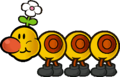 A Wiggler. Note that it has black shoes rather than the usual red.
 Animated variant


Graphics for Monty Mole resembling their appearance from Paper Mario exist in the files. Internal data appears to suggest that the would emerge from the wall like in Super Mario World and also would've had the ability to throw rocks at the player like in Super Mario 64.
 The unused Monty Mole.
 A full view of Monty Mole's body
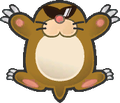 Monty Mole from the front
 The hole left after Monty Mole emerges from a wall
 A rock thrown by Monty Mole


Additionally, a Blooper Baby has graphics as a test enemy (TEST_s_gesso-), which appears incomplete as the texture features a solid black line at the bottom (possibly to test collision); the game's normal Blooper is also labeled as a test enemy in its texture file (TEST_gesso-), so they were both likely used to test underwater gameplay.[citation needed]
 The unused Blooper Baby.

Similar to the previous game, an unused Dark Boo-like variant of Atomic Boo exists in the files. Unlike in Paper Mario: The Thousand-Year Door, it is fully functional, and uses similar attack patterns to its smaller counterparts.
There are also various recolors of existing enemies within the files with unknown purposes.
 A different colored Squiglet
 A different colored Squig
 A green Boomboxer
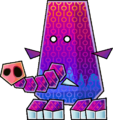 A purple Muth
 A monochrome Underchomp
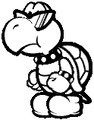 A colorless Koopa Troopa
 A colorless Koopa Shell
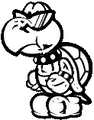 A transparent Koopa Troopa


Bosses[edit]
Dimentio has an unused walk/run animation, which is never used in the final game, as he is only ever seen floating when he moves.
 Dimentio's walking animation.

Francis's data contains an sprite depicting an earlier version of his model with slight differences, such as a larger head, differently shaped hands, and a shorter tail.
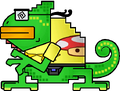 Early design for Francis.
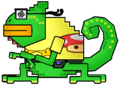 Final counterpart for comparison


Mr. L's model contains various unused sprites for animations only used by Luigi. Many of them are simply direct copies, but a few have been properly redrawn to reflect Mr. L's appearance.
 Mr. L crouching
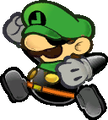 An unused section of Mr. L's jumping animation.


Similar to Mario, Mr. L has unused eye textures in his data, resembling Mario's appearance when having his body stolen by Doopliss.
In the files for the Sammer Guys is an unused variant resembling a smaller version of End Boss.
 A regular-sized Sammer Guy with End Boss-like armor

Count Bleck has various unused animations in his data, some of which are variations of his used animations with his tattered appearance seen after defeating him near the end of the game.
Items[edit]
There are some unused items still stored in the game. Most of them are labeled as "Unavailable Item", and do not do anything.[7][dead link] Additionally, graphics exist for several items that do not appear in the game. Notably, the pink Cooking Disk is functional and referred to in-game as "Cooking Disk PI" ("Cooking Disk 1" in the PAL versions),[8] though it does not add any pages to the Dining Specializer. Most likely, the first recipe page was going to be obtained via a Cooking Disk instead of being built-in from the start. This also explains why the purple Cooking Disk is called "Cooking Disk PU" instead of simply "Cooking Disk P".
 A Boo's Sheet.
 A pink Cooking Disk.
 An unused key.
 Another unused key with a similar design.
 Another unused hammer. This one more closely resembles its final counterpart, but is abnormally large. Duplicates of these sprites are also contained in the models for the other playable characters, as well as Mr. L, who never uses a hammer during any of his encounters.


Objects[edit]
Various hidden objects are found within levels with root nodes disabled. Reenabling them on a model viewer such as the noclip website reveals unused geometry in multiple areas.
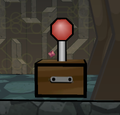 A switch with unknown purpose in Chapter 5-3, using a texture from minecart rails. A chest takes its place in game.
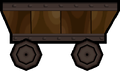 An early version of the minecarts found in Chapter 5-3.


Unused sprites of a Bush as well as burnt variants of it exist in the files. It is presumed that the burnt versions would have been unused when using Bowser's Fire Breath on it. In the final game, Bushes generally do not interact with Bowser's flames at all.
 Unused sprite of a bush.
 Burning variation of the above bush.
 Fully burnt variation of the above two bushes.


Maps[edit]
There are a number of unused maps and rooms in the game. These include a room in the Whoa Zone featuring a chest containing Piccolo's card, an unused room in the final area of Castle Bleck, and a room in Floro Caverns with a Save Block and some enemies.[9] Some used maps have unused collision data and textures in the third dimension. If the player manages to spawn in one of these maps, they can be played normally. These include the Mario Bros.' House, Bowser's Castle and the chapel in which parts of the prologue and ending take place.[10]
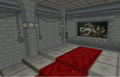 Bowser's Castle in 3D, displaying an otherwise unseen painting.

Korean version exclusives[edit]
For unknown reasons, the Korean version of Super Paper Mario contains 11 unused maps not found in the other versions, some of which include unique humanoid cat creatures that are part of the stage geometry and cannot be interacted with.[11] These do not fit the style of the rest of the game, though they somewhat resemble the style of the first Paper Mario.
Audio[edit]
In the game are unused audio files, including early versions of music tracks used in the final game.
 Dummy - "Ground BGM" from Super Mario Bros. 3 with added crackles Dummy - "Ground BGM" from Super Mario Bros. 3 with added crackles | File info 0:30 |
| Happy Flower - The music that would have played while a Happy Flower was active | File info 0:16 |
| Bitlands Event - Music that was meant for one of the chapter openings in the Bitlands | File info 0:30 |
| Relax Event - A slow-paced music track with unknown purposes. | File info 0:30 |
| Minigame Over (early) - Unused track which would play when failing a minigame or puzzle. | File info 0:04 |
| Perfect Solution (early) - Early version of the "puzzle complete" jingle. This sound was originally used in one of the trailers for the game. | File info 0:02 |
| Underchomp Battle (early) - Slightly different version of the music which plays while fighting Underchomp. | File info 0:30 |
The files contain five unused sounds which are meant to play when performing a Stylish move. Normally, after performing at least five tricks, the game simply repeats Stylish move 5, rendering the subsequent jingles unused.
| Stylish move 6 - Super Paper Mario | File info |
| Stylish move 7 - Super Paper Mario | File info |
| Stylish move 8 - Super Paper Mario | File info |
| Stylish move 9 - Super Paper Mario | File info |
| Stylish move 10 - Super Paper Mario | File info |
Miscellaneous[edit]
 Original title screen with the unused Pixl. Unlike the final Title screen, this variant is a static image, similar to the title screens of the previous two games.
 Screenshot crop of the unused Pixl.
 Leftover graphic from the GCN version.
 Leftover graphic from the GCN version.
 Pre-release artwork of Nastasia paired together with Tiptron. In the final game, the two never interact during the events of the game's story.


References[edit]

- ^ a b Wii Preview: Super Paper Mario. NGamer Magazine. Archived December 9, 2009, 14:01:26 UTC from the original via Wayback Machine. Retrieved May 30, 2024.
- ^ Hatfield, Daemon (January 22, 2007). Paper Mario Unfolding in April?. IGN (English). Retrieved May 30, 2024.
- ^ a b Nintendo Power Issue 206. Page 64-65. (Archived via Wayback Machine.)
- ^ Super Paper Mario/Unused & Early Graphics & Animations. The Cutting Room Floor. Retrieved August 25, 2025.
- ^ Ishida, Katsuo (June 17, 2006). The 24th Next Generation World Hobby Fair GAME Watch. Retrieved 7th August 2024.
- ^ SPM_Community (October 31, 2021). We've had a pretty crazy week in SPM, with Zaku finding new tech called Fleep Ledge Cancels! Just walk on an edge in 3D and use fleep, and you can get some cool results by holding up! Zaku found it's actually possible to see the unused ladder animation in game with this trick!!!. X. Retrieved November 19, 2021.
- ^ http://www.youtube.com/watch?v=RnjaCMT7Usw Unused items
- ^ The Cutting Room Floor
- ^ PokGOT4N (October 19, 2015). Super Paper Mario - SECRET Unused Maps!. YouTube. Retrieved May 30, 2024.
- ^ fawfulthegreat64 (September 12, 2016). Super Paper Mario: Cutscene-Only Rooms Explored. YouTube (English). Retrieved May 30, 2024.
- ^ GameIntus (December 18, 2018). Super Paper Mario's Biggest Secret EXPOSED! - GameIntus (feat. MayroSMM). YouTube. Retrieved December 21, 2018.

