List of Paper Mario: Sticker Star pre-release and unused content
This article needs Paper Mario improvement. Specifically:
- See here and here
- In the textures for World 2, there are early versions of the Mural Toads.
- Many enemies who retreat into shells have unused sprites showing non-origami variants of their shells. (Koopa Troopas, Spinies, Buzzy Beetles, etc.)
- The Oasis Toad has a 2D version of his float which is appears to be unused. (A similar float appears in the credits, but it is a seperate file.)
- The Big Cheep Cheep from Surfshine Harbor appears to have various sprites for a normal Cheep Cheep body, rather than the 3D model it normal uses. A damage sprite with color-banded shading is used when defeating the boss with a sharp attack, while the mouths and other appendages are used to animate the 3d model, however there are apparent higher-quality versions of other Cheep Cheep textures, and a color-banded texture with a default pose. Are these remaining textures unused?
- The digital manual openly mentions that Mario will receive a Game Over if he manages to fall out the level, suggesting that this was originally planned to be a feature of the game achievable without glitches.
This is a list of pre-release and unused content for the game Paper Mario: Sticker Star.
Concept Art[edit]
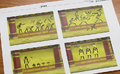
During an Iwata Asks interview about the game's development,[1] concept images are provided which show changes to the designs of Mural Koopas in the Drybake Stadium, with darker green colors instead of brown skin tones, and more pronounced plastrons. Mural Koopa Paratroopas are also featured on the wall, which do not appear in the finalized areas of Drybake Stadium. There is also an image of a diorama constructed with white paper. The environment resembles areas of World 1 in the final game based on the shapes of the hills and grass.
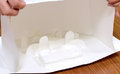 An uncolored diorama featuring environmental concepts similar to Warm Fuzzy Plains.


Early versions of key artwork can be found in collages from the 2013 edition of Nintendo's Kaisha-annai, a company booklet provided to new recruits. Specifically, page 61 features an earlier draft of Mario posing a sticker and his Album at Sticker Fest, while page 64 reveals an in-progress photo of character artwork for Bowser and Gooper Blooper, taped to a specialized photographic platform.[2]
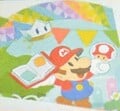 Concept art of Mario at the Sticker Fest.
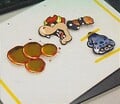 Unfinished artwork of Bowser and Gooper Blooper.


Early ideas[edit]
- According to Kensuke Tanabe in an interview with Thomas East of the Official Nintendo Magazine, Bowser's Sky Castle was intended to include minigames. The final game instead features a fight against Kamek, a carpet platforming section, and the final battle against Bowser, with the minigames cut due to development time restraints.[3]
Early builds[edit]
E3 2010 footage[edit]
The following changes can be seen in a demo video of the game showcased on Nintendo 3DS systems during E3 2010.[4]
- The scenery was similar to Paper Mario's.
- ? Blocks were smaller and had light brown outlines, and were animated similar to Paper Mario: Color Splash and Paper Mario: The Origami King.
- When a sticker was being selected, a curtain backdrop similar to the ones from Paper Mario: The Thousand-Year Door is seen, disappearing when Mario or his partner would attack.
- In-battle stickers originally appeared in big light brown and blue squares and had different designs.
- One of the stickers had an appearance similar to the Multibounce badge from the first two Paper Mario games.
- Paperization did not include the screen turning into a photograph. Instead, the object was simply placed in the wanted area akin to a sticker.
- A bridge sticker could be placed above a small gap so Mario can cross it. This was possibly changed to the Wooden Bridge scrap for the final game.
- Enemies such as Goombas and Pokeys reused their sprites from the previous two Paper Mario games, the final game redraws most of its NPCs to more closely reflect their contemporary designs.
- A Chain Chomp was shown to be a party member.
- The Chain Chomp had an overworld ability similar to Kooper and Koops where it could charge in a certain direction to hit objects.
- The Chain Chomp had a move in battle similar to Power Shell that hits all enemies.
- The Wiggler had more body segments and had a pink flower similar to the unused Wiggler sprite in Super Paper Mario.
- There was going to be a Monty Mole king boss named King Choropu (キングチョロプー)[5], featuring a purple and red mushroom on its crown. It was potentially replaced by Gooper Blooper as it is shown in a forest area similar to World 3.
- One image shows a maze made of playing cards that does not appear in the final game.
- Whomp was smaller, bluer, and most likely a regular enemy. Its back also had a different design.
- In the castle area, the color palette seems to have differed between areas, with some footage showing a gray color for the stonework, and other scenes giving it more of a blue color scheme.
- Fish Bones, were originally set to appear as enemies. When hit, multiple fishes would have appeared. In this demo, they have a noticbly different design from their final counterparts.
- The battle scene had an interactive ceiling in certain battles.
- A ! Switch was originally found in a castle area. Unlike the previous two games, this switch uses a rounded appearance like in Paper Mario.
- The background would have had a bounce effect when revealing secrets.
- In the final shot of the preview footage, an open field similar to Petal Meadows is seen, albeit adding in the colorful spotted hills introduced in New Super Mario Bros. Wii.
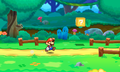 Different ? Blocks, and also the Candy Pops in the background
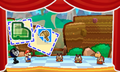 Paper Mario background, curtains, and early stickers. Also note the early Koopa Troopa and Goombas.
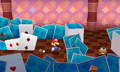 A maze made of playing cards which is never seen in the final game
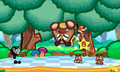 Early Chain Chomp partner
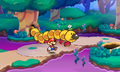 The early Wiggler
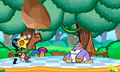 The scrapped King Choropu boss
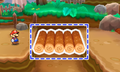 An early bridge sticker
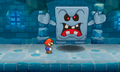 An early Whomp
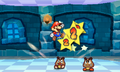 Early battle system
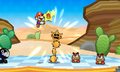 The damage Mario receives is represented by a yellow star instead of a red one. Also note the early Pokey sprite.
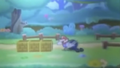 Early Chain Chomp partner in the overworld
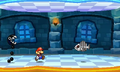 The early Fish Bone
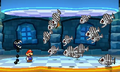 The Fish Bone enemy after multiplying
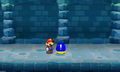 The early ! Switch
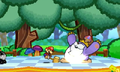 The mushroom in King Choropu's crown revealing itself as he takes damage
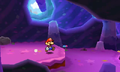 The purple cave area
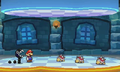 Early Spinies


Nintendo Conference 2010 footage[edit]
- The art style appeared to be much closer to the art style in the final game.
- The health HUD was a white and yellow bar and the numbers were orange.
- An unknown "S" rainbow HUD was placed under Mario's health meter, likely either a power generation bar, some sort of "Limit Break" bar, or was similar to Star Power.
- The Frog Suit sticker acted as an attack sticker, not a defense one. Its original purpose was inserted into the Line Jump.
- Stickers were red circles with an icon on them.
- The health meter numbers were red.
- Koopa Troopas are flipped over when hit, similar to the first two Paper Mario games.
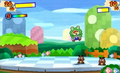 An early HP HUD and early rainbow meter.
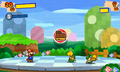 An early sticker being used.
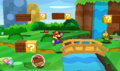 An early area resembling Warm Fuzzy Plains.


Nintendo World 2011 trailer[edit]
- Coins reused their sprites from the previous two games, whereas the final game generally replaces them with 3D models.
- The interior of Goomba Fortress' large tower was slightly different, as it had both Heart and Save blocks at the bottom, lacked ?-Blocks and appeared to be colored darker.
- The center of Decalburg had a third path branching off from it.
- The Shop in Decalburg had a mushroom design that resembled the previous three Paper Mario games.
- An unused area that resembled Whammino Mountain that had falling Parabombs was shown.
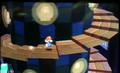 An early interior of Goomba Fortress's Tower.
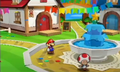 An early version of Decalburg, with multiple different pathways.
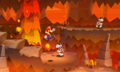 An early volcano-themed area with Dry Bones.
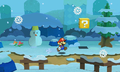 An early snow-themed area.


E3 2011 trailer[edit]
- The game was known as "Paper Mario" at this point.
- The opening shows a very different map and seven Royal Stickers rather than six, suggesting that more worlds were planned.
- Battle Spin was originally called "Battle Chance".
- The Scissors' clipping effect just included bright lines to appear in the screen. They also were red instead of green.
- In-battle Fan would appear as a sticker and right on the stage, instead of the background.
- The stickers on the Shop in Decalburg were actual stickers instead of cardboard.
- A Mystery Box sticker is included on an artwork released with Mario, but a Mystery Box sticker is not seen anywhere in the final game, nor in any screenshots.
 Early logo
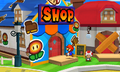 The early version of the Shop.
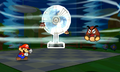 An early in-battle Fan.
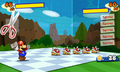 Red Scissors.
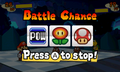 "Battle Chance".
 Early coins.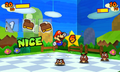
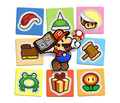 The Mystery Box.
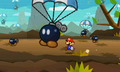 Early mountainous area with Parabombs.


Nintendo Conference 2011 trailer[edit]
- Stickers had a hexagonal shape.
- The Scissors were cyan-colored.
- The Baahammer was simply a Sleepy Sheep-like head on a handle. The final version for this item is a purple hammer with a slightly modified Sleepy Sheep marked on its side.
- Album pages displayed their number and the total number of pages instead of only the page number in a semicircle.
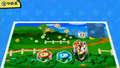 Hexagon-shaped stickers
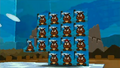 Early Megasparkle Goomba boss fight
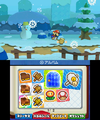 Early Baahammer design
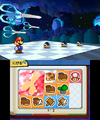 Cyan-colored Scissors
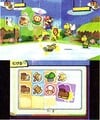 A battle with an unused sticker design in Mario's album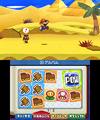
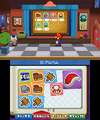
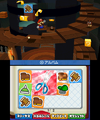


Miscellaneous[edit]
- The principal Action command was assigned to the B button. In the final version, it is assigned to the A button.[citation needed]
Unused data[edit]
Unused maps[edit]
The Sticker Fest plaza featured a different design and a blocked-off exit most likely intended to be accessed later in the game. There is an unused map with a pipe that is labeled "Mario's house pipe" which suggests that the Mario Bros.' House was possibly planned to be in the game.
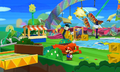 The unused Sticker Fest plaza.
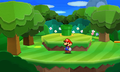 The unused map labeled as "Mario's house pipe".


Unused models[edit]
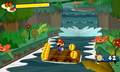
The river sections of World 5 initially featured a different design for the raft that Mario rides across the water compared to the final release, featuring darker coloring, floor lashings securing both ends, and little flaps on either side. This version of the raft was seen during certain pre-release footage and images from the Nintendo World E3 2011 presentation. The model can be found out of bounds in certain rooms of the Jungle Rapids. A very similar set of logs is crossed as a bridge in Water's Edge Way.
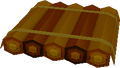 The unused version of the river rafts
.png)
Bowser Jr.'s Flotilla takes place aboard an Airship, which appears to have no objects above the propellors of the masts in-game. However, there is a crow's nest above the central mast which is only visible when the maps w6_sky_00 and w6_sky_01 are opened with a model viewer. This crow's nest is colored in a similar manner to the Junior Clown Car, with a green trim at the top, a white and rounded body, and another green trim in place of a bottom propellor.
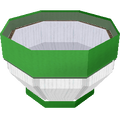 The unused, Clown Car-themed crow's nest.
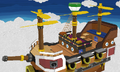 The crow's nest visible on the Airship in a model viewer.
.png)
.png)
Unused text[edit]
There is unused text in the files relating to several enemies which are normally not able to be fought.[6]
- 2-Fold Shiny Goomba
- 4-Fold Goomba
- 4-Fold Shiny Goomba
- Shiny Spiny - Shiny Spinies would later appear in Mario & Luigi: Paper Jam
- Deep Cheep
- Monty Mole
- Inky Piranha Plant
- Ptooie
- Bullet Bill - Bullet Bills appear in Bowser Jr.'s Flotilla, but are instantly destroyed upon making contact with the player, and attacking them defeats them instantly.
- Bill Blaster - Bill Blasters also appear as obstacles in Bowser Jr.'s Flotilla, but cannot be fought.
- Banzai Bill - Banzai Bills are only seen in Bowser Jr.'s Flotilla, but are not fightable enemies.
- Banzai Blaster - Similar to Bill Blaster, a Banzai Bill cannon appears in the hold of Bowser Jr.'s Flotilla, but not as a fightable enemy
- Crowber
- Shiny Dry Bones - Like Shiny Spinies, Shiny Dry Bones would later appear in Mario & Luigi: Paper Jam.
The PRIMA Official Game Guide mentions 2-Fold Shiny Goombas, 4-Fold Goombas, 4-Fold Shiny Goombas and Shiny Dry Bones.
Unused graphics[edit]
NPCs[edit]
Various assets for Princess Peach are found in the \Graphics\player\ directory, a folder primarily containing models for Mario and his hammer, while other NPCs are typically found in a separate \Graphics\npc\ directory. This suggests Princess Peach was planned to be playable akin to her intermissions in the previous three entries to the Paper Mario series. However, the lack of references to Peach in the ksm_player.bin script implies either this idea was scrapped early in development, or is a consequence of how character files were organized when reusing assets from previous games.
Her peach_r.bcrez model features leftovers from Peach's design in Paper Mario: The Thousand-Year Door, particularly her dress. Peach is never seen from behind in the final game, leaving this rear model and its animations unused, though the animations can be seen when modifying the game to play as Peach.[5]
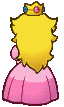 An unused backsprite for Princess Peach, reusing her appearance from Paper Mario: The Thousand-Year Door.

Within the model for the sticker shop Toads found in \Graphics\npc\n_kinopio_shop.bcrez, there are unused animations and icons related to the types of items Mario can collect. In animations KNP_S_3 and KNP_T_2, the shop Toad holds up several sticker icons including Hammer and Jump stickers. These icons have frames which are reminiscent of earlier designs for sticker shapes and outlines.
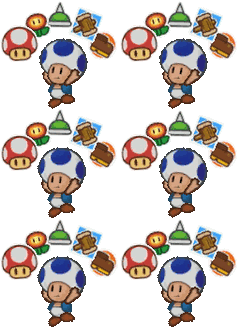 An unused animation of a sticker shop Toad showing off various types of stickers.
 The unused Hammer sticker icon.
 The unused Jump sticker icon.


Enemies[edit]
The trio of musical Shy Guys seen on the Yoshi Sphinx originally wore red ponchos each with a different color strap. These ponchos are still found within the graphics of the Sombrero Guy in the final game.
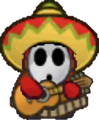 Earlier design for Sombrero Guy with a red and orange poncho.
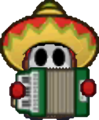 Earlier design for Accordion Guy with a red and purple poncho.
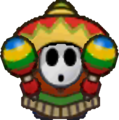 Earlier design for Maraca Guy with a red and green poncho.


The game was initially going to include Ptooies, which are still mostly functional if spawned into a battle.[7] Ptooies spawn Spike Balls above themselves as protection and can blow this Spike Ball towards Mario as an attack. If Mario is able to smack the Ptooie, this Spike Ball will fall back and potentially damage the enemy behind them. These enemies have 25 HP, similar to Piranha Plants, and deal six damage with their attack. Ptooies would later be introduced to the series in Paper Mario: Color Splash.
In addition, Ptooies and Spikes both have sprite versions of their Spike Balls in both of their textures. In the final game, Spikes have a partial Spike Ball sprite visible in their mouths with a white-spike coloration, before it is replaced with the brown-spike 3d model. The Spike Ball model for both enemies is identical in design and animations, only being differentiated by internal labels.
 An unused Ptooie.
 An unused sprite version of Spike Balls thrown by Spikes and the unused Ptooie.
 Ptooie's spikeball. It is identical to the projectile used by Spikes, however it is internally named e_huhupakkun_tama.


The single Lakitu found on Whammino Mountain cannot be fought in the final game, despite having associated damaged sprites for various battle interactions. However, it is possible to defeat it using the nearby Super Star by doing precise movement to catch it as it descends, which will show its normal defeat animation without the crumple effect.[8] There is also a stick resembling a fishing rod within Lakitu's graphics.
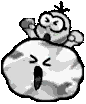 Graphic of a Lakitu being damaged beyond zero HP.
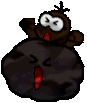 Graphic of a Burned Lakitu.
 What appears to be a fishing rod is stored with the Lakitu graphics.


In the graphics for Fire Bros and Ice Bros are unused variations of their Fireballs and Ice Balls, respectively. The Fireball sprites in particular appear to be leftovers from the graphics for Fire Bros in the previous two games. The final game generally replaces these graphics with larger, papercraft variants of themselves.


There are various other unused graphics for other enemies as well:
 A spiked Green Pokey head. In the final game, these enemies have no spikes, while the normal variety of Pokeys retain theirs.
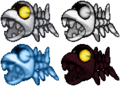 Graphics of a Fish Bone being damaged. As they act as mere obstacles in the final game, they cannot be fought in battle but can be attacked with the hammer.
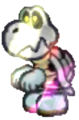 An unused shiny Dry Bones.
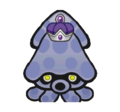 Earlier design for Gooper Blooper
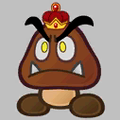 Megasparkle Goomba, as he appears in the game's credits. His Royal Sticker appears to be colored differently than the final release, and appears to be missing its shading.
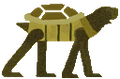 Early design for Mural Koopa.
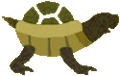 Early design for Mural Koopa.
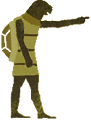 Early design for Mural Koopa. Unlike the others, including its final counterpart, this variant uses a bipedal posture instead of standing on all fours.


Stickers[edit]
 An unused larger version of the Leaf sticker.
 An unused Piranha Plant sticker. Its internal name ("sl_pkn_hat") suggests it was an early or alternate version of the Spike Helmet sticker.
 An unused rock sticker. Likely would have functioned similarly to the Pebble from Paper Mario.
 An unused Spiny Egg sticker.
 An unused Leaf sticker which somewhat resembles a Super Leaf. It is possible that it originally filled the role used by Tail stickers in the final game.


