List of Super Mario Galaxy pre-release and unused content
This is a list of pre-release and unused content for Super Mario Galaxy.
Early concepts[edit]
The official Prima Games guide for Super Mario Galaxy was released in two editions: the Premiere Edition and the Collector's Edition. Among the features included in the Collector's Edition were six pages of concept art and development info from the game's developers.
Rosalina was intended to be related to Princess Peach. They have very similar appearances, reflecting this. Her original design would have portrayed Rosalina with a beehive hairdo and a ballroom gown similar to that of Peach's, while her finalized design portrayed her with a similar hairstyle as Peach's, although with some differences such as her sporting a large bang covering her right eye, and her outfit was redesigned to look more like a nightgown. Bonefin Galaxy was intended to be much darker, as was Deep Dark Galaxy. These were changed in the interest of playability. Guppy was originally a dolphin, and a friendly character. Some art of the Sea Slide and Beach Bowl Galaxies suggests that they were conceived as a single galaxy, with Beach Bowl's main planet in the center of Sea Slide's ring.
A piece of concept art labeled only "fortress" is captioned as a piece that is very memorable to the Super Mario Galaxy development team, since it was one of the earliest drawings of Galaxy. In spite of this, the planet shown in the art is nowhere in the final game, though aspects of it exist across several planets. This unused fortress, dubbed "Starman Fort" internally, does still have some assets remaining in the code, and can actually be pieced back together for the most part. Several cannons and the waterfall are missing, and the underside of the fortress where Mario fights BossCrab is not programmed.[1]
At one point, Yoshi was going to accompany Mario in his adventures in space, while Starship Mario was going to be the game's hub level instead of the Comet Observatory.[2] Both did not appear until the sequel, although a planet shaped like Yoshi's head made a brief appearance in the Space Junk Galaxy.
Concept artwork[edit]
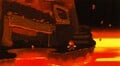 Melty Molten Galaxy
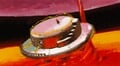 Melty Molten Galaxy
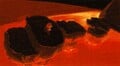 Melty Molten Galaxy
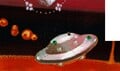 Melty Molten Galaxy
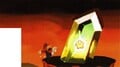 Melty Molten Galaxy
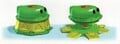 Concept art of a Sentry Garage
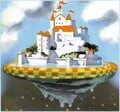 An unused Castle-like planet
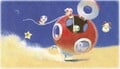 Toad Brigade in their Starshroom
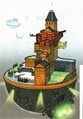 An unused fortress
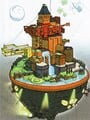 Backside of an unused fortress
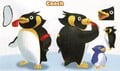 The Coach
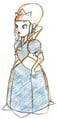 Rosalina's early design
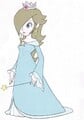 Rosalina's final design
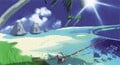 Beach Bowl Galaxy and Sea Slide Galaxy
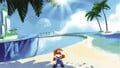 Beach Bowl Galaxy and Sea Slide Galaxy
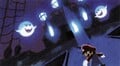 Deep Dark Galaxy
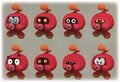 Many expressions of an Octoguy
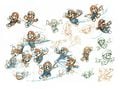 Many concept arts of Mario
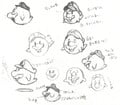 Concept arts of Boo Mario
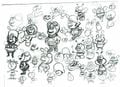 Concept arts of Bee Mario
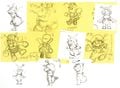 Other concept arts of Bee Mario
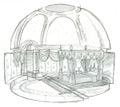 The Bedroom
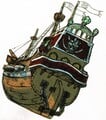 An Airship
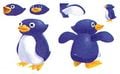 A Penguin
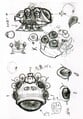 Other concept arts of Tarantox
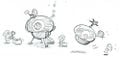 The Toad Brigade and a Starshroom
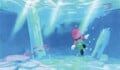 Deep Dark Galaxy and Bonefin Galaxy
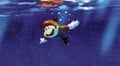 Deep Dark Galaxy and Bonefin Galaxy
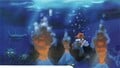 Deep Dark Galaxy and Bonefin Galaxy
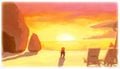 Deep Dark Galaxy


Early builds[edit]
Press kits[edit]
Many things had different names in pre-release info. For example, the character Rosalina went by her Japanese name, "Rosetta", which comes from a type of orbit.
Also, several things underwent graphical changes:
- As seen in one of the IGN.com screenshots,[3][dead link] Bowser was originally going to be fought on an arena on a magma planet instead of a glassy planet in the released game.
- The Pokeyplant was originally green.
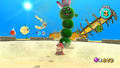 The green Pokeyplant

In this screenshot, the player has collected only 19 Power Stars and 3 Grand Stars, but has access to the Trial Galaxies.
E3 2006 (May 10-12)[edit]
E3 2006 was the first event in which Nintendo publicly showed Super Mario Galaxy in anything akin to its final form, although it was quite different from the final game. In this prototype build, attendees were treated to a single-galaxy demo of the game, in which they were given ten minutes to find and collect a star. This build had many differences from the final game, although all the basic principles of the game existed in some form.
- Some game mechanics eventually changed:
- Mario had the ability to spin to attract coins to him, which he lost in the final version. He can still do this as Flying Mario and underwater.
- In this version of the game Mario could spin multiple times in a row. In the final version, a small delay is enforced between spins.
- In this prototype, players had to hold
 and point at Star Bits to grab them. This was later changed because the developers settled on using the button to fire Star Bits (which was impossible at this point).
 - Mario could kick Star Bits around.
- Mario's Star Pointer was more powerful. It had many of the powers given to the second player's cursor in the final game, such as holding enemies.
- The Life Meter was more like the ones in Super Mario 64 and Super Mario Sunshine, having a total of eight wedges, and changing color more like the Super Mario 64 version. This was changed to three wedges in the final version.
- Like in Super Mario Sunshine, the early life meter would fluctuate in size, getting faster the lower Mario's health was.
- At this point, notes had an on-screen counter, showing players how many notes they had collected, as well as how many there were total.
- Here, if a player wanted to use a Pull Star (or what would eventually be called a Pull Star), they would need to point at it constantly, as moving the star cursor too far away would deactivate it. In the final game, the Pull Star will remain active until players release the
 button.
 - If a character wanted to talk to Mario, an exclamation point in a thought bubble would appear above its head. When Mario got close to that character, its dialogue would appear onscreen without interrupting gameplay.
- When the player pulled on a sling pod a blue arrow will show the direction Mario is going to go; if the player took the cursor off-screen, the arrow would turn red and a beeping sound would play.
- The player would use the button to use sling pods. In the final version of the game, the player would use .
- When the player grabbed a coin, the coin sound effect can be heard on the Wii Remote's speaker.
- When the player attacked a Goomba, it did not spin after being launched.
- Some graphics were not complete, or were different:
- The Star Bit counter said 0/100 in this version. No attendee to E3 collected all 100 of the galaxy's "star shards" (as they were then known), so their purpose is unknown.
- The Star Pointer was yellow in color, and it had a longer "tail." It flashed red if players were not pointing the Wii remote at the screen.
- Slurples were colored purple.
- Speech bubbles had a cloudlike design.
- The message "You Got a Star!" was white, and written in all caps. This is changed to green in the final version. The "Too Bad!" text was the same but it later changed to red letters in the final version.
- The HUD effects for using a Sling Pod were different. These can be seen in the Tarantox videos.
- The Mario head used as a lives counter was captioned "MARIO."
- The HUD design used the number font from Super Mario Sunshine.
- 1-Ups used a simpler, green "1up!" effect when collected.
- Certain sound effects were substituted out for others, usually because not all sound composition was complete:
- When Mario grabbed a star, the music was an arrangement of "World Clear" from Super Mario Bros.
- Mario's voice clips from Super Mario Sunshine were used as a placeholder.
- A different sound effect was used for grabbing Star Bits.
- A slightly simpler sound effect was used for 1-Up collection.
- When flying after being shot from a Launch Star, a synthesized drum beat was playing over the music.
- A few things also existed under different names:
- Star Bits were called "star shards".
- Launch/Sling Stars were simply "stars".
- Pull Stars were called "blue stars".
- Sling Pods were called "wobble launchers".
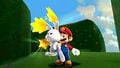 Early picture of Mario catching a Star Bunny. The background suggests the Puzzle Cube was once in a different galaxy.
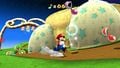 Early Notes
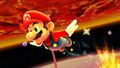 Early Melty Molten Galaxy


Star World[edit]
The Star World, as titled in the introductory "Welcome to the Star World!" message, was the demonstration galaxy created to show off Super Mario Galaxy for E3 2006. It was composed of many planets taken from other galaxies in the game. It was notably different from any galaxy in the final game in that it was composed of a "branching" path; choosing different routes on different planets could lead to different stars entirely. It is likely this was done for the demo specifically. It was also notable for its heavy use of asteroids instead of unique planets. The final game ended up using these asteroids only twice, as moons in two galaxies. The level compiled many different planets into the galaxy, most of which became planets in Good Egg Galaxy, Space Junk Galaxy, and Bowser Jr.'s Robot Reactor.
This galaxy was inhabited by rabbits and the conjecturally named Cosmic Toads, who were distinguished from normal Toads by the star shaped spots on their caps. They gave players hints and explained the controls. Sometimes, the rabbits could change into Cosmic Toads. Their role was likely replaced by Lumas. They explained various aspects of the game to Mario.
At least three routes through the galaxy were discovered by attendees to the show. The stars were guarded by King Kaliente, Tarantox, and Megaleg.
The music that plays in this galaxy is known as "Egg Planet." It is the theme of Good Egg Galaxy in the final game, though it sounds noticeably different.
In this version, when Mario falls into a black hole, he has an oval-like line.
Since this galaxy was compiled into a build that allowed Mario's Star Pointer to hold enemies, some of its puzzles made use of that.[4]
Bosses[edit]
Megaleg was notably different from the final game's Megaleg. This version of Megaleg was not commanded by Bowser Jr, and not powered by a Star. The weak point started out blue, and became red once the outer protective layer was broken (in the final game, it starts out white, then turns pink). Also, the rotating light source is inside the glass dome on top of Megaleg, as opposed to on top of it. Megaleg had a small depression on the top of its head, which it does not have in the final game. Megaleg had three coins near each of the two metal patches on its head, and two coins on each leg, making the battle somewhat easier for players. After it was hit for the first time, it guarded its weak point with four unbreakable walls, rather than eight breakable ones. When Megaleg is defeated, its head smokes, which does not happen in the final game. This Megaleg guarded a normal Power Star like the other bosses, as opposed to a Grand Star. It also had spikes on its legs, which are gone in the final game.
Tarantox was also different, though not nearly as much so as Megaleg. Attacking any of the fluid-filled green sacs on it was enough to flip it over, while in the final game, only the large one on its bottom is sufficient. Once the red sacs on its belly have been destroyed one time each, the final version's Tarantox will regrow all of the green sacs. Not so for the Star World's Tarantox. The red sacs on the Star World's Tarantox also pulsate more, and with a higher-pitched sound effect.
King Kaliente's battle was somewhat identical to his battle in the released game. The major difference observed is that the flaming projectiles he shot could be batted away with the star cursor. His phases also changed from E3 2006 to the final version. Traditionally, the player would deflect King Kaliente's coconuts once in phase one, twice in phase two, and three times in phase three. However, in the demo, there were only two phases in which the player had to deflect the coconuts three times. This was likely changed to lower the difficulty. The Lava Bubbles were colored orange instead of the later blue.
All three bosses did not release Star Bits when attacked, since there were only 100 Star Bits in the whole galaxy. However, no attendee to the show ever collected all of them, so their purpose remains unknown (they could not be fired at enemies as they can in the final game).
Demo planets[edit]
Home Planet[edit]


"HomePlanet" as it is called internally by the game's files is one of the only planets not present in the final game in some form. Its model data is still present, but is never used. After Mario is released from the bubble, he lands on this planet.


The planet has multiple different sections. Most of it is covered in grass, with dirt marking a pathway to the Sling Star. Small eggs with stars plastered on them around the outskirts of the planet indicate this planet was originally part of Good Egg Galaxy. There is also a small beach section on the left side of the planet. Heading down the pathway leads the player to a small gate, where using the cursor to ring the bells allows Mario to collect 20 music notes. Continuing down the pathway leads to a small incline, and then there are two small jumps Mario had to make to get to the Sling Star. This launches the player to the top of the planet, which has a Launch Star and leads to a pair of asteroid planets.
Glassy Twin Planets A & B[edit]

Following HomePlanet are two identical asteroid planets. The first one has star bits surrounding the entire planet while the second has star bits on one side of the planet. The player also lands on a star bit, where a Cosmic Toad explains how to collect the star bits. Multiple Goombas can be found on both planets. These planets also have some plants on them.
Using a Sling Star, the player could launch over to the second asteroid. The second asteroid also has a Sling Star, which launches the player to the next planet.
It is likely these asteroids were named GlassyTwinsPlanetA & B. However, according to the files, these asteroids were later updated to include darker colors and different textures.
Disk Flower Planet[edit]


The first planet from Good Egg Galaxy, named DiskGardenPlanet in the final version, is shown in a drastically different form here. Firstly, the planet's filename is instead "DiskFlowerPlanet". The house is more akin to a real life one, and a pine tree appears in this version as opposed to a more traditional Super Mario-style tree in the final version. There is also different placements for the patches of grass and dirt, with there being 4 patches instead of 2.
The bridges leading to the other side of the planet are also slightly altered. The left side has a slightly different design, and arrows pointing to the player which direction they have to go. The right side also does this. The right bridge also has a different color for the floor, and the sides of the bridge are now red instead of black. The planet also looks slightly more decayed on the darker side compared to the final version, especially around the tower. The trees also have a different shape and texture and look more decayed as well.
When Mario landed on this planet in the demo, he was greeted by two Star Bunnies, which could transform into Cosmic Toads. Following one of them led to one of two different paths. If the player took the left bridge, they are led up the tower, which is mostly identical to the final version. This led to a Pull Star, which led to a Sling Star, which led to a Launch Star, which took Mario to the Tropical Planets. In the final version, the roof of the house is what took the player to the Tropical Planets, with the tower taking Mario to the Boulder Planet. From here, the mission plays out very similarly to King Kaliente's Battle Fleet. If the player took the right bridge, they were led to the twisty walkway. This twisty walkway looks noticeably different to the final game. Firstly, there were no stairs to get up. Instead, the player had to use two Pull Stars. The walkway itself is different to the final. The final version has a quite simple design. This version, however, has several large circular platforms, all connected to each other. While easy to navigate, this version had less rails, making it easier for Mario to fall off. The walkway led the player to the Pull Star section from Space Junk Galaxy.
G Capture Tutorial Zone[edit]

This section is used in most missions in Space Junk Galaxy, and is almost identical to the final version. Like the final version, going down took the player to the Glass Maze Planet, and leads to Tarantox. However, heading up led the player to a small relay planet, which took the player across several planets leading to Megaleg.
Tropical Planets[edit]


These two Tropical Planets are taken from King Kaliente's Battle Fleet, which is the third mission in Good Egg Galaxy. The position of the planets were different from the final. Mario also landed on a different spot on the planet. More coconuts and crates are present on the first planet compared to the final. Another change is that the palm tree on the first planet was slightly bigger, and sprouted larger leaves. Also, no thorny flowers or crystals were present here. Instead of having to break a thorny flower to activate a Sling Star which takes the player to the next planet, the Sling Star is already activated. The second planet remains mostly the same, however there is a Sling Star on the bottom of this planet for an unknown reason. Defeating the Pokeynut still takes the player to the Asteroid Planet, but they use a Sling Star before using the Launch Star. There is also a different flight and camera sequence.
Asteroid Planet[edit]

This planet remains identical to the final version design-wise. However, almost no videos released of the demo show the player attempting to explore the planet. There are no Chomps and there is no pipe on the bottom side. Instead there are Slurples and a few plants on this version of the planet. Another change is that rocks surround this and the Chomp Saucer Planet.
Chomp Saucer Planet[edit]

This planet only received minor changes. In the E3 version, the player does not land in the center of the planet. The planet's rocks, lasers and Goombas are placed in different spots as well. The bottom stone slab of the staircase is missing, and there are three steps on a tiny staircase instead of two in the final. The Amps are also missing. The crystal usually present on the very top of the planet is not there as well. Along with the Asteroid Planet before it, multiple space rocks surround the planet, unlike the final version.
Rocto Airships[edit]

When landing on the airships in this version, the music stays the same, instead of playing "Tension". The Airships also have a slightly different design. There is also an inaccessible door on the right side, where a wooden platform and three crates are placed. The Toad is also not trapped in a crystal unlike the final. The barrels where the Roctos stand on, as well as the bridge, also have a different design. The black hole is closer to the airships in this version compared to the final. On the second airship, the stairs are wider, the extension which contains a life mushroom is not there, there is one set of stairs instead of multiple, the airship is taller, there are only two Octoombas while there are four in the final, and there is a Sling Star instead of a Launch Star leading to King Kaliente's Planet. The Sling Star also has a really fast animation when taking Mario to King Kaliente's Planet.
King Kaliente's Planet[edit]

Apart from the fight itself, this planet remains mostly the same aside from the Luma and Star Bit crystals not being present. The top side of the planet also seems to look slightly darker than the final version.
Relay Planet C[edit]

This is a small wooden planet that leads to the Boulder Planet that is only found in the demo. There was also a sign that said "This way to the P-Nut Star".
Boulder Planet[edit]

"PeanutPlanet" as it is known in the files was an early version of the Boulder Planet in Good Egg Galaxy, but without the Star Chips and mud, along with a different color for the planet itself. The player had to simply navigate around a few boulders to reach the end of the planet, with a coin trail leading to the Launch Star. The Boulders would break upon running into them, and spinning into them would destroy them as well. The boulders also do not have a weak spot in this version.
Hole Planet[edit]

This planet is the starting planet from Bowser Jr's Robot Reactor. However, it is grassy, as opposed to metallic. It has a design similar to the second planet in Gateway Galaxy, except bigger. A minor glitch in the released game causes the grassy version of this planet to appear if players stand on top of Megaleg and look at the metallic version. This is caused by an incorrectly set-up culling method. When the planet was redesigned, its low-poly model was not.
Megaleg's Planet[edit]

Apart from the fight itself, this planet is exactly the same as the final version.
Glass Maze Planet[edit]

This planet is taken from Tarantox's Tangled Web in Space Junk Galaxy. Most of this planet remains the same, however there seemed to be less enemies and there is a Star Bunny that would lead the player through the maze and to the star, instead of the player finding their way all on their own. A sign from Super Mario Sunshine was on the planet's outer shell and read "Crystal Maze".[5]
Grave Stone A, B & C[edit]
These 3 Grave Stone Planets are found in the final game as well. In the demo, they appear to be more decayed, and lack the Spoings that appear in the final.
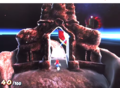 Grave Stone A
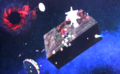 Grave Stone B
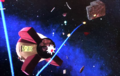 Mario about to use a Sling Pod to go from Planet Rocket to Grave Stone C


Planet Rocket[edit]
This planet is almost identical to the final version, but lacks crystals and Spoings.
Phantom Boss Spider Zone[edit]

Apart from the fight itself, the planet itself is almost completely identical to the final version.
Gallery[edit]
 Early logo from E3 2006
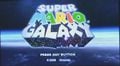 Title screen
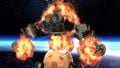 Megaleg exploding.
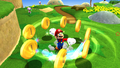 The early coin-attracting move.


Videos:
- A trailer shown at E3 (a man and a woman play the Star World together) [2][6][dead link]
- Fighting King Kaliente [3][6]
- A Cosmic Toad explains "stars" and "star shards" (later renamed "Launch Stars" and "Star Bits," respectively) [4][6][dead link]
- "HomePlanet" [5][6]
- Battle with Megaleg, showing many differences from the final game [6][6]
- Route to Tarantox [7][6]
- Tarantox [8][6]
- "HomePlanet" appears in the final game's code, but not the game itself [9][6]
- The Galaxy - Route from "HomePlanet" to Megaleg [10][6]
GDC 2007 (March 5-9)[edit]
Although no playable version of Super Mario Galaxy was shown at Game Developer's Conference 2007, a trailer was released, showing a much more complete version of Galaxy.[7]
Scene 1[edit]

- A Pull Star was used to climb on top of the house in Good Egg Galaxy. The Launch Star also fires Mario to the Egg Planet from Good Egg's second mission, rather than the Tropical Planets from Good Egg's third mission.
- In other shots, the Starting Planet in Good Egg looks identical to the one in Star World. However, in this first shot, the house's roof looks more like the final version. The pine tree also looks more like the tree in the final version. This is likely due to the low-poly model not being updated, or this scene was shot later than the other ones in Good Egg.
- The Starting Planet also seems to be shoved closer to the other planets in Good Egg's second mission.
- The Egg Planet from Good Egg Galaxy seems to be facing at a straight, vertical angle, instead of being slightly tilted like the final version.
- The Rock Planet has no platforms, as well as multiple Launch Stars.
- Dino Piranha's Planet has a different look to it, with a bluish color. Like the house planet, it seems to be shoved closer to the planets in Good Egg's second mission.
Scene 2[edit]

- The volcano in Melty Molten Galaxy has a different design, reminiscent of volcanic glass.
- The planet seems to be lacking the colorful platforms on the left side of the planet, where the Sling Star is that takes the player towards the one next to the volcano.
- The Thwomp Planet from the second mission in Melty Molten is missing.
Scene 3[edit]


- The Boulder Planet from Good Egg Galaxy's first mission is still the same as it was in Star World, without the mud and Star Chips.
- Three Bean Planets appear in this scene that look similar to the ones in Gusty Garden Galaxy.
- The camera briefly follows Mario before zooming out until Mario lands on the Boulder Planet. In the final game, the camera follows Mario until he lands on the planet, never zooming out at any point.
Scene 4[edit]
- The boulders have a different model, without the red spot, just like in Star World. Mario can break them by spinning at them when close to him.
- Mario can still spin to attract coins.
- Unlike the Star World Demo, this version of the Boulder Planet has a crystal that must be broken to activate the Launch Star.
Scene 5[edit]
- Three Bean Planets are shown in this scene. Only one is in Good Egg in the final game, and none of these three have a stone platform or Piranha Plant where a vine would spawn.
- The first Bean Planet seems to be quite empty, only containing a few plants and a Sling Star which would take Mario to the second of these planets. The second only contains a vine sprout which when spun into, creates a vine. The final of these 3 planets contains a few sandy patches and a Pokey Head. It is highly likely these planets were later moved to Gusty Garden Galaxy.
- These planets also seem to have a blur effect which blocks out the other planets, which is rarely used in the final game aside from boss planets.
- By looking very closely at the start of the clip, it can be seen that the blue planet near the planets in Good Egg's second mission has an egg on top of it, likely meaning that Dino Piranha was on that planet.
Scene 6[edit]

- Honeyhive Galaxy received several changes. The Mushroom Twin Planets have different enemy placement. Wigglers are on the first planet in this trailer instead of the second in the final, and Goombas are on the second planet.
- The Starting Planet in Honeyhive's first mission seems to have more wood on the main planet, and an unused wooden tower can be seen on the planet as well.
- This scene also seems to show that Honeyhive and Gold Leaf Galaxy would have been a single galaxy at some point. Almost every planet from Gold Leaf is present in this shot.
- The flower planet in Honeyhive's first mission is in a different position.
- A Ground Pound Switch can be found on the Stump Planet. In the final game, this is replaced by a Question Mark Coin containing a Rainbow Star.
- The camera movement in this area is also quite different to the final version.
Scene 7[edit]

- The rock planet has no platforms or Boulders. It also has 3 Launch Stars. It is unknown where the other two would lead.
- For an unknown reason, the Launch Star Mario flies out of in this shot leaves a red trail, although the Launch Star is its normal orange color.
- The camera also seems to behave differently on the Rock Planet.
- This Launch Star sequence seems to be a little longer than the final version.
- This shot seems to show the player would not start on the House Planet like in the final, as three unused planets are shown behind it, with a Launch Star trail leading over two of these planets and to the House Planet.
- Another planet shown in this shot is a dotted planet at the bottom of the screen, which is actually the low-poly version of the Tower Planet from A Snack of Cosmic Proportions in the final game. This planet is visible in multiple shots throughout the trailer, confirming it was once an accessible planet in Good Egg Galaxy.
Scene 8[edit]


- The Pill Planet has no enemies inside, however it has a lot of coins instead of Star Bits.
- The crystal leading up to the top of the Pill Planet has a coin inside, which is quite uncommon in the final game.
- When Mario flies out of the Pill Planet, the camera does not zoom out, but rather follows Mario immediately.
- The first of the two Tropical Planets is missing its palm tree.
- This shot shows another one of the three planets behind the House Planet, which looks like a tiny moon, with a Launch Star trail leading over the two planets next to it. These two planets and the other smaller planet can not be found anywhere in the game's files, so it is unknown what these planets were and what their purpose was. However, in the scene later on where Mario is fighting Dino Piranha, it is shown that in the first mission, the small moon has a Launch Star leading to the blue planet, and the planet on top of that has a Launch Star leading to the House Planet.
- The Star Planet also seems to be further out than usual, and Mario seems to be flying towards the bottom right rather than the bottom left.
- There seems to be a tiny asteroid underneath the Airships. This is likely just decoration.
Scene 9[edit]

- Both of the Starshrooms at the beginning of the Space Junk Galaxy are red.
- The Airships and Tarantox's planet are still shown in the background of Space Junk when they are not in the final, as in the final they are only present in their respective missions.
- The large Amps on the Glassy Planets are gone.
- The Assembly Block Planet appears to be missing.
- There are multiple coins in the Pull Star section.
- The Pull Star Capsules appear to be missing.
- The skybox seems to be in a different position.
Scene 10[edit]

- The Life Mushroom has not yet been added into the area of Melty Molten Galaxy with miniature suns, for obvious reasons.
- Mario has a different burning sound effect when he screams.
- The Cube Planet from Dreadnought Galaxy is shown in the background.
Scene 11[edit]

- Gusty Garden Galaxy has a background similar to Good Egg Galaxy.
- This seems to be a very early version of Gusty Garden, as most planets have either been changed or are nowhere to be seen in the final, apart from the Apple Planets.
- The Apple Planets have no enemies.
- There is no cutscene for when the caterpillar breaks out of each apple.
- Two identical planets can be seen, both looking like the Stone Planet from Gusty Garden, however they lack the Stone Platforms.
- There are also two identical Boulder Planets, both looking exactly like the one in Good Egg Galaxy.
- There are two identical Bean Planets as well, looking exactly like the ones shown earlier in Good Egg Galaxy.
- There are several tiny asteroids. It is unknown whether they would be accessible or just background decoration.
- There is a simple spherical planet that seems to be half-grassy, half-rocky. There appears to be a Sling Star on it as well, meaning it could have potentially been before the Major Burrows fight, as it looks similar to the planet before Major Burrows in the final game.
Scene 12[edit]


- Melty Molten Galaxy originally featured Topmen, as well as some other elements and planets from Dreadnought Galaxy.
- The second planet in the third mission of Dreadnought Galaxy is unseen. Only the UFO and Cube Planet are shown.
- Electrogoombas are present here, where they are nowhere in Melty Molten in the final.
Scene 13[edit]
- In this scene, a Launch Star actually fires Mario through one of the hardened lava structures in Melty Molten Galaxy. This was never included in the final product.
- Instead of flying to Fiery Dino Piranha's Planet, this Launch Star sequence takes Mario to one of the Hardened Lava Planets that is used in multiple missions in the final game.
- Electrogoombas are in place of Li'l Cinders.
Scene 14[edit]
- Topmaniac appears, with a much different design. It also seems to behave more like a regular Topman, rather than having its own behavior.
- Topmaniac's planet seems to lack rails surrounding the lasers.
- This fight seems to be taking place near the Lava Spire.
Scene 15[edit]

- An area appears in the video in which there are many sinking platforms above lava. Though this area has many coins in the video, they have all become Star Bits in the final game. The final game's Lumalee is also missing.
Scene 16[edit]

- Electrogoombas seem to have a different animation, also present in Star World.
Scene 18[edit]
- A crate is in front of the cave in which Beach Bowl Galaxy's Gringill lives.
Scene 20[edit]
- The Floaty Fluff also had a slightly different animation.
- The Floaty Fluff also seems to lack an amount of uses, as Mario uses Floaty Fluff twice in this clip, and the Floaty Fluff does not degrade at all.
- The Hedge Ring Planet appears way more grassy here, and the vines appear to be coming in and out of the planet, as opposed to circling around it.
Small changes in galaxies[edit]
- Good Egg Galaxy has a slightly darker background.
- It appears already activated Launch Stars would have remained present in multiple missions for some galaxies, as shown frequently in Good Egg Galaxy. An example is the Rock Planet, which has three Launch Stars on it that even appear when Mario is playing missions where he is not visiting the planet.
- Some planets seem to be detailed even when far away, instead of in the final when planet models do not render properly unless close to it. An example is the Pill Planet in Good Egg Galaxy, which in this trailer has the lit-up arrows visible from far away planets, unlike the final where they do not appear in the low-poly model.
- Lots of enemies, plants and crystals are missing on planets, leaving some areas looking quite empty. This is likely because the galaxies were still quite unfinished.
Other changes[edit]

- The music in the trailer is an early version of Egg Planet, which is used in Good Egg Galaxy. (This is also used in the E3 2006 demo.)
- A second design of the Health Meter was used, this one identical to the first except with the green and blue colors swapped.
- The Star Bit counter is still of the format 0/100.
- The air meter has a different, bubble-like design.
- The trailer shows that in this build of the game, touching lava would reduce the health meter by three, similar to Super Mario 64.
- The Star Pointer is still designed like the one in the Star World era builds. However, it has the shorter tail of the modern star cursor.
- Star Bits still had a different sound effect compared to the final.
Gallery[edit]
 Early air meter.

E3 2007 (July 10-13)[edit]
Since E3 was downsized to the E3 Media and Business Summit in 2007, less Galaxy info was released than in 2006. The first Galaxy related content was a press conference video, which was very close to the final game.[8]
- This is the first video to show Mario with a health meter with three sections.
- Good Egg Galaxy's background and music are still unchanged, meaning they were likely changed late in development.
- The Star Pointer now has its final design, and co-op mode is first seen. However, the two star cursors are not labeled "P1" and "P2", as they are in the final game.
- Bowser is seen breathing a stream of fire as an attack.
- The fly meter has a bubble-like design.
- An area of the Honeyhive Galaxy is shown in which two rings of Star Bits float above purple flower platforms. In the final game, these are coins.
- The Star Bit counter is now of the format 000 (it shows all three digits, even when they are zeros).
- Players no longer needs to hold to collect Star Bits.
- Shrinking green platforms (from the Hurry-Scurry Galaxy) do not have a silver border.
- The vault room in Ghostly Galaxy has Star Bits, rather than coins.
- In the presentation after the trailer, changes in Gusty Garden Galaxy can be spotted. Mainly, the Apple Planets are found in between where the Grassy Spheres Planet and Disk Planets would be, the Grassy Spheres Planet is found below where the Apple Planets would be, there is an extra Hedge Planet and the spiky planet before Major Burrows is missing. A Launch Star is also underneath the stone planet. It is unknown where it would have sent Mario.[10]
Gallery[edit]
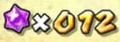 The Star Bit counter from the video.
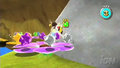 The Star Bits in an early version of Honeyhive Galaxy.
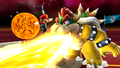 Bowser's Star Reactor Bowser fight, showing Bowser breathing a stream of fire. In the final game, this does not happen.
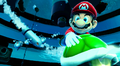 An early picture of Buoy Base Galaxy
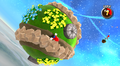 Gusty Garden Galaxy: At this angle, the apple planets should be visible and the fan in the background does not appear there in the final game.
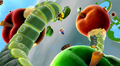 Gusty Garden Galaxy, but a lot of things have changed. The Apple Planets are in between where the Grassy Spheres Planet and Disk Planet would be, and the waterfall planet from Beach Bowl Galaxy is here.
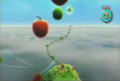 Another picture of Gusty Garden Galaxy, showcasing the Bean and Apple Planets.
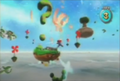 Another picture of Gusty Garden, showcasing many planets. There are two Hedge Ring Planets, the Grassy Spheres Planet has been moved and the planet before Major Burrows is gone.
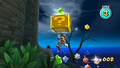 A screenshot of the Good Egg Galaxy (note the Star Bits)
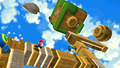 This image suggests that Honeyhive Galaxy and Gold Leaf Galaxy were planned to be one galaxy at one point.
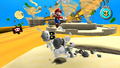 Early sign in Dusty Dune Galaxy.
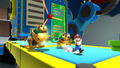 Early Toy Time Galaxy with the Heavy Metal Mecha-Bowser segment. Note the gold screws and panel in the distance are still concealing the Warp Pipe when in the final game it is required to unscrew them to reach this point in the mission.


Later on, attendees were allowed to play a demo of the game, from which they had access to Gateway Galaxy, Good Egg Galaxy, Honeyhive Galaxy, and Space Junk Galaxy.
Gateway Galaxy was called Gate Galaxy and its mission was titled "Rescue the Grand Star" instead of "Grand Star Rescue". Good Egg Galaxy was called Egg Planet Galaxy and the first mission was called "The Prehistoric Piranha" instead of simply "Dino Piranha". Honeyhive Galaxy was called Honeybee Galaxy, and Space Junk Galaxy was called Star Dust Galaxy and "Pull Star Path" was labeled as "The Beam Star Trail".
The press conference video above is not from this demo, but from a very slightly earlier build of the game.[11][dead link] Some videos taken by attendees reveal differences from the released game.
- There are scuff marks from the boulders in the final game.
- The ? Block is a ? Coin in the final game.
- Here we can see early names for several things.
- The "Space Junk Galaxy" was called "Star Dust Galaxy." This is also the galaxy's name in the Japanese version.
- The first star of that galaxy was called "The Beam Star Trail" ("Pull Star Path" in the final game).
- Thus, "Pull Stars" were known as "Beam Stars."
- In the opening movie to a galaxy, the name of the current star is printed at the top of the screen, while the galaxy's name is at the bottom. In the final game, both are at the top, with the star's name below the galaxy's name.
- Tarantox's planet is visible in this mission, when in the final, Tarantox's mission only appears in "Tarantox's Tangled Web" and "Yoshi's Unexpected Appearance".
- Here, the message "Point at the screen with [the Wii Remote]" is aligned with the left side of the screen, rather than centered. "Aim at [the beam star] and press [A]." is similar.
- One coin featured in this demo version is missing from the final game.
- Matt Casamassina (the man playing the demo) refers to the galaxy as the "Honeybee Kingdom." However, this is not seen on-screen.
- Once again, there are Star Bits above the purple flowers.
- Good Egg Galaxy still has its darker skybox and different soundtrack.
- The Luma on top of the tower says "My comrades are ahead... Hurry!" In the final game it says "My friends are ahead. Hurry!"
- The text is also vertically centered in the final game, which is not true here.
- The Luma who explains coins is not present.
- Mr. Casamassina refers to the Star Chips as "little triangles," suggesting that the players weren't given their true name.
- Captain Olimar's ship does not have crystals holding coins on its windows.
- One of the asteroids flanking the Beam Star trail is flatter and thinner than in the final game. (The round asteroid with green gems in it.)
- Mr. Casamassina says that player 2 uses the B trigger to hold enemies, but in the final game, the A button does this.
- The red plant next to the Piranha Plant in the video is not in the final game. Instead, the Piranha Plant is surrounded by green stretchy plants.
GC 2007 (August 23-26)[edit]
A demo of Galaxy was featured at Games Conference 2007. It is believed to be the same as the demo from E3 2007.[12]
- In this video, the bee says "Welcome to the Honeybee Kingdom! Our queen rules this land." In the final game, the bee says "Welcome to the Honeyhive Kingdom! Our queen rules this land."
- Later, a different bee says "New Bees must greet the Queen Bee!" In the final game, she says "New Bees must greet Her Highness, Queen Bee!"
- The Bee Mushroom has a slightly different design.
- There is no music when Mario becomes Bee Mario for the first time.
- The text box that informs players of Bee Mario's flying ability is a lighter shade of blue, and the font is different.
E for All[edit]
In what could be E for All, it was shown the Sweet Sweet Galaxy was originally called "Cookie Factory Galaxy" and "Rocky Road" was known as "Conquering the Sweet Cake".[14][dead link]
Prima Guide[edit]

In all versions of the guide, readers are advised to look for a "unicorn-like horn" on the floor of the Bonefin Galaxy's main planet, since there is a red shell near it. The guide even shows a picture of the aforementioned. However, it is totally absent from the final game, suggesting that some modifications were made to the game even after it was given to the guide's writers.
Unused data[edit]
In the final build of Toy Time Galaxy, a train set is hidden beneath a platform in the first mission, likely because it is easier than simply getting rid of it (although it could be an Easter egg).
HomePlanet, from the Star World, still exists in the game's code. The Star World itself has not been discovered, and is likely no longer accessible.

Some unused models were found in the game.[15] These include the following:
- "Kinopi", a fake inflatable Toad balloon enemy.
- Two different Bullies; one with yellow horns and green feet, and one with red horns and bluish green feet.
- A blue and yellow genie's hand (much like Master Hand).
- A Red Switch. Its filename is flagsaveswitch, suggesting that it was used as a checkpoint of some type.
- Mario's model from Super Mario Sunshine. It only has his running, swimming, and waiting animations, meaning it may have been an early placeholder before Mario's Galaxy model was finished.
- Also from Super Mario Sunshine is Peach's ponytail hair model which may have been a placeholder for something else.
- A creature composed of torimochi[16] with a face.
- Several leftovers from Donkey Kong Jungle Beat, including a Helper Monkey.
- Tico-Jii, a character resembling Eldstar. Its name is probably a derived from the Japanese words チコ tiko, meaning "Luma" and お祖父さん ojīsan, meaning "grandfather" or "old man".
- Onitsutsu,[17] which would appear to be a type of Tox Box. It has the Japanese character 鬼 oni on one face,[18] referring to the oni from Japanese folk lore. The second half of its name is probably from the word 筒 tsutsu, meaning tube.
- Billboarder, a small humanoid figure made out of flat circular textures with over fifty animations.
- The model for the "fortress" from the Prima Guide's concept art page exists in the data, as well as the large Megaleg-like figure below it, which is known as "BossCrab".
- "BossCrab" itself, a 4-legged version of what would become Megaleg; all of its animation exists.
- A very early version of the note model with a wiggling animation.
- DragonHeadFlower,[19] a gigantic Piranha Plant-like creature. It has animations for eating Mario/Luigi and spitting them back out. It would have been used on stages involving Star Balls.
- A humanoid creature made of ice, called IceMan.[19] It has animations such as AngryDemo and DeathDemo, indicating it was possibly some kind of boss. Also included is a model for the ice chunks that it would throw at the player.
- The original purple version of the Slurple.
- A large Piranha Plant given the nondescriptive name of "Octopus Queen."[19]
- OtaJack, a large green Rocto with a closer resemblance to Electrogoomba. Its name indicates it is related to King Kaliente (known as OtaKing in the game's data). It has animations for waiting and being picked up. It also vaguely resembles Prince Pikante from the sequel.
- A massive sand golem whose main model only contains skeleton and animation data, being built out of individual segments known as SandGolemBlock and SandGolemColumn.
- TetuKuri, a shiny gray Goomba whose name translates to "Iron Goomba". It lacks animations for getting hit by a spin attack, indicating that it would be immune to it.
- SpiderItemShell, a yellowish ball that opens up like the Party Ball from the Super Smash Bros. series. Its file name coincidentally relates to the Beady Long Legs from the Pikmin series, a spider-like creature whose head resembles and opens up like a Party Ball.
- A set of various flying insects. The fact that the butterfly used in the game uses similar textures indicates that they were possibly intended for this game.
- DummyNPC,[20] a creature with a round, pink head and round, rainbow body.
- Uminoko,[19] a red creature which appears to be a species of Spiny, though the name more relates to Koopa Troopas.
- An early model of a Red Star which resembles an ordinary Star more than a Pull Star.[21]
- A placeholder design for a Bomp. Due to the file name, it seems it was intended to be a gigantic version of them, but the model itself is of the standard size.
- Jiraira, a black landmine with a Bowser emblem on it. Like Mikey Mines, it too can regenerate after detonation.
The low-polygon model for the house in Ghostly Galaxy has two chimneys that the high-polygon model lacks. Part of this model can be seen from the first Phantom Tower Planet in Beware of Bouldergeist by turning the camera around towards the mansion.
- An early model of Buoy Base Galaxy. It has more platforms than the final design.
If a player uses hacks to leave the cave in Deep Dark Galaxy's Purple Coin star, they will find that the objects outside the cave are mostly gone or misplaced.[22][dead link] These oddities include:
- The entire Toad Brigade is present, even though they are also in the cave with the purple coins.
- Captain Toad is on the beach, and he says Banktoad's normal message ("Nope, I don't see any Purple Coin(s) hidden in the dirt.").
- The Yellow Toad is also on the beach, standing on top of a blue structure only found on some levels in the Sea Slide Galaxy. He will create an empty text box if spoken to.
- Banktoad is dancing where Hint Toad stood during star 2.
- Hint Toad is inside the titular box of the "Boo in a Box" star. He floats above the ground and does not have glasses. If Mario gets too close to him, he will create an empty "small" text box.
- Mailtoad is standing next to Captain Toad, and he gives his normal message for that star, which makes no sense when read out of context.
- There is a green pipe on the beach next to Captain Toad and the Mailtoad. It is connected to another green pipe next to the Hint Toad. This could be an early route to the "Boo in a Box" star, or it could simply be an aid for testing.
- Next to Banktoad there is a series of climbable poles. One of these is tilted at an odd angle an does not lead anywhere significant.
- Also next to Banktoad is an Amp, not present in any other star.
An unused attack for Ice Mario is present in the game that allows the player to turn Electrogoombas into ice blocks by spinning into them, but it cannot be seen by normal means as Electrogoombas and Ice Mario do not appear in any mission together. The attack appears to be unfinished, as using it can cause Mario to clip into the floor and get stuck. Ground Pounding into the ice block yields three Star Bits and a single coin and they can also be kicked, causing them to slide.[23]
Unused planets[edit]
- Early in development, a planet known as "Starman Fort" was to be included in the game. The planet was composed of a large castle-like structure, as well as a construction zone and a snowy area.[24] The zone contained a boss that is referred to as "Boss Crab". It is thought that it is an early version of Megaleg.
- An unused section of the Bubble Blast Galaxy contains cube bubbles. The only section of land is a small metal platform. The area is heat-based, and contains such obstacles as fireballs, wind, and steam. The level is designed in a maze format.
- Buoy Base Galaxy's frame was different.
- Bowser's Dark Matter Plant had two different blocks of dark matter.
- If the Unactivated Megaleg "glitch" from the game is performed in Bowser Jr.'s Robot Reactor, a green and light brown planet can be seen if Mario/Luigi climbs to the top and enters first-person view. This is the grassy planet from the E3 demo before Megaleg.
Gallery[edit]
![This unused model of a Super Mushroom would have been used as Life Mushroom,[25] The unused model can be seen in the E3 demo but was replaced for unknown reasons.](https://mario.wiki.gallery/images/thumb/c/c3/SMG_Unused_Mushroom.png/117px-SMG_Unused_Mushroom.png) This unused model of a Super Mushroom would have been used as Life Mushroom,[25] The unused model can be seen in the E3 demo but was replaced for unknown reasons.
This unused model of a Super Mushroom would have been used as Life Mushroom,[25] The unused model can be seen in the E3 demo but was replaced for unknown reasons. The unused "TicoJii" Luma, who resembles Eldstar from Paper Mario and Mario Party 5, and the Millennium Star from Mario Party 3
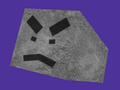 A placeholder design for a larger Bomp
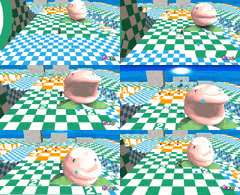 The "DragonHeadFlower"
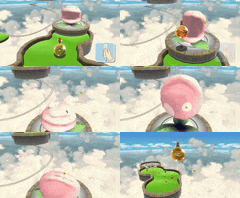 The "DragonHeadFlower" throwing Mario onto the next area
 The unused "IceMan" with a chunk of ice
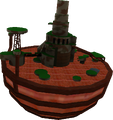 The early design of Buoy Base Galaxy
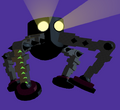 The Boss Crab that is found under the "fortress". It resembles Megaleg from the final game
 An unused purple Slurple
 An unused model of a P Switch
 A tall radish, most likely a daikon
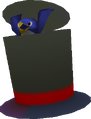 An unused model of a penguin in a hat
 The Piranha Plant labeled "Octopus Queen"
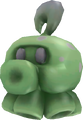 An unused model of Rocto under the filename "OtaJack", resembling an Electrogoomba
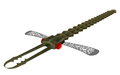 An unused model of a bigger fly
 An ! Switch which was supposed to be the checkpoint in galaxies
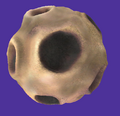 A meteor
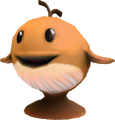 Mocina, a creature that sticks to the ground
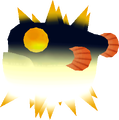 A Spined Puffer from Donkey Kong Jungle Beat under the name "RushAirFish"
 A tree-hanging, throwing variant of a Helper Monkey from Donkey Kong Jungle Beat
 Unused Bullies
![This unused model of a Super Mushroom would have been used as Life Mushroom,[25] The unused model can be seen in the E3 demo but was replaced for unknown reasons.](/File:SMG_Unused_Mushroom.png)


References[edit]
- ^ SwankyBox (March 29, 2020). The Lost Level of Super Mario Galaxy: Starman Fort. YouTube (English). Retrieved May 26, 2024.
- ^ Sahdev, Ishaan (June 9, 2010). Yoshi Originally Intended For First Super Mario Galaxy. Siliconera. Retrieved May 26, 2024.
- ^ Pages 25-4
- ^ June 8, 2006. Super Mario Galaxy Nintendo Wii Video - E3 Demo Walkthrough. IGN (English). Retrieved May 26, 2024.
- ^ BlueOtti (October 6, 2006). Super Mario Galaxy (01:47). YouTube. Retrieved May 26, 2024.
- ^ a b c d e f g h i wii.ign.com (Accessed on 15-Aug-2008)
- ^ IGN (June 23, 2011). Super Mario Galaxy Nintendo Wii Trailer - GDC 2007 Trailer. YouTube (English). Retrieved May 26, 2024.
- ^ Reverend Booyah (May 26, 2007). E3 2007 Schedule Released. Gamesradar (English). Archived May 28, 2007, 17:26:12 UTC from the original via Wayback Machine. Retrieved May 26, 2024.
- ^ a b c d e f g wii.ign.com (Accessed on 17-Aug-2008)
- ^ Savesx (July 11, 2007). Super Mario Galaxy E3 2007 Presentation. YouTube (English). Retrieved May 27, 2024.
- ^ wii.ign.com As seen here, the fly meter was in its final design, unlike in the conference video. (Accessed on 18-Aug-2008)
- ^ Bramwell, Tom (July 25, 2007). Games Convention 2007 expects 200,000 visitors. GamesIndustry.biz (English). Retrieved May 26, 2024.
- ^ wii.ign.com (Accessed on 18-Aug-2008)
- ^ [1]
- ^ The Cutting Room Floor
- ^ March 30, 2009. Mailbag. The Mushroom Kingdom (English). Retrieved May 26, 2024.
- ^ onitsutsu-mario-galaxy-unused.jpg. Unseen64. Retrieved May 26, 2024.
- ^ OnitsutsuT.png. Photobucket. Retrieved May 26, 2024.
- ^ a b c d birby100 (September 8, 2010). Super Mario Galaxy: Unused Model Madness!. YouTube (English). Retrieved May 26, 2024.
- ^ Birby100 (June 18, 2010). Super Mario Galaxy's Unused Models: DummyNPC. YouTube (English). Retrieved May 26, 2024.
- ^ Birby100 (January 3, 2011). Super Mario Galaxy: Unused Model Madness 2. YouTube (English). Retrieved May 26, 2024.
- ^ www.usbgecko.com (Accessed on 30-aug-2008)
- ^ SPG64 (October 11, 2020). Ice Mario's Unused Attack in Super Mario Galaxy. YouTube. Retrieved May 26, 2024.
- ^ The Cutting Room Floor
- ^ simpsonstino (July 12, 2007). super mario galaxy E3 2007 Developer Walkthrough (00:11). YouTube. Retrieved May 26, 2024.


