Stomp
This article needs Mario + Rabbids improvement. Specifically:
- Include additional information for Mario + Rabbids Sparks of Hope


A stomp, also called a Foot Stomp,[1] is the act of falling onto an enemy to crush it and bounce off. If this does not defeat the enemy in question, it at least inflicts damage to them. Enemies that have unique reactions to being stomped, such as Goombas, are usually flattened before they despawn. While stomping is conventionally performed after jumping off of the ground or another platform, it only requires falling. Stomping on enemies is Mario's primary attack, and it is introduced in the game Super Mario Bros. Traditionally, enemies with spikes, enemies that are on fire, and ghost enemies cannot be stomped. Trying to stomp them indicts damage on the stomper. However, the vulnerability of enemies to being stomped tends to vary on a game by game basis.
More or less every character who is playable in a game that implements jumping as an action can stomp, even if they cannot jump themselves. In Captain Toad: Treasure Tracker, Captain Toad and Toadette can stomp enemies despite the game having no jumping mechanics. Characters who cannot stomp are almost always portrayed as being particularly vulnerable, such as Parry the Parallel Bird. The exception to this are characters who perpetually fly, who usually cannot stomp enemies in spite of not being as weak as characters like Parry. A character's ability or inability to stomp often varies on a game by game basis. Sometimes this is given a fictional explanation. An example of this is Expresso, who cannot stomp enemies in Donkey Kong Country but can in Donkey Kong Land, which Super Smash Bros. for Nintendo 3DS explains as the character becoming stronger between games in the description for the character's Trophy.
In Super Mario role-playing games, jumping attacks inflict damage through stomping the target(s), and the stomp itself usually has an associated Action Command. Performing the Action Command can increase the damage of the stomp or add an additional jump and stomp to the attack.
History[edit]
Super Mario series[edit]
Stomping enemies is the primary form of offense in games of the Super Mario series. The player characters of this series usually can only attack by stomping enemies unless they have access to items and objects that offer alternative means of attack. If the player holds  or
 as they stomp an enemy, they leap off the enemy with a jump that has a maximum height higher than a normal jump from a platform. This is called a Super Stomp in some games. Not all enemies are defeated by stomping on them. Most enemies with shells, such as Koopa Troopas and Buzzy Beetles, withdraw into their shells when they are stomped. This enables the player to stomp or kick the shell to launch it into other enemies as a follow up attack, though if the shell is left alone for too long the enemy will emerge from it and continue acting. A shell that is already moving cannot be kicked but it can be stomped, which makes the shell stop moving. Galoombas temporarily flip over when they are stomped. In this state, they can be kicked around picked up to carry and throw them. In Super Mario 3D World and Super Mario 3D World + Bowser's Fury, flipped Galoombas cannot be picked up, as any contact with them causes the player to kick them in order to defeat them. In most games, Bob-ombs are knocked backward and are immobilized, but their fuse lights up. The player can kick them around or pick them up to throw them until their fuse runs out and they explode. In Super Mario 3D World and Super Mario 3D World + Bowser's Fury, stomping Bob-ombs turns them into normal bombs. Dry Bones and Bony Beetles crumble into pieces when stomped, which is a state where they cannot move and do not collide with players and enemies but is not a defeated state. Given time, the Dry Bones or Bony Beetle will reassemble itself and stand back up, regaining its ability to move and collide with players and enemies. Most enemies with wings, like Koopa Paratroopas and Paragoombas, lose their wings when they are stomped but are otherwise unharmed. This converts them into their wingless counterpart, such as Koopa Troopas and Goombas in the case of the prior examples. Certain enemies, such as Big Dry Bones, can be stomped and react to being stomped but do not take damage. In the case of Big Dry Bones, it stops and rattles, but is unharmed.
If the player stomps on several enemies in a row without landing on the ground or any other kind of platform, and if stomping on the enemies in question is worth points or coins (enemies like Big Dry Bones that are not hurt by being stomped usually do not grant points when they are stomped), they earn additional points for each enemy defeated in games that have points and additional coins for each enemy defeated in games that do not have points. Super Mario Run identifies this property as a move: Consecutive Stomps. It further rewards the player for doing this by making Consecutive Stomps a stylish move that produces blue stars that contribute to starting a Coin Rush. Toads in Super Mario Run love seeing Consecutive Stomps, and in the Toad Rally mode, one will start cheering for the player each time they perform a stomp that qualifies. Super Mario Run also makes it easier to perform Consecutive Stomps compared to other Super Mario games: The player can vault over grounded enemies to avoid touching the ground and perform a Vaulting Jump off an enemy they are Vaulting over to start or continue using Consecutive Stomps, and the player can Spin Strike enemies to stomp them from a farther range than manually stomping.
In most two-dimensional Super Mario games, if the player stomps on and damages eight enemies in succession without landing on the ground or any other kind of platform, they earn a 1-Up instead of getting points. This continues to happen for every further enemy stomped before landing on a platform. Super Mario Land 2 - 6 Golden Coins makes the break point where players get extra lives for stomping on multiple enemies in a row five enemies instead of eight. In Super Mario 3D Land, Super Mario 3D World, and Super Mario 3D World + Bowser's Fury, the break point is also five enemies. Typically, the way this rule is designed means that players have to find locations with a sufficient amount of enemies placed close enough together to stomp them all one after the other to earn extra lives through this method. However, players can take advantage of enemies that take damage from stomps but are not instantly defeated by them, such as Koopa Paratroopas and Chargin' Chucks, to meet the requirements for gaining extra lives while stomping fewer distinct enemies. The fact that Koopa Shells and Buzzy Shells respond to being stomped by being launched forward, or by stopping if they are already careening around, is used for "infinite 1-UP tricks". The shell in question is left in a position where launching it forward with a stomp makes it bounce off a wall and back into a player, such that they can stomp it again to stop it before stomping it one more time to launch it forward again. This allows the player to stomp the same shell an infinite number of times. Since stomping on a shell grants points / coins, this loop of actions goes up the point scoring / coin granting chain until it generates 1-Up after 1-Up.
In Super Mario games, enemies with spikes and ghost enemies cannot be stomped. Examples of these include Spinies, Pokeys, Boos, and Peepas. Most player characters fall through them and take damage. Some enemies without spikes take advantage of this by extending spikes from themselves or putting their out of play spikes into play. Examples of this include Bony Beetles and Boom Boom. The Koopalings weaponize this property as the shell spin, hiding in their unstompable spiked shells while still attacking. Certain playable characters, like Yoshi, have a resistance to spikes and can stomp on enemies with spikes. In some games, this inflicts damage to the enemy, but in other games it does not. In certain games, normal player characters can Spin Jump to stomp on enemies with spikes, with the same variability on if the enemy does or does not take damage from it. Normal player characters can ride in Goomba's Shoes to gain the same resistance to spikes that Yoshi has.
In most two-dimensional Super Mario games, normal player characters cannot stomp enemies while underwater, This makes them especially vulnerable to enemies while underwater, and bosses like Wendy O. Koopa take advantage of this by temporarily filling the screen with water. Boss fights that take place entirely underwater always provide a permanent means to inflict damage without needing items and objects from earlier parts of the course. For example, Dragonzamasu from Super Mario Land is battled underwater, but he is in the level World 2-3 and that level gives the player permanent access to the Marine Pop. Another example is Bowser Jr.'s boss battle in The Mighty Cannonship in New Super Mario Bros. U and All Aboard! in New Super Luigi U. It takes place in a flooded room, but Bowser Jr.'s Targeting Teds can be redirected into him to damage him. In Super Mario 3D Land, Super Mario 3D World, and Super Mario 3D World + Bowser's Fury, the player can stomp enemies while underwater. However, most enemies that appear underwater, like Cheep Cheeps and Bloopers, are immune to being stomped while they are underwater. This means the ability to stomp those enemies rarely matters, especially as the height boost from stomping does not matter in a setting where the player can gain infinite height while swimming as long as they remain in the water.
Some items allow the player to improve the power of their stomps. Aside from the aforementioned Goomba's Shoe, players can use Big Mushrooms to become Big Mario. Big Mario can stomp enemies with spikes and ghost enemies and defeats them when he does so. He can also stomp blocks to destroy them, though stomping blocks puts the player into a special state where they cannot stomp other blocks until they stomp something else or land on a platform. If Big Mario wears a Goomba's Shoe, his stomping abilities are overriden by the Goomba's Shoe's.
Some items modify stomping in other ways. Players wearing Ice Skates crash through enemies they fall into instead of stomping them, which means they lose the ability to stomp enemies in favor of being able to tackle them.
In Super Mario Run, resting Koopa Shells and Buzzy Shells cannot be stomped normally because kicking them takes priority over stomping them in this game. However, they can be stomped by using the Spin Strike on them.
Donkey Kong Country series[edit]
In Donkey Kong Country Returns and its Nintendo 3DS and Nintendo Switch ports, Donkey Kong and Diddy Kong have their own unique version of stomping, though it is only ever described as jumping off an enemy. In these games, Donkey Kong punches enemies as he lands on them, hitting them while bumping himself up. He can do this with only one hand, if the other is being used to hold an object. Unlike games of the Super Mario series, Donkey Kong gains almost no height when jumping off of enemies if the player only holds the jump button. Rather, to jump high off an enemy the player has to press the jump button as they land on the enemy. If Donkey Kong is not holding an item and this input is performed correctly, he flips around in the air. Rambi and Mine Carts the player is riding inside can jump on enemies, although they do not have differing animations. Rambi is stronger compared to the player characters, defeating anything that can be defeated with stomps in just one hit regardless of if Donkey Kong or Diddy Kong would have to stomp it multiple times or not. Spiky enemies like Tiki Zings cannot be stomped, but Rambi can defeat them by colliding with them from above regardless because he is near invincible. However, enemies that are on fire like Flaming Tiki Buzz can never be stomped, Rambi or otherwise. They are also immune to Rambi landing on them or otherwise colliding with them.
If the player stomps on multiple enemies consecutively without touching the ground or other platform, then they get rewards. Stomping on any enemy past the second in a row up to the seventh in a row rewards the player with a Banana Coin. Stomping on any enemy past the seventh in a row rewards the player with a Red Balloon. Enemies that can be stomped more than once before being defeated are more common in this game than in other games of the Super Mario franchise, including large, bulky but not invincible enemies like Tiki Doom. This makes it easier to stomp multiple enemies in a row.
Donkey Kong Country Returns revolves less around stomping than the Super Mario series, since the player can Barrel Roll, Cartwheel Attack, Kong Roll, and Charge to defeat enemies as well.
These mechanics are retained in Donkey Kong Country: Tropical Freeze.
Yoshi series[edit]
In the Yoshi series, stomping works almost identically to the Super Mario series. However, Yoshi does not have his resistance to landing on spikes in games of this series, meaning he cannot stomp them. If Yoshi uses the Flutter Jump after landing on an enemy, Yoshi can ascend higher than normal. This is because the existence of the Flutter Jump makes it harder to hold the jump button while landing on an enemy, since holding it too early will make Yoshi Flutter Jump and rise instead of falling on the enemy. Thus, this mechanic allows the player to confirm that they stomped an enemy and then use the upward boost provided by stomping on an enemy.
Poochy Dash, a mode of Poochy & Yoshi's Woolly World where Poochy is the playable character, has stomping work exactly the same as in the Super Mario series since Poochy cannot Flutter Jump.
Games of the Yoshi series do not have any mechanic rewarding the player for stomping on enemies consecutively without landing on a platform.
The Yoshi series revolves less around stomping than the Super Mario series, since the player can flick out Yoshi's tongue to eat enemies, spit them or other objects out to defeat other enemies, or convert them into Yoshi's Eggs to throw at enemies to defeat them.
Super Mario RPG: Legend of the Seven Stars / Super Mario RPG[edit]
In Super Mario RPG: Legend of the Seven Stars and its Nintendo Switch remake, Mario's Jump, Super Jump, and Ultra Jump attacks inflict damage by stomping. Further, the three attacks are the only player usable attacks that have the Jump element, so they inflict extra damage on enemies who are weak to it. The Timed Hit for all three attacks is pressing the  button when Mario performs the stomp. The Timed Hit for Jump makes the attack inflict more damage, but the Timed Hit for Super Jump and Ultra Jump let Mario leap again to attack again with another stomp. They reference the concept of stomping enemies consecutively from the Super Mario series. Super Jump repeatedly hits the same target, up to 100 times, while Ultra Jump has Mario land on a different enemy with each stomp. If Super Jump or Ultra Jump hit enough times, they start causing the sound effect for getting 1-Ups in the Super Mario series to play with each stomp.
Super Smash Bros series[edit]
The Footstool Jump is a variant of stomping present in the Super Smash Bros. series from Super Smash Bros. Brawl onward. It is performed by jumping while directly over an opponent, which makes fighter perform the jump off of the opponent while locking them in place for the animation. This does not use one of a fighter's limited midair jumps, but the height gained from consecutive Footstool Jumps decays until the chain is broken by landing on a platform. This eventually makes it so that the player's Footstool Jump does not gain enough height to get them above the fighter they Footstool Jumped off of to perform another Footstool Jump, breaking the chain. If a fighter Footstool Jumps off an opponent who is in the air, the opponent is pushed downward by the animation. This can be used to prevent a recovering opponent from returning to the stage in order to KO them, while bolstering the user's own recovery if applicable.
In Super Smash Bros. Ultimate, using a Footstool Jump on Piranha Plant while it is crouching causes it to automatically react with an extremely fast upwards biting attack meant to hit the fighter using the Footstool Jump. This references how Piranha Plants attack in two-dimensional games of the Super Mario series by rising out of their pipe, and may further invoke how Piranha Plants cannot be stomped through normal means in those games.
Paper Mario series[edit]
In the Paper Mario series, Mario's jump attacks inflict damage by stomping enemies. The Action Command for Mario's jump attacks is universally to press the button when landing on an enemy, which usually enables Mario to jump a second time and deliver another stomp to the enemy. Enemies with Defense stats higher than 0 block damage equal to their defense stat from each hit of an attack, which is more detrimental to jump attacks than other kinds of attacks because they spread their damage across two hits and thus allow an enemy's Defense stat to factor in twice. Unlike in the Super Mario series, Mario can stomp on ghost enemies. However, enemies with spikes and enemies that are on fire repel jump attacks automatically and inflict damage on Mario when they do so. Electrified enemies can be hit with a jump attack, but if Mario is not Electrified himself, they shock Mario so his attack ends immediately on contact with them. This prevents him from performing the second jump of a normal jump attack even if the player tries to use the Action Command. Mario can use his jump to stomp enemies in the field, initiating a First Strike where he gets to start to start the battle with a jump attack on that enemy, though the First Strike does not have an Action Command and thus only stomps once.
Paper Mario[edit]
In Paper Mario, starts the game with access to his normal Jump attack, which works as listed above. However, he can equip badges that grant access to additional kinds of jumping attacks or change the properties of his attacks. The D-Down Jump badge grants Mario the ability to use D-Down Jump, a jump attack whose stomps ignore the defense of the target. The Power Jump badge grants access to Power Jump, a jump attack that only stomps one time even if the Action Command is used but inflicts two extra damage in exchange. The Power Bounce attack of the Power Bounce badge succeeds the Super Jump from Super Mario RPG: Legend of the Seven Stars, hitting one enemy with consecutive stomps until the player misses an Action Command for the attack. The Multibounce attack of the Multibounce badge does the same thing for Ultra Jump. It increases the resemblance to stomping on enemies on after the other in the Super Mario series by specifically having Mario stomp the enemy closest to him first, then the enemy after that one and the enemy after that one until Mario has stomped every enemy in the battle or the player misses an Action Command for a stomp.The Spike Shield badge enable Mario to jump and stomp on enemies with spikes, and the Fire Shield and Ice Power badges have the same effect for stomping enemies who are on fire. Among these badges are the Shrink Stomp, Sleep Stomp, Dizzy Stomp badges, which are named after stomping and allow Mario to perform a corresponding jump attack.
Mario can upgrade all of his jump attacks by obtaining the Super Boots and Ultra Boots, increasing their power. In the field, Mario can perform Spin Jumps in the field with the Super Boots and Tornado Jumps in the field with the Ultra Boots, which have extra power when used as First Strikes. They also change all of his Action Command only hits of his jump attacks in battle into different Spin Jumps and Tornado Jumps, respectively. This is mostly cosmetic, but they change the timing of the stomps past the first in Power Bounce and Multibounce and therefore the timing of the Action Commands in those attacks. When Mario gains the Ultra Boots, he stops using the Super Boots and therefore loses the ability to Spin Jump.
Paragoombas and Koopa Paratroopas lose their wings if they are hit by jump attacks, turning them into Goombas and Koopa Troopas. Koopa Troopas that are hit by jump attacks get flipped over, preventing them from attacking and reducing their Defense to 0 until they recover.
Additonally, Goombario can perform a jump-like attack that inflicts damage with a headbutt instead of stomping: Headbonk. The headbutts of Headbonk work exactly like the stomps of a jump. He can learn the Multibonk attack, which is a Headbonk version of Mario's Multibounce attack.
Paper Mario: The Thousand-Year Door[edit]
Stomping in Paper Mario: The Thousand-Year Door follows mostly from how it works in Paper Mario. The Shrink Stomp, Sleep Stomp, and Dizzy Stomp badges all return, though Sleep Stomp is renamed Sleepy Stomp. They are joined by the new badge Soft Stomp, which also grants access to a corresponding attack. Fire Shield is removed from the game, leaving Ice Power as the only way to gain the ability to jump and stomp on enemies that are on fire. A new duo of badges have very unique effects. Jumpman makes all of Mario's stomps stronger but removes his ability to attack with his hammer in battle. Its opposite, Hammerman, makes all of Mario's hammer attacks stronger but removes his ability to perform jump attacks in battle.
The Super Boots and the Ultra Boots are also in this game, but the Ultra Boots grant access to Spring Jump instead of Tornado Jump. Spin Jump has a separate input in the field from Spring Jump, so Mario has access to both moves while using the Ultra Boots. Additionally, Spin Jump and Spring Jump are separate moves in battles rather than replacing hits of jump attacks performed with Action Commands, with their own properties.
Shady Koopas can attack when they are flipped over by a jump attack. They use a backspinning version of Shell Toss that hits for double damage compared to the normal version.
Goombella has very similar abilities to Goombario, including the Headbonk and Multibonk attacks.
Paper Mario: Sticker Star[edit]
In Paper Mario: Sticker Star, jumping and stomping in the field is mostly similar to how it works in Paper Mario: The Thousand-Year Door. However, the Super Boots and Ultra Boots are no longer items. Mario can increase the damage of his jumps performed as First Strikes by collecting HP-Up Hearts instead. In battle, instead of selecting attacks from a menu, Mario selects stickers from his album to attack with by placing them in sticker zones. Instead of badges granting access to new attacks when Mario equips them, Mario obtains different stickers with different jumping attacks. When a attack hits an opponent and ends, its sticker falls off of the sticker zone and is used up. However, jump attacks hit multiple times when their Action Command is used, and this is represented by the sticker in the sticker zone gradually peeling off with each successful Action Command and then falling off when the player misses an Action Command or the attack reaches its maximum number of hits. Normal Jump stickers have a maximum of five hits and therefore allow Mario to stomp up to five times. Hopslipper and Infinijump succeed Power Bounce by being attacks that stomp and enemy ten times or 100 times, respectively, with Infinijump bringing the attack more in line with the original Super Jump. Line Jump draws from Multibounce, but changes the rules because Mario starts the attack against the targeted enemy instead of the attack being unable to target and always starting on the first enemy, Further, it switches to jumping and stomping on enemies in reverse order Mario reaches the last enemy in the battle during the attack. Iron Jump succeeds Spike Shield by being a normal Jump attack with the exception of being able to stomp enemies with spikes. Clone Jump is a new kind of stomping attack where Mario and three duplicates of him stomp the target one after the other, meaning the timing of the stomps and the Action Commands is different compared to other jump attacks. As with all stomping attacks, it ends early if an Action Command is missed, preventing all remaining Marios from performing their jumps and stomps.
The Shell, Shiny Shell, and Flashy Shell summons a green Koopa Troopa, red Koopa Troopa, or Buzzy Beetle into the battle respectively. Mario jumps and stomps on the enemy to force it into its shell, then does a second jump and stomp to launch it through all enemies in the battle and damage them. The enemy called by the sticker does not reenter the battle. The Action Commands for this sticker correspond to both of the stomps.
Using a stomp attack on Paragoombas and Koopa Paratroopas causes them to lose their wings and turn into Goombas and Koopa Troopas. This does not work on 5-Fold Paragoomba. Since it uses paper power to lock its state into place, stomping it does not cause it to turn into a Goomba equivalent.
Using a stomp attack as a First Strike on Koopa Troopas, Shiny Koopa Troopas, Buzzy Beetles, and Shiny Buzzy Beetles causes them to retreat into their shell. Using any kind of stomp attack on the shell launches the shell through all enemies behind the shell and out of the battle, just like a Shell sticker does. This replaces the mechanic of enemies with shells flipping over when they are hit by jumping attacks from previous games.
There are no enemies that are on fire in this game, and this game does not have the Electrified status.
Mario Party series[edit]
In the Mario Party series, many combat-centric minigames that use standard movement controls allow players to jump on their rivals to stun them and flatten them briefly. Being flattened makes the player move slower. Stomping is not as effective at stunning players as using a Ground Pound on them, punching them or kicking them. Compared to the Ground Pound and to punching, stomping keeps the player in the more mobile jumping state, and compared to kicking, stomping allows the player to continue moving around rather than having to collide horizontally with an opponent. Thus, stomping has some advantages. Moreover, stomping can be used in any minigame that allows jumping and has players within reach of their opponents, even if the minigame is not combat-centric and does not have punching, kicking, or ground pounding as options. Since it is an attack, players who are stomped gain mercy invincibility to protect them from further attacks.
WarioWare series[edit]
In the WarioWare series, microgames that are based on or inspired by video games where the player can stomp often allow the player to stomp. Super Wario Bros., for instance, is inspired by Super Mario Bros, and has Wario stomp Goombas. Unlike in Super Mario Bros, Wario does not bounce off the Goombas as he stomps them, instead continuing to drop until he touches the ground. Microgames that are directly based on video games tend to be more accurate to those games regarding the mechanics of stomping. The player can have Mario stomp enemies in Super Mario Bros. in WarioWare, Inc.: Mega Microgame$! and WarioWare, Inc.: Mega Party Game$! as well as in Super Mario Bros. in WarioWare: Twisted! and WarioWare Gold.
WarioWare: Get It Together![edit]
In WarioWare: Get It Together!, all crew members who are affected by gravity can stomp to defeat enemies. The characters who can are: Cricket, 18-Volt, 9-Volt, Dr. Crygor, Kat, Ana, Jimmy T, 5-Volt, Mantis, Lulu, Penny and Pyoro. For most crew members, stomping only offers a minimal height boost. Kat and Ana perform full jumps off of enemies they stomp. If the player holds the  when they stomp as Cricket or Mantis, the height they get from stomping varies in the same way their jump height does, and it overall feels very similar to stomping enemies in then Super Mario series. Stomping is not given a call out as any specific character's ability, but Cricket's tutorial includes a section about stomping. The microgames Super Mario World, New Super Mario Bros. U, Super Mario Bros., and Donkey Kong Country Returns have the player encounter enemies from games that have stomping, and they mostly act like they do in the source material, but Banazi Bills in the first of them cannot be stomped whereas they could be in Super Mario World. The crew cannot stomp while participating in the game Friendless Battle.
Mario Kart Tour[edit]
The subject of this section has not been officially identified, so it has been conjecturally merged into this article.
If an acceptable name is found for this section's subject, it may need to be split into a new article.
In Mario Kart Tour, the player can land on Goombas to defeat them and get a Jump Boost for doing so. Unlike in the Super Mario series, Goombas do not have a flattened animation for being stomped.
Mario + Rabbids series[edit]
In the Mario + Rabbids series, Mario can gain the ability to stomp on enemies when he comes down from a Team Jump, dealing damage to them and getting a little extra distance for the Team Jump overall. This ability can be upgraded in Mario's Skill Tree in both games in the series, increasing the damage dealt and increasing the distance Mario can move after performing the attack. In Mario + Rabbids Sparks of Hope, the player can also increase the number of enemies that can be stomped consecutively from one Team Jump.
Profiles and statistics[edit]
Super Mario Run[edit]
Consecutive Stomps[edit]
- Notebook description:
- English:
If you stomp multiple enemies in a row, the Toads will cheer and you earn extra coins!
- English:
Mario + Rabbids Sparks of Hope[edit]
- Description: While Gliding, an extra attack can be performed by Stomping on the head of the target below.
- Base DMG is based on Mario's current LVL.
Gallery[edit]
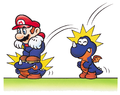
 Artwork from Super Mario All-Stars


Names in other languages[edit]
| Language | Name | Meaning | Note(s) | Ref. |
|---|---|---|---|---|
| Japanese | 踏みつける Fumitsukeru | To stomp | [2] | |
| Finnish | Pomppia | To stomp | [3] | |
| Italian | Pestone | Stomp | Super Mario Run | [?] |
| Schianto | Slam | Mario + Rabbids Sparks of Hope | [?] | |
| Norwegian | Stampe | To stomp | [4] | |
| Portuguese (Brazil) | Pisada | Stomp | Super Mario Run | [?] |
| Pisar | To stomp | Mario + Rabbids Sparks of Hope | [?] | |
| Romanian | tropăi | stomp (albeit typically in reference to stomping one's feet loudly on bare ground) | [5] | |
| călca (în picioare) | stomp (with one's feet) | [5] | ||
| Russian | Прыжок на врага Pryzhok na vraga | Jump on enemy | [?] | |
| Swedish | Stampa | To stomp | [6] |
References[edit]
- ^ July 1994. Nintendo Magazine System (AU) Issue #16. Page 18.
- ^ Nintendo Koushiki Guidebook Series: Super Mario World
- ^ Nintendo-lehti (1990-1994, Finnish)
- ^ Summer 1991. Power Player Nummer 11-12. Oslo, Norway: Semic AS (Norwegian). Page 29.
- ^ a b "Joacă de tropăit inamicii [...] Joaca prin călcatul de inamici - Treci la nivelul următor cu LEGO Super Mario Set de extindere Pantoful lui Goomba (71404) care include un pantof construit din cărămizi pentru distracție cu sărituri, călcat în picioare și răsturnare" ("Enemy-stomping play [...] Enemy-stomping play – Level up with the LEGO Super Mario Goomba’s Shoe Expansion Set (71404), featuring a brick-built shoe for hopping, stomping, flipping fun") – Set de extindere Pantoful lui Goomba. LEGO.com (Romanian). Retrieved October 3, 2026. (Screenshot.)
- ^ Nintendo Magasinet Nr 6-7 1991