Mario's Picross
- This article is about the Game Boy game. For the video game series, see Mario's Picross (series). For the Club Nintendo comic, see Mario's Picross (comic).
| Mario's Picross | |||||||||||
|---|---|---|---|---|---|---|---|---|---|---|---|
 North American box art For alternate box art, see the related gallery. | |||||||||||
| Developer | Jupiter | ||||||||||
| Publisher | Nintendo | ||||||||||
| Platforms | Game Boy, Virtual Console (Nintendo 3DS), Game Boy – Nintendo Classics | ||||||||||
| Release dates | Game Boy: March 14, 1995[1] March 14, 1995[1] March 14, 1995[2] March 14, 1995[2] July 25, 1995[?] July 25, 1995[?] July 27, 1995[?] July 27, 1995[?]Virtual Console (3DS): July 14, 2011[?] July 14, 2011[?] August 4, 2011[?] September 21, 2011[?]Game Boy - Nintendo Classics March 6, 2025[3] March 7, 2025[4] March 7, 2025[5] March 7, 2025[6] March 7, 2025[?] March 7, 2025[?] March 7, 2025[7] March 7, 2025[7] | ||||||||||
| Languages | English Japanese | ||||||||||
| Genre | Puzzle | ||||||||||
| Ratings |
| ||||||||||
| Mode | Single player | ||||||||||
| Format |  Digital download Digital download Game Pak Game Pak Cartridge Digital download Cartridge Digital download | ||||||||||
| Input |  Joy-Con (horizontal) Joy-Con (horizontal) | ||||||||||
| Serial codes | DMG-APCJ-JPN DMG-APCE-USA (USA/Europe/Australia) | ||||||||||
 - Kids to Adults
 - All ages
 - Three years and older
 - All ages
 - General


Mario's Picross is a puzzle game for the Game Boy developed by Jupiter and the first game in the Nintendo-published Picross series. It was released in 1995 and stars Mario, who appears in the role of an archaeologist. Mario's Picross is based on paint-by-number puzzles known as nonograms. Several sequels have been released since then, most of which are Japan-only games.
Gameplay[edit]

The objective of each logic puzzle is to reveal a hidden picture in a grid by scraping specific squares of it. Each puzzle starts with an empty grid and several numbers are given at the side of each horizontal row and vertical column of the grid. The numbers tell the player how many squares have to be scraped in each line.
For example, a "5" means that the player has to scrape five consecutive squares in the respective line. If there is more than one number, then there has to be at least one blank square between the scraped areas. For instance, "4 6 2" means that four consecutive squares have to be scraped in the line, followed by at least one blank square. After the blank space(s), the player has to scrape an area of six squares. Again, there has to be at least one blank square between this area and the last two consecutive squares that have to be scraped. If the player is sure that a square does not have to be scraped, e.g. when a blank square is needed or all required squares in a line have been scraped, they can mark it with an "X".
The revealed pictures show food, animals and other objects, but also make some Super Mario franchise references.
Modes[edit]
The game features 256 puzzles in total. All puzzles are a size of 15x15 squares, except for the 5x5 and 10x10 square puzzles of Easy Picross that are aimed at beginners. The puzzles are split into different modes (64 puzzles each):
- Easy Picross (for beginners)
- Picross (split into two courses)
- Kinoko Course
- Star Course (unlocked after completing Kinoko Course)
- Time Trial (unlocked after completing Star Course)
The first two modes, where the puzzles can be played in any order, follow the same rules. Before playing the game, the player can decide to get a hint, which means that the correct squares of a row and a column are already scraped when starting the puzzle. A roulette the player has to stop defines which lines are revealed, which can make a puzzle easier to solve, though it is possible to solve them all without using hints. Each puzzle has a time limit of 30 minutes. Marking squares with an "X" that should be scraped incurs no penalty, but scraping squares that should not be scraped reduces the time limit. The first mistake costs two minutes, the second one four minutes, and all subsequent mistakes eight minutes each, meaning that a maximum of four mistakes can be made; making another mistake afterward always ends the game. If time runs out before the player has revealed the picture, the game is over. For each puzzle, the first and best times are saved, with an "H" to the left of the time if a hint was used to solve a puzzle.
Time Trial[edit]
The last mode known as Time Trial comes with different rules. The player does not get a hint at the beginning, and the game does not note wrongly-scraped squares, so the player does not know whether a mistake has been made. The 64 puzzles appear randomly; the player is not able to select a specific puzzle. This random selection is guaranteed to show the player a puzzle they have not yet solved, until all 64 possible puzzles have been solved once.
There is no time limit - instead, time counts up from zero, measuring how long the player took to solve the puzzle. Upon completing a puzzle, the player has the option to enter their time into a high-score board of fastest times, with up to three letters to represent their name. This score board is shared across the 64 possible puzzles. After entering a score, the player can decide to "try again" - however this will load a random puzzle, not necessarily the one that was just completed.
The default entries on the score board are the following:
- 15:00 - NIN
- 20:00 - APE
- 30:00 - JUP
- 40:00 - MAR
- 50:00 - PIC
Levels[edit]
The puzzles in the game's first three courses are stored in order in the game's memory; this pattern has been used to determine the "order" of the Time Trial puzzles.
Easy Picross[edit]
| Level | A | B | C | D | E | F | G | H |
|---|---|---|---|---|---|---|---|---|
| 1 | the letter “L” | the letter “E” | the letter “T” | the letter “S” | the letter “W” | the letter “O” | the letter “R” | the letter “K” |
| 2 | note | diamond | spade | heart | clover | question mark | dollar sign | arrow |
| 3 | crescent | star | sailboat | car | cactus | apple | chestnut | doughnut |
| 4 | knife and fork | flag | cup | flask | house | glove | balloon | pencil |
| 5 | pot | umbrella | bell | boot | candle | faucet | bulb | anchor |
| 6 | choplifter | ball | BOO DIDDLY | panda | wild duck | chicken | snail | MARIO |
| 7 | lipstick | silk hat | ax | wood stove | locomotive | frozen pop | carrot | whale |
| 8 | chair | hourglass | bottles | skillet | coffee maker | mail box | camera | scissors |
Kinoko Course[edit]
| Level | A | B | C | D | E | F | G | H |
|---|---|---|---|---|---|---|---|---|
| 1 | GAME BOY | STAR | high-heel | bread | cake | hanger | bus | tinkle |
| 2 | skate | shoe | cap | telephone | can | garlic | hand | hamburger |
| 3 | shovel | necklace | UFO | BULLET BILL | tomato | flower | GRAND GOOMBAS | coffee cup |
| 4 | mutt | overalls | leaf | unicorn | bull | controller | onion | skull and crossbones |
| 5 | snowman | chameleon | cucumber | buildings | pear | owl | rice ball | soap bubbles |
| 6 | baby buggy | bomb | kettle | weight lifting | coffee mill | plug | sun-glasses | crow |
| 7 | vacuum | NESSIE | camel | oranges | bucket | angel | racing car | purse |
| 8 | rocking-horse | ice-cream cone | deer | strawberry | bicycle | atlantic-penguin | ambulance | back hoe |
Star Course[edit]
| Level | A | B | C | D | E | F | G | H |
|---|---|---|---|---|---|---|---|---|
| 1 | bubble pipe | shirt | hermit crab | shooting star | acorn | lamp | sun fish | green peas |
| 2 | ladybug | balance | samurai | wild duck | MINI YOSHI | weathercock | crown | poodle |
| 3 | scarecrow | grape | cannon | ship | duckbill | crab beetle | christmas tree | tiger |
| 4 | bowling pins | sea lion | SUN-FLOWER | ice-cream sundae | cowboy hat | ray | SPINY | cherry |
| 5 | palm tree | tank | hawk | fly | spinning top | MUSHROOM | squirrel | bath |
| 6 | skiing | coat | crab | goldfish | reindeer | jack-o-lantern | mud | chili peppers |
| 7 | radar | mermaid | fox | sumo wrestler | frog | cat fish | racket | guitar |
| 8 | spider | pelican | dragonfly | wild boar | beetle | seal | kite | armadillo |
Time Trial[edit]
| Level | A | B | C | D | E | F | G | H |
|---|---|---|---|---|---|---|---|---|
| 1 | witch | bow | Man in the moon | alarm clock | water melon | straw hat | rocket | rabbit |
| 2 | bird | banana | corn | ostrich | TERUTERU BOUZU | pineapple | feather | mouse |
| 3 | BLOOPER | fish | monkey | dirk | BUZZY-BEETLE | bee | cat | KOOPA TROOPAS |
| 4 | candy | crane | ram | giraffe | scorpion | kangaroo | pig | white lion |
| 5 | sake bottle | flower | friendly dog | shrimp | hippopotamus | tulip | clay image | wooden horse |
| 6 | socks | butterfly | tortoise | football | scooter | koala | lock | chick |
| 7 | CHEEP-CHEEPS | snake | white eye | elephant | horse | tea cup | pegasus | rhinoceros |
| 8 | angler | ring | woodpecker | Grim Reaper | hedgehog | dump truck | bi-plane | sheriff |
Cameos[edit]
Some of the pictures show characters, enemies, and items from the Super Mario franchise. A picture of the Game Boy also appears. The captions of these puzzles appear in all uppercase, unlike other puzzles, whose captions appear in lowercase.
Easy Picross
- 6C - Boo Diddly
- 6H - Mario
Kinoko Course
- 1A - Game Boy
- 1B - Star
- 3D - Bullet Bill
- 3G - Grand Goombas
Star Course
- 2E - Mini Yoshi
- 4C - Sun-Flower
- 4G - Spiny
- 5F - Mushroom
Time Trial
Differences in the Japanese version[edit]
In the overseas release of the game, a handful of puzzles were changed to remove references to alcohol and other elements. The puzzles included in the Japanese release are listed below.
Easy Picross
- 6C - Cocktail
- 7B - Wine Glass
Kinoko Course
- 2A - Shogi Piece
- 2F - Shrine Bell
- 2H - Rice Pot
- 4D - Tsukimi Dango
- 6H - Beer Mug
- 7F - Folding Fan
Star Course
- 6H - Niō's Face
Time Trial
- 1H - Pellet Drum
- 3D - Shuriken
- 3F - Tobacco
- 4D - Kasa-obake
Staff[edit]
- Main article: List of Mario's Picross staff
Reception[edit]
Mario's Picross was unable to sell notably well in either North America or Europe when it was released, leading both territories to no longer receive any more Picross games by Nintendo until Picross DS in 2007[citation needed]. The game, despite citations that the Game Boy's tiny screen makes it difficult to see the puzzles clearly, is considered a cult hit in the Western world[citation needed].
Andy Dyer of Total! magazine gave the game an overall score of 80/100.[8] He finds that the gameplay is instantly addictive and fits the Game Boy perfectly. He calls the graphics simple, which is desirable for clarity, and highlights the number of puzzles available. However, he critiques the game for a lack of gameplay variety, which could lead to fatigue once the gameplay has been mastered, and the music, which can get annoying after player for hours. As a second opinion, Rob Pegley states that the game does not have the long-term appeal that Tetris or Dr. Robotnik's Mean Bean Machine have, but still agrees with Andy.
For its release on the Nintendo 3DS eShop, Lucas Thomas of IGN rates the game 8.5/10.[9] He praises Jupiter for adapting the nonogram puzzle format to the Game Boy while keeping its addictive appeal and making the learning process easy for beginners. He also notes the large number of puzzles for the game's price as a boon. Similarly, Marcel van Duyn of Nintendo Life mentions states that Mario's Picross has a great value for its number of puzzles, rating the game 8/10.[10] The graphics and music are also called appropriate for the game.
GameInformer has consistently put Mario's Picross as one of the entries in its "Top Games of All Time" lists. It placed 91st in the "Top 100 Games of All Time",[11] placed 76th in the "Top 200 Games of All Time",[12] and placed 248th in the "Top 300 Games of All Time".[13]
| Reviews | |||
|---|---|---|---|
| Release | Reviewer, Publication | Score | Comment |
| Game Boy | Games World[14] | 84% | "It may sound a strange idea for a game, but once you get the hang of it you're hooked. Ideally suited to the handheld format, and boasting battery backup, Picross is a must for puzzle fans." |
| Game Boy | Frank O'Connor, VideoGames[15] | Graphics: 6/10 | "The addictive qualities are the real beauty of Mario's Picross. Like Tetris, your first few tries will leave you thinking, "Huh?" But give it a couple of hours and you’ll be totally hooked. There are lots of puzzles, hundreds in fact. Solving just a couple should take you ail day, so hopefully this cart has as long a lifespan as Tetris too." |
| Sound / Music: 5/10 | |||
| Playability: 8/10 | |||
| Game Boy | Laurie Yates, Electronic Games[16] | B- | "Picross' game field, however, even for a Game Boy, is ludicrously small, and playing it via the Super Game Boy adapter doesn’t help. The music is inane and will quickly exceed most players’ annoyance levels. Picross is entertaining, but its flaws keep it from reaching the heights expected from Nintendo." |
| Nintendo 3DS | Kristan Reed, Eurogamer | 8/10 | "Unlike some games you could mention, Mario's Picross doesn't exactly suffer in the light of technological advancements over the intervening years. If anything, developer Jupiter nailed it the first time - and the only thing that's aged is the person playing it." |
Legacy[edit]
Due to the game's success in the region, Japan received a number of sequels. The first one was Mario's Super Picross for the Super Famicom in 1995, followed by the Game Boy title Picross 2 in 1996. In 1999 and 2000, eight Picross NP games for the Super Famicom were released and could be downloaded by the players onto Nintendo Power cartridges. Four of them feature puzzles related to the Super Mario franchise. Of these, Mario's Super Picross is the only one available outside of Japan, appearing on the European and Australian Virtual Consoles in September 2007 for the Wii and April 2013 for the Wii U. Japan received a Virtual Console release in December 2006 for the Wii and April 2013 for the Wii U. In 2012, a Japan-only Club Nintendo exclusive title called Club Nintendo Picross was released; that title received a sequel called Club Nintendo Picross+ in 2014.
Gallery[edit]
- For this subject's image gallery, see Gallery:Mario's Picross.
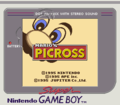 Title screen (Super Game Boy)
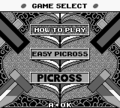 Game select menu
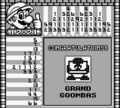 Grand Goombas cameo


Multimedia[edit]
 Title screen Title screen | File info 0:30 |
| Main menu | File info 0:30 |
| Easy Picross puzzle | File info 0:30 |
| Kinoko Course puzzle | File info 0:30 |
| Star Course puzzle | File info 0:30 |
| Puzzle solved - Plays when a puzzle is solved, before it is revealed | File info 0:30 |
| Puzzle fanfare - Plays when the solved puzzle is revealed | File info 0:03 |
References in later games[edit]
- Various tracks in the game's soundtrack re-appear, and are rearranged in this title.
- Mario's outfit for the Mystery Land board resembles the outfit Mario is depicted as wearing in Mario's Picross.
- A costume Mario can wear in the game is nearly identical to the explorer outfit Mario is depicted wearing in Mario's Picross, and later sequels.
Names in other languages[edit]
| Language | Name | Meaning | Note(s) | Ref. |
|---|---|---|---|---|
| Japanese | マリオのピクロス Mario no Pikurosu | Mario's Picross | [17] |
Notes[edit]
- The letters in the solutions of the first eight puzzles in "Easy Picross" spell "LETS WORK".
- Star course 6-G is titled "Mud" in the English localization, despite portraying what appears to be a snail with an elongated shell. In the Japanese version, this puzzle is named タニシ (tanishi), which is a family of freshwater snails called Viviparidae. It is possible that the intended localization was "Mud Snail", as the puzzle does bear a resemblance to the New Zealand mud snail.
References[edit]
- ^ マリオのピクロス. Nintendo Co., Ltd. (Japanese). Retrieved March 3, 2009.
- ^ Sakai, Kazuya, kikai, Rachel Roberts, and Jenny Blenk, editors (2019). The Art of Super Mario Odyssey (First English Edition). Milwaukie: Dark Horse Books. ISBN 978-1-50671-375-5. Page 362.
- ^ Nintendo of America (March 6, 2025). Game Boy – March 2025 – Nintendo Switch Online. YouTube. Retrieved March 7, 2025.
- ^ Nintendo 公式チャンネル (March 7, 2025). ファミリーコンピュータ & スーパーファミコン & ゲームボーイ Nintendo Switch Online 追加タイトル [2025年3月7日]. YouTube. Retrieved March 7, 2025.
- ^ @NintendoEurope (March 7, 2025). "Pixelated puzzles a-plenty or platforming peril? Whatever your style, you can now enjoy the classic #GameBoy games Mario’s Picross and Donkey Kong with #NintendoSwitchOnline!". X. Retrieved March 7, 2025.
- ^ @NintendoAUNZ (March 7, 2025). "Two classic #GameBoy titles are now live for #NintendoSwitchOnline members! ☑️ Mario's Picross ☑️ Donkey Kong". X. Retrieved March 7, 2025.
- ^ 任天堂(香港)有限公司 (March 7, 2025). 【香港資訊】 加入「Nintendo Switch Online」就可遊玩的「Family Computer & Super Famicom & Game Boy Nintendo Switch Online」現已新增2款可遊玩的作品《咚奇剛》和《マリオのピクロス》。 #NintendoSwitchOnline. Facebook. Retrieved March 7, 2025.
- ^ July 1995. Total! issue 43. Future plc (British English). Page 53. (Archived via Wayback Machine.).
- ^ Thomas, Lucas M. (August 5, 2011). Mario's Picross Review. IGN (English). Retrieved July 28, 2026. (Archived February 2, 2018, 02:28:02 UTC via Wayback Machine.)
- ^ van Duyn, Marcel (July 15, 2011). Mario's Picross Review. Nintendo Life (English). Retrieved July 28, 2026. (Archived March 5, 2026, 07:41:04 UTC via Wayback Machine.)
- ^ August 2001. Game Informer Issue 100. GameStop Corp. (American English). Page 24. (Archived via Wayback Machine.)
- ^ December 2009. Game Informer Issue 200. GameStop Corp. (American English). Page 69. (Archived via Wayback Machine.)
- ^ March 2018. Game Informer Issue 300. GameStop Corp. (American English). Page 27. (Archived via Wayback Machine.)
- ^ August 1995. Games World issue 14. Paragon Publishing Ltd (British English). Page 73. (Archived via Wayback Machine.)
- ^ May 1995. Video Game Volume 7, Issue 5. LFP, Inc (American English). Page 84. (Archived via Wayback Machine.)
- ^ June 1995. Electronic Games Volume 3, No. 9. Decker Publications, Inc. (American English). Page 101. (Archived via Wayback Machine.)
- ^ Japanese box art
External links[edit]


- Official website (Japanese)
- Japanese Virtual Console site
- Official American English website
- Official British English web page
- Official Jupiter website (English/Japanese)
| Game Boy games | |
|---|---|
| Super Mario franchise | Alleyway (1989) • Baseball (1989) • Super Mario Land (1989) • Golf (1989) • Dr. Mario (1990) • Super Mario Land 2 - 6 Golden Coins (1992) • Donkey Kong (1994) • Mario's Picross (1995) • Picross 2 (1996) |
| Donkey Kong franchise | Donkey Kong (1994) • Donkey Kong Land (1995) • Donkey Kong Land 2 (1996) • Donkey Kong Land III (1997) |
| Yoshi franchise | Yoshi (1991) • Yoshi's Cookie (1992) • Tetris Attack (1996) |
| Wario franchise | Wario Land: Super Mario Land 3 (1994) • Wario Blast: Featuring Bomberman! (1994) • Wario Land II (1998) |
| Miscellaneous | Tetris (1989) • The Legend of Zelda: Link's Awakening (1993) • Game & Watch Gallery (1997) • Game & Watch Gallery 2 (1997) • Game Boy Camera (1998) |


