Donkey Kong 3
This article needs Donkey Kong improvement. Specifically:
- Identify differences between the Japanese and international arcade versions.

|
It has been suggested that this article be split into Donkey Kong 3, Donkey Kong 3 (Nintendo Entertainment System). (discuss) |
- This article is about the arcade game. For other uses, see Donkey Kong 3 (disambiguation).
- "DK3" redirects here. For the third installment in the Donkey Konga series, see Donkey Konga 3. For the microgame in WarioWare: D.I.Y. Showcase, see DK 3.
| Donkey Kong 3 | |||||||||||||||
|---|---|---|---|---|---|---|---|---|---|---|---|---|---|---|---|
 Art of the arcade cabinet For alternate box art, see the related gallery. | |||||||||||||||
| Developer | Nintendo R&D1 | ||||||||||||||
| Publisher | Nintendo | ||||||||||||||
| Platforms | Arcade, Family Computer, Nintendo Entertainment System, e-Reader, Virtual Console (Wii, Wii U, Nintendo 3DS), Nintendo Switch (Arcade Archives), Nintendo Entertainment System – Nintendo Classics | ||||||||||||||
| Release dates | Arcade: October 21, 1983[1] October 21, 1983[1] November 10, 1983[2] November 10, 1983[2] 1983[?] 1983[?]
Family Computer:
July 4, 1984[3] 1900s[4] 1900s[4]Nintendo Entertainment System: June 1986[5] September 15, 1987[6]e-Reader: April 21, 2003[7]Virtual Console (Wii): July 14, 2008[8] July 23, 2008[8] January 9, 2009[?] January 9, 2009[9] January 9, 2009[?] January 9, 2009[9]Virtual Console (Nintendo 3DS): March 27, 2013[8] December 5, 2013[8] December 12, 2013[?] December 12, 2013[9] July 6, 2016[?] July 6, 2016[?]Virtual Console (Wii U): September 26, 2013[8] October 24, 2013[?] October 24, 2013[9] November 6, 2013[8]Nintendo Switch (Arcade Archives):  April 5, 2019[10] April 5, 2019[11] April 5, 2019[12] April 5, 2019[13] April 6, 2019[14] April 5, 2019[10] April 5, 2019[11] April 5, 2019[12] April 5, 2019[13] April 6, 2019[14]Nintendo Entertainment System - Nintendo Classics: July 17, 2019[15] July 17, 2019[16] July 17, 2019[?] July 17, 2019[17] July 17, 2019[?] July 17, 2019[18] July 17, 2019[?] July 17, 2019[17] July 17, 2019[?] July 17, 2019[18] | ||||||||||||||
| Language | English | ||||||||||||||
| Genres | Fixed shooter, platform | ||||||||||||||
| Ratings |
| ||||||||||||||
| Mode | Up to two players (alternating turns) | ||||||||||||||
| Format |
 Cartridge CartridgeNES:
 Game Pak Game PakWii:  Digital download Digital download Digital download Digital download Digital download Digital download e-Reader card Digital download e-Reader card Digital download | ||||||||||||||
| Cabinet | Upright and cocktail | ||||||||||||||
| Monitor | Raster, standard resolution | ||||||||||||||
| Input | Joystick
NES:
Wii:  Wii Remote (horizontal) Wii Remote (horizontal) Wii Remote (horizontal) Wii Remote (horizontal) Joy-Con (horizontal) Joy-Con (horizontal) | ||||||||||||||
| Serial codes | Famicom: HVC-DT HVC-DT NES: NES-DT-US | ||||||||||||||
 - Everyone
 - All ages
 - Three years and older
 - Six years and older
 - General audience
 - All ages
 - General







Donkey Kong 3 is a fixed shooter and platformer game, released in 1983 as the third installment in the Donkey Kong arcade series. Unlike the prior entries, Donkey Kong and Donkey Kong Jr., it does not feature Mario and instead stars Stanley, having been designed with the Game & Watch game Green House in mind.[21] Functionally an expansion on Green House, the game's approach is closer to a shoot 'em up rather than a platformer, further distinguishing it from the previous Donkey Kong games.
Hudson Soft developed a semi-sequel, titled Donkey Kong 3: Dai Gyakushū, featuring new levels and gameplay. Donkey Kong 3 was ported to the Family Computer along with the Nintendo Entertainment System under the Arcade Classics Series of games, came out for the e-Reader as part of Series Three, along with seeing a Virtual Console release for the Wii, Nintendo 3DS, and Wii U. The Japanese and international arcade versions were released under HAMSTER Corporation's Arcade Archives brand on the Nintendo Switch's eShop on April 5, 2019.[22] In addition, an emulation of the Famicom and NES port exists as an obtainable item in Animal Crossing.
Story[edit]
Donkey Kong breaks into Stanley's greenhouse and goes to hang in the rafters where he stirs up nests of bugs, which will destroy Stanley's flowers in revenge. Armed with a Sprayer, Stanley must destroy the bees and chase Donkey Kong away before he eats all five of his flowers.
Gameplay[edit]
The game is very simplistic, requiring the player to gather points as the objective rather than have any specific long-term goal in mind. There are three screens per level, and once the player completes all three, they return to the first. Throughout the screens are scattered various enemies: Buzzbees, Creepies, Super Bees, Vine Eaters, Beespies which shatter into stingers when destroyed, Attackers, Kabutomushi, and Butterflies. Buzzbees and Butterflies attempt to steal Stanley's flowers, and should be destroyed before they bring them back to Donkey Kong to obtain bonus points.
Donkey Kong himself hangs from two vines at the top of the screen. Destroying all the flying insects (except in the yellow greenhouse) or spraying him to drive him upwards and eventually off the screen are the two methods to win. However, if Donkey Kong stays on the bottom of the vines for too long, he will drop on the ground and instantly defeat Stanley, resulting in a loss of a life. This can also happen if the Vine Eaters cuts off the vines Donkey Kong is holding onto in the arcade version, or if the player runs out of time in the Family Computer and Nintendo Entertainment System version.
In the arcade version, defeating him in the yellow greenhouse causes his head to be pushed into a beehive. Stanley automatically moves out of his way as Donkey Kong falls, where the beehive splits in half. He becomes stunned, and Stanley does a victory dance.[23] In the Family Computer and Nintendo Entertainment System version, the beehive falls on his head, but the rest of the cutscene is absent.[24] If Stanley is defeated, the insects immediately eat him, though this is removed in the home console port.
The gray greenhouse never appears in the first round. The yellow greenhouse directly follows the blue greenhouse, but the gray greenhouse is included in all rounds following the first. The blue greenhouse is repeated from the 159th screen to the 255th screen. The game then loops back to the first round, which skips the gray greenhouse.
A Super Sprayer is available once per life, attached to the vines Donkey Kong hangs by. When it is pushed to its maximum level, it falls, allowing Stanley to equip it for a limited time. It turns his insecticide yellow, and it becomes more powerful, even being able to defeat Creepies.
Greenhouses[edit]
| # | Greenhouse | Levels | Hazards | |||||
|---|---|---|---|---|---|---|---|---|
| Beehive | Coconut | |||||||
| 1 |  Blue |
3 | 2 | 0 | ||||
| 2 |  Gray |
3 | 2 | 0 | ||||
| 3 |  Yellow |
2 | 3 | 2 | ||||
Glitch on level 160[edit]
Unlike its predecessors, Donkey Kong 3 does not feature a traditional kill screen; however, a glitch occurs on level 160. The blue greenhouse will repeat 97 times before switching to gray, as intended. Otherwise, the game is endless, as is the NES version, which does not have this issue.[25][better source needed]
Characters[edit]
| Character | Name | Information |
|---|---|---|
 
|
Stanley | The player character, who must use his spray to get rid of Donkey Kong and the insect pests. With the Super Sprayer, he gets more power. |

|
Donkey Kong | The troublesome ape. Defeating him is the main objective. |
Enemies and obstacles[edit]
| Enemy/obstacle | Name | Debut | Information | Points |
|---|---|---|---|---|

|
Beehive | Round 1 | The source of all the troublesome insects, Donkey Kong's head must be knocked inside one to stop them. | N/A |

|
Coconut | Round 1 | Hard fruit thrown by Donkey Kong. | N/A |
 
|
Buzzbee | Round 1 | The most basic insect enemies, which toss spears and try to steal the flowers. From round 12 (9 on NES), they are replaced by a newer, more aggressive type. | 100 (default) 400 (with a flower) |

|
Super Bee | Round 1 | Speedy, aggressive bees that are the result of a Buzzbee or Butterfly feeding a flower to Donkey Kong. They are absent in the NES version. | 700 |
 
|
Beespy | Round 3 | Buzzbee queens that take two hits to defeat and are sometimes escorted by the original Buzzbees. Upon defeat, four spears rain forth. | 400 (standalone) 700 (alongside one Buzzbee) 1000 (alongside two Buzzbees) |
 
|
Creepy | Round 1 | Inchworms that crawl along vines. They can be stunned by the Sprayer but only the Super Sprayer can defeat them. | 0 (when stunned) 300 (when defeated) |

|
Vine Eater | Round 1 | Creatures that bite through Donkey Kong's vines if Stanley takes too long, similar to Snapjaws from Donkey Kong Jr. They are absent in the NES version. | N/A |

|
Attacker | Round 6 | Thin blue mosquitos that charge at Stanley horizontally. | 200 |

|
Kabutomushi | Round 18 Round 12 (NES) |
Rhinoceros beetles that act as quicker Attackers. | 700 |

|
Butterfly | Round 24 Round 15 (NES) |
Function similarly to the Buzzbees, throwing spears like them, but are even more aggressive. | 700 |
Re-releases[edit]
On April 5, 2019, both the Japanese and international arcade versions were re-released for the first time on a home console as part of HAMSTER Corporation's Arcade Archives brand on the Nintendo Switch's eShop.[26] As with other Arcade Archives games, it adds a menu screen and two new modes: Hi Score Mode, where the player competes for the highest score on an online leaderboard with only one credit and no saves or pauses, and Caravan Mode, where the player competes for the highest score but in a five minute timeframe.
Ports[edit]
Unlike its predecessors, Donkey Kong 3 did not receive any ports to non-Nintendo systems. However, it was still released on the Family Computer and Nintendo Entertainment System as part of the Arcade Classics Series. Most subsequent ports are based on this version.
Family Computer / Nintendo Entertainment System[edit]

The following changes were made to the Famicom/NES port:
- A title screen, with the same music that plays when Donkey Kong hits the Beehives, was added.
- A two-player mode was added, where players take turns controlling Stanley.
- A harder B Mode was also added, including a two-player variant.
- Stanley now wears white and has blue hair, regardless of whether the Super Sprayer is equipped.
- The backgrounds are entirely black, with no outline of the greenhouse.
- There are three leaves overhanging each side of the blue and gray greenhouses instead of two.
- There are fewer enemies on screen due to the Famicom and NES's slower CPU, and to prevent sprite flicker.
- Donkey Kong does not fall when getting his head stuck in the Beehive, nor does Stanley dance.
e-Reader[edit]
Referred to as Donkey Kong 3-e on the game's packaging, this version is mostly an emulation of the NES version, but with minor changes to better suit the Game Boy Advance:
- The aspect ratio is now 3:2 instead of 4:3. As such, the graphics have more width but less height.
- The audio is slightly more compressed.
- There are no 2-player modes.
Emulated versions[edit]
- Virtual Console (Wii, Nintendo 3DS, Wii U)
- The Virtual Console versions were direct ports of the Famicom and NES versions, with support for save states on the 3DS and Wii U.
- The colors are darker on the Wii U, like all Famicom and NES games on its Virtual Console.
- NES Classic Edition / Nintendo Classic Mini: Family Computer
- Both versions can be played in three filters: CRT Filter (adds scanlines and slight blur), 4:3 (original aspect ratio with slight stretch), and Pixel Perfect (sharp, square pixels).
- Nintendo Entertainment System – Nintendo Classics
- The same filters as the NES Classic Edition version can be applied.
- Online multiplayer was added.
Donkey Kong 3: Dai Gyakushū[edit]
- Main article: Donkey Kong 3: Dai Gyakushū
In 1984, Hudson Soft developed and published a semi-sequel known as Donkey Kong 3: Dai Gyakushū. Released on the PC-6001mkII/PC-6601, PC-8801, X1, and IBM JX, it shares the core gameplay of Donkey Kong 3, but is simpler, with no platforms and fewer enemies on-screen. There are, however, 20 unique stages with more realistic backgrounds than those of the original as well as bonus stages. There are no vines, so Donkey Kong now uses parachutes, while Creepy has a jetpack.
Staff[edit]
- Main article: List of Donkey Kong 3 staff
Like its predecessors, Donkey Kong 3 was developed by Nintendo Research & Development 1 with Shigeru Miyamoto as the game designer and director. It is the last Donkey Kong game in which he served these roles, shifting focus to the Super Mario series soon after. Hirokazu Tanaka replaced Yukio Kaneoka as the composer, and Jerry Momoda acted as a market research analyst. The Famicom and NES versions have mostly the same development team, but with Hiroshi Yamauchi as executive producer, while HAMSTER Corporation both ported and published the Arcade Archives release.
Reception[edit]
Critical reception to Donkey Kong 3 was relatively positive on release. Computer and Video Games praised the character designs, with Stanley being a "likeable" replacement for Mario and each pest having a "personality of its own". They concluded the game's "fast action and superior sound effects" made it a "sure hit" in arcades.[27] Computer Entertainer found the NES port had "graphic detail is up to Nintendo's usual high standards, with especially amusing facial expressions on the beleaguered ape". They concluded that, while different from previous Donkey Kong games, it's "delightfully silly" with "simple and straightforward" yet addictive gameplay.[28]
Retrospective reviews have been more mixed, with criticism aimed at the stylistic departure from its predecessors and the absence of Mario. Vintage Arcade Gal called it a "disaster", stating they did not believe many players thought it was a good enough game to make up for abandoning the "run and jump platforming" of Donkey Kong and Donkey Kong Jr.[29] Indie Game Chick believed the game was an attempt to "cash-in on the Space Invaders craze", adding that HAMSTER Corporation did a good job on the Arcade Archives release, if not for the $7.99 price.[30] Nathan Birch of Uproxx ranked Donkey Kong 3 twentieth on a list of the thirty Nintendo Entertainment System black box titles, stating its "fun enough" but criticizing the gameplay as "simple, not-terribly-challenging arcade action", claiming change in genre "almost killed" the series until Donkey Kong Country.[31] Christopher Cruz of Rolling Stone was more positive, ranking it eighth on a list of every Donkey Kong game, above the original and just below Donkey Kong Jr. While acknowledging the shift in gameplay, Cruz still felt the game was an "exceptionally well-designed arcade experience that’s snappy to play and instantly captivating".[32]
| Reviews | |||
|---|---|---|---|
| Release | Reviewer, Publication | Score | Comment |
| Arcade | Brett Alan Weiss, AllGame | 7/10 | "What makes this shooter unique, other than its absurd premise, are the platforms near the bottom of the screen that Stanley can run and jump on. A highly underrated game, Donkey Kong 3 spawned a very nice NES port, but it remains an obscure relative to other games in the series." |
| Arcade | Gene Lewin, Play Meter | 8/10 | "It seems Nintendo is offering another professional looking conversion for Donkey Kong. When converted, Donkey Kong 3 looks just like a brand new game. So much for the idea that conversions mean inferior games." |
| Nintendo Entertainment System | Joe Santulli, Digital Press | 7/10 | "I'm usually a big fan of games that were flops in the arcade and perfect translations for home consoles (see my many ColecoVision reviews of the past), but I can't get into DK3. Apparently I'm not alone, and even Nintendo knows that. Stanley, the bees, and the snake that could be a worm but is probably a squirrel haven't been seen since (I'm not counting DK Country where every possible creature in the jungle community is represented). Rest in peace, Stanley. Rest in peace." |
| e-Reader | Craig Harris, IGN | 7/10 | "The game is more of a shooter like Galaga than it is a platformer like Donkey Kong or Donkey Kong Jr., and it's probably this drastic change in gameplay (as well as a distinct lack of variety in the levels) that made this sequel a bit on the forgettable side. But it's a very challenging and fast-paced game design that becomes viciously difficult higher in the levels. It's a fun, original game, but a strange direction for a sequel." |
| Wii | Lucas M. Thomas, IGN | 6/10 | "Fans of arcade shooters like Galaga should be the first to consider the 500 Wii Point investment that it would take to download Donkey Kong 3, as, though it's part of the original DK series, it plays more similarly to the alien-invading blaster designs of the early '80s. This VC download is also a more compelling digital purchase than the Virtual Console versions of the first Donkey Kong and Donkey Kong Jr., as well, because it's a more replayable design and didn't lose any content in its transition from the arcade to the NES." |
| Wii | Pedro Hernandez, Nintendo World Report | N/A | "If you are able to look past the different style of gameplay and strip yourself of the notion that you are playing a "Donkey Kong" game, Donkey Kong 3 is a really fun fast-paced game that provides a nice breath of fresh air when it comes to classic gaming. But those who have been raised on the idea that Donkey Kong doesn't deviate from its first iconic arcade release will see this as being a fun but brief diversion. That's why this is a release best recommended for fans that enjoyed the game during its initial release on the arcade and NES and who are able to enjoy it without letting the different game style be a bother." |
| Nintendo 3DS | Morgan Sleeper, Nintendo Life | 6/10 | "It's not a timeless classic like the original Donkey Kong, but the great ape's third outing still has plenty to recommend for retro fans. It's very simple fun, with a unique shooter/platformer gameplay mix that feels different from any other DK to date, and quick play sessions that encourage high-score chasing and honing your skills. It's dated and silly short by modern standards, but for old-school arcade fans not bugged by a challenge - and anyone looking to get in on the ground floor with a forgotten Nintendo character before the inevitable Year of Stanley - Donkey Kong 3 is worth a shake." |
| Wii U | Marcel van Duyn, Nintendo Life | 4/10 | "Donkey Kong 3 is a strange departure from the gameplay of its predecessors, but unfortunately it just didn't turn out very well; Stanley's insect spraying never quite gets as entertaining as Mario's barrel jumping and DK Jr.'s vine climbing. Perhaps it's not that many people don't know the game, but rather that they choose to forget it ever happened?" |
Sales[edit]
Donkey Kong 3 was moderately successful in Japan. It was listed by Game Machine as the fourth most successful table arcade unit of November 1983.[33] However, it was a commercial failure in North America, partially due to the video game crash of 1983.[34] According to The Ultimate History of Video Games, it moved 5,000 units in the continent, a steep decline from the previous installments (which sold 60,000 and 30,000 units respectively).[35] Unlike earlier titles, Donkey Kong 3 never had dedicated cabinets, and was only sold as Nintendo-Pak conversion kits for Donkey Kong, Donkey Kong Jr., and Popeye cabinets. This foreshadowed the VS. System, the Nintendo PlayChoice-10, and the Nintendo Super System.
Profiles[edit]
e-Reader:
Some of the world's greatest classic video games are making a triumphant return! Now, with e-Reader technology, the code for an entire game can be stored on a stack of just five cards! Just slide the e-Reader cards through an e-Reader attached to a Game Boy Advance and you're ready to play.
Donkey Kong is back in the role of villain once again. This time he's out to get your plants -- and you! You are Stanley the greenhouse man, armed only with a spray can and deadly accuracy. Fight off all of the baddies that get too close, and don't go easy on the ape -- he won't go easy on you.
Nintendo UK:
Unique to the classic series, Donkey Kong 3 is a frantic action game starring newcomer Stanley, whose greenhouse has been invaded by the troublesome ape and swarms of angry insects.
Armed with a spray can, you must push Donkey Kong up the screen while fending off the swarms of bugs intent on stealing Stanley's precious flowers.
Avoid the coconuts that DK throws at you, and try to grab the power spray can for a few seconds of super-charged spraying as you aim for a high score!
Based on the third game in the enormously popular arcade series, Donkey Kong 3 introduces an exterminator named Stanley as he desperately tries to protect the flowers in his greenhouse from Donkey Kong.
Armed only with a can of bug spray, Stanley must force Donkey Kong higher and higher into the greenhouse rafters until Donkey Kong is off the screen and the next stage is reached. But not surprisingly, Donkey Kong isn’t going to move without a fight, so he sends wave after wave of bugs, bees, and other creatures toward Stanley.
Not only must Stanley repel the insects in order to save the flowers, but he’ll have to keep an eye out for projectiles thrown by Donkey Kong himself. If Stanley is good enough, he’ll be able to grab a can of more powerful bug spray and really get Donkey Kong moving.
It all adds up to frantic fun that anyone can enjoy!
Donkey Kong has lodged in a greenhouse and it's bugging the bees out of Stanley!
Based on the third game in the enormously popular arcade series, Donkey Kong 3 introduces an exterminator named Stanley as he desperately tries to protect the flowers in his greenhouse from Donkey Kong.
Armed only with a can of bug spray, Stanley must force Donkey Kong higher and higher into the greenhouse rafters until Donkey Kong is off the screen and the next stage is reached. But not surprisingly, Donkey Kong isn't going to move without a fight, so he sends wave after wave of bugs, bees, and other creatures toward Stanley. Not only must Stanley repel the insects in order to save the flowers, but he'll have to keep an eye out for projectiles thrown by Donkey Kong himself. If Stanley is good enough, he'll be able to grab a can of more powerful bug spray and really get Donkey Kong moving. It all adds up to frantic fun that anyone can enjoy!
DONKEY KONG 3 is a shooting game released by Nintendo in 1983.
Take on the role of the hero STANLEY, and use your Sprayer to drive away DONKEY KONG and exterminate the various flower-stealing bugs that appear in the botanical garden.
Get high scores with a perfect bonus by chasing off DONKEY KONG and having no flowers stolen!
Gallery[edit]
- For this subject's image gallery, see Gallery:Donkey Kong 3.
 Group art


Multimedia[edit]
- For the complete list of media files for this subject, see Multimedia:Donkey Kong 3.
 Game Start Theme Game Start Theme | File info 0:04 |
| Blue and Gray Greenhouse Theme | File info 0:26 |
| Blue and Gray Greenhouse Clear Theme | File info 0:04 |
| Yellow Greenhouse Theme | File info 0:12 |
References in later games[edit]

- The microgame Donkey Kong 3 is based on the Famicom/NES ports of the game. It cycles between the three greenhouses with the same goal of spraying Donkey Kong up the vines. However, they now swing.
- The microgame Donkey Kong 3 is also based on the Famicom/NES version. While similar in presentation and gameplay, Stanley can no longer move, and his sprayer is controlled by blowing into the Nintendo DS's microphone.
- The microgame DK 3 is also based on the Famicom/NES port. Exclusively set in the yellow greenhouse, the player must spray Donkey Kong up vines into a beehive, while avoiding Creepies.
- Four challenges are based on the game, but only appear in Bonus. These include obtaining 500 points, spraying Donkey Kong until he leaves the screen, forcing Donkey Kong into the beehive, and defeating all the insects.
- A recreation of the blue greenhouse appears in the background of Fruity Factory's second checkpoint.
Names in other languages[edit]
| Language | Name | Meaning | Note(s) | Ref. |
|---|---|---|---|---|
| Japanese | ドンキーコング3 Donkī Kongu Surī | Donkey Kong 3 | [36] | |
| Chinese (Simplified) | 咚奇刚3 Dōngqí Gāng 3 (Mandarin) Dūngkèih Gōng 3 (Cantonese) | Donkey Kong 3 | [37] | |
| Chinese (Traditional) | 咚奇剛3 Dōngqí Gāng 3 (Mandarin) Dūngkèih Gōng 3 (Cantonese) | [37] |
Notes[edit]
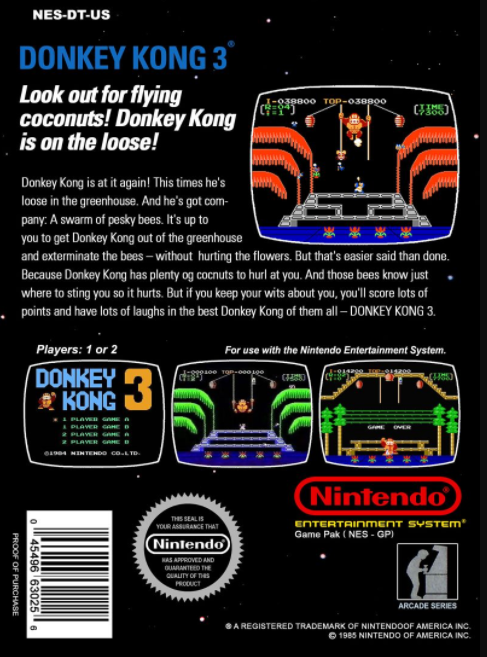
- The back of the United States NES boxart for the game has three typos. Two of them are back-to-back misspellings reading, "Donkey Kong has plenty og cocnuts to hurl at you", and the last one is "Nintendoof America" with a missing space.
- The background music for the blue and gray greenhouses comes from "Flight of the Bumblebee".

References[edit]
- ^ November 15, 1983. Game Machine. Page 22.
- ^ 1984. Official Gazette of the United States Patent and Trademark Office. U.S. Department of Commerce, Patent and Trademark Office. Page 437. Retrieved December 16, 2025.
- ^ ドンキーコング3. Nintendo of Japan (Japanese).
- ^ Hu Xiangtai. TAIWAN SAMPO C1 TV Cassette. Football Technologies Inc.. Retrieved January 4, 2026 from Museo. (Archived Oc