Donkey Kong Jr. (New Wide Screen)
- This article is about the New Wide Screen version. For Table Top version, see Donkey Kong Jr. (Table Top). For the DSiWare port, see Game & Watch: Donkey Kong Jr.
| Donkey Kong Jr. | |
|---|---|

| |
| Developer | Nintendo Research & Development 1 |
| Publisher | Nintendo |
| Platforms | Game & Watch, Mini Classics |
| Release dates | Game & Watch: October 26, 1982[1] October 26, 1982[1] October 26, 1982[?] October 26, 1982[?]Mini Classics:  August 6, 1998[?] 1998[?] August 6, 1998[?] 1998[?] |
| Genre | Puzzle |
| Mode | Single player |
| Format |
Built-in
|
| Input | |
| Serial code | DJ-101 |

Donkey Kong Jr. is a 1982 Game & Watch adaptation of the arcade game of the same name. As in the arcade game, Donkey Kong is captured by Mario, and Donkey Kong Jr. must save him. There is an identically named 1983 Table Top version, but it has an entirely different level and obstacle layout. Donkey Kong Jr. was the first game in the New Wide Screen series. This game was ported to the Mini Classics, Game & Watch Gallery 3, and Game & Watch Gallery 4. It is also mentioned in the Museum in Game & Watch Gallery 2. The game was digitally recreated for the DSiWare as Game & Watch: Donkey Kong Jr. The game also has an indirect sequel in the form of Donkey Kong II.
Gameplay[edit]
New Wide Screen / Classic version[edit]


Donkey Kong Jr. starts at the bottom of the screen, where he is immediately bombarded by birds and Snapjaws. After Donkey Kong Jr. climbs a pair of vines to the second floor, he can find a piece of fruit, which can be dropped on enemies below for bonus points: three for a Snapjaw on the second floor, six for a bird, and nine for a Snapjaw on the first floor. After avoiding more Snapjaws, Donkey Kong Jr. must jump to the swinging key above, which he can use to unlock part of Donkey Kong's cage. The faster Donkey Kong Jr. does this, the more points he earns (from 5 to 20). He then drops down, repeating the process. Once four keys are delivered, Donkey Kong is free, awarding 20 points to the player. Along the way, Donkey Kong Jr. can also grab hold of vines above, which help in avoiding the ground-bound Snapjaws. Every time Donkey Kong Jr. jumps over a Snapjaw without holding on to a vine or jumps down from a vine right after a Snapjaw passes, he receives a point. As the player progresses in the game, more enemies appear, and they eventually move faster. If an enemy hits Donkey Kong Jr., if he jumps and misses the key, or if he falls off the left side on the second floor, he loses a life. If Donkey Kong Jr. reaches 300 points without any misses, the points are worth double until he does get a miss. If he has any misses at said score, every miss is cleared instead. When he loses three lives, the game is over.
Modern version[edit]


The version in the Game & Watch Gallery series has similar controls, although the enemies are different, including Goombas, Nipper Plants, Bullet Bills, and Spinies. Unlike in the Classic version, Mario throws the key at the beginning of each stage. Also, if Donkey Kong Jr. takes too long to free Donkey Kong after getting the last key, Donkey Kong Jr. receives fewer than 20 points. Donkey Kong Jr. can stomp Goombas and Bullet Bills to destroy them, earning a point for each defeat in the process. In this version, Donkey Kong Jr. earns five points for dropping a fruit on an enemy. The stage also alters its appearance each time the player successfully releases Donkey Kong. The game starts with a jungle ground-level setting. When Donkey Kong Jr. gets the key here, a Rotary Lift appears to the left of the cage. The next stage features the treetops during sunset. An albatross appears to the right of the cage when Donkey Kong Jr. gets the key here. The final stage is a clouded area at night. Here, two Cloud Blocks appear to the left of the cage when Donkey Kong Jr. gets the key. If he jumps onto a spinning Rotary Lift, a disappearing albatross, or fluffing Cloud Blocks, he falls to the second floor (or a small safety platform on the second stage). This version also has bottomless pits on the second and third stages, and if Donkey Kong Jr. falls into one, he loses a life. When Donkey Kong Jr. amasses 200, 500, and 700 points, a heart appears for him to remove a miss. Music is also featured in this version, with the tempo changing depending on the speed of the game. When the player goes to a different stage, the music changes.
In Game & Watch Gallery 4, selecting the game yet waiting to actually start it results in a humorous sequence being played. In particular, Donkey Kong Jr., while strolling, notices a fruit in a tree and attempts to jump up to grab it, but to no avail. Mario then arrives and grabs the fruit. Just at that moment, however, Donkey Kong arrives, causing Mario to flee, only to presumably crash into something. Donkey Kong then leaves offscreen, only to come back and reveal that he somehow got Mario locked in a cage, which Donkey Kong drags with him before posing.
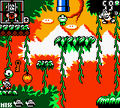 The second stage of the Modern version of Donkey Kong Jr. from Game & Watch Gallery 3
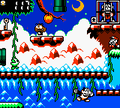 The third stage of the Modern version of Donkey Kong Jr. from Game & Watch Gallery 3
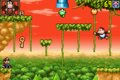 The second stage of the Modern version of Donkey Kong Jr. from Game & Watch Gallery 4
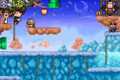 The third stage of the Modern version of Donkey Kong Jr. from Game & Watch Gallery 4


Controls[edit]
Game & Watch Gallery 3[edit]
 : Move
 and
and  : Jump
Game & Watch Gallery 4[edit]
 : Move
 and
and  : Jump
Gallery[edit]
New Wide Screen[edit]
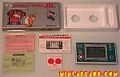 The complete kit
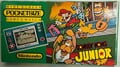 Alternate box art
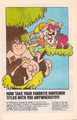 Promo
Promo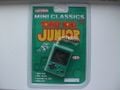 Mini Classics cover art
 Mario striking the bell
 Alarm Bell


Modern version[edit]
Game & Watch Gallery 3[edit]
 Warp Pipe (green and vertical)
 Warp Pipe (blue and vertical)
 Warp Pipe (green and horizontal)


Game & Watch Gallery 4[edit]
 Bullet Bill
 Donkey Kong Jr.
 Donkey Kong
 Mario
Mario Albatross
 Cloud Block
 Fruit
Fruit Goomba
 Key
Key Nipper Plant
 Rotary Lift
 Spiny
Spiny Warp Pipe (green and vertical)
 Warp Pipe (blue and vertical)
 Warp Pipe (green and horizontal)
 1 UP Heart


References in later games[edit]
- Super Smash Bros. series
- Mr. Game & Watch has a downward aerial where he swings a key in a near-identical fashion to Donkey Kong Jr.
Notes[edit]
- When the player plays the Modern version of Donkey Kong Jr. in Star Mode, all Goombas are replaced with Spinies, regardless of the score. This is similar to how the new quest mode of Super Mario Bros. replaced Goombas with Buzzy Beetles.
Names in other languages[edit]
| Language | Name | Meaning | Note(s) | Ref. |
|---|---|---|---|---|
| German | Donkey-Kong Junior | - | [2] | |
| Italian | Donkey Kong Junior | - | [3] |
References[edit]
External links[edit]


- Nintendo UK site
- Donkey Kong Jr. info page on In the Attic, a website dedicated to classic videogames (Internet Archive: Wayback Machine)
| Donkey Kong Jr. | ||
|---|---|---|
| Characters | Donkey Kong Jr. • Donkey Kong • Mario | |
| Enemies | Bird • Drop* • Egg • Nitpicker • Snapjaw • Spark | |
| Items | Fruit • Key | |
| Objects | Chain • Jump Board • Pole • Vine | |
| Rounds | Vine Scene • Jump Board Scene • Mario's Hideout • Chain Scene | |
| Music | "Title BGM" | |
| Other | Donkey Kong Classics • Donkey Kong, Donkey Kong Junior, Mario Bros. • Donkey Kong II • Donkey Kong Jr. (board game) • Donkey Kong Jr. (New Wide Screen) • Donkey Kong Jr. (Table Top) • Donkey Kong Jr. + Jr. Sansū Lesson • Donkey Kong Junior (cereal) • Donkey Kong Junior (playing cards) • Gallery • Game & Watch: Donkey Kong Jr. • Game Sound Museum: Donkey Kong Jr. • Multimedia • Nintendo Music (soundtrack) • Pre-release and unused content • Staff | |
| Adaptations | Donkey Kong Junior (coloring/activity books) • Saturday Supercade | |
| Game & Watch games | ||
|---|---|---|
| Super Mario franchise | Donkey Kong (1982, MS) • Mario Bros. (1983, MS) • Mario's Cement Factory (1983, TT/NWS) • Mario's Bombs Away (1983, PS) • Donkey Kong Hockey (1984, MVS) • Super Mario Bros. (1986, CrS | 1987, Sp | 1988, NWS) • Mario the Juggler (1991, NWS) • Game & Watch: Super Mario Bros. (2020, CoS) | |
| Donkey Kong franchise | Donkey Kong (1982, MS) • Donkey Kong Jr. (1982, NWS) • Donkey Kong II (1983, MS) • Donkey Kong Jr. (1983, TT/PS) • Donkey Kong 3 (1984, MVS) • Donkey Kong Circus (1984, PS) • Donkey Kong Hockey (1984, MVS) | |
| Miscellaneous | Green House (1982, MS) | |
| Game & Watch Gallery series | ||
|---|---|---|
| Games | Game & Watch Gallery (1997, GB) • Game & Watch Gallery 2 (1997, GB | 1998, GBC) • Game & Watch Gallery 3 (1999, GBC) • Game & Watch Gallery 4 (2002, GBA) | |
| Super Mario minigames | Donkey Kong2,4 • Donkey Kong Jr.3,4 • Donkey Kong II3 • Donkey Kong 34 • Mario Bros.3,4 • Mario's Bombs Away4 • Mario's Cement Factory4 | |
| Minigames remade with Super Mario content |
Ball2 • Boxing4 • Chef2,4 • Egg3 • Fire1,4 • Fire Attack4 • Greenhouse3 • Helmet2 • Manhole1 • Octopus1,4 • Oil Panic1 • Parachute2 • Rain Shower4 • Turtle Bridge3 • Vermin2 | |
| Gallery Corner | Message Board • Museum • Music Room | |
| Further info | Gallery (2 · 3 · 4) • Game Boy Gallery Musics • Pre-release and unused content (4) • Staff (2 · 3 · 4) | |
| Related games | Action Yoshi-2 • Game & Watch Collection • Game Boy Gallery 3 Rinse-in Shampoo | |

