Eerie
| Eerie | |||
|---|---|---|---|
 Artwork from Super Mario World | |||
| First appearance | Super Mario World (1990) | ||
| Latest appearance | Nintendo Puzzle Collection (2003) | ||
| Variant of | Boo | ||
| |||
Eeries are ghostly dinosaur enemies introduced in Super Mario World.
History[edit]
Super Mario World[edit]
Eeries debut in Super Mario World, appearing in all Ghost Houses, including the Sunken Ghost Ship, but with the exception of the Donut Ghost House. They can fly in either straight or wobbly lines and usually appear in packs, damaging Mario or Luigi on contact. Like Boos, Eeries can be defeated only with a Super Star and can be hopped on with a Spin Jump.
Super Mario Kodansha manga[edit]
In the Super Mario Kodansha manga, Eerie makes some small cameos in the Super Mario World ghost houses.
The only relevant role they have is in a skit in the second chapter of Super Mario Bros. 4: Super Mario World 2: before entering Valley Ghost House, Mario and his friends starts to think that Yoshi does not want to enter the Ghost Houses so he can spy on them disguised as a Eerie, so they beat him up for it.
Super Mario-kun[edit]

Eeries appear in the Super Mario-kun, with the roles of undertakers or, more correctly, of psychopomps, the mythological figures that accompany deceased souls to the underworld.
In chapter 4 of volume 8, Larry manages to kill off Mario, so his spirit is carried by some Eeries to Hell.
In chapter 11 of volume 5, Eeries set a coffin to resemble a group of beds. After Mario and his friends lie on them, the Eeries carry them to the cemetery, where the Fishin' Boo gravekeeper attacks them.
Nintendo Puzzle Collection[edit]
Eeries make another appearance in the Nintendo GameCube version of Yoshi's Cookie included in the Nintendo Puzzle Collection, where they appear as the fourth opponent in the game's VS. Mode if the player plays on medium difficulty.
Unused appearance[edit]
Although Eeries are absent in Super Mario Advance 4: Super Mario Bros. 3, their graphics are present in the game's code, possibly intended for a level in World-e.
Profiles[edit]
Super Mario series[edit]
Super Mario World[edit]
- Instruction booklet description:
- English:
'This is a dinosaur spook that roams the haunted house. It comes after you with its pale face and ohhhh, what a ghastly spook it is![1] - Other languages:
- Japanese:
お化け屋敷に出てくる恐竜の幽霊。青白い顔をして向かってくるんだ。こわいなあ。[2]
(Translation: A dinosaur ghost in a haunted house. They come at you with a pale face. It's scary.)
- Japanese:
- English:
- Mario Mania: As they sweep through Ghost Houses, Eeries can catch Mario off guard. He can't beat them but he can jump them or stop them with a Spin Jump.[3]
- Nintendo Power Issue #28: Eeries: These zombie-like Eeries fly in their sleep.[4]
Super Mario World: Super Mario Advance 2[edit]
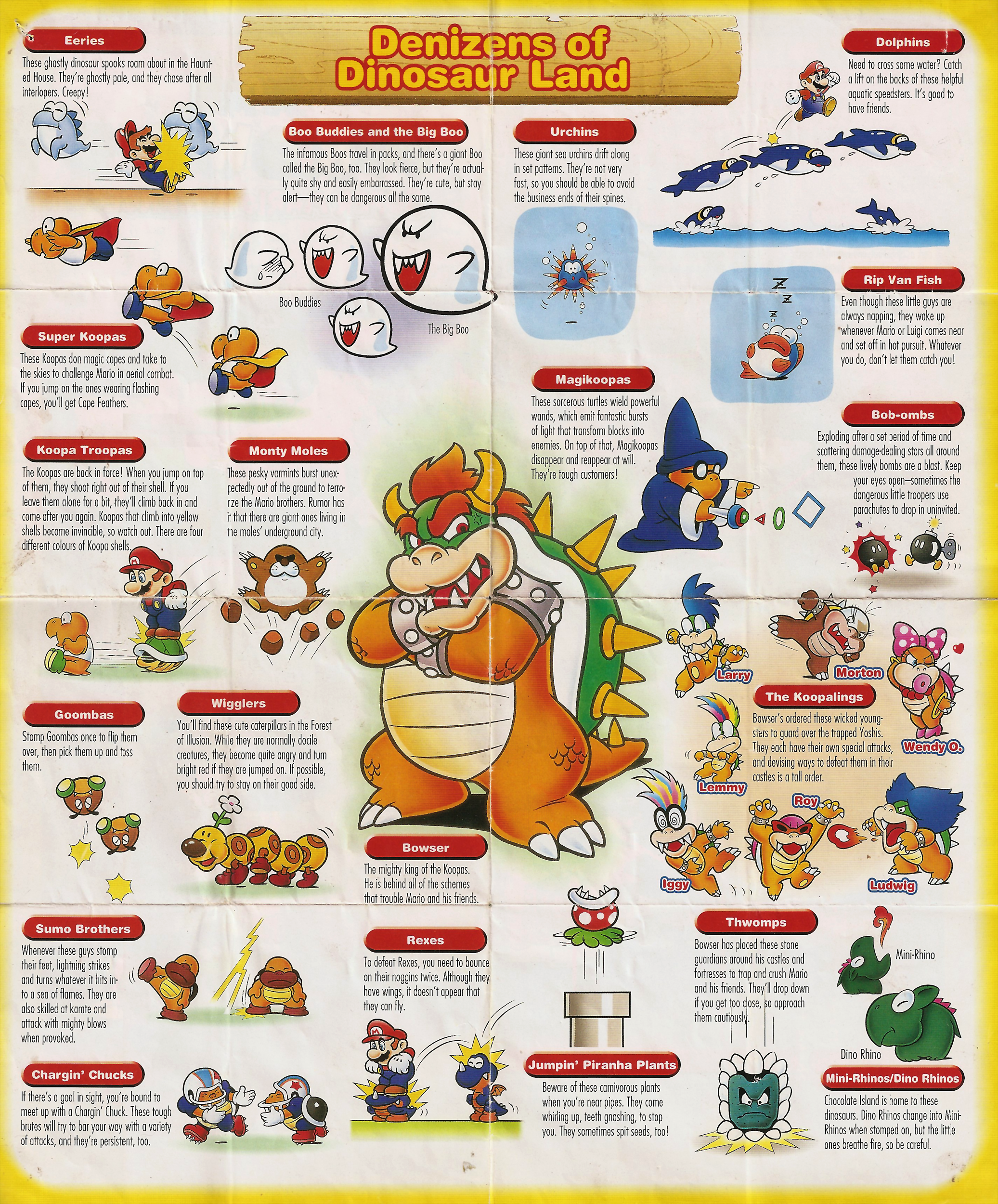
- Denizens of Dinosaur Land poster: These ghastly spooks roam about the Haunted House. They're ghostly pale, and they chase after all interlopers. Creepy![5]
- Nintendo La Rivista Ufficiale:
- Italian:
Non può essere distrutto. Accucciatevi o saltatelo.[6]
(Translation: It can't be defeated. Crouch or jump over it.)
- Italian:
Nintendo Kōshiki Guidebook – Yoshi's Egg[edit]
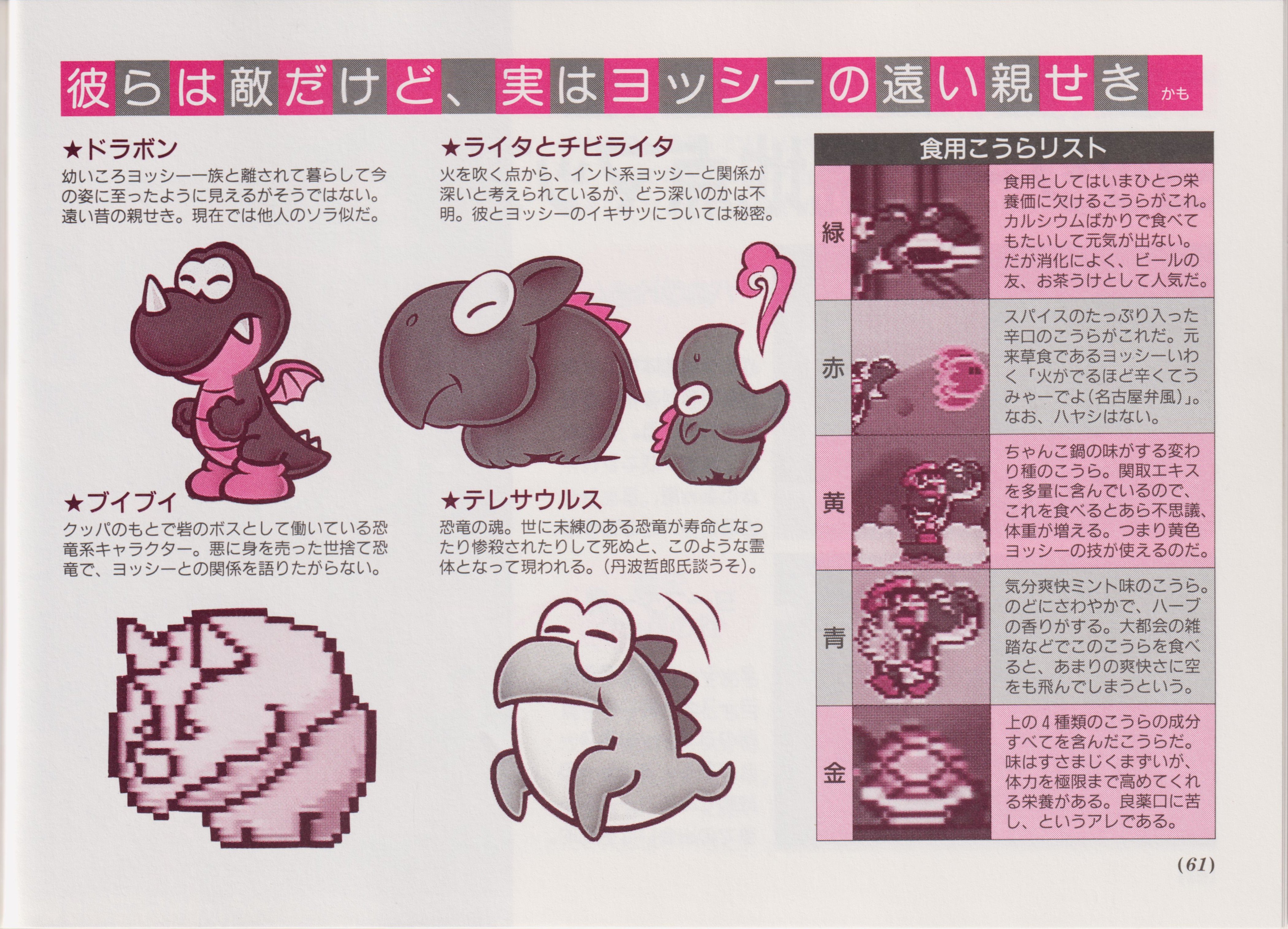
★テレサウルス
恐竜の魂。世に未練のある恐竜が寿命となったり惨殺されたりして死ぬと、このような霊体となって現われる。(丹波哲郎氏談うそ)。[7]
★Eerie
A dinosaur spirit. When a dinosaur with lingering regrets dies naturally or is slain, it appears as such a ghostly body. (Mr. Tetsurō Tamba's unbelievable claim).
Perfect Ban Mario Character Daijiten[edit]
| テレサウルス (JP) / Eerie (EN) | |||
|---|---|---|---|

| |||
| Original text (Japanese) | Translation | ||
| ゴースト族 | Tribe | Ghost clan | |
| のんびり屋さん | Disposition | Easygoing | |
| ワールド | Game appearances | World | |
| おばけ屋敷にさまよう恐竜 おばけ屋敷で、テレサたちと一緒暮らしている、恐竜のおばけ。集団で空中をさまよっているだけで、これといった攻撃はしてこない。とぼけた顔の恐竜おばけだ。[8] |
A dinosaur wandering in a haunted house Dinosaur ghosts who live with the Boos in a haunted house. They only wander around in the air in groups and do not attack in any particular way. They are expressionless dinosaur ghosts. | ||
Gallery[edit]
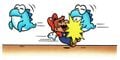 Artwork from Super Mario World
 Sprite from Super Mario World
 Animated sprite from Super Mario World
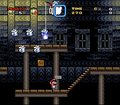 Super Mario World
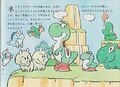 Original Story illustration, Nintendo Kōshiki Guidebook – Yoshi's Egg
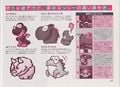 Nintendo Kōshiki Guidebook – Yoshi's Egg
 Sprite from Super Mario World: Super Mario Advance 2
 Sprite from Nintendo Puzzle Collection
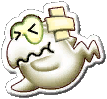 Sprite from Nintendo Puzzle Collection
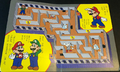 Super Mario Game Picture Book 2: Mario and Luigi
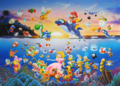 Artwork used for a Super Mario puzzle
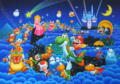 Artwork used for a Super Mario puzzle
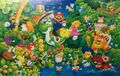 Artwork used for a Super Mario puzzle
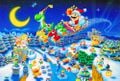 Artwork used for a Christmas-themed Super Mario puzzle
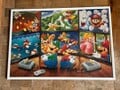 Artwork used for a Super Mario World puzzle
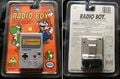 Packaging for the Radio Boy, where an Eerie is erroneously colored green


List of appearances[edit]
| Title | Year | Format |
|---|---|---|
| Super Mario World | 1990 | SNES |
| Nintendo Kōshiki Guidebook – Yoshi's Egg | 1991 | Book |
| Super Mario-kun Volume 4 | 1992 | Manga |
| Super Mario-kun Volume 5 | 1993 | Manga |
| Perfect Ban Mario Character Daijiten | 1994 | Book |
| Super Mario All-Stars + Super Mario World | 1994 | SNES |
| Super Mario Game Picture Book 2: Mario and Luigi | 1995 | Book |
| Super Mario World: Super Mario Advance 2 | 2001 | Game Boy Advance |
| Nintendo Puzzle Collection | 2003 | Nintendo GameCube |
Naming[edit]
The word "eerie" is defined as something strange or mysterious in a frightening way, somewhat similar to "spooky" or "uncanny", befitting their ghostly nature.
Names in other languages[edit]
The contemporaneous name for each language is listed first. Subsequent names are listed in chronological order for each language, from oldest to newest, and have the media they are associated with in the "Notes" column.
| Language | Name | Meaning | Note(s) | Ref. |
|---|---|---|---|---|
| Japanese | テレサウルス Teresaurusu | 「テレサ」(Teresa, "Boo") with a transliteration of the Greek σαῦρος (sauros, "lizard"), a near ubiquitous suffix in the generic names of dinosaurs; officially romanized as "Telesauls" | [2][9][10] | |
| Chinese (Simplified) | 嘘嘘龙 Xūxū Lóng | Repetition of "嘘" (xū, "boo") with "龙" (lóng, "dragon"), alluding to the Simplified Chinese name for Boo prior to 2018 | [11] | |
| Dutch | Eerie | - | [12]:54 | |
| French | Sinistre | Sinister | [13] | |
| Le Mystérieux | The Mysterious One | Super Mario World | [12]:24 | |
| German | Eerie | - | [14] | |
| Dino-Spuki | Dino Spooky | Super Mario World | [15][16] | |
| Italian | Eerie | - | [17][6][18][19] | |
| Korean | 테레사울스 Teresaulseu | Transliteration of the Japanese name | [20] | |
| Portuguese | Eerie | - | [21] | |
| Spanish | Eerie | - | [22][23] |
References[edit]
- ^ 1991. Super Mario World instruction booklet. Nintendo of America. Page 24.
- ^ a b 1990. 『Super Mario World 取扱説明書』 (PDF). Kyoto: Nintendo Co., Ltd. (Japanese). Page 28.
- ^ August 1991. Nintendo Mario Mania Player's Guide. Nintendo of America (American English). Page 51.
- ^ Tilden, Gail, et al. (September 1991). Nintendo Power Volume 28. Nintendo of America (American English). Page 11.
- ^ Super Mario World: Super Mario Advance 2 promotional flyer
- ^ a b Andrea Minini Saldini (June 2002). Nintendo La Rivista Ufficiale Numero 1. Milan: Future Media Italy SpA (Italian). Page 83.
- ^ February 1, 1992. 「任天堂公式ガイドブック ヨッシーのたまご」 (Nintendo Kōshiki Guidebook – Yoshi's Egg). Shogakukan (Japanese). ISBN 4-09-104196-5. Page 61.
- ^ November 20, 1994. Perfect Ban Mario Character Daijiten. Shogakukan (Japanese). ISBN 4-09-259067-9. Page 117.
- ^ Kagawa, Ryo (APE/Shigesato Itoi), Koichi Toda (100 Percent), Masaki Kuramochi (100 Percent), Shigeo Tanabe, Naomaru Asao, and Ryuji Osawa, editors (1991). "UNIT 2 CHARACTER" in『任天堂公式ガイドブック スーパーマリオワールド』. Tokyo: Shogakukan (Japanese). ISBN 4-09-104117-5. Page 30.
- ^ Sakai, Kazuya (ambit), kikai, Akinori Sao, Junko Fukuda, Kunio Takayama, and Ko Nakahara (Shogakukan), editors (2015). "Super Mario World" in『スーパーマリオブラザーズ百科: 任天堂公式ガイドブック』. Tokyo: Shogakukan (Japanese). ISBN 978-4-09-106569-8. Page 55.
- ^ In-game name from the ending of the iQue version of Super Mario World: Super Mario Advance 2. (Archived 28 Aug. 2013 via Baidu Teiba by 无敌阿尔宙斯.)
- ^ a b 1992. Super Mario World mode d'emploi / Handleiding. Nederland, Brussels: Nintendo (French, Dutch).
- ^ In-game name from the ending of Super Mario World: Super Mario Advance 2 (French). (Archived 19 Nov. 2010 via YouTube by Diddy64wii.)
- ^ In-game name from the ending of Super Mario World: Super Mario Advance 2 (German). (Archived 15 Oct. 2011 via YouTube by Spendem.)
- ^ 1992. Super Mario World Spielanleitung. Großostheim: Nintendo (German). Page 24.
- ^ Menold, Marcus, Claude M. Moyse, and Andreas G. Kämmerer, editors (1993). Der offizielle Nintendo Spieleberater "Super Mario World". Großostheim: Nintendo of Europe GmbH (German). Page 19.
- ^ 1992. Super Mario World Libretto di Istruzioni. Großostheim: Nintendo of Europe GmbH (Italian). Page 24. (Archived 29 Apr. 2019 via Mario's Castle by Alessandro "Stormkyleis" Imbesi.)
- ^ Sakai, Kazuya (ambit), kikai, Akinori Sao, Junko Fukuda, Kunio Takayama, Ko Nakahara (Shogakukan), and Marco Figini, editors (2018). "Super Mario World" in Super Mario Bros. Enciclopedia. Translated by Marco Amerighi. Milan: Magazzini Salani (Italian). ISBN 889367436X. Page 55.
- ^ Sakai, Kazuya (ambit), kikai, Akinori Sao, Junko Fukuda, Kunio Takayama, Ko Nakahara (Shogakukan), and Marco Figini, editors (2025). "Super Mario World" in Super Mario Bros. Enciclopedia (2nd ed.). Translated by Alessandro Apreda. Milan: Magazzini Salani (Italian). ISBN 979-1259575760. Page 55.
- ^ [SFC] 슈퍼마리오 월드 현대 정발판.
- ^ 1991. Super Mario World Manual de Instruções. Redmond: Nintendo of America (Brazilian Portuguese). Page 24.
- ^ 1992. Super Mario World Manual de Instrucciones. Madrid: Nintendo (European Spanish). Page 24.
- ^ In-game name from the ending of Super Mario World: Super Mario Advance 2 (European Spanish). (Archived 12 Sept. 2021 via YouTube by El Tiempo Es Ahora.)