Mario Tennis Fever
| Mario Tennis Fever | |||||||||||||||||||||||||
|---|---|---|---|---|---|---|---|---|---|---|---|---|---|---|---|---|---|---|---|---|---|---|---|---|---|
 American box art For alternate box art, see the related gallery. | |||||||||||||||||||||||||
| Developer | Camelot | ||||||||||||||||||||||||
| Publisher | Nintendo | ||||||||||||||||||||||||
| Platform | Nintendo Switch 2 | ||||||||||||||||||||||||
| Release date |  February 12, 2026[1] February 12, 2026[1] | ||||||||||||||||||||||||
| Languages | English Japanese Chinese (Simplified) Chinese (Traditional) Dutch French (Canada) French (Europe) German Italian Korean Portuguese (Brazil) Spanish (Latin America) Spanish (Europe) | ||||||||||||||||||||||||
| Genre | Sports | ||||||||||||||||||||||||
| Ratings |
| ||||||||||||||||||||||||
| Modes | Single player Multiplayer (2–4 players) Local Wireless Play (2–4 players) Online Play (2–4 players) LAN Play (2-4 players) Local GameShare (2-4 players) | ||||||||||||||||||||||||
| Format |  Game Card Game Card Digital download Digital download | ||||||||||||||||||||||||
| Input |  Joy-Con 2 (horizontal) Joy-Con 2 (horizontal) Joy-Con (horizontal) Joy-Con (horizontal) | ||||||||||||||||||||||||
 - Everyone
 - All ages
 - Seven years and older
 - Six years and older
 - General audience
 - All ages
 - Seven years and older
 - All ages
 - All ages
 - Seven years and older
 - General
 - Parental guidance

Mario Tennis Fever is the eighth direct installment in the Mario Tennis series, released worldwide for Nintendo Switch 2 on February 12, 2026 as part of the Super Mario Bros. 40th Anniversary celebration. It introduces new features, mainly Fever Rackets; each racket has its own special abilities, creating unique effects on the court. Players can build up their Fever Gauge during rallies, allowing them to use new tactics with Fever Shots. The game incorporates elements from Super Mario Bros. Wonder in modes, such as Tournament and Mix It Up.
Additionally, a story mode (Adventure) is featured, which has Mario and others travel to a remote island, being encountered by monsters that transformed them into babies. Having lost their tennis skills, the babies must learn to play tennis from the start and defeat the monsters to return to their original forms.
The game was first revealed on the Nintendo Direct which aired on September 12, 2025.[1] An overview trailer for the game was released on January 8, 2026.[14]
Gameplay
Mario Tennis Fever retains the basic tennis gameplay of the Mario Tennis series. Players play tennis matches by using various types of shot to return a ball between each other, scoring points if the opponent fails to return it properly. Players can charge their shots by pressing combinations of buttons, resulting in the character slowing down to prepare a more powerful type of shot known as a Super Charge Shot. If the player is not close enough to the ball when trying to hit it, their character will automatically slide or dive towards it. When serving, hitting the ball when it is at its highest can provide a stronger shot. Players receiving a serve can also press any shot button to instead execute a taunt, which raises the power of their next shot.
New to the series are the Fever Rackets, special rackets which can execute Fever Shots with unique effects. Each player can hold up to two Fever Shots by filling up their Fever gauge, with the second shot taking longer to charge. The gauge is charged by rallying the ball during normal gameplay, and each player starts a game with one Fever Shot already charged. Depending on the type of Fever Shot, when it is activated, it can take effect immediately on the player, granting them a boost, or take effect whenever the ball next bounces on the court, creating an obstacle. If the opponent manages to hit the Fever Shot back before it touches the ground, the Fever Shot will not be activated and can even take effect on the user's side of the field. This move is called a Fever Shot Counter. Activating a Fever Shot while the player is too far from the ball gives them a temporary speed boost to potentially reach the ball in time. If they cannot reach the ball, the gauge is not depleted.
Character HP is also a new mechanic introduced in Mario Tennis Fever. During gameplay, characters can lose HP when taking damage from obstacles or body shots. Upon losing all their HP, characters will either lose movement speed in singles or be knocked out in doubles, requiring time to recover before they can rejoin the match. Additionally, in doubles, teammates can time their shot to hit a Fever Shot together at the same time. Due to the presence of obstacles on the court from Fever Rackets, the traditional court change between sets does not occur when Fever Rackets are on.
Swing mode also returns from Mario Tennis Aces, allowing players to control their racket by swinging a Joy-Con 2 controller.
Controls
In the game's settings, the player can manually map actions to the  /
/  ,
,  /
/  ,
,  and
and  buttons. The actions that can be mapped to them are: Lobs, drop shots, canceling a charge, and moving their CPU partner forward or back in doubles matches. The player can also turn off the ability to press
  and
and  simultaneously to hit flats, which the option is on by default, as of version 1.1.0. When receiving, players can also taunt at the start of a match by pressing , or
  before the opponent serves the ball.
| Action | Input | |
|---|---|---|
Dual Joy-Con / Pro Controller  
|
Joy-Con (sideways)
| |
| Move Aim Fever Shot |
 / /  / / 
|

|
| Topspin |
|

|
| Slice |
|

|
| Flat | / + (together)
|
 / + (together) / + (together)
|
| Lob | →
|
→
|
| Drop shot | →
|
→
|
| Fever Shot |  (when an FV Gauge is full) (when an FV Gauge is full)
|
 (when an FV Gauge is full) (when an FV Gauge is full)
|
| Pause game |  / / 
|
/
|
Types of shots
| Shot | Description |
|---|---|
 Topspin |
A red-trailed shot that cause the ball to rotate forward, making it fly and bounce higher when it lands. Pressing twice causes it to become a power-topspin shot, which bounces higher but is harder to aim at the court edges.
|
 Slice |
A blue-trailed shot that gives the ball a backspin, flying lower than topspin shots and curving outward. Pressing twice causes it to become a power-slice shot, which is faster and curves more, but is harder to aim at the court edges.
|
 Flat |
A purple-trailed shot that travels straight and is the fastest shot. Pressing twice causes it to become a stronger power-flat shot. Using a flat shot while over a star point makes it into a stronger Star Shot.
|
 Lob |
A yellow-trailed shot that flies in a high arc, landing at the back of the court. It can create a star point, which makes it easier to be returned by an opponent. |
 Drop Shot |
A white-trailed shot with a reverse spin that is very weak, lands close to the net, and does not bounce much. |
 Fever Shot |
A powerful charged shot with that can be aimed with . It deals damage around the area where it lands, and has unique special effects depending on which Fever Racket is being used.
|
Balls

Mario Tennis Fever features three different types of balls, which have different speeds on the court: the Slow Ball, the Standard Ball, and the High-Speed Ball. They can be chosen when selecting a court. Additionally, scanning a compatible amiibo unlocks special alternate visuals for the three balls, which do not alter their effects. There are twelve total amiibo balls. Unlike the regular balls, each amiibo ball looks the same between the three types.


Game modes
Adventure

The Adventure mode is a single player mode centered around a story where Mario and his friends, with the help of Wario and Waluigi, travel to a mysterious island to find a golden fruit that can heal Daisy from her sickness. Mario, Luigi, Peach, Wario and Waluigi are cursed and turned into babies, losing all their tennis skills in the process.
The player controls Baby Mario and Baby Luigi as they train at the Mushroom Tennis Academy, learning the basics of playing the game through various minigames. Later, they return to explore the mysterious island in order to find a way to turn Baby Mario, Baby Luigi, Baby Peach, Baby Wario and Baby Waluigi back to normal. They must then beat various challenges and defeat bosses along the way.
Tournament
Tournament mode allows players to participate in three tournament cups made up of eight-player bracket, featuring commentary from a red Talking Flower. Initially, only the Mushroom Cup is available, while the Flower Cup and Star Cup are unlocked by clearing the preceding cup. This is also the first Mario Tennis game where unlockable characters can appear as opponents in the tournament bracket.
| Cup | Court | Rules |
|---|---|---|
 Mushroom Cup |
 Grass Court |
|
 Flower Cup |
 Clay Court |
|
 Star Cup |
 Hard Court |
|
Trial Towers
Trial Towers mode features three towers made up of ten challenges each. Characters, rackets and rules are predetermined for each challenges. In each tower, the player starts with three hearts. If they fail a trial, they lose a heart and are forced to re-do it. Losing all hearts causes them to re-do the entire tower from the start. Beating one tower unlocks the next one. After beating all three towers, 100 new, individual trials, are unlocked, with each trial having three objectives. A second player can join as a shadow character.


Free Play
Free Play mode allows players to create custom matches by changing a variety of rules. Players can pick between singles and doubles, choose to use one, two, or no Fever Rackets, and set the match length between quick play (first to seven points wins, like in a tiebreaker), extended play (two-game, one-set match), or custom length (players can select one, three, or five games per set, two, four, or six sets, and with or without tiebreaker). Then, players select the court, along with the ball speed and camera angle, followed by the characters and the difficulty of the CPUs which have five different difficulties: Novice, Intermediate, Expert, Pro, and Ace. The Expert, Pro, and Ace difficulties are unlockable by beating the opponent in a singles Free Play match on Intermediate, Expert, and for Ace difficulty specifically, beating the opponent on Pro while also obtaining at least one of the five medals respectively. Finally, players can select the rackets.
Mix It Up
Mix It Up mode contains a variety of unconventional game modes with special rules, items and obstacles appearing on the court.
Special Matches
In Special Matches, matches with unique rules or obstacles can be played. Like with Free Play and Swing Mode, players can pick between singles and doubles, select the ball speed (cannot be done for Ring Shot) and camera angle, and characters as well as their CPU difficulties which range from easiest to hardest: Novice, Intermediate, Expert, Pro, and Ace. Unlike Free Play and Swing Mode, however, players cannot set the match length, select the court, or choose their rackets, which the latter will default to the Personal Racket. All Special Matches can be played with up to four players.
| Game mode | Description |
|---|---|
 Ring Shot |
In the returning Ring Shot mode, players either compete or cooperate to pass the ball through various rings that continuously spawn over the net within a time limit. Hitting multiple rings at once grants a multiplier bonus, and rallying a Fever Shot through rings without letting it touch the ground provides a larger multiplier (up to 5x). |
 Forest Court Match |
In a Forest Court Match, played only on the Forest Court, the court is divided into sections which can be contain grass (considered inside the court) or dirt (considered out). During the match, player's can feed balls to Piranha Plants and Gold Piranha Plants to cause their opponent's side to grow grass, increasing their court area. Grass squares fade away if a Piranha Plant next to them isn't fed on time. |
 Pinball Match |
In a Pinball Match, which takes place on Waluigi's Pinball Arcade, various effects can be triggered on the court, such as bumpers appearing on one side, Flippers appearing to protect a player's baseline, or extra balls in play. |
 Racket Factory Match |
In a Racket Factory Match, taking place on the eponymous Racket Factory, the court is divided into quadrants on either side. A cannon in the background periodically launches Fever Rackets into random quadrants during play, allowing players to change their rackets mid-game. |
 Wonder Court Match |
A match taking place on the Wonder Court, with Wonder Effects which can be triggered by hitting Wonder Flowers with the ball. Effects include Trottin' Piranha Plants appearing on the net, various Hoppos bouncing around the court, or Spikes throwing colored Spike Balls into the court. Wonder Seeds can be collected during Wonder Effects as well. |
 Galaxy Court Match |
A match which takes place on the Galaxy Court. The court's surface is curved and asteroids float across the net, which can create fire obstacles and black holes when hit with the ball. Partway through matches, Prankster Comets cause various effects on the match. |
Score Challenges
In Score Challenges, players try to reach specific amounts of points in various challenges with special rules.
| Game mode | Description | Player amount |
|---|---|---|
 2P Co-op Ring Shot |
A cooperative singles version of the Ring Shot where both sides work together to achieve a score goal. | 1-2 |
 4P Co-op Ring Shot |
A cooperative doubles version of the Ring Shot where both sides work together to achieve a score goal. | 1-4 |
 Piranha Plant Challenge |
The returning mode from Mario Tennis. The player must hit balls shot randomly from three Piranha Plants without letting their opponent return it in order to reach a score goal. | 1 |
 Auto Tennis |
A special game where the player must return a ball shot from a Piranha Plant robot in order to hit panels on the floor and score enough points. Panels can give different amounts of points, and the robot can occasionally shoot Fever Shots. Like in Galaxy Rally and Gooper Blooper Volley from previous Mario Tennis games, the number of panels that the ball can hit will decrease over time. | 1 |
Swing Mode
In Swing Mode, players play matches with the option of using the Joy-Con 2 or Joy-Con motion controls. The only Fever Rackets available in this mode are the Personal Racket, Shadow Racket, Ghost Racket, Bullet Bill Racket, Inky Racket and the Boomerang Racket, the last of which is exclusive to this mode.
Playable characters
The game has 38 playable characters, tied with Mario Tennis: Power Tour for the most of any game in the series, of which 18 are available from the start, while the other 20 must be unlocked. Wiggler appears as a playable character for the first time since Mario Power Tennis, and Baby Mario and Baby Peach are playable for the first time since Mario Tennis Open, with Baby Peach also being playable for the first time in a home console installment.
Six characters make their playable debut in the Mario Tennis series in this game, those being Nabbit, Goomba, Piranha Plant, Baby Luigi, Baby Wario, and Baby Waluigi, with the game also marking Baby Luigi and Nabbit's debut in the Mario Tennis series (excluding the former's cameo in the intro cutscene for Mario Power Tennis and being playable in the Tennis mode in Mario Sports Superstars), Baby Wario's first appearance in a home console game, and Baby Waluigi's first appearance overall. In addition, there are color variations for some characters and as in the previous game, Mario Tennis Aces, the variations do not have their own distinct characters; for example, Lumalee is simply called "Luma". Including the color variations, this makes a total of 64 playable characters.

Playable characters are once again classified with a playing type, and four stats are now visible: Speed, Power, Control, and Spin. Each stat is rated out of five.
| Character | Type | Description | Speed | Power | Control | Spin | Unlock criteria |
|---|---|---|---|---|---|---|---|
 Mario |
All-Around | A star player who excels in all areas. Always ready for a challenge! | 3.5 | 3.5 | 3.5 | 1.5 | Available from the start. |
 Luigi |
All-Around | Specializes in volleys and feels right at home close to the net. Powerful slice shot (→) is extra strong.
|
3 | 4 | 2.5 | 1.5 | Available from the start. |
 Peach |
Technical | Expertly lands shots right at the court's edge with unrivaled accuracy. | 1 | 1.5 | 5 | 2 | Available from the start. |
 Daisy |
All-Around | Known for consistent power and control. Powerful topspin shot (→) is extra strong.
|
2 | 3 | 3 | 2 | Available from the start. |
 Rosalina |
Tricky | Overwhelms opponents with dizzying spin and power. Lobs soar like shooting stars! | 3 | 3.5 | 2.5 | 3.5 | Available from the start. |
 Pauline |
Speedy | Known for astonishing speed and poise. Can reach even the most difficult returns! | 5 | 1.5 | 3 | 1.5 | Available from the start. |
 Wario |
Powerful | A deadly combo of strong and fast. Topspin shot () can charge up in a flash.
|
2.5 | 5 | 2 | 1 | Available from the start. |
 Waluigi |
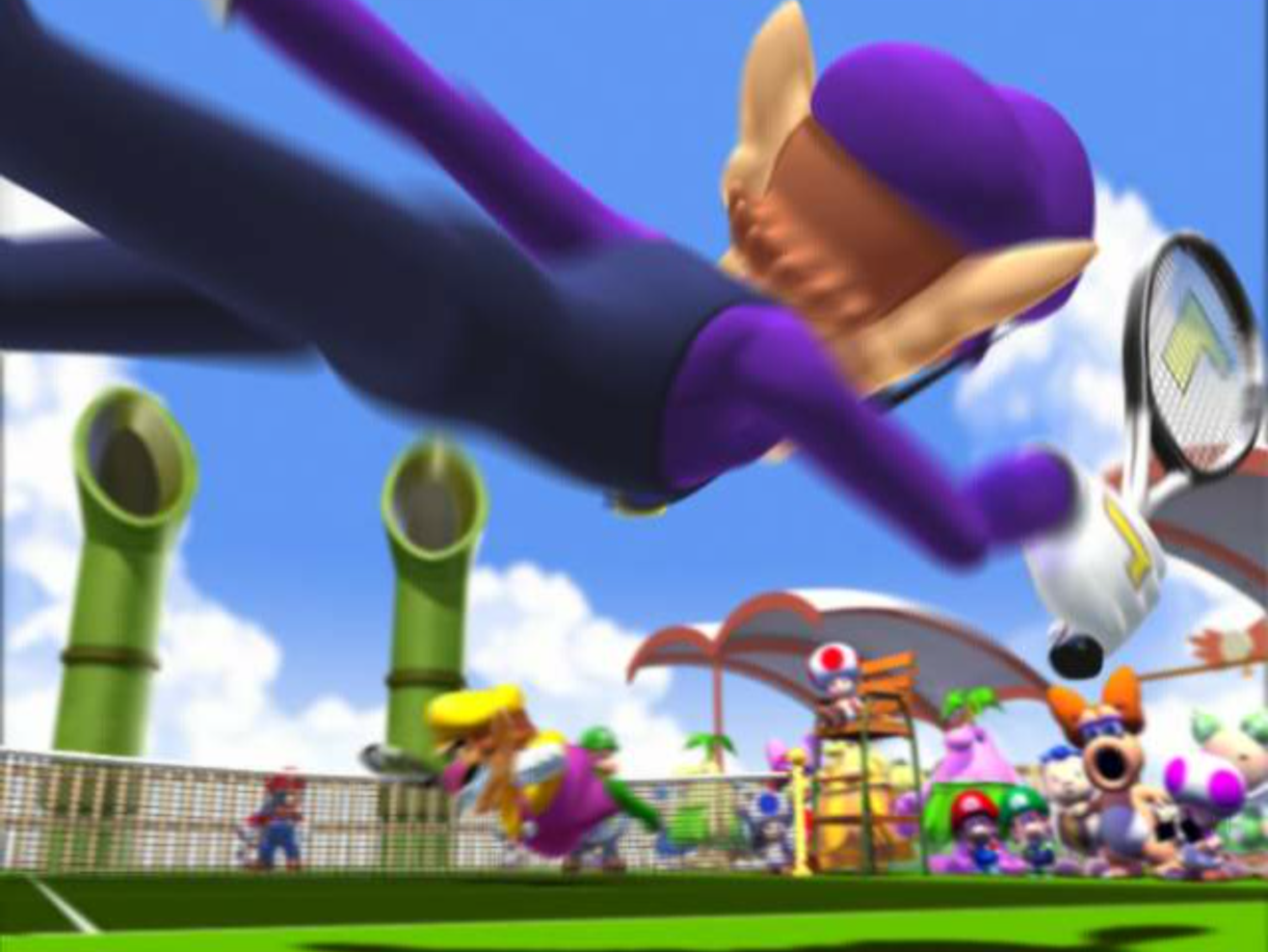
Defensive | Long limbs mean great defense! Thrives at the net. Powerful flat shot (→) is extra strong.
|
1 | 2.5 | 1 | 2 | Available from the start. |
 Toad |
Speedy | A hard worker who is quick to lend a hand around the Mushroom Kingdom. No one can get to the ball faster. | 5 | 2 | 2 | 1.5 | Available from the start. |
 Toadette |
Technical | Angled-shot specialist skilled at catching opponents off balance. | 1 | 1 | 5 | 3 | Available from the start. |
 Luma |
Technical | Galaxy denizen who floats around the court. Returns are extra strong if hit right when the ball bounces. | 2 | 1.5 | 4.5 | 2 | Available from the start. |
 Yoshi |
Speedy | Zips around the court at high speed, returning balls with ease. Excels in rallies. | 5 | 2 | 2.5 | 2 | Available from the start. |
 Bowser |
Powerful | Never to be outmuscled, he can send rivals flying with a charged-up, powerful topspin shot (→).
|
2 | 5 | 2.5 | 0.5 | Available from the start. |
 Bowser Jr. |
Tricky | Mischeivous champ who worked hard to hone a uniquely sly topspin curve. | 3.5 | 2 | 3.5 | 4 | Available from the start. |
 Donkey Kong |
Powerful | Cheerful and mighty in equal measure. Powerful slice shot (→) is extra strong and can push the receiver back.
|
3.5 | 5 | 2.5 | 1 | Available from the start. |
 Boo |
Tricky | Known for a surprisingly wide-curving slice serve that keeps opponents on their toes.
|
3.5 | 1 | 2.5 | 5 | Available from the start. |
 Shy Guy |
Technical | Sharp-eyed control pro. Can land powerful topspin shots (→) even at the edge of the court.
|
2 | 2.5 | 4.5 | 1.5 | Available from the start. |
