Goomboss
- Not to be confused with Boss Goomba.
| Goomboss | |
|---|---|
 Model from Mario Kart DS | |
| Species | Goomba |
| First appearance | Paper Mario (2000) |
| Latest appearance | Mario Kart DS (2005) |
| Member of | Bowser's Minions |
- “Bwa ha ha! I'm no ordinary Goomba... I am Goomboss, the great Goomba, the grand pooh-bah Goomba. That Mario always stomps on us. But now the tables have turned! I locked him up in a room. I bet he's crying like a baby. I have no business with you, so scram! There's no way a prehistoric wimp like you could beat my stupendous stomps!”
- —Goomboss, Super Mario 64 DS
Goomboss, formerly known as the Goomba King or King Goomba, is a character introduced in Paper Mario. He is a giant Goomba who appears as their leader. Goomboss, like other certain bosses, takes pride in his royal status.
He is the first boss encountered in Paper Mario. He later reappears as a boss in Super Mario 64 DS and Mario Kart DS, making him the first original Paper Mario series boss character to reappear in other Super Mario games.
History[edit]
Paper Mario series[edit]
Paper Mario[edit]


In Paper Mario, he was originally an ordinary Goomba, but Bowser used the Star Rod to make him a king (which also greatly increased his size) under the conditions that he would assist Bowser later on. He is first seen when the Goomba Bros. come to his fort wailing about their defeat to Mario. He lets them in his fort, and when Mario comes by, he has a short conversation with him and then engages him in battle along with his minions. The Goomba King serves as the boss of the prologue.
In battle, he is accompanied by the Red & Blue Goomba Bros. Mario will find him by his fortress. The easiest way of defeating him is to hit the Goomnut Tree at the start of the battle to make one giant Goomnut fall on him and the Red & Blue Goomba Bros., doing three damage and instantly knocking the weakened Goombas out. When the Goomba King is defeated, he surrenders and retreats to his fort while pleading that Mario will not press a nearby switch. When Mario presses the switch, the Goomba King tries to warn him to not press it, but realizes he already pressed it. The fort changes into a bridge to get to Toad Town, and he and his minions are sent flying and fall into the abyss, defeated.
While Mario battles the Goomba King and the Red & Blue Goomba Bros., Kammy Koopa is secretly observing the battle. She reports back to Bowser, who is furious at the Goomba King's defeat and also yells "I used the Star Rod to make him a king because he begged me..."
In the ending parade of Paper Mario, the Red & Blue Goomba Bros. are trying to get the Goomba King out of a tree. He then falls out, and dizzily wobbles off the screen, followed by the Goomba Bros.
Paper Mario: The Thousand-Year Door[edit]
Although the Goomba King does not physically appear in Paper Mario: The Thousand-Year Door, a character known in the English localization as the Chestnut King is mentioned as the main antagonist of Luigi's tale. In all non-English language versions of the game, this character is referred to as the Goomba King instead.[1] Goombas are named「クリボー」(kuribō, literally "chestnut guys") in Japanese, and both the Goomba King and the Chestnut King are referred to as the「クリキング」(kuri kingu, literally "chestnut king"). This follows the convention of food-related names within the Waffle Kingdom. Despite some other translation inconsistencies being corrected in the Nintendo Switch remake, the Chestnut King is still referred to as such in the English localization. The remake's Canadian French localization also refers to this character as "King Chestnut", while all other languages refer to him as the Goomba King or a derivative name.
While not extensively physically described, Luigi recalls in his story that the Chestnut King was "monstrous and drooling" and that puddles of toxic goo dripped from his mouth, which melted the ground at his and Luigi's feet. He is also said to have fangs, a chest, and a skull. This description makes it unclear if the Chestnut King and Goomba King are meant to be the same individual, as it differs from the Goomba King's established appearance; however, due to Luigi's recollections of his adventures being embellished to varying degrees, it is unclear how truthful he is being. Additionally, the idea of Luigi going on a quest to defeat the previous game's prologue boss may have been intended as a joke playing on Luigi's depiction in this game as something of a wimp, loser, or klutz.
According to Luigi, the Chestnut King is the villain who kidnaps Princess Eclair from the Waffle Kingdom and brings her to Hatesong Tower. Luigi travels to the tower by using the Marvelous Compass. Once there, Luigi challenges the Chestnut King to a battle. The king eventually loses to Luigi and his hammer. However, before Luigi can deliver the final blow, Princess Eclair appears and stops him. It turns out that the Chestnut King and the princess are actually lovers, much to Luigi's dismay. The King was transformed into a monster through the magic of Minister Crepe of the Waffle Kingdom. Eventually, Luigi defeats Crepe, presumably restoring the Chestnut King to his former self. Luigi never directly admits that he was wrong in believing that the Chestnut King was the Princess' captor (although he does admit after a long pause that, though he had won, he ended up beating a shadowy figure shortly afterward), and Mario can only read about it in the Super Luigi book series.
Super Mario 64 DS[edit]

The Goomba King reappears as a boss in Super Mario 64 DS, now called Goomboss. He is fought within the battle arena in Goomboss Battle, which can be reached after eight Power Stars are collected. In order to defeat him as Yoshi, the player must eat Goombas and spit them back at him in the form of an egg to win back Mario's Key in order to unlock him as a playable character in the game. However, Goomboss starts getting bigger, faster, redder, and angrier after every hit and also gains more Goomba followers. He needs to be hit three times in order to admit defeat. When returning to fight him once again as Mario, the player can kick Goomboss in his face or back and obtain a Super Mushroom. Using it and attacking him while under its influence is not required to defeat him; the player can just punch the Goombas into him to damage him. After he is defeated, Yoshi gets Mario's Key, which is used to unlock Mario. This appearance also proves that Goomboss knows Luigi, but he does not know Wario. Also, when Goomboss is hit, every normal Goomba runs up to him, as if worried. He sometimes even tramples his own Goombas. When the player plays as Yoshi, the Goombas spawn behind Goomboss, while for the other player characters, the Goombas spawn in front of him at first and can spawn in front of him and behind him later in the fight.
Mario Kart DS[edit]

Goomboss is the boss of the third level of the Missions mode in Mario Kart DS. The player character, Toad, races against Goomboss in three laps of the GCN Baby Park. After each lap, Goomboss becomes bigger and angrier, but he has to stop for a few seconds to grow, giving the player a chance to pass him. Another chance to pass him is when he stops to throw one Goomba on the first lap; one or three Goombas on the second lap; or one, three, or five Goombas on the third lap. On the second lap, Goomboss will rarely run around in a circle once. If Toad hits a Goomba, the player will lose one of their three balloons, and if the player does not reach the goal in time, they lose all three balloons and fail the mission, although the player will not lose a balloon if Toad hits Goomboss. Occasionally, Goomboss will throw a Mushroom instead of a Goomba to fool the player, allowing the player to get a boost of speed. Additionally, on the third lap, Goomboss will cheat by hopping over the center divider, improving his chances of winning. If the player is in front of Goomboss, he will not stop to toss Goombas, but will run faster so he can catch up.
Profiles and statistics[edit]
Paper Mario[edit]
| Paper Mario enemy | |||||||||
|---|---|---|---|---|---|---|---|---|---|
| Goomba King | |||||||||

|
Max HP | 10 | Attack | 1 | Defense | 0 | |||
| Role | Boss | Type | Ground | Level | 49 | ||||
| Strong | None | Weak | None | Moves | Spin Kick (1), Ground Stomp (2) | ||||
| Sleep? | 100%, -1 | Dizzy? | 100%, -1 | Shock? | 100%, -1 | ||||
| Shrink? | 100%, -1 | Stop? | 100%, -1 | Fright? | 0% | ||||
| Air Lift? | 0% | Hurricane? | 0% | Coins | N/A | ||||
| Items | N/A | Run | N/A | Location(s) | Goomba Road | ||||
| Tattle | This is the Goomba King. He's really big. I mean, look at him! He looks really powerful. Max HP: 10, Attack Power: 1, Defense Power: 0 He's the boss of Red Goomba and Blue Goomba. Who cares if he's strong? You're much stronger. Gee, I wonder what he ate to become so big? I'd like to be a bit bigger, too. | ||||||||
- Player's Guide: A surly fellow with a nifty mustache, the Goomba King is a frightening sight. Don't be fooled by his massive size, though. His Heart Points are fairly low, and he has a habit of standing in inopportune places during battle.
Goombario suggests that you attack the Goomba Bros. first, but your initial move should be for the tree in the background. If you hit it with the Hammer you'll dislodge a large nut that smashes the brothers flat, while also knocking the Goomba King on the noggin.[2]
Gallery[edit]
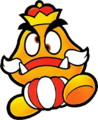 Artwork from Paper Mario
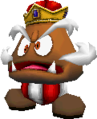 In-game model from Super Mario 64 DS
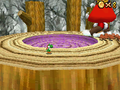 Screenshot from Super Mario 64 DS
 Course map icon from Mario Kart DS


Naming[edit]
Goomboss' name is a portmanteau of "Goomba" and "boss".
Names in other languages[edit]
The contemporaneous name for each language is listed first. Subsequent names are listed in chronological order for each language, from oldest to newest, and have the media with which they are associated in the "Notes" column.
Goomboss[edit]
| Language | Name | Meaning | Note(s) | Ref. |
|---|---|---|---|---|
| Japanese | クリキング Kuri Kingu | Chestnut King, in reference to「クリボー」(Kuribō, "Goomba", literally "chestnut boy") | [3][4][5] | |
| Chinese (Simplified) | 栗子王 Lìzi Wáng (Mandarin) Leuhtjí Wòhng (Cantonese) | Chestnut King | [6] | |
| French (Europe) | Goomboss | - | [7][8] | |
| Roi Goomba | King Goomba | Paper Mario | [9] | |
| German | Gumboss | Goomboss | [10][11] | |
| Gumba-König | Goomba King | Paper Mario | [12] | |
| Italian | Goomboss | - | [13][14] | |
| Re dei Goomba | King of the Goombas | Paper Mario | [15] | |
| Korean | 킹굼바 King Gumba | King Goomba | [16][17] | |
| Spanish (Latin America) | King Goomba | - | [18] | |
| Spanish (Europe) | Gran Goomba | Grand Goomba | [19][20] | |
| Rey Goomba | King Goomba | Paper Mario | [21] |
Chestnut King[edit]
| Language | Name | Meaning | Note(s) | Ref. |
|---|---|---|---|---|
| Japanese | クリキング Kuri Kingu | Chestnut King | [22][23] | |
| Chinese (Simplified) | 栗国王 Lì Guówáng (Mandarin) Leuht Gwokwòhng (Cantonese) | Chestnut King | [24] | |
| Chinese (Traditional) | 栗國王 Lì Guówáng (Mandarin) Leuht Gwokwòhng (Cantonese) | [25] | ||
| Dutch | Goomba-koning | Goomba King | [26] | |
| French (Canada) | Roi Châtaigne | King Chestnut | [27] | |
| French (Europe) | Roi Goomba | Goomba king | [28][29] | |
| German | Gumba-König | Goomba King | [30][31] | |
| Italian | Re Goomba | King Goomba | [32][33] | |
| Korean | 굼바왕 Gumba Wang | Goomba King | [34] | |
| Spanish (Latin America) | Rey de los Goombas | King of the Goombas | [35] | |
| Spanish (Europe) | [36][37] |
References[edit]
- ^ Mario in Japan | Paper Mario: The Thousand-Year Door. The Mushroom Kingdom (English). Retrieved June 30, 2024.
- ^ Averill, Alan, Jason Leung, and Jennifer Villarreal (2001). Paper Mario Official Nintendo Player's Guide. Nintendo of America (English). ISBN 1-930206-07-0. Page 104.
- ^ 「クリキングだ とにかく でっかい クリボーだ はくりょくだけは たっぷりだね」– Goombario tattling during battle (11 Aug. 2000). Paper Mario by Intelligent Systems. Nintendo Co., Ltd. (Japanese).
- ^ 「ワッハッハ!ワシこそが クリボーのなかのクリボー、クリキングさまだ!」– Goomboss during "Goomboss Battle" (2 Dec. 2004). Super Mario 64 DS by Nintendo EAD. Nintendo Co., Ltd. (Japanese).
- ^ Noriaki, Kamiguchi, Kaisa Hitoshi, Teshiromori Nobuhito, Nagashima Kazutaka, Somoto Shitsuya, and Matsumoto Royo (2005). 『「スーパーマリオ64DS」タッチ!&ゲット!パワースター
攻略 ブック』. Tokyo: Kadokawa (Japanese). ISBN 4-8402-2960-0. Page 220–225. - ^ In-game name displayed during battle in the iQue version of Paper Mario (Simplified Chinese). (Archived 3 Jan. 2023 via Bilibili by 新人库帕.)
- ^ « Bwa ha ha ha ha ! Je ne suis pas un Goomba comme les autres. Je suis le Goomboss, le plus fort des Goomba. » – Goomboss during "Goomboss Battle" (11 Mar. 2005). Super Mario 64 DS by Nintendo EAD. Nintendo of Europe GmbH (French).
- ^ « Passez la ligne d'arrivée avant Goomboss! » – Description for the level 3 boss mission (25 Nov. 2005). Mario Kart DS by Nintendo EAD. Nintendo of Europe GmbH (French). (Archived 21 Dec. 2024 via YouTube by Krnage 2.0.)
- ^ « C'est LE Roi Goomba. Super balèze... Mate un peu le style! Il est trop fort. » – Goombario tattling during battle (5 Oct. 2001). Paper Mario by Intelligent Systems. Nintendo of Europe GmbH (French).
- ^ „Buahahaha! Ich bin kein gewöhnlicher Gumba. Ich bin Gumboss, der Große Gumba, der großartige puumba Gumba.“ – Goomboss during "Goomboss Battle" (11 Mar. 2005). Super Mario 64 DS by Nintendo EAD. Nintendo of Europe GmbH (German).
- ^ „Erreiche vor Gumboss das Ziel!“ – Description for the level 3 boss mission (25 Nov. 2005). Mario Kart DS by Nintendo EAD. Nintendo of Europe GmbH (German). (Archived 26 May 2020 via YouTube by ChallengeTime.)
- ^ „Das ist der Gumba-König. Er ist wirklich groß. Ich meine, sieh ihn dir doch an! Er sieht auch sehr stark aus.“ – Goombario tattling during battle (5 Oct. 2001). Paper Mario by Intelligent Systems. Nintendo of Europe GmbH (German).
- ^ «Ba ah ah! Non sono un Goomba qualsiasi... Sono Goomboss, il grande Goomba, il grande bleah Goomba.» – Goomboss during "Goomboss Battle" (11 Mar. 2005). Super Mario 64 DS by Nintendo EAD. Nintendo of Europe GmbH (Italian).
- ^ «Taglia il traguardo prima di Goomboss!» – Description for the level 3 boss mission (25 Nov. 2005). Mario Kart DS by Nintendo EAD. Nintendo of Europe GmbH (Italian).
- ^ Saldini, Andrea Minini (Jan. 2003). Nintendo La Rivista Ufficiale Numero 8. Milan: Future Media Italy SpA (Italian). Page 108.
- ^ "와하하 ! 내가 굼바 중의 굳바 바로 킹굼바님이시다 ! 평범한 굼바가 아니야. 엄청 훌륭한 굼바지." – Goomboss during "Goomboss Battle" (26 Jul. 2007). Super Mario 64 DS by Nintendo EAD. Nintendo of Korea Co., Ltd. (Korean).
- ^ "킹굼바보다 빨리 골인해라!" – Description for the level 3 boss mission (5 Apr. 2007). Mario Kart DS by Nintendo EAD. Nintendo of Korea Co., Ltd. (Korean). (Archived 21 July 2024 via YouTube by Sendan.)
- ^ Rodriguez, Gustavo, and José Sierra, editors (May 2001). "Paper Mario" in Club Nintendo, 10 (no. 5). Latin American Spanish. Page 71.
- ^ «¡Boa, joa, joa! ¿No sabes quién soy?... Soy el Gran Goomba, el Goomba más Goomba de todos los Goomba.» – Goomboss during "Goomboss Battle" (11 Mar. 2005). Super Mario 64 DS by Nintendo EAD. Nintendo of Europe GmbH (European Spanish).
- ^ «¡Cruza la línea de meta antes que el Gran Goomba!» – Description for the level 3 boss mission (25 Nov. 2005). Mario Kart DS by Nintendo EAD. Nintendo of Europe GmbH (European Spanish). (Archived 11 May 2018 via YouTube by DANDRESGAMER.)
- ^ «Es el Rey Goomba. Es enorme. ¡Fíjate en él! Parece muy fuerte.» – Goombario tattling during battle (5 Oct. 2001). Paper Mario by Intelligent Systems. Nintendo of Europe GmbH (European Spanish).
- ^ 「ボクかい? じつは ボク カイブツ クリキングに さらわれた ワッフル
王国 の エクレア姫 を助 けるために ぼうけんを してるんだ」– Luigi after "Chapter 1: Castle and Dragon" (22 July 2004). Paper Mario: The Thousand-Year Door by Intelligent Systems. Nintendo Co., Ltd. (Japanese). - ^ 「ボクかい? じつは ボク カイブツ クリキングに さらわれた ワッフル王国の エクレア姫を 助けるために ぼうけんを してるんだ」– Luigi after "Chapter 1: Castle and Dragon" (23 May 2024). Paper Mario: The Thousand-Year Door by Intelligent Systems. Nintendo (Japanese).
- ^ "我啊?其实格子松饼王国的意可蕾公主被怪物栗国王掳走了。我正在为了救她四处冒险。" – Luigi after "Chapter 1: Castle and Dragon" (23 May 2024). Paper Mario: The Thousand-Year Door by Intelligent Systems. Nintendo (Simplified Chinese).
- ^ 「我嗎?其實是格子鬆餅王國的意可蕾公主被怪物栗國王抓走了。我為了拯救他,正在冒險途中。」– Luigi after "Chapter 1: Castle and Dragon" (23 May 2024). Paper Mario: The Thousand-Year Door by Intelligent Systems. Nintendo (Traditional Chinese).
- ^ "Ja, het is een hachelijke situatie. Ze is ontvoerd door de gemene Goomba-koning." – Luigi after "Chapter 1: Castle and Dragon" (23 May 2024). Paper Mario: The Thousand-Year Door by Intelligent Systems. Nintendo (Dutch).
- ^ « Une affaire horrible... Elle a été enlevée par le machiavélique Roi Châtaigne. » – Luigi after "Chapter 1: Castle and Dragon" (23 May 2024). Paper Mario: The Thousand-Year Door by Intelligent Systems. Nintendo (Canadian French).
- ^ « Moi? Je dois sauver Princesse Ganache qui a été enlevée par le Roi Goomba. » – Luigi after "Chapter 1: Castle and Dragon" (12 Nov. 2004). Paper Mario: The Thousand-Year Door by Intelligent Systems. Nintendo of Europe GmbH (French).
- ^ « Ce que je fais ici ? Je dois sauver la princesse Ganache qui a été enlevée par le roi Goomba. » – Luigi after "Chapter 1: Castle and Dragon" (23 May 2024). Paper Mario: The Thousand-Year Door by Intelligent Systems. Nintendo (French).
- ^ „Sie wurde nämlich entführt, und zwar von einem finsteren Gumba-König.“ – Luigi after "Chapter 1: Castle and Dragon" (12 Nov. 2004). Paper Mario: The Thousand-Year Door by Intelligent Systems. Nintendo of Europe GmbH (German).
- ^ „Sie wurde nämlich entführt, und zwar von einem finsteren Gumba-König.“ – Luigi after "Chapter 1: Castle and Dragon" (23 May 2024). Paper Mario: The Thousand-Year Door by Intelligent Systems. Nintendo (German).
- ^ «Il temerario Re Goomba l'ha rapita e io devo salvarla!» – Luigi after "Chapter 1: Castle and Dragon" (12 Nov. 2004). Paper Mario: The Thousand-Year Door by Intelligent Systems. Nintendo of Europe GmbH (Italian).
- ^ «Il malvagio Re Goomba l'ha rapita e io devo salvarla!» – Luigi after "Chapter 1: Castle and Dragon" (23 May 2024). Paper Mario: The Thousand-Year Door by Intelligent Systems. Nintendo (Italian). (Archived 11 Set. 2025 via YouTube by khedtraduzioni.)
- ^ "나 말이야? 사실 나는 괴물 굼바왕에게 납치당한 와플 왕국의 에클레르공주님을 구하기 위해서 모험을 하고 있어" – Luigi after "Chapter 1: Castle and Dragon" (23 May 2024). Paper Mario: The Thousand-Year Door by Intelligent Systems. Nintendo (Korean).
- ^ "El malvado rey de los Goombas secuestró a la princesa Petisú del Reino Waffle y debo rescatarla." – Luigi after "Chapter 1: Castle and Dragon" (23 May 2024). Paper Mario: The Thousand-Year Door by Intelligent Systems. Nintendo (Latin American Spanish).
- ^ «El malvado Rey de los Goomba... ha secuestrado a la Princesa Letucia del Reino Gofre y debo rescatarla.» – Luigi after "Chapter 1: Castle and Dragon" (12 Nov. 2004). Paper Mario: The Thousand-Year Door by Intelligent Systems. Nintendo of Europe GmbH (European Spanish).
- ^ «El malvado rey de los Goombas ha secuestrado a la princesa Letucia del Reino Gofre y debo rescatarla.» – Luigi after "Chapter 1: Castle and Dragon" (23 May 2024). Paper Mario: The Thousand-Year Door by Intelligent Systems. Nintendo (European Spanish).