Mini Rocket
This article needs Super Mario improvement. Specifically:
- Reformat to match other articles
- Add infobox
- Split into "History" sections
- "Rocket" redirects here. For other uses, see Rocket (disambiguation).
- This article is about the rocket that appears in Super Mario Bros. 2, Super Mario 3D World and Super Mario Odyssey. For the Bros. Attack from Mario & Luigi: Paper Jam, see Rocket Blast.

The Rocket[1] (or rocket),[2] also called the Rocket Ship[3] (or Rocketship),[4] is an item in Super Mario Bros. 2 and its reissues in Super Mario All-Stars and Super Mario Advance. It can be plucked from the ground, just like Vegetables, and acts as the "door" to the next area, taking Mario, Luigi, Toad, or Princess Peach upwards. After a certain height, the player's character jumps out of it, and it explodes shortly afterwards. After reaching the next area of the said levels, all characters except Luigi jump out of the Mini Rocket in a ducking position. The Rocket appears only in World 4-1, World 4-2, and World 7-1. In the Super Mario-kun adaption, Mario, Luigi, Yoshi, and Toad defeat Clawgrip with a rocket.
Rockets also appear in Super Mario 3D World and its reissue. After Meowser is defeated, the Sprixie Princesses build a rocket in World 1, which leads to World Star set in space. Rockets also appear at the ends of World Star and World Flower, both of which lead to World Mushroom and World Crown, respectively, after the players have met the requirements.
Rockets return in Super Mario Odyssey, where they are known as Mini Rockets.[5] Mario must capture them with Cappy to use them, then the player must hold  or
or  to blast off. They land in a bonus area floating high in the air, and can return to the place they left either through the original rocket or with the rocket at the end of the area. Certain areas, such as the Picture Match accessible from the Mushroom Kingdom, do not have a second Mini Rocket.
Gallery[edit]
 Super Mario Bros. 2
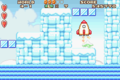 Super Mario Advance
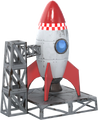 Super Mario Odyssey


Names in other languages[edit]
- Rocket
| Language | Name | Meaning | Note(s) | Ref. |
|---|---|---|---|---|
| Japanese | ロケット Roketto | Rocket | [6][7][8][2] | |
| Chinese | 火箭 Huǒjiàn | Rocket | [2] | |
| Dutch | Raket | Rocket | [2] | |
| French | Fusée | Rocket | [2] | |
| German | Rakete | Rocket | [2] | |
| Italian | Razzo | Rocket | [2] | |
| Korean | 로켓 Roket | Rocket | [2] | |
| Portuguese | Foguete | Rocket | [2] | |
| Spanish | Cohete | Rocket | [2] |
- Mini Rocket
| Language | Name | Meaning | Note(s) | Ref. |
|---|---|---|---|---|
| Japanese | ミニロケット Mini Roketto | Mini Rocket | [5] | |
| Chinese | 迷你火箭 Mínǐ Huǒjiàn | Mini Rocket | [5] | |
| Dutch | Miniraket | Minirocket | [5] | |
| French (Canada) | Mini fusée | Mini rocket | [5] | |
| French (Europe) | Mini-fusée | Mini-rocket | [5] | |
| German | Minirakete | Minirocket | [5] | |
| Italian | Mini razzo | Mini rocket | [5] | |
| Korean | 미니 로켓 Mini Roket | Mini Rocket | [5] | |
| Russian | Мини-ракета Mini-raketa | Mini-rocket | [5] | |
| Spanish | Minicohete | Minirocket | [5] |
References[edit]
- ^ 1993. Super Mario All-Stars Player's Guide. Nintendo of America (American English). Page 88.
- ^ a b c d e f g h i j Nintendo World Championships: NES Edition, Over & Out and Whale of a Time challenge descriptions
- ^ Stratton, Bryan (June 7, 2001). Super Mario Advance Prima's Official Strategy Guide. Prima Games (American English). ISBN 0-7615-3633-7. Page 11.
- ^ Arnold, J. Douglas, James Yamada, and Mark Elies (June 4, 2001). Super Mario Advance Official Perfect Guide. American English. ISBN 0-9706468-4-4. Page 46, 47, 49, and 78.
- ^ a b c d e f g h i j k Super Mario Odyssey, Capture List entry
- ^ Shigesato Itoi and Ryō Kagawa (APE), Hideaki Nishitani, Masatoshi Watanabe and Koichi Sugiyaba (Chō Onsoku), Jun'ichiro Okubo and Shigeo Tanabe (Shogakukan); editors (August 10, 1993 (first edition)). 「スーパーマリオコレクション任天堂公式ガイドブック」(Super Mario Collection Nintendo Kōshiki Guidebook). Shogakukan (Japanese). ISBN 4-09-102444-0. Page 141.
- ^ Kazuki Motoyama (February 6, 1993). 「スーパーマリオUSA」(Super Mario USA). Kodansha (KC Deluxe) (Japanese). Page 89.
- ^ Yukio Sawada (October 25, 1993). 「スーパーマリオくん⑧」(Super Mario-kun Volume 8). Shogakukan (CoroCoro Comics) (Japanese). Page 68.


