Uproot
- Not to be confused with Upshoot.
| Uproot | |||
|---|---|---|---|
 Artwork from Super Mario Odyssey | |||
| First appearance | Super Mario Odyssey (2017) | ||
| Latest appearance | Minecraft: Bedrock Edition (Nether Update) (2020) | ||
| |||
- “A creature that can stretch many times its height upward! I have been hoping to investigate one up close!”
- —Bonneter biologist, Super Mario Odyssey
Uproots are enemies that can be captured in Super Mario Odyssey. Uproots are yellow onion-like creatures with red eyes. They usually have brown flowerpots over their heads with a broken opening to see from. They have green thorny legs, which, according to the Bonneter biologist, telescope outward. They can use this ability to push their bodies into the air, then retract them in an instant to jump.
History[edit]
Super Mario Odyssey[edit]
Uproots can be found in the Wooded Kingdom, in a secret lava-filled area in the Seaside Kingdom, and on the Darker Side. They spawn from Senobi Generate Points, which are dirt patches in the ground. When an Uproot notices Mario, it stretches up and then leaps in his direction. If the Uproot hits Mario mid-stretch, it will stop, then finish its movement. Uproots respect invisible boundaries that generally prevent them from chasing Mario too far. Uproots are immune to being jumped on and can be defeated only with a Ground Pound.
In most cases, Uproots have flowerpots. To capture an Uproot, Mario needs to use a Cap Throw to break the pot, allowing a second throw to capture the Uproot. If it was stretching, the Uproot will return to the ground when it is captured. A captured Uproot can be used to reach high platforms. Uproots can break blocks and push movable covers. Shaking the controller as an Uproot makes it stretch faster than normal, and briefly stay at a higher position before shrinking back to the normal maximum height. It can also stretch higher when two buttons are used at once. While stretched, Uproots walk more slowly than they do without stretching or by using repeated jumps. An Uproot (captured or not) can defeat other Uproots by stomping them, as though a Ground Pound was used.
An Uproot is required to defeat Torkdrift, a boss in the Wooded Kingdom, with its stretching power needed to reach the boss's weak points and strike from below. The height from stretching is also necessary to dodge one of Torkdrift's attacks. As such, an Uproot also appears in the rematch against the boss in the Mushroom Kingdom.
A concept design for Uproots depicted them as mushroom-type enemies. More concepts for Uproots were partially based on Pokeys and Bramballs.[1]
Minecraft[edit]
In the Super Mario Mash-Up Pack in Minecraft, Striders are replaced by Uproots.
Profiles[edit]
- Website description:
Gallery[edit]
 Artwork of a captured Uproot
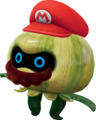 Artwork of a captured Uproot
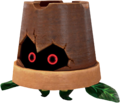 Artwork of a potted Uproot
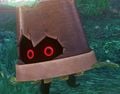 Screenshot of a potted Uproot
 An Uproot as a strider in Minecraft
 A chilly Uproot (outside of the lava) in Minecraft
 A saddled Uproot in Minecraft


Naming[edit]
"Uproot" is derived from a word referring to a plant being pulled from the ground, and their name also refers to their root-like legs.
Names in other languages[edit]
| Language | Name | Meaning | Note(s) | Ref. |
|---|---|---|---|---|
| Japanese | セノビー Senobī | From「 | [4][5] | |
| Chinese (Simplified) | 腿伸伸 Tuǐshēnshēn (Mandarin) Téuisānsān (Cantonese) | "腿" (tuǐ / léui, "legs") with a repetition of "伸" (shēn / sān, "to stretch") | [4] | |
| Chinese (Traditional) | 塞諾比 Sàinuòbǐ (Mandarin) Sāknohkbéi (Cantonese) | Transliteration of the Japanese name | [4] | |
| Dutch | Uproot | - | [4] | |
| French | Poupousse | Repetition and play on words between pousse ("bud") and pousser ("to stretch") | [4][6] | |
| German | Mieswurz | Mies ("bad") with a contraction of Wurzel ("root") | [4][7] | |
| Italian | Bulbotto | Bulbo ("bulb") with the diminutive suffix -otto | [4] | |
| Korean | 쭈우키 Jjuuki | From "쭈욱 키" (jjuuk ki, "keep going tall") | [4] | |
| Portuguese (Europe) | Uproot | - | [8] | |
| Russian | Корняк Kornyak | Portmanteau between корень (koren', "root") and сорняк (sornyak, "weed") | [4] | |
| Spanish | Cebolleto | From cebolla ("onion") and seto ("hedge") | [4][9] |
References[edit]
- ^ October 22, 2019. The Art of Super Mario Odyssey. Milwaukie, Oregon: Dark Horse Books. ISBN 978-1-50671-375-5. Page 146.
- ^ Super Mario Odyssey § Meet Cappy. nintendo.com (British English). Retrieved September 15, 2024. (Archived August 3, 2024, 21:20:56 UTC via archive.today[deprecated link].)
- ^ スーパーマリオ オデッセイ : 新アクション「帽子投げ」!. nintendo.co.jp. Retrieved April 18, 2023. (Archived November 13, 2017, 02:59:47 UTC via Wayback Machine.)
- ^ a b c d e f g h i j Capture list (27 Oct. 2017). Super Mario Odyssey by Nintendo EPD Tokyo (Ver. 1.3.0). Nintendo.
- ^ Sakai, Kazuya, and kikai, editors (2018). 『スーバーマリオ オデッセイ 公式設定資料集』. Tokyo: ambit (Japanese). ISBN 978-4-19-864696-7. Page 146.
- ^ Walsh, Doug, and Epstein, Joe (2017). Guide de Jeu Super Mario Odyssey (French Edition). Terni: Multiplayer Edizioni, Prima Games (French). ISBN 9788866312628. Page 343.
- ^ Walsh, Doug, and Epstein, Joe (2017). Super Mario Odyssey: Das offizielle Lösungsbuch (German Edition). Terni: Multiplayer Edizioni, Prima Games (German). ISBN 978-8-8663127-9-6. Page 343.
- ^ 2017. Super Mario Odyssey. Nintendo PT (European Portuguese). Tab «Apresentamos o Cappy». (Archived May 23, 2024, 12:22:18 UTC via Wayback Machine.)
- ^ Walsh, Doug, and Epstein, Joe (2017). Guía Oficial Super Mario Odyssey (Spanish Edition). Terni: Multiplayer Edizioni, Prima Games (European Spanish). ISBN 978-8-8663126-7-3. Page 343.

