Trapeetle
| Trapeetle | |
|---|---|
 Artwork from Super Mario Odyssey. | |
| Appears in | Super Mario Odyssey (2017) |
- “It CAUGHT me!? I can't get away!”
- —Cappy, Super Mario Odyssey
Trapeetles are spherical beetle enemies with two large hands, purple chameleon-like eyes and a spike on top. They appear exclusively in the Lost Kingdom of Super Mario Odyssey.
When Trapeetles see Mario, they slowly walk toward Mario, but do not walk off ledges. Trapeetles stop if they hit, but resume afterward. If Mario gets too far away, a Trapeetle will stop its pursuit. Left alone long enough, a Trapeetle vanishes. Using the Cap Throw against a Trapbeetle causes it to catch Cappy. On the first instance, Cappy is surprised at being caught. In this state, the enemy glows red and charges up while continuing to face Mario. Once complete, the Trapeetle launches in Mario's direction to explode on impact or after flying too far. They only aim on the horizontal plane they are on. They move in a straight line, ignoring gravity. Their trajectory is locked upon launching, allowing Mario to dodge around them. Once they explode, Cappy is freed. After either vanishing or exploding, they burrow out of the ground at their spawn point. Mario and Cappy can use a Trapeetle's attack to their advantage by luring it into tackling destructible Blocks, which can clear paths or reveal hidden items.
The brochure for the kingdom warns heavily against them, referring to their explosive behavior as "a tragic display seen absolutely nowhere else in nature"[1], however it does not mention anything about it being able to launch itself before exploding.
A concept design for the Trapeetles depicted them as Bob-omb variants with suction cups for feet.[2]
Gallery[edit]
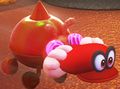 A Trapeetle preparing to explode
 Picture of a Trapeetle on the Lost Kingdom brochure


Naming[edit]
"Trapeetle" is a portmanteau of "trap" and "beetle".
Names in other languages[edit]
| Language | Name | Meaning | Note(s) | Ref. |
|---|---|---|---|---|
| Japanese | キャッチムシ Kyatchi Mushi | Catch Bug | [3][4] | |
| Chinese (Simplified) | 接帽虫 Jiēmàochóng (Mandarin) Jipmóuchùhng (Cantonese) | Cap-catching Bug | [5] | |
| Chinese (Traditional) | 接帽蟲 Jiēmàochóng (Mandarin) Jipmóuchùhng (Cantonese) | Cap-catching Bug | [6] | |
| Dutch | Trapeetle | - | [7] | |
| French | Raflard | From rafler ("to nick", "to steal") and the pejorative suffix -ard or cafard ("cockroach") | [8][9][10] | |
| German | Schnappäfer | Contraction of Schnapp Käfer ("snap beetle"); comparable to Schnellkäfer ("click beetle") and potentially a play on Schnappkiefer ("snapjaw") | [11][12] | |
| Italian | Rapinsetto | Portmanteau between rapire ("to kidnap") and insetto ("insect" or "bug") | [13] | |
| Korean | 캐치벌레 Kaechi Beolle | Catch Bug | [14] | |
| Russian | Жук-хватун Zhuk-khvatun | Catching beetle | [15] | |
| Spanish | Atraparásito | From atrapar ("catch") and parásito ("parasite") | [16][17][18] |
References[edit]
- ^ Kingdom Brochures
- ^ Sakai, Kazuya, kikai, Rachel Roberts, and Jenny Blenk, editors (2019). The Art of Super Mario Odyssey (First English Edition). Translated by TransPerfect. Milwaukie: Dark Horse Books. ISBN 978-1-50671-375-5. Page 166.
- ^ 「空の覇者がジャンゴなら、大地の覇者はキャッチムシだ。」– Lost Kingdom brochure (27 Oct. 2017). Super Mario Odyssey by Nintendo EPD Tokyo (Ver. 1.3.0). Nintendo (Japanese).
- ^ Sakai, Kazuya, and kikai, editors (2018). 『スーバーマリオ オデッセイ 公式設定資料集』. Tokyo: ambit (Japanese). ISBN 978-4-19-864696-7. Page 166.
- ^ "秃鹫强哥若是空中的霸主,接帽虫则是大地的霸主。" – Lost Kingdom brochure (27 Oct. 2017). Super Mario Odyssey by Nintendo EPD Tokyo (Ver. 1.3.0). Nintendo (Simplified Chinese).
- ^ 「禿鷲若是空中霸者,大地霸者就是接帽蟲。」– Lost Kingdom brochure (27 Oct. 2017). Super Mario Odyssey by Nintendo EPD Tokyo (Ver. 1.3.0). Nintendo (Traditional Chinese).
- ^ "Trapeetles zijn een ware plaag in dit rijk." – Lost Kingdom brochure (27 Oct. 2017). Super Mario Odyssey by Nintendo EPD Tokyo (Ver. 1.3.0). Nintendo (Dutch).
- ^ « Le raflard, un vrai danger. Après avoir saisi sa proie, il la tient fermement, puis bondit en avant et explose. » – Lost Kingdom brochure (27 Oct. 2017). Super Mario Odyssey by Nintendo EPD Tokyo (Ver. 1.3.0). Nintendo (Canadian French).
- ^ « Le Raflard, un vrai danger. Après avoir saisi sa proie, il la tient fermement, puis bondit en avant et explose. » – Lost Kingdom brochure (27 Oct. 2017). Super Mario Odyssey by Nintendo EPD Tokyo (Ver. 1.3.0). Nintendo (French).
- ^ Walsh, Doug, and Epstein, Joe (2017). Guide de Jeu Super Mario Odyssey (French Edition). Terni: Multiplayer Edizioni, Prima Games (French). ISBN 9788866312628. Page 347.
- ^ „Vorsicht vor dem Schnappäfer!“ – Lost Kingdom brochure (27 Oct. 2017). Super Mario Odyssey by Nintendo EPD Tokyo (Ver. 1.3.0). Nintendo (German).
- ^ Walsh, Doug, and Epstein, Joe (2017). Super Mario Odyssey: Das offizielle Lösungsbuch (German Edition). Terni: Multiplayer Edizioni, Prima Games (German). ISBN 978-8-8663127-9-6. Page 347.
- ^ «Guardatevi bene dal pericoloso Rapinsetto: usa le sue grandi mani per catturare la preda e tenerla stretta a sé finché non esplode.» – Lost Kingdom brochure (27 Oct. 2017). Super Mario Odyssey by Nintendo EPD Tokyo (Ver. 1.3.0). Nintendo (Italian).
- ^ "하늘을 장고가 지배하고 있다면 땅을 지배하는 생물은 캐치벌레다." – Lost Kingdom brochure (27 Oct. 2017). Super Mario Odyssey by Nintendo EPD Tokyo (Ver. 1.3.0). Nintendo (Korean).
- ^ «Жук-хватун — опасное существо: он крепко хватает жертву гигантскими лапами, а затем взрывается.» – Lost Kingdom brochure (27 Oct. 2017). Super Mario Odyssey by Nintendo EPD Tokyo (Ver. 1.3.0). Nintendo (Russian).
- ^ "Los atraparásitos representan un gran peligro." – Lost Kingdom brochure (27 Oct. 2017). Super Mario Odyssey by Nintendo EPD Tokyo (Ver. 1.3.0). Nintendo (Latin American Spanish).
- ^ «Los Atraparásitos suponen un gran peligro.» – Lost Kingdom brochure (27 Oct. 2017). Super Mario Odyssey by Nintendo EPD Tokyo (Ver. 1.3.0). Nintendo (European Spanish).
- ^ Walsh, Doug, and Epstein, Joe (2017). Guía Oficial Super Mario Odyssey (Spanish Edition). Terni: Multiplayer Edizioni, Prima Games (European Spanish). ISBN 978-8-8663126-7-3. Page 347.

