Floor

|
It has been suggested that this article be split into floor (platform), floor (ground). (discuss) |
- This article is about the flat surfaces that first appeared in Mario Bros. For other uses, see Floor (disambiguation).
| Floor | |||
|---|---|---|---|
 Artwork from the Famicom version of Mario Bros. for the Famicom 40th Anniversary | |||
| First appearance | Mario Bros. (1983) | ||
| Latest appearance | WarioWare: Move It! (2023) | ||
| |||
Floors[1][2] are horizontal surfaces in the Mario Bros. arcade game and its various ports. They have subsequently appeared in contexts alluding to Mario Bros. in the franchise, as well as independent platforms in the mainline Super Mario series. Player characters can jump into blue floors (also called platforms)[3] from below to bend or dislodge individual segments, stunning or defeating any enemy standing on top, while the red floor (also called the ground)[3] is composed of bricks and serves as stable footing above the water. The gameplay mechanic of floors has subsequently become incorporated into other games in the franchise and has become a staple of their platformers, most notably through ? Blocks and Brick Blocks.
History[edit]
Mario Bros.[edit]

Floors appear as the main platforms used in Mario Bros. While they function as normal platforms when the player stands on them, the player can also bump blue floors from below to stun enemies and collect coins on the place where the platform was bumped. Their appearance changes depending on the phase, and there are also slippery and invisible versions. On the edges of the upper and bottom floors are pipes where enemies and coins enter and exit the phase, respectively.
Floors reprise their roles in the various in-game ports of Mario Bros., including the battle mode in Super Mario Bros. 3, the Battle Game in Super Mario All-Stars, the remake in the Super Mario Advance games and Mario & Luigi: Superstar Saga, and the game Luigi Bros. in Super Mario 3D World and its Nintendo Switch port.
Super Mario series[edit]
Super Mario Bros. 3 / Super Mario All-Stars[edit]
In the Mario Bros.–inspired Battle Mode of Super Mario Bros. 3, floors[4] return as footholds. The blue floors make up the broad platforms that the player must hit from below to defeat the enemies on top. Unlike the original arcade game or its Famicom conversion, blue floors are segmented and interacted with similarly to normal blocks found in the courses: striking a segment nudges it upward, but not the segments it is continuous with. The direction the enemy flips still depends on Mario or Luigi's position relative to the enemy rather than either to the block. Red floors are now colored orange in the NES version and green in the SNES and GBA versions, although different red brick floors appear in the final level.
New Super Mario Bros.[edit]

Orange floors appear in New Super Mario Bros., behaving the same as blue floors their debut game. They appear in World 2-2 and World 8-6.
New Super Mario Bros. U / New Super Luigi U / New Super Mario Bros. U Deluxe[edit]
Red and white platforms[5] appear in New Super Mario Bros. U, New Super Luigi U, and their enhanced port. They act similarly to the previous orange floors. Red and white platforms appear in Screwtop Tower, Shifting-Floor Cave, and World  Coin-2 in New Super Mario Bros. U and in Sumo Bro's Spinning Tower in New Super Luigi U.
The platforms in the Boss Sumo Bro's battle area can be used to stun it as it falls on its back, leaving its stomach vulnerable, and to ground-pound it to cause damage to the large Sumo Brother,
Super Smash Bros. series[edit]
Floors appear in the Super Smash Bros. series in the Mario Bros. stage introduced in Super Smash Bros. Brawl and returning in Super Smash Bros. Ultimate. They function the same as in the original arcade game. Bumping the blue floor while an opponent is on top bumps them into the air with no damage taken.
Gallery[edit]
 Mario Bros. Atari 2600 advertisement
 Sprite from Super Mario Bros. 3
 Super Mario Bros. 3 (background layer, unused)
 Super Mario Bros. 3 (sprite layer, unused)
 Sprite from Super Mario All-Stars
 Luigi hitting a floor block
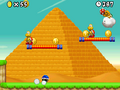 New Super Mario Bros.
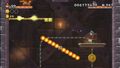 New Super Mario Bros. U
 Mario Bros. (Famicom 40th Anniversary)
 Promotional photo for the Family Computer - Nintendo Switch Online controllers from Nintendo Co., Ltd.'s Instagram account


Naming[edit]
Internal names[edit]
| Game | File | Name | Meaning
|
|---|---|---|---|
| New Super Mario Bros. U | content/Common/actor/mario_brothers_yuka.szs | mario_brothers_yuka | Mario Brothers Floor |
Names in other languages[edit]
| Language | Name | Meaning | Note(s) | Ref. |
|---|---|---|---|---|
| Japanese | マリオブラザーズ床 Mario Burazāzu Yuka | Mario Brothers Floor | [6] | |
| フロア Furoa | Floor | Mario Bros. | [7] | |
Yuka | Mario Bros., Super Mario Bros. 3, Super Mario All-Stars | [8][9][10][11] | ||
| ブロック Burokku | Block; referring to an individual segment | Super Mario Bros. 3 | [12] | |
| Italian | Blocco | Block | [13][14] | |
| Pavimento | Floor | Mario Bros. (ATARI 2600), Super Mario Advance series | [15][16] | |
| Piattaforma rossa e bianca | Red and white platform | New Super Mario Bros. U | [17] | |
| Piattaforma | Platform | NES Classic Edition | [18][19] | |
| Pavimento Mario Bros. | Mario Bros. floor | Super Mario Bros. Encyclopedia | [20] |
References[edit]
- ^ "1 hit flips it over!! Only when touching floor!!" – 1983. Mario Bros. Fighterfly in-game demonstration. Nintendo (English).
- ^ 1983. Mario Bros. back flyer. Nintendo of America Inc. (English).
- ^ a b Rocha, Garitt, and Nick von Esmarch (November 11, 2016). Playing With Power: Nintendo NES Classics. Prima Games (American English). ISBN 9780744017779. Page 53.
- ^ 1990. Super Mario Bros. 3 Instruction Booklet (PDF). Redmond: Nintendo of America. Page 28.
- ^ Screwtop It Up video description in New Super Mario Bros. U Deluxe.
- ^ Sakai, Kazuya (Ambit) et al. (October 19, 2015). Super Mario Bros. Hyakka: Nintendo Kōshiki Guidebook, Super Mario Sunshine section. Shogakukan (Japanese). ISBN 978-4-09-106569-8. Page 119 and 217.
- ^ 1983. 『マリオブラザーズ』back flyer. Nintendo Co., Ltd. (Japanese).
- ^ 1983. 『マリオブラザーズ 遊び方』(cabinet instruction card). Nintendo Co., Ltd. (Japanese). No furigana.
- ^ 1983. 『マリオブラザーズ 取扱説明書』(Family Computer) (PDF). Kyoto: Nintendo Co., Ltd. (Japanese). Page 7 and 8. No furigana.
- ^ Nintendo Co., Ltd. (1988). 『スーパーマリオブラザーズ3 取扱説明書』 (PDF). Tokyo: Nintendo Co., Ltd. (Japanese). Page 27.
- ^ Perfect Ban Mario Character Daijiten. Shogakukan (Japanese). Page 178.
- ^ November 20, 1994. 「パーフェクト版 マリオキャラクター大事典」(Perfect Ban Mario Character Daijiten). Shogakukan (Japanese). ISBN 4-09-259067-9. Page 149.
- ^ «Se salti sopra al tuo avversario o colpisci da sotto il blocco su cui si trova, questo farà cadere un'eventuale carta in suo possesso.» – 2010. Super Mario All-Stars - Edizione 25° anniversario manuale di istruzioni. Nintendo of Europe (Italian). Page 20.
- ^ «Colpisci i blocchi sotto le tartarughe e i granchi per capovolgerli!» – description for Mario Bros. (3 Nov. 2023). WarioWare: Move It! by Intelligent Systems. Nintendo (Italian).
- ^ «Per sbarazzarsi di una bestiolina sul pavimento, colpite il pavimento direttamente sotto la bestiolina per buttarla a zampe all'aria» – 1988. Mario Bros. (ATARI 2600) multilanguage booklet. Nintendo (Italian). Page 5.
- ^ «Per capovolgere i nemici colpisci il pavimento sotto di loro. Quando sono capovolti, calciali fuori dallo schermo per eliminarli.» – 2001. Super Mario World: Super Mario Advance 2 instruction booklet. Nintendo of Europe (Italian). Page 118.
- ^ New Super Mario Bros. U - Sfide: Su con le viti (Wii U)
- ^ «Ribalta i nemici colpendo dal basso la piattaforma sulla qual si trovano, poi tira loro un calcio per eliminarli.» – Mario Bros. e-manual. Nintendo of Europe (Italian). Tab 3.
- ^ «I nemici escono dai tubi nella parte superiore dello schermo e li puoi eliminare colpendo la piattaforma sotto di loro e dando poi loro un calcio.» – Super Mario Bros. 3 e-manual. Nintendo of Europe (Italian). Tab 7.
- ^ November 15, 2018. Super Mario Bros. Enciclopedia. Magazzini Salani (Italian). ISBN 889367436X. Page 119 and 217.


| Mario Bros. | |
|---|---|
| Characters | Mario • Luigi |
| Items and objects | ? Blockb • ? Kinokoc • Cardb • Coin • Eggd • Fish Skeletond • Floor • Garbage cand • Heartd • Koopa Shelld • Ladderb • POW Block • Starmand • Super Mushroomc • Wafera |
| Enemies and obstacles | Booc • Bowserd • Fighter Fly • Fireball • Ice • Icicle • Koopac • Shellcreeper • Sidestepper • Slipice • Spinybcd |
| Music and sound effects | "Coin" • "Game Start" • "Ocean Loader 2"e • "Title BGM" • "Bros. Battle"bcd |
| Alternate versions | Battle Game • Donkey Kong/Donkey Kong Junior/Mario Bros • Luigi Bros. • Mario Bros. (Classic Serie) • Mario Bros. (Game Boy Advance) • Mario Bros. (Super Mario Bros. 3) • Mario Bros. Returns • Mario Bros. Special • Punch Ball Mario Bros. |
| Other | Gallery • Game Sound Museum: Mario Bros. / Super Mario USA • Mario Bros. (board game) • Multimedia • Nintendo Music (soundtrack) • "Something's Gumming Up the Plumbing"a • Staff • Submissions |
| e Commodore 64 PAL port | |