Small animal
- This article is about wildlife from Super Mario Odyssey and Donkey Kong Bananza. For the animal friends from the Sonic the Hedgehog franchise, see Animals.
| Small animal | |||
|---|---|---|---|
    Squared screenshots | |||
| First appearance | Super Mario Odyssey (2017) | ||
| Latest appearance | Donkey Kong Bananza (2025) | ||
| |||
Small animals[1] appear in Super Mario Odyssey and Donkey Kong Bananza as interactable creatures that are naturally skittish and defensively run away a short distance if the player is near. Their behavior does not change even if they are approached slowly or is in a captured form.
Though not as behaviorally complex, the small animals parallel the small birds in the same games.
History[edit]
Super Mario Odyssey[edit]
Small animals are found in Super Mario Odyssey throughout the earthbound kingdoms and represent four different species of animal, complimenting their respective kingdom's environment. Like many other creatures in Super Mario Odyssey, small animals are of realistic designs. Doggedly chasing one eventually causes the small animal to disappear in a puff of dust, leaving a collectible coin behind. They otherwise appear idly moving in an area, often slowly. Like small birds and fish, all four appear in the Mushroom Kingdom once Princess Peach and Tiara return to Peach's Castle. The four small animals are as follows:
- Chipmunks, striped rodents found in the forested portions of the Wooded Kingdom. They forage for seeds and sit upright while idling, but run away on all fours. They resemble Siberian chipmunks, the only chipmunk species that occurs in Japan.
- Rats, dark-furred rodents found in the Metro Kingdom, most often within back alleys and around Trash Cans. They forage and run away on all fours, often disappearing at the corners of buildings. They occur in the Underground Power Plant. The rats resemble Asian house rats and black rats.
- Geckos, terrestrial lizards found in the Sand Kingdom and the Deep Woods of the Wooded Kingdom. They have banded backs and orange sclerae. In the Deep Woods, their bodies reflect light as if covered in water. While largely unmoving while idling, geckos rapidly shift their bodies from side to side when they flee. This emulates the Carrier's constraint that impacts the locomotion of real-world lizards. They do not closely resemble any one real-world species of gecko.
- Crabs, decapods found in the Lake Kingdom and Seaside Kingdom. They are the only small animal that occurs on land and underwater. While idling, crabs gesture as if foraging for food or stretch their claws skyward. The crabs in the Lake Kingdom are pink, and the ones in the Seaside Kingdom are yellow. The right claw is larger. They run away sideways, like real crabs. Though they do not resemble any one real-world species, they are most similar to Brachyura. Crabs have made prior appearances in the Super Mario franchise. Their behavior in Super Mario 3D World is most similar to the small animals and may have influenced their conceptualization.
Donkey Kong Bananza[edit]
This section needs more Donkey Kong franchise information and is being worked on by TheCatLover738 (talk). Specifically:
- Add the remaining small animal types (squirrels and pink bugs).
- Determine what real life species the lizards most closely resemble.
Small animals reappear in Donkey Kong Bananza, although unnamed. Small animals can either appear at preset locations on a layer or when smashing terrain. Many of the small animals are less realistic and have a wider variety of behaviors compared to their prior appearance; however, the rats found in Ingot Isle Cave-In maintain their realism. Most of them feature gemstones on their body. When a small animal is attacked by Donkey Kong or is chased long enough, it will burrow into the ground and leave behind a single gold flake that is automatically added to the player's gold total.
In the Emerald Rush game mode added in the DK Island & Emerald Rush DLC, the emerald ore given by small animals can be increased by acquiring certain Emerald Perks.
The small animals are as follows:
- Crabs, decapods found on the Lagoon Layer, Resort Layer, and DK Island. They are blue-colored with gemstones on their back in the Underground World and red-colored without gemstones on DK Island. Crabs are almost motionless when idiling, only moving their body up and down slightly.
- Rats, rodents found in Ingot Isle Cave-In and on the Racing Layer. The rats found in Ingot Isle Cave-In highly resemble the ones found in the Metro Kingdom, being gray and realistic. In contrast to the realistic design of the Ingot Isle Cave-In and New Donk City rats, the rats found in the Racing Layer are a light shade of blue and feature blue and green gemstones lining their tail. When idle, rats sniff the area and squeak.
- Moles, green Eulipotyphla found on the Hilltop Layer and the Landfill Layer. When approached, they burrow underground and run away from Donkey Kong. Eventually, they will emerge from the ground until approached again, after whoich they will run away again. Moles have green gemstones in place of claws, though their hind claws appear less gemstone-like. Like crabs, moles are almost motionless when idle, only moving their body slightly.
- Lizards, blue reptiles found on the Canyon Layer, the Forest Layer, and the Radiance Layer. They have the ability to climb on ceilings unlike other climbing small animals. Lizards have blue and purple gemstones lining their backs. When idle, lizards flick their tail left and right, interrupted by an occasional upward flick.
Gallery[edit]

Artwork of a chipmunk
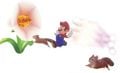
Artwork of chipmunks

Model of a gecko
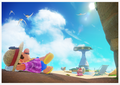
Artwork of a yellow crab in the Seaside Kingdom
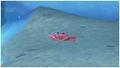
Screenshot of a pink crab
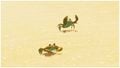
Screenshot of a yellow crab
.png)


Names in other languages[edit]
| Language | Name | Meaning | Note(s) | Ref. |
|---|---|---|---|---|
| Japanese | 小動物 Shōdōbutsu |
Small Animal | [2] |
References[edit]
- ^ Sakai, Kazuya; kikai; Roberts, Rachel; Blenk, Jenny (editors) (2019). "Cascade Kingdom". The Art of Super Mario Odyssey (First English Edition). Milwaukie: Dark Horse Books. Page 85.
- ^ Sakai, Kazuya; kikai (editors) (2018). 『スーバーマリオ オデッセイ 公式設定資料集』. Tokyo: ambit (Japanese). ISBN 978-4-19-864696-7. Page 85.

