
Mario vs. Donkey Kong: Tipping Stars
| Mario vs. Donkey Kong: Tipping Stars | |||||||||||
|---|---|---|---|---|---|---|---|---|---|---|---|
 European Wii U box cover  European Nintendo 3DS box cover For alternate box art, see the related gallery. | |||||||||||
| Developers | Nintendo Software Technology Corporation Nintendo SPD Group No.3 | ||||||||||
| Publisher | Nintendo | ||||||||||
| Platforms | Wii U Nintendo 3DS | ||||||||||
| Engine | Nintendo Web Framework | ||||||||||
| Release dates |  March 5, 2015[1][2][3] March 5, 2015[1][2][3] March 19, 2015[4] March 19, 2015[4] March 20, 2015[5][6] March 20, 2015[5][6] March 21, 2015[7] March 21, 2015[7] | ||||||||||
| Languages | English (United States) English (United Kingdom) Japanese French (Canada) French (Europe) German Italian Spanish (Latin America) Spanish (Europe) | ||||||||||
| Genre | Puzzle | ||||||||||
| Ratings |
| ||||||||||
| Mode | Single-player | ||||||||||
| Format |  Optical disc Optical disc Digital download Digital download Game Card Digital download Game Card Digital download | ||||||||||
| Input | |||||||||||
| Serial codes | Wii U: WUP-WAFJ-JPN WUP-WAFP-EUR Nintendo 3DS: CTR-JYLJ-JPN CTR-JYLP-EUR | ||||||||||
 - Everyone
 - All ages
 - Three years and older
 - All ages
 - General

Mario vs. Donkey Kong: Tipping Stars is an action puzzle game for the Wii U and Nintendo 3DS. It is the sixth Mario vs. Donkey Kong game overall and the first game in the series to be released on a home console. The game is a follow-up to Mario vs. Donkey Kong: Mini-Land Mayhem! and shares elements with most of the series, including navigating a number of Minis to their exits and allowing players to build their own levels. Players were able to share custom stages through Miiverse until it was shut down on November 7, 2017. The title could also be played over Nintendo Network, but the service was terminated on April 8, 2024, making the game no longer playable online.[13][14] The focus of the game are the stars, which form a reward earned in accordance to how the player performs in levels. They are used to tip other players for their shared stages or unlock parts and new Minis for custom levels in the Workshop Store. The game is digital-only except in Japan. Game cases with download codes were sold in Europe. The Wii U version requires 0.93 GB of memory to be installed, and the Nintendo 3DS version requires 3,200 blocks[15] (409.6 MB).
The game supports a form of cross-platform play, where if one version of the game is bought off the Nintendo eShop, the buyer receives a free download code of the other version, and levels can be shared between the Nintendo 3DS and Wii U versions of the game.
The game was later removed from the Wii U and 3DS eShop services after their discontinuation on March 27, 2023, making it no longer possible for players outside of Japan to purchase the game, but players who did so before this date can still play it as long as any version is on their Wii U device, their 3DS device, or both.
Story[edit]
As in previous Mario vs. Donkey Kong games, Pauline is once again kidnapped by Donkey Kong, although this time, no motivation is given. Mario chases after Donkey Kong with his Mini Mario toys to rescue her.
After traversing six puzzle-filled worlds, while freeing cursed Mini Mario toys along the way, Mario catches up to Donkey Kong and Pauline in a darkened room. The lights are switched on, revealing Pauline, Donkey Kong, and two Toads giving Mario a surprise party. Mario can then continue through more worlds and bonus levels knowing Pauline is safe.
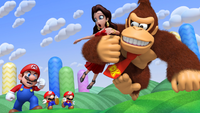 The beginning of the game
 Mario's surprise party


Gameplay[edit]
As in the game's predecessors, the main goal of every stage is to simply lead all Mini toys to the end of the level, which is done by manipulating certain parts of the environment. Using the console's touchscreen, players are able to drag objects such as red girders, springs, conveyor belts, pipes, and lifts to guide the characters.
The most common level type in the game is the Single-Door level, in which a lone Goal Door represents the objective. In order to clear a course, each Mini must be brought to the Goal Door, immediately followed by another. The first Mini toy to reach the exit commences a short timer which shuts the door after a few moments, locking away any other Mini toy if they do not reach the door in time and resulting in a Game Over. Multi-Door levels, a feature introduced in Mario vs. Donkey Kong: Mini-Land Mayhem!, are also found in Tipping Stars, where different Minis have to be rescued from Capsules and led through separate doors, each assigned to one of the Minis. In Multi-Door levels, there is no time limit between entering different doors.

Each world contains eight levels and follows a specific formula:
- the first level of every world introduces a new game mechanic, which becomes recurrent from that point onward.
- the third level, and sometimes the sixth level, is where enemies such as Shy Guys, Pokeys or Thwomps appear.
- the fourth level is always a Multi-Door course, the rest being Single-Door.
- the fifth level is then marked by the presence of a type of Donkey Kong's robot, such as Circus Kongs, Cannon Kongs or Capture Kongs.
- the seventh level has a locked exit, which can only be opened by a Key Mini Mario
- instead of a boss battle as in the predecessors, every world is closed by a level where a Cursed Mini Mario has to be reverted to its normal state by hitting it with Hammers, then escorted along with the other Minis to the Goal Door.
A level must be finished within its time limit, always set to 300 seconds. Otherwise, the result will be a Game Over. Game Overs also occur if Minis touch spikes, fall from a height of ten blocks or more and land without breaking their fall by sliding down a slope, or come into contact with enemies.[16] Enemies can be defeated by having a Mini slide down a slope into them, shooting a Mini from a cannon into them, or by using Hammers. Hammers function similarly to the hammer from the Donkey Kong arcade game: the Mini with the Hammers swings them automatically while moving, but they wear off after a short period.
When there are only 30 seconds left in the timer, a frantic melody starts playing, prompting the player to hurry and finish the level. The music is the same as in the third installment, but remixed.
Scoring system and stars[edit]

Each level has a trophy ranking based on a score, which is determined by the following:
- Small and big coins spread throughout the levels. They are worth 100 and 1000 points, respectively. There is also a single M Coin in each level, worth 2000 points. Collecting all coins in a level awards the player an additional 6000 points.
- Every second left on the timer, each worth 20 points.
Three high scores signifying three different rankings are established for each level and are linked to a bronze, silver, and gold trophy, in order from lowest to highest. Acquiring one trophy rewards the player with one star; in this respect, achieving the gold trophy in a level signifies a three star rating for that level. Stars form a collectable entity, and a total of 267 stars can be earned in the main game. Before Miiverse was shut down, additional ones could also be obtained as tips from other players for uploaded levels.
Workshop[edit]

- Main section: Construction Zone § Mario vs. Donkey Kong: Tipping Stars
The game also features a mode known as the Workshop, which allows the player to create, play, and share their own custom levels. The Workshop Store allows players to use their collected stars to unlock elements that can be used in the level editor, which is known as the Workshop Editor.
Community[edit]

The game presented online functions, which were paired with Miiverse. However, as of November 7, 2017, when the service was shut down, these are no longer available. Before the discontinuation, levels made and shared by other players could be accessed in Community mode. People could play and 'Yeah' these levels. Stars earned in the main game or by playing user-created levels could be tipped to level creators, which unlocked Miiverse stamps for the tippers in exchange. Levels could be sorted by "Popular", "Latest", "Saved" (there was a download feature), "Friends & Followed", "Official Levels", and "Street Pass".
Both the Workshop mode and the Community mode are based on a user profile that was activated when users first entered either of them. Players without a profile have currently no access to the Community, but those who had opened a profile prior to the dicontinuation of Miiverse can still enter it, although it is devoid of levels. Players can click their Mii icon to access their own user profile, which displays some information linked to the service: the number of 'Yeah's received on their levels, comments posted, and stars tipped to other players, as well as the number of shared levels. Likewise, the SpotPass functionality can be toggled there. The profiles of other players could be accessed in Community mode via comments they had posted on other levels. Their region determined the color behind their Mii on the profile picture, which was red for Japan, yellow for Europe and Oceania, and blue for the Americas.
Help Mode[edit]
The game offers in-game tips for gameplay, editing and online features. However, they are handled differently depending on the version they appear in. In the Wii U version, tips simply appear on the loading screens. In the Nintendo 3DS version, there is a separate "Help Mode" accessible through a button with a question mark in each of the Game, Bonus, Workshop and Community menus.
In the main Game and Bonus menus, tips are related to gameplay. They are the following:
- Chain Rule: Minis must reach the goal close together, otherwise the M Door will shut and lock the others out.
British English version: Minis must reach the goal close together; otherwise the door will shut and lock the others out. - Items: Items like Red Girders can be placed, picked up, and placed again.
- Scrolling Controls [Nintendo 3DS version]: On large levels, use
 /
/  ,
,  ,
,  ,
,  , or
, or  to scroll around the screen.
Scrolling Controls [Wii U version]: On large levels, use the Left Stick or the Right Stick to scroll around the screen. - Earning Gold Trophies: Pick up all the coins and reach the door quickly to earn a high score and a gold trophy.
In the Workshop menu, tips are related to building levels and sharing them:
- Earning Tips: Share your level to earn stars! Online levels will earn stars when they are played. They can also earn stars when players tip you.
- Resource Item Limits: Your level can contain up to four replaceable types of items, such as Red Girders, Long Springs, Movable Pipes or Blue Lifts.
- Getting Ready To Share: Before you can share a level, you'll need to play through it and collect all the coins.
- Level Themes: When editing a level, you can change the appearance of items in the background.
Finally, the Community menu offered tips related to users found online and the interaction with them:
- Profiles: Access a player's profile by selecting their Mii from the comments list.
- Tipping Good Levels: Tip the creator of a level with stars to let them know how much you like it. You can earn stamps in the process.
- Location Colors: Check a Mii character's background color to see where the post came from.
- Earning Stars: You can earn up to three stars on a level - one for each trophy.
Controls[edit]
 – drag or tap objects; navigate menus
- //
 /
/ – navigate level
  /
/  – pause game
Characters[edit]
The cast is primarily composed of the Mini toys, which are the focus of the Mario vs. Donkey Kong series. Mini Luigi appears for the first time, and Mini Donkey Kong receives a redesign. Despite Mario and Donkey Kong being titular characters, they fulfill only minor roles, appearing only on the title screen and the game's few cutscenes. In addition, Mario can be heard exclaiming "Way to go!" after all coins are collected in a level. Pauline and a few Toads also make appearances in the cutscenes.
All Minis have the same behavior: They start levels inactive and unmoving. Once activated, they walk forward, jump up one block high steps, slide down slopes too steep for them to walk up, reverse direction at walls or when they walk into each other, and use any items or objects they come into contact with. If there is no ground beneath a Mini, it falls straight downward. If they land on another Mini, they bounce a short distance straight up but do not change direction. Minis do not reverse direction if they collide with a Mini who is in the process of using a Goal Door. All Minis break if they touch spikes, touch an enemy, or fall from a height of ten blocks without breaking their fall by sliding down a slope. Since all Minis must reach a Goal Door for a level to end, any Mini breaking causes a Game Over.
In Multi-Door levels, each of the different Goal Doors can only be entered by the Mini they depict. Minis in these levels can be trapped inside Capsules, and they can only be freed by having an active Mini touch the Capsule. Minis that are freed from Capsules start off activated. Some levels have a Key Mini Mario, who has to be led to the Goal Door to unlock it so that all the Minis are able to enter the door. When a Key Mini Mario unlocks the Goal Door, it immediately enters it.


Worlds[edit]

Each of the eight main worlds of the game (six standard, two extra) introduces a new mechanic and contains eight levels. The last level in each world is always centered around a Cursed Mini Mario. Levels in the main game are unlocked by completing the level that precede them.
Apart from the main game, there are 24 additional levels to unlock in a separate, Bonus feature. The player unlocks a Bonus Level for every 4 gold trophies obtained, except for Level B-21 onward, when levels are unlocked for each gold trophy earned. In order to unlock all Bonus Levels, the player has to acquire a total of 87 gold trophies. Compared to levels from the main game, Bonus Levels have increased difficulty. Each world from the main game is the setting of two consecutive Bonus Levels.
Between the Nintendo 3DS and the Wii U versions of the game, many levels have slight design differences to accommodate to the screen of the console. However, they only minimally affect gameplay in some of them.
| Main worlds | ||
|---|---|---|
| # | World | Description |
| 1 |  Rolling Hills |
Introduces the simple mechanics used throughout the game, such as Red Girders, Rivets and Ladders. The only enemies are a single Shy Guy and the Cursed Mini Mario in the final level, though there are also two Circus Kongs. Levels 1-1 • 1-2 • 1-3 • 1-4 • 1-5 • 1-6 • 1-7 • 1-8 |
| 2 |  Jumpy Jungle |
A world that focuses on the use of Long and High Springs. Circus Kongs are also present here. Levels 2-1 • 2-2 • 2-3 • 2-4 • 2-5 • 2-6 • 2-7 • 2-8 |
| 3 |  Runaway Warehouse |
The emphasis of this world are the conveyors, many of which are purple and can be stretched between rivets. It introduces Thwomps and Cannon Kongs. Levels 3-1 • 3-2 • 3-3 • 3-4 • 3-5 • 3-6 • 3-7 • 3-8 |
| 4 |  Crumbling Cavern |
A place teeming with Movable Pipes, green pipes which can be positioned conveniently. A few Fire Piranha Plants inhabit this world. Levels 4-1 • 4-2 • 4-3 • 4-4 • 4-5 • 4-6 • 4-7 • 4-8 |
| 5 |  Dashing Desert |
This world introduces Blue Lifts and also marks the first appearance of Pokeys and Capture Kongs in the game. Levels 5-1 • 5-2 • 5-3 • 5-4 • 5-5 • 5-6 • 5-7 • 5-8 |
| 6 |  Twilight Valley |
The last world before the game's conclusion. It adds Pink Blocks to the gameplay, which act as solid walls and platforms and can be placed or removed. Levels 6-1 • 6-2 • 6-3 • 6-4 • 6-5 • 6-6 • 6-7 • 6-8 |
| E1 E2 |
  Orbiting Observatory |
Two extra worlds in the main game, in which magnet surfaces are first explored. Many other elements introduced in previous worlds also appear. Levels E1-1 • E1-2 • E1-3 • E1-4 • E1-5 • E1-6 • E1-7 • E1-8 E2-1 • E2-2 • E2-3 • E2-4 • E2-5 • E2-6 • E2-7 • E2-8 |
| Bonus Levels | |
|---|---|
| Bonus # | Levels |
| Bonus 1 | B-1 • B-2 • B-3 • B-4 • B-5 • B-6 • B-7 • B-8 |
| Bonus 2 | B-9 • B-10 • B-11 • B-12 • B-13 • B-14 • B-15 • B-16 |
| Bonus 3 | B-17 • B-18 • B-19 • B-20 • B-21 • B-22 • B-23 • B-24 |
Other areas[edit]
There are four unlockable backgrounds in the Workshop Store that can be used by players to decorate levels created by them in the editor. Although these areas do not have their own worlds in the main game, they theme some of the Bonus Levels. In the Workshop, there is an additional Editor Land theme, which is available to use from the start; however, none of the pre-built levels feature it.
| Area | Description | Levels |
|---|---|---|
 Winding Ravine |
Winding Ravine is a sky area with rocky peaks and crags seen in the far background. Many huge, colorful mushrooms are grown above the clouds. Winding Ravine is set at dusk, as there are many stars visible in the sky. | B-15, B-16, B-17 |
 Swirling Courtyard |
Swirling Courtyard is an area located closely to Peach's Castle. Numerous arches with crenels surrounding the foreground are patterned with stars, as well as some heraldic banners containing Golden Mushroom badges. Further behind, beyond a shrub garden where several white pigeons fly around, lie the castle ramparts, with an opening visible. On a hill continuing even further and behind some towers is Princess Peach's Castle itself. The music that plays in Swirling Courtyard is reused from Teatime Twirl in Mario vs. Donkey Kong: Mini-Land Mayhem!. | B-18, B-19, B-20 |
 Clattering Cabin |
Clattering Cabin is a sinister and gloomy building with large Gothic windows and architecture. Many torches are placed on the walls, and there is a lot of old furniture as well. The area features two staircases leading to a big corridor. Next to the staircases is a grandfather clock with a pendulum resembling a Shy Guy mask, and under the staircases, the portrait of a Shy Guy. The music that plays in Clattering Cabin is a retuned version of Warped Mansion's music from Mario vs. Donkey Kong: Mini-Land Mayhem!. | B-21, B-22, B-23 |
 Shimmering Gold Palace |
Shimmering Gold Palace, or simply Gold Palace,[17] is an area with piles of treasure gathered around a gilded palace. Structures present around the main building include towers and ramparts with many windows. The music that plays in Shimmering Gold Palace levels is an arrangement of "Invincibility BGM" from the Super Mario franchise, which is also used for the Mini Guide in Mario vs. Donkey Kong: Mini-Land Mayhem!. | Level B-24 |
 Editor Land |
Editor Land is an area that resembles the editing space in the Workshop, having a grid background. This is the only Workshop background not to decorate any pre-loaded levels from the game. | N/A |
Objects[edit]
The game's numerous objects can be split into four categories: collectibles, objects that can be obtained only by a Mini toy; resource items, which can be stockpiled and moved or dragged on the screen using the console's touchscreen; fixed objects, which cannot usually be modified but can be manipulated to help the Minis advance through a stage, and Donkey Kong's robots, a group of large toys that do something to Minis that collide with them. Their actions can either help or impede the player, depending on the location of the toy and its exact effect. Donkey Kong's robots can be temporarily stunned by Minis wielding Hammers, enabling the Minis to pass without triggering the robot. Cannon Kongs and Blue Lifts are the game's only new objects.
| Collectibles | |||
|---|---|---|---|
| Item | About | First appearance | Last appearance |
  Coins |
Items found in every level, usually arranged in rows of three or more. Each awards the player 100 points for the score. Among these coins, there is also a large variety that is worth ten normal coins and, therefore, 1000 points. The player needs to collect all coins in a level in order to achieve three stars for that level. | Level 1-1 | Level E2-8 |
 Hammers |
A pair of weapons that can be used by the Minis to combat enemies or destroy rocks. They are acquired for a short time and are banged repeatedly on the ground, confering the Mini that wields them a short period of invincibility. After they disappear, Hammers respawn in their initial position, allowing another use. If a Mini comes into contact with a Ladder or a Blue Lift while the Hammers are in use, they will be thrown high up in the air and can be picked up again if the Mini reaches the end of these objects in time. | Level 1-3 | Level E2-8 |
 M Coin |
A special "M"-stamped coin that is worth 2000 points. Only one appears in every stage. Like the other types of coins, collecting the M Coin is mandatory to obtain a three-star rating in a level. | Level 1-1 | Level E2-8 |
      Pickups |
Collectibles that increase the amount of resource items the player has, such as Girders, Blue Lifts and Purple Conveyors. However, they cannot be grabbed with the stylus; Minis are required to walk into them instead. | Level 1-2 | Level E2-7 |
| Resource items | |||
| Item | About | First appearance | Last appearance |
 Blue Lift |
A vertical succession of platforms that can be built between two blue rivets, only if one is located directly above the other. The movement of the platforms in a Blue Lift is determined by the direction of the swipe that created the Blue Lift. Upon encountering a Blue Lift, Minis will stop walking and will take the lift in the direction it moves, helping them reach platforms that are located underneath or above. | Level 5-1 | Level E2-7 |
  High Spring and Long Spring |
Trampolines that help the Minis bounce to higher areas. High Springs are magenta and have an oblong shape—they launch the Minis on a vertical arc. Long Springs are yellow, rounded, and launch the Minis on a more widened arc. | Level 2-1 | Level E2-8 |
 Movable Pipes |
A pair of separate pipes that are somehow interconnected. When a Mini enters one pipe, it will be warped onto the other. The player can change the positions of these pipes to facilitate movement throughout an area, even though they can only be placed on predetermined slots. | Level 4-1 | Level E2-8 |
 Pink Block |
A block that can be picked up with the stylus and then used to fill a special slot by tapping on it. Pink Blocks come in formations, and act as platforms or walls to guide the Minis. | Level 6-1 | Level E2-7 |
 Purple Conveyor |
A platform that can be dragged across purple rivets. It moves automatically in the direction established by the player with the stylus. Apart from transporting the Minis, Purple Conveyors also turn them back if they are in opposing directions, without the need of a wall. | Level 3-2 | Level E2-3 |
 Red Girder |
A platform that can be created by connecting two rivets of the corresponding color. The main game only contains red Girders, but the Workshop mode allows the player to use Girders of different colors, associated with a playable character (green—Mini Luigi, blue and white—Mini Toad, pink—Mini Peach etc.) If Red Girders are positioned horizontally or slightly slanting, the Minis can walk on them as on normal platforms. If their slant is too abrupt, they cause the Minis to slide on them as on a slope. If they are positioned vertically, they act as walls that prevent the Minis from walking further. Red Girders can be passed from underneath, making them semisolid. | Level 1-1 | Level E2-8 |
| Fixed objects | |||
| Item | About | First appearance | Last appearance |
 Cannon |
An object that slowly changes launching direction by rotating in place. It can store any amount of Minis that end up inside it, and can be tapped on to blast all Minis in the current direction. This way, apart from being able to reach far areas, the Minis can also zoom into rocks and enemies to destroy them. | Level 2-6 | Level E2-7 |
 Color Switches |
Red, blue, and yellow switches that enable or disable blocks of the same colors when jumped on. | Level 2-2 | Level E2-3 |
 Conveyor |
A platform that conveys the Minis in the direction indicated by its arrows. Conveyors are always horizontal. | Level 3-1 | Level E2-5 |
 Girder |
A semisolid platform that the Minis can walk on. Girders are always horizontal. | Level 1-2 | Level E2-8 |
 Goal Door |
The exit of each stage in the game. In Single-Door levels, the goal is to get all Minis into a single door. Once a Mini enters the door, a timer on the door starts filling up. The door closes when the timer is filled, locking out the remaining Minis and causing a Game Over. If a Mini enter the door while timer is filling up, the timer resets. A few levels feature locked exits, which require a Key Mini Mario to unlock. In Multi-Door levels, each character must be guided to the door that displays its face on it. Doors in these levels do not have timers. | Level 1-1 | Level E2-8 |
 Ladder |
A vertical set of steps needed to climb up to raised platforms, or go down a lower level. They can be seen as stationary Blue Lifts. Minis grab on a Ladder as soon as they walk into it, then continue to walk in the direction they previously followed. When two Minis bump into each other on a Ladder, they both change directions. | Level 1-6 | Level E2-7 |
.jpg) .jpg) Magnet Ground |
A platform that allows the Minis to walk on all of its surfaces. Minis fall off a Magnet if they are hanging upside-down and encounter a non-magnetic surface on their way. | Level E1-1 | Level E2-6 |
 Rock |
A small fragile block that breaks when hit with Hammers, a slope slide or a Cannon blast. Otherwise, rocks act as normal platforms the Minis can walk onto. | Level 3-7 | Level E1-5 |
 Spikes |
Dangerous surfaces covering walls and platforms. Minis that touch them are destroyed, which causes a Game Over. Spikes cannot be destroyed. | Level 1-1 | Level E2-8 |
  Pipes |
Warp Pipes come in two variations. Some Pipes are found in one piece, while others, also known as Split Pipes, have their ends separated from each other, and are also color-coded to acknowledge the player which pipe is connected to the other. Both types help transport the Minis to different locations in a level, although the length of blue Warp Pipes affect how long the Minis take to reach the other end, while Split Pipes have considerably less delay. | Level 1-4 | Level E2-7 |
| Donkey Kong's robots | |||
| Item | About | First appearance | Last appearance |
 Cannon Kong |
A stationary toy whose body consists of a giant cannon. When a Mini enters a Cannon Kong, it gets immediately launched in the direction the enemy is currently facing. This can help traverse unskippable distances and, sometimes, crash through Rocks. | Level 3-5 | Level E2-7 |
 Capture Kong |
A wandering toy that is equipped with a small barrel on its back, which it uses to capture and disable any Mini that walks into it. Hitting a Capture Kong with Hammers will stun it and free all captured Minis. While not lethal, Capture Kongs can cause a Game Over if they capture all Minis in a level. In some cases, Capture Kongs are used to the Minis' advantage, as they are able to travel on spikes and thus ferry the Minis to a safe spot. | Level 5-5 | Level E2-5 |
 Circus Kong |
A toy that tosses Minis upward repeatedly, as if juggling. Minis can escape a Circus Kong if a surface is placed between them, or if the Kong is stunned with Hammers. | Level 1-5 | Level E1-5 |
Enemies[edit]
Enemies break Minis on contact, causing a Game Over in the process. Most of them be destroyed with Hammers or other means of attack, but Thwomps are indestructible.
| Enemy | About | First appearance | Last appearance |
|---|---|---|---|
 Fire Piranha Plant |
A stationary enemy that is stuck to a surface. Apart from being harmful to touch directly, it attacks by spitting a single fireball, which travels in a straight line and returns into the enemy's mouth after bouncing off any opposing surface. The fireball can be blocked from re-entering the plant's mouth if a surface is placed in |