All Night Nippon: Super Mario Bros.
The title of this article is from the English Super Mario Bros. Encyclopedia, which reportedly sourced some names from fan wikis.
If a higher-priority source is found, then the article should be moved to the new title.
| All Night Nippon: Super Mario Bros. | |
|---|---|
 Cover art For alternate art, see the related gallery. | |
| Developer | Nintendo EAD |
| Publisher | Nippon Broadcasting System |
| Platform | Family Computer Disk System |
| Release date |  December 20, 1986[1] December 20, 1986[1] |
| Language | English |
| Genre | 2D platformer |
| Mode | Single player |
| Format | FCDS:
 Disk Card Disk Card |
| Input | |
| Serial code | ANN-NSM |

All Night Nippon: Super Mario Bros. is an officially licensed retool of Super Mario Bros.: The Lost Levels. The game was produced in 1986 for the Family Computer Disk System. As such, there is no 2 Player Game but rather the option to play as Luigi with his unique physics. This version is based on the Japanese radio program All Night Nippon, and it was sold through a lottery system on the show itself to celebrate the 20th anniversary of the program in the upcoming year. The game was published by Nippon Broadcasting System, a subsidiary of Fuji Television who would go on to publish Yume Kojo: Doki Doki Panic, localized in the Western world as Super Mario Bros. 2.
Only 3,040 copies of this game were released. Due to high demand and limited supply, listeners were told from December 15 to December 19, 1986, to send a postcard that would be entered into a lottery for 2,000 of the copies. The card had to be postmarked by December 20, 1986, to qualify. Winners received a reply postcard to alert them to send a money order for their copy. 1,000 copies were sold directly at Nippon Broadcasting System's music center window on December 20, which lead to a long queue of prospective buyers in front of the building. In addition, Famicom Tsūshin (Famitsu) and Family Computer Magazine (Famimaga) each gave out 20 free copies to their readers in a lottery. The deadline for Famitsu was December 25, 1986, while Famimaga's was January 15, 1987. Famitsu received over 30,000 submissions.[1][2][3]
The game is a remix with most of the level designs adapted from Super Mario Bros. along with the likenesses of the show's hosts as sprite swaps. It takes place in the ビバ
Story[edit]
Translated from the instruction booklet[4]
One day, the peaceful All Night Nippon dream land Viva Kingdom where Mushrooms live was invaded by the tribe of the huge turtle Koopa, who possesses powerful magic. Said magical power was used to transform all the quiet Mushroom People into rocks, bricks and mikes among other forms. All Night Nippon personalities Miyuki Nakajima, the Tunnels, Kyōko Koizumi, Beat Takeshi, and the AB Brothers were also captured. What became of Sunplaza Nakano? Pitiable Sunplaza was fooled by Koopa's letter to his “Illusionary Business Prosperity” corner into visiting him. And he was changed into Koopa Tribe minion “OkaP”.
The only one who can undo this magic on the Mushrooms and revive All Night Nippon is the Viva Kingdom's own Princess Peach. She is presently in the hands of King Koopa.
Mario has stood up to help the personalities trapped in each world, defeat the Koopa Tribe, rescue Princess Peach, and rebuild the peaceful All Night Nippon dream land Viva Kingdom.
The Mario in the TV is an avid All Night Nippon listener like you. Only you can bring this adventure quest (expedition) to a conclusion.
Differences[edit]
Graphics[edit]
- World 1 takes place at nighttime.
- Most of the graphics are from The Lost Levels, although bricks and mountains are drawn like those in Super Mario Bros. Bricks are not shaded, and mountains have smooth slopes instead of jagged slopes. Cloud platforms were replaced with the Super Mushroom platforms but now with segmented stalks (which also replace the original Super Mushroom platform designs from the original Super Mario Bros.). Additionally, microphones replace the mushrooms found in the background.
- Little Goombas and Piranha Plants were changed to big-headed caricatures of DJ Sunplaza Nakano, the Friday night host, and are respectively called OkaP and Pakkun OkaP.
- The Starman was changed into the Hiranya, a symbol popularized by Yūji Miyake's Young Paradise, the radio program that preceded All Night Nippon on the same station.
- The Nippon Broadcasting System, Inc. (the radio station that runs All Night Nippon) Mentama Mark logo is found on the flag that is raised when Mario or Luigi enter a fortress. This logo is also found as the axe.
- The mushroom retainers were changed to show's hosts, while Princess Peach is dressed as a traditional Japanese princess. This marks the first time Princess Peach has ever done her hair up, predating Super Mario Sunshine by 16 years, and is also the first media to depict her in a different outfit from her usual attire.
| Artwork | Sprite | Location | Identity |
|---|---|---|---|

|

|
World 1 | みゆき(中島みゆき) / Miyuki (Miyuki Nakajima), Monday host |

|

|
World 2 | たかあき(とんねるず・石橋貴明) / Takaaki (Tunnels' Takaaki Ishibashi), Tuesday co-host |

|

|
World 3 | のりたけ(とんねるず・木梨憲武) / Noritake (Tunnels' Noritake Kinashi), Tuesday co-host |

|

|
World 4 | KYON²(小泉今日子) / KYON² (Kyōko Koizumi), Wednesday host |

|

|
World 5 | たけし(ビートたけし) / Takeshi (Beat Takeshi), Thursday host |

|

|
World 6 | まっちゃん(ABブラザーズ・松野大介) / Matchan (AB Brothers' Daisuke Matsuno), Saturday co-host |

|

|
World 7 | ひでちゃん(ABブラザーズ・中山秀征) / Hidechan (AB Brothers' Hideyuki Nakayama), Saturday co-host |
| N/A | 
|
Worlds 8 & D | ピーチ |
| N/A | 
|
Worlds A-C | Unknown (unlisted in the manual) |
Detailed set of level differences[edit]
Most of the levels of the first eight worlds are from Super Mario Bros., but some are from The Lost Levels.
Much like VS. Super Mario Bros., the number of repeated levels from the original were reduced by reusing levels from The Lost Levels to replace them. Every level also features various edits, such as the appearance of more enemies, different maze solutions, and changed locations of ?s and bricks. However, these changes are not the same as those found in VS. In addition, all Pakkun OkaP on the ground are green and all hanging ones, introduced in World A, are red but both behave like the red Piranha Plants in The Lost Levels. The Hammer Brothers in 7-1 and 8-3 pursue Mario or Luigi like they do in those worlds in The Lost Levels. Two features from The Lost Levels have been removed. Poison Mushrooms have been replaced with regular power-ups. The removal of wind affects the difficulty of the courses they were found in. Super Springs, however, have been kept. Attempting the Minus World glitch will have an effect similar to The Lost Levels, either sending the player to the pipe near the flagpole or back to 1-1. Due to World 8-4 in this game being reused from Super Mario Bros.: The Lost Levels, along with World D-4 returning from that game, both the blue Fake Bowser and the fake Bowser's Brother from the latter level return as well.
| All Night Nippon level | Corresponding level | Description |
|---|---|---|
| 1-1 | Super Mario Bros. 1-1 | The first Super Mushroom at the start is moved up to the highest ? Block in the air. The ? Block containing the second mushroom that was originally inbetween two bricks is moved up above to the leftmost edge of the long row of bricks that the OkaPs come down from. The brick containing the Super Star, now a Hiranya in this game, is moved above the spaced row of three ? Blocks, where the ? Block containing third mushroom originally was. That third mushroom is moved to the furthest right ? Block in that same formation. |
| 1-2 | Super Mario Bros. 1-2 | The Super Star that was originally hidden in the right side of the squiggly arrangement of bricks is now moved to the left, right below a floating coin. Immediately after the first mushroom, hidden in a L-shaped arrangement of bricks hanging from the top, is a floating vertical arrangement of bricks from which an OkaP drops down from. Right above where the highest OkaP's initial position is, on the brick ceiling, is a 1-Up Mushroom inside it, earlier than its original placement above the horizontally-arranged set of bricks just after the gap. Meanwhile, the original 1-Up Mushroom spot now hosts a Super Mushroom, adding an extra to the level overall. |
| 1-4 | Super Mario Bros. 1-4 | The first two Fire Bars that hang from the low ceiling have been completely removed, alongside their empty blocks. After the narrow corridor with several Fire Bars is a wider room originally with two Fire Bar blocks on top and three on the floor. In 1-1 originally, only two of the three on the floor are actually lit up before Hard Mode. In this version, all three are. Meanwhile, the leftmost block on the ceiling has been completely removed. |
| 2-1 | Super Mario Bros. 2-1 | The second mushroom in the bottom row of ? Blocks has been moved to its exact position right on the above row of same blocks. The bricks containing the Vine and Super Star have swapped exact positions. The small gap between the pipes going in and out of the underground Sub-area has been filled. Right after the row of pipes was originally a gap where a green Koopa Troopa would eventually fall in if the player did not intervene, followed by a small bare piece of ground where a green Koopa Paratroopa leaped at the player, and then another small gap with a three blocks tall pillar that the player had to jump over to get to the rest of the level. In this version, right after the row of pipes is a red Paratroopa that flies up and down, followed by the grounded green Koopa Troopa being replaced by a red one that doesn't fall in the same gap. The trampoline originally at the end of the level is moved all the way up, which the player can use, or the green Paratroopa above that floats back and forth, to reach a block containing a second 1-Up Mushroom added to the level. On the ground is another red Koopa Troopa, and the second small gap and column of three blocks have been removed. At the end of the level, as the trampoline is no longer there, the player is forced to proc the Hidden Block to get over the tall column of blocks. |
| 2-2 | Super Mario Bros. 2-2 | Right after the pit with the coins arranged in a smile-like curve, one of the small coral columns sticking out from the floor has been removed. In addition, the small gap originally above the pipe leading back up to air has been filled likely to prevent a glitch of the player clipping in. |
| 2-3 | Super Mario Bros. 7-3 | Replaced with the harder variation from the original game. |
| 2-4 | Super Mario Bros. 2-4 | The first inactive Fire Bar block is active now, however unlike 5-4, it's only a normal-sized Fire Bar. In the narrow corridor following it, all Fire Bar blocks on the ground have been completely removed. After the corridor and lifts is another inactive Fire Bar block surrounded by coins, which is now replaced by a brick block containing up to 10 coins. Another 10-coin brick block is added on the leftmost end of the row of bricks above Fake Bowser's bridge. |
| 3-1 | Super Mario Bros. 3-1 | A 10-coin brick block was added to the short row of bricks right at the start. A gap was also added just before the first pipe. The lone brick block that was originally above a tree in the background has been removed. Right after the small staircase of blocks is four ? Blocks spaced out, with a Super Mushroom originally in the bottom right block. In this version, the mushroom has been moved above to the top right block instead. |
| 3-2 | Super Mario Bros. 3-2 | A random Hard Block is added right before a gap to a small patch of ground with a lone empty brick block floating above. |
| 3-3 | Super Mario Bros. 3-3 | In the original game, right after the row of islands with coins on them are a pair of Balance Lifts followed by a pair of horizontal lifts. In this version, the elevator lifts are detached and now simply just Flimsy Lifts with no bearing on each other, and the pair of horizontal lifts right after have been removed. |
| 3-4 | Super Mario Bros. 3-4 | An active Fire Bar block has been added right above the row of ? Blocks. Right after is a hallway of Fire Bar blocks, three each above and below. However in this version, the middle Fire Bar block above has been completely removed. Right after the last set of Podoboos is a narrow corridor leading to Bowser's bridge, that in this version, has a small hole in the ground to allow the player to hide from Bowser's long-range fire breaths. |
| 4-1 | Super Mario Bros. 4-1 | Towards the end, a small column of Hard Blocks right before the last gap has been removed, and a hovering Paratroopa moving back and forth was added. |
| 4-2 | Super Mario Bros. 4-2 | At the start, a 10-coin brick block has been added to the narrow one-block-wide corridor that the player could cross to reach the first Super Mushroom. |
| 4-3 | Super Mario Bros. 4-3 | The last three pair of Balance Lifts have been replaced with detached Flimsy Lifts. |
| 4-4 | Super Mario Bros. 4-4 | The overall level is mostly the same, but the path through the maze has been changed up, with a few modifications. First, the player must take the below path under the rows of floating stone bars and over the pipe. After the small lava pit, rather than the take the lowest path, the player must jump across towards the highest path and continue there towards the end. If the player accidentally falls to the ground, there is a hidden block that they can hit to get back up to the top and continue across. |
| 5-1 | Super Mario Bros. 5-1 | The 1-Up Mushroom remains in the same place as it was, but the brick blocks next to it are removed. |
| 5-2 | Super Mario Bros. 5-2 | The brick block originally containing a Vine has been replaced with one that dispenses a Super Mushroom. The Vine has now been moved to a lone brick block floating high in the air right after the first Bill Blaster, with a Hidden Coin Block nearby to help the player reach it better. The elevator lifts in the underwater sub-area have been made slightly smaller. |
| 5-3 | Super Mario Bros.: The Lost Levels 4-3 | The first chronological level ported over from The Lost Levels. A notable difference is that in this version, all lifts were made slightly smaller. This is similar to what 6-3 of VS. Super Mario Bros. did, which also used 4-3 from The Lost Levels. |
| 5-4 | Super Mario Bros.: The Lost Levels 2-4 | Right after the narrow corridor with Fire Bar blocks, a Bill Blaster was added to a small floating platform. |
| 6-1 | Super Mario Bros. 6-1 | Right at the start, the brick blocks containing the first Super Mushroom and 10-coin block swap places. |
| 6-2 | Super Mario Bros. 6-2 | The first brick block containing the Super Mushroom is moved earlier towards the floating row of bricks right above the Hidden Coin Block, to the left of the already-placed 10-coin place. In its original place is another 10-coin block. An additional OkaP was added to the one already on the high floating row of bricks in the middle of the level. The brick block containing the Super Star swaps spots with the other floating pair of brick blocks to the right of it. |
| 6-3 | Super Mario Bros. 6-3 | A red Paratroopa that floats up and down was added to the middle of the level. |
| 6-4 | Super Mario Bros.: The Lost Levels 4-4 | What was originally the first lone Goomba is now three OkaP bunched together. |
| 7-1 | Super Mario Bros. 7-1 | The brick block containing the Super Mushroom is replaced with a 10-coin block, and a Super Mushroom is instead added to the third ? Block in the row of ? Blocks right after. The 10-coin block originally placed right behind the floating Bill Blaster is now moved right in front of it. The rows of brick blocks that the first pair of Hammer Bros. patrol are now replaced with rows of ? Blocks, and the rows of brick blocks that the third lone Hammer Bros patrol has been made slightly smaller than in the original. |
| 7-2 | Super Mario Bros.: The Lost Levels 6-2 | Originally 7-2 of VS. Super Mario Bros. In this version, the pairs of elevator lifts are reduced to just one in each spot. |
| 7-3 | Super Mario Bros.: The Lost Levels 6-3 | Originally 7-3 of VS. Super Mario Bros. |
| 7-4 | Super Mario Bros. 7-4 | The overall level is mostly the same, but the path through the maze has been changed up, with a few modficiations. The first half requires the player to always take the highest path across. Right at the first Fire Bar block, the player will need to go on the path above it. Then, the player must take the middle path between the floating stone platforms all the way across, then the lowest path with the small staircase to get ouf the maze. Towards the end, most of the gaps where the player could originally hide from Bowser's fire breaths now go all the way down into the lava, rendering them unusable. |
| 8-1 | Super Mario Bros. 8-1 | The original Hidden Block containing a 1-Up Mushroom has been moved all the way down towards the end right above a pit containing a trapped green Koopa Troopa. In its original place is a Super Mushroom, adding one to the level. The brick block that originally had a Super Star was moved all the way to a lone brick block right after the row of three pipes. |
| 8-2 | Super Mario Bros. 8-2 | At the other end of the long floating row of bricks that the 1-Up Mushroom is supposed to cross, is a brick block containing a Super Mushroom, which must be reached with a Hidden Block underneath. The lone pair of brick blocks below that are suppoed to catch the traveling 1-Up Mushroom have been removed. The brick block originally containing a Super Mushroom now dispenses up to 10 coins. A 10-coin brick block has been added right behind the floating Bill Blaster to compensate. |
| 8-3 | Super Mario Bros. 8-3 | The placements of the brick blocks containing Super Mushrooms on the rows of bricks that the Hammer Bros patrol have been swapped to the other side of those respective rows. |
| 8-4 | Super Mario Bros.: The Lost Levels 8-4 | Unlike The Lost Levels, this version does not contain any Poison Mushrooms. For instance, what was originally the first Hidden Block containing a Poison Mushroom at the start now dispenses a normal Super Mushroom, and right after the underwater sub-area, the second Hidden Block with a Poison Mushroom also dispenses just a Super Mushroom. In that same section, the row of ? Blocks are replaced with brick blocks, with the original block containing a Super Mushroom now dispensing up to 10 coins. As in The Lost Levels, the player must take the lowest path closest to the lava and over the long Fire Bar to continue forward. However, in this version, this is made easier as there is an additional vertical lift right above the lava to provide more ground for the player to cross. Right after the Fake Bowser was originally a upside-down pipe hanging from the ceiling with a Piranha Plant. However, in this version, the pipe is right-side up and connected to the ground. |
Beating the all eight worlds without using a Warp Zone does not unlock World 9 or anything similar to it. Instead, beating 8-4 will add a star to the title screen (up to twenty) and reveal Hard Mode in which all OkaP are replaced with Buzzy Beetles and all enemies move faster but players must start from 1-1 as there is no world select option. Hard Mode is not permanent as resetting returns the game to its normal difficulty. Like The Lost Levels, after beating 8-4 eight times (does not matter if with Warp Zones or not), the player gains access to edited versions of Worlds A, B, C, and D. Some of the levels are replaced with those from the first eight worlds of that game as seen here:
| All Night Nippon levels | Corresponding The Lost Levels | Notes |
|---|---|---|
| B-1 | 5-1 | Without the Warp Zone and the wind |
| B-3 | 3-3 | |
| C-3 | 7-3 | No wind |
| C-4 | 7-4 | |
| D-1 | 8-1 | This level had a major redesign with the Warp Zone and wind removed and parts of D-2 duplicated. There are two different flagpoles, both leading to D-2. |
Gallery[edit]
- For this subject's image gallery, see Gallery:All Night Nippon: Super Mario Bros.
 Instruction manual cover
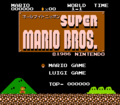 The title screen
 Princess Peach sprite


Names in other languages[edit]
| Language | Name | Meaning | Note(s) | Ref. |
|---|---|---|---|---|
| Japanese | オールナイトニッポン スーパーマリオブラザーズ Ōru Naito Nippon: Sūpā Mario Burazāzu | All Night Nippon: Super Mario Bros. | Box art and disk's exterior | [6] |
| オールナイトニッポン Super Mario Bros. Ōru Naito Nippon: Super Mario Bros. | Title screen | [7] | ||
| Italian | All Night Nippon Super Mario Bros. | - | [8][9] |
Notes[edit]
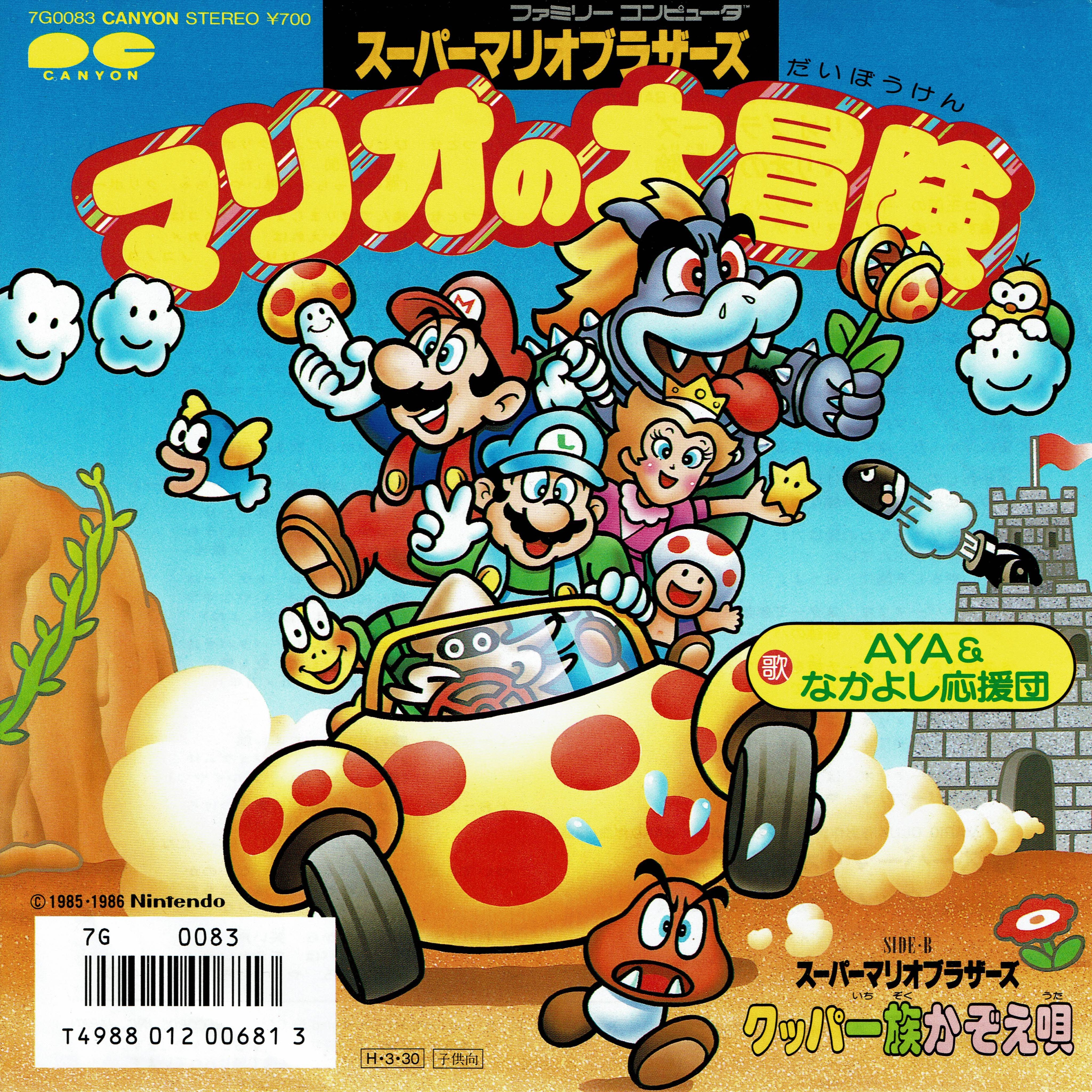
- Luigi is shown to look exactly like Mario but with a cyan hat and overalls and a green shirt on the cover of this game. The cover is a modification of artwork for Mario no Daibōken, a 1986 single by Pony Canyon, a subsidiary of Fujisankei Communications Group like Fuji TV.[10] Pony Canyon also released a Super Mario Bros. promotional video under the same title that featured the same cover.[11] That video ends with "GO GO Mario!!", the side B song from the Mario no Daibōken/GO GO Mario!! single which also featured the same cover, which was the winner of All Night Nippon's nation-wide contest for lyrics to the Ground Theme. It was from this partnership that the idea for the game was born.
- Pakkun OkaP and Princess Peach are represented by a "?" in the manual.
References[edit]

- ^ a b BAD君 (March 29, 2022). オールナイトニッポンスーパーマリオブラザーズのプレゼントはあったのか? 前編. Hatena Blog (Japanese). Retrieved November 26, 2022.
- ^ BAD君 (July 4, 2022). オールナイトニッポンスーパーマリオブラザーズのプレゼントはあったのか? 後編. Hatena Blog (Japanese). Retrieved November 26, 2022.
- ^ ディスクシステム - パッケージアート1. 箱のすみっこげーむ資料 (Japanese). Retrieved November 26, 2022.
- ^ a b 1986. All Night Nippon: Super Mario Bros. instruction booklet (PDF). Nintendo (Japanese). Page 6 and 7.
- ^ 1986. All Night Nippon: Super Mario Bros. instruction booklet. Nintendo (Japanese). Page 6.
- ^ Box art
- ^ Title screen
- ^ Sakai, Kazuya (ambit), kikai, Akinori Sao, Junko Fukuda, Kunio Takayama, Ko Nakahara (Shogakukan), and Marco Figini, editors (2018). Super Mario Bros. Enciclopedia. Translated by Marco Amerighi. Milan: Magazzini Salani (Italian). ISBN 889367436X. Page 239.
- ^ Sakai, Kazuya (ambit), kikai, Akinori Sao, Junko Fukuda, Kunio Takayama, Ko Nakahara (Shogakukan), and Marco Figini, editors (2025). Super Mario Bros. Enciclopedia (2nd ed.). Translated by Alessandro Apreda. Milan: Magazzini Salani (Italian). ISBN 979-1259575760. Page 239.
- ^ Mario's Big Adventure/GO GO Mario!!. VGMdb (English). Retrieved January 23, 2021.
- ^ NES Tunes (January 8, 2021). Nintendo VHS: Super Mario Bros.Promotion Tape: Mario's Adventure | All Night Nippon Famicom Warriors. YouTube (Japanese). Retrieved January 23, 2021.