Luigi Circuit (Mario Kart Wii theme)
- "Luigi Circuit/Mario Circuit" redirects here. For other musical themes with similar names, see Luigi Circuit (disambiguation) and Mario Circuit (disambiguation).
| "Luigi Circuit" | |||
|---|---|---|---|
| "Luigi Circuit" in Mario Kart Wii | |||

| |||
| Composed by: Unknown (either Asuka Hayazaki or Ryo Nagamatsu) | |||
| Key | D Dorian, D major | ||
| First appearance | Mario Kart Wii (2008) | ||
| Latest appearance | Mario Kart World (2025) | ||
| |||
| |||
"Luigi Circuit"[1] is a musical theme in Mario Kart Wii, where it plays in Luigi Circuit and Mario Circuit. This theme quotes "Title" from the same game and is used as a recurring motif throughout the game.
History[edit]
Mario Kart series[edit]
Mario Kart Wii[edit]
Mario Kart Wii marks the first appearance of "Luigi Circuit". It is also included in the official albums Mario Kart Wii Platinum Soundtrack and The Year of Luigi Sound Selection.
The game also features three additional arrangements of the theme:
- An arrangement of "Luigi Circuit" plays in the profile options screen. It is titled 「オプション/ライセンス管理」 (Opushon/Raisensu Kanri, "Options/License Management") in the Mario Kart Wii Platinum Soundtrack album.
- The ending section of the theme that plays in Daisy Circuit quotes that of "Luigi Circuit". It is titled 「デイジーサーキット」 (Deijī Sākitto, "Daisy Circuit") in the Mario Kart Wii Platinum Soundtrack album.
- The theme that plays in the game's staff credits quotes "Luigi Circuit". It is titled 「スタッフロールB」 (Sutaffu Rōru B, "Staff Roll B") in the Mario Kart Wii Platinum Soundtrack album.
 オプション/ライセンス管理 - The arrangement heard in Mario Kart Wii オプション/ライセンス管理 - The arrangement heard in Mario Kart Wii | File info 0:30 |
| スタッフロールB - The arrangement heard in Mario Kart Wii | File info 0:30 |
Mario Kart 7[edit]
In Mario Kart 7, a techno medley arrangement of "Toad Circuit" and "Mario Kart 7 Title Screen" from the same game, "Toad's Turnpike" from Mario Kart 64, and "Luigi Circuit" from Mario Kart Wii plays in Neo Bowser City. It is likewise titled "Neo Bowser City" in the Nintendo Music app.
| Neo Bowser City - The arrangement heard in Mario Kart 7 | File info 0:30 |
Mario Kart World[edit]
In Mario Kart World, a jazz fusion arrangement of "Luigi Circuit" in the key of A major can play in Free Roam during the day. It is fully titled "Luigi Circuit (Mario Kart Wii)" in the Nintendo Music app. This arrangement also takes elements of "Options/License Management" from Mario Kart Wii. The corresponding Nintendo Music image depicts a race on Mario Circuit, a scenario in which the arrangement cannot play.
| Luigi Circuit (Mario Kart Wii) - The arrangement heard in Mario Kart World | File info 0:30 |
Mario & Sonic at the Olympic Winter Games[edit]
In the Wii version of Mario & Sonic at the Olympic Winter Games, an arrangement of "Luigi Circuit" plays in the Dream Ski Cross events. It is likewise titled "Dream Ski Cross" in the game's sound test.
| Dream Ski Cross - The arrangement heard in the Wii version of Mario & Sonic at the Olympic Winter Games | File info 0:30 |
Other appearances[edit]
nintendogs + cats[edit]
In all four versions of nintendogs + cats (French Bulldog & New Friends, Golden Retriever & New Friends, Toy Poodle & New Friends, and Shiba Inu & New Friends), a compressed version of "Luigi Circuit" plays whenever the player is controlling the Mario Kart toy.
| Toy: Mario Kart - The remix heard in Nintendogs + Cats | File info 0:30 |
Gallery[edit]
 Image for "Neo Bowser City" from Mario Kart 7 on Nintendo Music
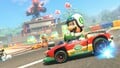 Image for "Luigi Circuit (Mario Kart Wii)" from Mario Kart World on Nintendo Music


List of Super Mario appearances[edit]
Games[edit]
| Work | System | Year | Type | Title | Credits |
|---|---|---|---|---|---|
| Mario Kart Wii | Wii | 2008 | Original | 「ルイージサーキット/マリオサーキット」 (Ruīji Sākitto/Mario Sākitto)[2] | |
| Arrangement | 「オプション/ライセンス管理」 (Opushon/Raisensu Kanri)[2] | ||||
| 「デイジーサーキット」 (Deijī Sākitto)[2] | |||||
| 「スタッフロールB」 (Sutaffu Rōru B)[2] | |||||
| Mario & Sonic at the Olympic Winter Games | Wii | 2009 | Arrangement | "Dream Ski Cross"[3] | |
| Mario Kart 7 | Nintendo 3DS | 2011 | Arrangement | "Neo Bowser City"[4] | |
| Mario Kart World | Nintendo Switch 2 | 2025 | Arrangement | "Luigi Circuit (Mario Kart Wii)"[1] |
Albums[edit]
| Work | Year | Type | Title | Credits |
|---|---|---|---|---|
| Mario Kart Wii Platinum Soundtrack | 2011 | Original | 「ルイージサーキット/マリオサーキット」 (Ruīji Sākitto/Mario Sākitto) | |
| Past arrangement (Mario Kart Wii) | 「オプション/ライセンス管理」 (Opushon/Raisensu Kanri) | |||
| The Year of Luigi Sound Selection | 2013 | Original | 「ルイージサーキット」 (Ruīji Sākitto) | |
| Mario Kart World (Nintendo Music) | 2026[a] | Past arrangement (Mario Kart World) | "Luigi Circuit (Mario Kart Wii)" |
- ^ Added to the album on June 29, 2026
Naming[edit]
Internal names[edit]
| Game | File | Name | Meaning
|
|---|---|---|---|
| Mario Kart Wii | sound/strm/n_Circuit32_n.brstm | N Circuit | New Circuit |
Names in other languages[edit]
| Language | Name | Meaning | Note(s) | Ref. |
|---|---|---|---|---|
| Japanese | ルイージサーキット Ruīji Sākitto | Luigi Circuit | [1] | |
| Chinese (Simplified) | 路易吉赛道 Lùyìjí Sàidào (Mandarin) Louhyihkgāt Choidouh (Cantonese) | Luigi Racetrack | [5] | |
| Chinese (Traditional) | 路易吉賽道 Lùyìjí Sàidào (Mandarin) Louhyihkgāt Choidouh (Cantonese) | [5] | ||
| German | Luigis Piste | Luigi's Racetrack | [5] | |
| Polish | Tor im. Luigiego | Luigi Circuit | [5] | |
| Spanish | Circuito de Luigi | Luigi's Circuit | [5] |
References[edit]
- ^ a b c Mario Kart World (Nintendo Music)
- ^ a b c d Mario Kart Wii Platinum Soundtrack
- ^ Mario & Sonic at the Olympic Winter Games (Wii) sound test
- ^ Mario Kart 7 (Nintendo Music)
- ^ a b c d e Mario Kart World pause menu (Ver. 1.4.0, 1.5.0, 1.7.0)