Limited Lift (Remote-Control)

|
It has been suggested that this article be moved to Remote-Controlled Elevator. (discuss) |
| Limited Lift | |||
|---|---|---|---|
.png) Screenshot from New Super Mario Bros. U | |||
| First appearance | New Super Mario Bros. Wii (2009) | ||
| Latest appearance | New Super Mario Bros. U Deluxe (2019) | ||
| Effect | A lift that carries Mario upwards. It can be tilted using the controller. | ||
| Variant of | Tilt Lift | ||
| |||
The remote-controlled Limited Lift,[1] also called girder,[2] Remote-Controlled Elevator,[3] elevator,[4][5][6] lift,[7] and Remote-Controlled Lift,[3]:216
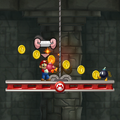
The first player to touch a Limited Lift can tilt it left and right with the Wii Remote. Depending on the character the player is playing as, and whoever got on it first, it will have a different color and emblem, corresponding to the character in control of it. If the player character falls or jumps off, the Limited Lift stops moving and starts slowly descending. The Limited Lift appears in World 7-Tower in New Super Mario Bros. Wii.
The Limited Lift appears in Red-Hot Elevator Ride in New Super Mario Bros. U and Current Event in New Super Luigi U, with a slightly different appearance and an additional function akin to a regular Limited Lift. When a player lands on it and assumes control, a number 1 appears on the lift, and if an enemy or object lands on the lift, the 1 is replaced with a 0, as the lift will not move anymore and the player will be unable to tilt it. The player has to get rid of the enemy or object in order to continue the ascension. Additionally, in New Super Luigi U, the lift is unable to rise, meaning the player can only progress through the level by tilting horizontally, and if they leave the lift, it will descend.
Profiles and statistics[edit]
This article needs Super Mario improvement. Specifically:
- Find out where these profiles come from.
- English:
The lift rises depending on how you operate your Wii Remote. - Other languages:
- Japanese:
コントローラを操作して上昇させるリフト。
(Translation: A lift that is raised by operating a controller.) - Italian:
Piattaforma che si alza muovendo il controller. (first edition)
Piattaforma che si alza muovendo il telecomando Wii. (second edition)
- Japanese:
Gallery[edit]
It has been requested that more images be uploaded for this section. Remove this notice only after the additional images have been added. Specifics: Model
New Super Mario Bros. Wii

Names in other languages[edit]
| Language | Name | Meaning | Note(s) | Ref. |
|---|---|---|---|---|
| Japanese | 上昇リフト Jōshō Rifuto |
Control Lift | [5][6] | |
| リモコン上昇リフト Rimokon Jōshō Rifuto |
Remote Control Lift | Super Mario Bros. Encyclopedia | [8] | |
| Chinese (Simplified) | 上升台 Shàngshēng Tái (Mandarin) Seuhngsīng Tòih (Cantonese) |
Ascension Lift | [5][6] | |
| Chinese (Traditional) | 上昇台 Shàngshēng Tái (Mandarin) Seuhngsīng Tòih (Cantonese) |
Ascension Lift | [5][6] | |
| Dutch | Lift | - | [4][5][6] | |
| French | Ascenseur | Elevator | [4] | |
| German | Aufzug | Elevator | [5][6] | |
| Italian | Ascensore | Elevator | [4][5][6][7] | |
| Montacarichi manovrabile | Maneuverable service lift | Super Mario Bros. Encyclopedia | [9][10] | |
| Korean | 상승리프트 Sangseung Ripeuteu |
Ascent Lift | [5][6] | |
| Portuguese (Europe) | Ascensor | Elevator | [4] | |
| Elevador | [5] | |||
| Plataforma | Platform | [6] | ||
| Russian | Лифт Lift |
Lift | [4][5][6] | |
| Spanish (Latin America) | Elevador | Elevator | [6] | |
| Spanish (Europe) | Ascensor | Elevator | [5] |
References[edit]
- ^ Stratton, Steve (2012). New Super Mario Bros. U: PRIMA Official Game Guide. Roseville: Prima Games. ISBN 978-0-307-89690-2. Page 199.
- ^ Bueno, Fernando (November 15, 2009). New Super Mario Bros. Wii PRIMA Official Game Guide. Prima Games (American English). ISBN 978-0-307-46592-4. Page 138-139.
- ^ a b Roberts, Rachel, and Cardner Clark, editors (2018). "New Super Mario Bros. U" in Super Mario Bros. Encyclopedia: The Official Guide to the First 30 Years (First English Edition). Translated by William Flanagan and Zack Davisson. Milwaukie: Dark Horse Books. ISBN 978-1-50670-897-3.:151
- ^ a b c d e f In-game name from "Red-Hot Elevator Ride" in New Super Mario Bros. U.
- ^ a b c d e f g h i j k In-game name from "Elevator Out of Service" in New Super Mario Bros. U.
- ^ a b c d e f g h i j k In-game name from "Express Elevator" in New Super Mario Bros. U.
- ^ a b In-game name from the description of "Elevator Out of Service" and "Express Elevator" in New Super Mario Bros. U.
- ^ Sakai, Kazuya (ambit), kikai, Akinori Sao, Junko Fukuda, Kunio Takayama, and Ko Nakahara (Shogakukan), editors (2015). "New Super Mario Bros. U" in『スーパーマリオブラザーズ百科: 任天堂公式ガイドブック』. Tokyo: Shogakukan (Japanese). ISBN 978-4-09-106569-8. Page 217.
- ^ Sakai, Kazuya (ambit), kikai, Akinori Sao, Junko Fukuda, Kunio Takayama, Ko Nakahara (Shogakukan), and Marco Figini, editors (2018). "New Super Mario Bros. U" in Super Mario Bros. Enciclopedia. Translated by Marco Amerighi. Milan: Magazzini Salani (Italian). ISBN 889367436X. Page 217.
- ^ Sakai, Kazuya (ambit), kikai, Akinori Sao, Junko Fukuda, Kunio Takayama, Ko Nakahara (Shogakukan), and Marco Figini, editors (2025). "New Super Mario Bros. U" in Super Mario Bros. Enciclopedia (2nd ed.). Translated by Alessandro Apreda. Milan: Magazzini Salani (Italian). ISBN 979-1259575760. Page 217.

