List of stages debuting in Super Smash Bros. for Nintendo 3DS
This is a list of Super Smash Bros. series stages that debuted in Super Smash Bros. for Nintendo 3DS. The page details their role in this series.
See also:
- List of stages debuting in Super Smash Bros.
- List of stages debuting in Super Smash Bros. Melee
- List of stages debuting in Super Smash Bros. Brawl
- List of stages debuting in Super Smash Bros. for Nintendo 3DS and Super Smash Bros. for Wii U
- List of stages debuting in Super Smash Bros. Ultimate
3D Land[edit]

- Main article: 3D Land
In Super Smash Bros. for Nintendo 3DS and Super Smash Bros. Ultimate, 3D Land is available from the start.
Golden Plains[edit]

- Main article: Golden Plains
In Super Smash Bros. for Nintendo 3DS and Super Smash Bros. Ultimate, 3D Land is available from the start.
Rainbow Road[edit]

- Main article: Rainbow Road (stage)
Rainbow Road only appears in Super Smash Bros. for Nintendo 3DS as a stage available from the start.
Paper Mario[edit]

- Main article: Paper Mario (stage)
In Super Smash Bros. for Nintendo 3DS and Super Smash Bros. Ultimate, Paper Mario is available from the start.
Gerudo Valley[edit]


Gerudo Valley is a stage appearing in Super Smash Bros. for Nintendo 3DS and Super Smash Bros. Ultimate. It is based on the location of the same name in The Legend of Zelda: Ocarina of Time, but the graphical style is specifically based on The Legend of Zelda: Ocarina of Time 3D.
The stage is set in the valley itself, on the bridge dividing the Gerudo Fortress from Hyrule Field. Two platforms appear on the land on both sides of the chasm. The bridge can be destroyed with enough attacks, causing fighters on it to fall down the chasm; beneath the bridge is a pair of platforms on both sides of land, and underneath those platforms are spikes. After a while, the Song of Time plays, and the bridge repairs itself.
Koume and Kotake will appear whenever the bridge is broken, and one of them will cast a spell that changes the environment on one side of the stage. Kotake casts an ice spell that covers the right side of the stage in spikes of ice, freezing any players on contact, while Koume casts a fire spell that covers the left side of the stage in flames that deal damage and knockback.
The Final Destination version of the stage is set on a platform with the valley in the background.
The unlock match for Ganondorf takes place here.
Songs[edit]
| Name | Source | Credits |
|---|---|---|
| Gerudo Valley | The Legend of Zelda: Ocarina of Time | Arrangement Supervisor: Rio Hamamoto Composition: Nintendo Arrangement: BANDAI NAMCO Studios Inc. |
| Ocarina of Time Medley | The Legend of Zelda: Ocarina of Time | Arrangement Supervisor: Michiko Naruke Composition: Nintendo Arrangement: Naru2 Co., Ltd. |
Gallery[edit]
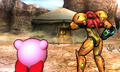 The carpenters' tent in the background
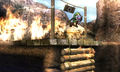 Kotake's fire covering one part of the stage


Names in other languages[edit]
| Language | Name | Meaning | Note(s) | Ref. |
|---|---|---|---|---|
| Japanese | ゲルドの谷 Gerudo no Tani | Gerudo Valley | [?] | |
| Chinese (Simplified) | 格鲁德之谷 Gélǔdé zhī Gǔ (Mandarin) Gaaklóuhdāk jī Gūk (Cantonese) | Gerudo Valley | [?] | |
| Chinese (Traditional) | 格魯德之谷 Gélǔdé zhī Gǔ (Mandarin) Gaaklóuhdāk jī Gūk (Cantonese) | Gerudo Valley | [?] | |
| Dutch | Gerudovallei | Gerudo Valley | [?] | |
| French | Vallée Gerudo | Gerudo Valley | [?] | |
| German | Gerudotal | Gerudo Valley | [?] | |
| Italian | Valle Gerudo | Gerudo Valley | [?] | |
| Korean | 겔드 협곡 Geldeu Hyeopgok | Gerudo Gorge | [?] | |
| Portuguese | Vale Gerudo | Gerudo Valley | [?] | |
| Russian | Долина Герудо Dolina Gerudo | Gerudo Valley | [?] | |
| Spanish | Valle Gerudo | Gerudo Valley | [?] |
Spirit Train[edit]


Spirit Train is a stage in Super Smash Bros. for Nintendo 3DS and Super Smash Bros. Ultimate, based on The Legend of Zelda: Spirit Tracks.
The stage takes place on the Spirit Train itself as it travels through New Hyrule, moving forward during gameplay. Similar to the road in Big Blue from Super Smash Bros. Melee and Super Smash Bros. Brawl, if players stand on the train tracks they will be pushed off the sides; landing in front of the train, however, causes them to be rammed into the air by the train. The train consists of the Spirit Engine, the Solid Passenger Car, and the Trusty Freight Car; the fighters can fight in and on each of the cars. Toon Link, in his Royal Engineer attire, also appears as the train's conductor; if either Link or Toon Link is part of the battle, Alfonzo conducts the train instead.
During the match, part the train will scroll off-screen, and when the train returns to its normal position the Trusty Freight Car will either be carrying Linebeck III's Trading Post or a pile of coal, or be entirely replaced with a destroyed passenger car or a series of platforms. Birds will occasionally carry another aerial platform on-screen. In addition, every so often an Armored Train or a Dark Train may show up on either side of the train; the Armored Train rams directly into the train, pushing it toward the other blast line, while the Dark Train explodes, either off to the sides or after leaping up on top of one of the train cars, which can damage fighters and occasionally temporarily cause the train cars to disconnect.
The Omega form of this stage consists of a floating platform moving over the land.
Songs[edit]
| Name | Source | Credits |
|---|---|---|
| Full Steam Ahead (Spirit Tracks) | The Legend of Zelda: Spirit Tracks / The Legend of Zelda | Arrangement Supervisor: Michiko Naruke Composition: Nintendo Arrangement: Naru2 Co.,Ltd. |
| Main Theme / Underworld Theme | The Legend of Zelda | Arrangement Supervisor: Hideki Skamoto Composition: Nintendo Arrangement: noisycroak Co.,Ltd. |
Super Smash Bros. for Nintendo 3DS trophy information[edit]
| Name | Image | NTSC-U Description | PAL Description |
|---|---|---|---|
| Spirit Train | 
|
The Spirit Train from The Legend of Zelda: Spirit Tracks. You'll travel the lovely Forest Land as you fight, but be careful where you're standing—the last car can come uncoupled from time to time. You may see Linebeck III's shop, and Alfonzo drives if Link or Toon Link are busy fighting. | The Spirit Train from The Legend of Zelda: Spirit Tracks takes you on a picturesque tour of the Forest Land while you, um...battle. Stay on your toes - the last car has a habit of decoupling and recoupling itself. Linebeck's shop also makes the odd appearance, and Alfonzo will drive the train if Link or Toon Link are busy with the brawl. |
Gallery[edit]
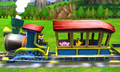 The stage viewed from the side
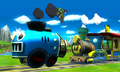 A Dark Train
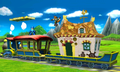 Linebeck III's Trading Post on the back of the train


Names in other languages[edit]
| Language | Name | Meaning | Note(s) | Ref. |
|---|---|---|---|---|
| Japanese | 汽車 Kisha | Steam Train | [?] | |
| Chinese (Simplified) | 蒸汽火车 Zhēngqì Huǒchē (Mandarin) Jīnghei Fóchē (Cantonese) | Steam Train | [?] | |
| Chinese (Traditional) | 蒸汽火車 Zhēngqì Huǒchē (Mandarin) Jīnghei Fóchē (Cantonese) | Steam Train | [?] | |
| Dutch | Trein der Wijzen | Train of the Wise | [?] | |
| French | Locomotive des Dieux | Locomotive of the Gods | [?] | |
| German | Zug der Götter | Train of the Gods | [?] | |
| Italian | Treno degli Spiriti | Train of the Spirits | [?] | |
| Korean | 기차 Gicha | Train | [?] | |
| Portuguese | Comboio-Espírito | Spirit Train | [?] | |
| Russian | Поезд духов Poyezd dukhov | Train of spirits | [?] | |
| Spanish | Tren de los Dioses | Train of the Gods | [?] |
Dream Land GB[edit]


Dream Land GB (formerly known as simply Dream Land) is an unlockable stage appearing in Super Smash Bros. for Nintendo 3DS and a starter stage in Super Smash Bros. Ultimate, based on the Game Boy title Kirby's Dream Land. In addition to taking place on the game's stages, the stage also features Game Boy monochrome graphics, as well as a Game Boy system bordering it, similarly to how the Flat Zone series of stages takes place on a Game & Watch. By holding  when selecting the stage, the stage is shown in black and white monochrome rather than the green monochrome. The stage can be unlocked in Super Smash Bros. for Nintendo 3DS by using Kirby's Final Smash. In Ultimate, the stage was renamed to its current name to be distinguished from the stage of the same name from the Nintendo 64 game.
When the fighters are appearing onscreen, the stage starts off with the Game Boy boot-up screen. The stage then automatically cuts to Green Greens, the first stage in Kirby's Dream Land, outside the first door in the game. After a while, the stage starts to move, the stage featuring two ledges with a bottomless pit in between and ending at the ledge where the first Warp Star would be.
At this point the stage takes one of several forms based on the game's levels. One of these forms is Castle Lololo, the game's second stage. This portion of the stage is set outside the castle, with three floating platforms all near the door, one platform under the door and another platform on the other side of the stage. The stage may also move inside the castle, three platforms and two doors on the bottom and top of the stage.
The stage can also change into Float Islands, the game's third stage. This portion starts off at the area with the ship, and scrolls across to a platform with a pair of higher ledges.
When the stage turns into Bubbly Clouds, the fourth stage in Kirby's Dream Land, the stage takes place on a set of cloudy platforms, two on left side, one on the other side, and a floating cloud platform above on the right side of the stage. The stage then moves to another set of platforms, another platform now on the right side of the stage and two in the center.
The stage can also change to Mt. Dedede, the game's final level. The stage can either turn into the wrestling ring where King Dedede is fought in the original game, or the boss rush room, which features two higher up ledges where the Whispy Woods and Kracko doors are.
The Battlefield and Final Destination forms of the stage are set at the beginning of the Green Greens portion of the stage. While the stage is still stylized to look like Kirby's Dream Land, the stage now visibly appears in full 3D, and the Game Boy foreground no longer appears.
Songs[edit]
| Name | Source | Credits |
|---|---|---|
| Green Greens Castle Lololo Float Islands Bubbly Clouds Mt. Dedede |
Kirby's Dream Land | Original |
| Green Greens Ver. 2 | Kirby's Dream Land | Arrangement: Masashi Hamauzu Composition: HAL Laboratory, Inc. |
Gallery[edit]
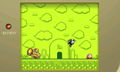 The starting portion in Green Greens
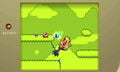 The Bubbly Clouds portion
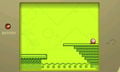 The Float Islands portion
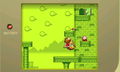 The Castle Lololo exterior portion
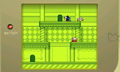 The Castle Lololo interior portion
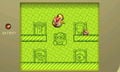 The Mt. Dedede boss rush room portion
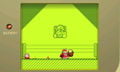 The Mt. Dedede final boss room portion


Names in other languages[edit]
| Language | Name | Meaning | Note(s) | Ref. |
|---|---|---|---|---|
| Japanese | プププランド GB Pupupu Rando GB | Pupupu Land GB | [?] | |
| Chinese (Simplified) | 噗噗噗之国GB Pūpūpū zhī Guó GB (Mandarin) Pokpokpok jī Gwok GB (Cantonese) | Pupupu Land GB | [?] | |
| Chinese (Traditional) | 噗噗噗之國 GB Pūpūpū zhī Guó GB (Mandarin) Pokpokpok jī Gwok GB (Cantonese) | Pupupu Land GB | [?] | |
| Dutch | Dream Land (GB) | - | [?] | |
| French | Dream Land (GB) | - | [?] | |
| German | Dream Land (GB) | - | [?] | |
| Italian | Dream Land GB | - | [?] | |
| Korean | 푸푸푸랜드 GB Pupupu Raendeu GB | Pupupu Land GB | [?] | |
| Portuguese | Terra dos Sonhos | Dream Land | [?] | |
| Russian | Страна грез (GB) Strana grez (GB) | Dream land (GB) | [?] | |
| Spanish | Dream Land (GB) | - | [?] |
Unova Pokémon League[edit]


Unova Pokémon League is a stage in Super Smash Bros. for Nintendo 3DS and returning in Super Smash Bros. Ultimate. The stage is based upon the Pokémon League as it appears in Pokémon Black Version and Pokémon White Version, with N's Castle in the background.
The stage is set at the foot of the temple, featuring a flat base platform and two floating platforms at both ends; soon after the match starts N's Castle appears in the background, which also causes extensions to the stage to appear. At various intervals, one of several Pokémon can appear in the background similar to Spear Pillar in Super Smash Bros. Brawl, including Zekrom, Reshiram, Shaymin, Milotic, or Whimsicott. Zekrom attacks either the left, right, or center of the stage by slamming into it, which can not only damage players but also tilt or move the stage, while Reshiram breathes a massive fireball that sets one half of the stage on fire. Milotic, Whimsicott, and Shaymin do nothing and disappear after a while, Shaymin transforming into its Sky Forme and flying up and Milotic simply flying away.
The Final Destination version of the stage is simply the base platform. N's Castle is always in the background.
The unlock match for Jigglypuff takes place here.
Songs[edit]
| Name | Source | Credits |
|---|---|---|
| N's Castle Medley | Pokémon Black Version and Pokémon White Version | Arrangement Supervisor: Shota Kageyama Composition: GAME FREAK inc. Arrangement: GAME FREAK inc. |
| Battle! (Reshiram / Zekrom) | Arrangement Supervisor: Atsuko Asahi Composition: GAME FREAK inc. Arrangement: Nintendo |
Names in other languages[edit]
| Language | Name | Meaning | Note(s) | Ref. |
|---|---|---|---|---|
| Japanese | イッシュポケモンリーグ Isshu Pokemon Rīgu | Unova Pokémon League | [?] | |
| Chinese (Simplified) | 合众宝可梦联盟 Hézhòng Bǎokěmèng Liánméng (Mandarin) Hahpjung Bóu'hómuhng Lyùhnmàhng (Cantonese) | Unova Pokémon League | [?] | |
| Chinese (Traditional) | 合眾寶可夢聯盟 Hézhòng Bǎokěmèng Liánméng (Mandarin) Hahpjung Bóu'hómuhng Lyùhnmàhng (Cantonese) | Unova Pokémon League | [?] | |
| Dutch | Unova League | - | [?] | |
| French | Ligue Pokémon d'Unys | Unova's Pokémon League | [?] | |
| German | Einall-Pokémon-Liga | Unova Pokémon League | [?] | |
| Italian | Lega Pokémon di Unima | Unova's Pokémon League | [?] | |
| Korean | 하나 포켓몬 리그 Hana Poketmon Rigeu | Unova Pokémon League | [?] | |
| Portuguese | Liga Unova | Unova League | [?] | |
| Russian | Лига Юнова Liga Yunova | Unova League | [?] | |
| Spanish | Liga Pokémon de Teselia | Unova Pokémon League | [?] |
Prism Tower[edit]


Prism Tower is the fifth gym in Pokémon X and Pokémon Y located in the center of Lumiose City appearing as a stage in Super Smash Bros. for Nintendo 3DS, available by default, and returns in Super Smash Bros. Ultimate.
The stage is a moving stage similar to Delfino Plaza from Super Smash Bros. Brawl, starting at the foot of the tower and moving up on a platform until finally moving out above the city and back to the base of the tower. The size of the platform and the amount of platforms also vary as the stage moves. As the stage moves, the time of day also changes, starting in the daytime at the base and slightly up the tower, turning to evening at the top of the tower, and going to night when moving away from the tower and going back to daytime when returning back to the start.
The Final Destination variation of the stage takes place on a large platform during the night.
Songs[edit]
| Name | Source | Credits |
|---|---|---|
| Battle! (Trainer Battle) (Pokémon X and Pokémon Y) | Pokemon X and Pokemon Y | Arrangement Supervisor: Yuzo Koshiro Composition: GAME FREAK inc. Arrangement: Ancient-corp |
| Lumiose City | Pokémon X and Pokémon Y | Original |
Super Smash Bros. for Nintendo 3DS trophy information[edit]
| Name | Image | Description |
|---|---|---|
| Prism Tower | 
|
NA: A notable location from Pokémon X and Pokémon Y. The Prism Tower is the symbol of Lumiose City, the metropolis at the heart of the Kalos region. In the game, platforms will take you on a tour around the tower and its surrounding areas, and at night you can marvel at the fabulous illuminations. You may see different Pokémon, as well. PAL: A notable location from Pokémon X and Pokémon Y. The Prism Tower is the symbol of Lumiose City, the metropolis at the heart of the Kalos region. In this game, platforms will take you on a tour around the tower and its surrounding areas, and at night you can marvel at the fabulous illuminations. Of course, you may run into a Pokémon, too. |
Names in other languages[edit]
| Language | Name | Meaning | Note(s) | Ref. |
|---|---|---|---|---|
| Japanese | プリズムタワー Purizumu Tawā | Prism Tower | [?] | |
| Chinese (Simplified) | 棱镜塔 Léngjìng Tǎ (Mandarin) Lìhnggeng Taap (Cantonese) | Prism Tower | [?] | |
| Chinese (Traditional) | 棱鏡塔 Léngjìng Tǎ (Mandarin) Lìhnggeng Taap (Cantonese) | Prism Tower | [?] | |
| Dutch | Prismatoren | Prism Tower | [?] | |
| French | Tour Prismatique | Prism Tower | [?] | |
| German | Prismaturm | Prism Tower | [?] | |
| Italian | Torre Prisma | Prism Tower | [?] | |
| Korean | 프리즘 타워 Peurijeum Tawo | Prism Tower | [?] | |
| Portuguese | Torre Prisma | Prism Tower | [?] | |
| Russian | Башня Призмы Bashnya Prizmy | Prism Tower | [?] | |
| Spanish | Torre Prisma | Prism Tower | [?] |
Mute City SNES[edit]


Mute City SNES (formerly known as simply Mute City) is a stage based on the Mute City I track from the first F-Zero game, appearing in Super Smash Bros. for Nintendo 3DS and Super Smash Bros. Ultimate. The entire stage uses the same 16-bit-stylized graphics from the original game. In Super Smash Bros. for Nintendo 3DS, it is an unlockable stage obtained by winning three Smash battles as Captain Falcon. In Ultimate, the stage was renamed to its current name.
Similar to the Mute City stage in Super Smash Bros. Melee and Port Town Aero Dive in Super Smash Bros. Brawl, Mute City in Super Smash Bros. for Nintendo 3DS takes place on top of a pair of platforms that move throughout the track, moving left and right as the stage moves as well; unlike these stages, however, the platform continuously moves across the racetrack, never stopping and dropping the fighters onto the track. F-Zero machines appear underneath, which can also be used as platforms. Sometimes the racers will start fighting against one another until one of them is knocked off the track. The text "CHECK" appears over a vehicle when it's about to drive offscreen, carrying any player on it along with it. Also like Melee's Mute City and Port Town, landing on the track itself results in the player being damaged.
The Battlefield and Final Destination forms of the stage are set on a large yellow platform moving high above the stage, following the Blue Falcon which can be seen racing on the track below.
Songs[edit]
| Name | Image | Description |
|---|---|---|
| Mute City | F-Zero | Original |
| Mute City | F-Zero | Arrangement: Kenji Ito Composition: Nintendo |
Trophy information[edit]
| Name | Image | Description |
|---|---|---|
| Mute City | 
|
NA: F-Zero is an interstellar race spread over nine different planets. The Blue Falcon sprints through Mute City, the first circuit in the Knight League. Fighters must do battle as they move between the various racing machines, being careful not to get knocked off and left behind in this high-speed stage. PAL: A metropolis in the heart of the Space Federation, where all the racing leagues begin in the original F-Zero game. In this tricky stage, you fight on top of the Blue Falcon as it thunders along the track, switching to different vehicles suddenly as the race rages on. Whatever you do, don't fall onto the track. That's sure to hurt! |
Gallery[edit]
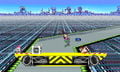 The Final Destination form in Super Smash Bros. for Nintendo 3DS

Names in other languages[edit]
| Language | Name | Meaning | Note(s) | Ref. |
|---|---|---|---|---|
| Japanese | ミュートシティ Myūto Shiti | "Mute City", from "mutant" | [?] | |
| ミュートシティ SFC Myūto Shiti SFC | "Mute City SFC", from "mutant" | <