Flee

- "Escape" redirects here. For the jigsaw puzzle, see Escape (jigsaw puzzle).
- “Running's another tool in your belt—just think about when and where to use it.”
- —Battle Master, Paper Mario: The Thousand-Year Door (Nintendo Switch)
Flee, also known as Run away[1] (Run Away in Paper Mario and Paper Mario: The Thousand-Year Door), and Run in Mario & Luigi: Superstar Saga, is an action used in the Super Mario role-playing games. Flee allows the player to attempt to run away from battle, leaving the enemy behind. This action is unavailable on some enemies, or more specifically bosses, however. In some games, the player will lose coins when they flee; however, they can pick them right back up in a few games. After the player flees, the enemy will freeze in place while flashing for a few seconds, making it so that the player cannot enter a battle with them for a moment. Fleeing can be used by enemies as well, mainly those who drop substantial coins and experience points when defeated.
History[edit]
Super Mario RPG: Legend of the Seven Stars[edit]
In Super Mario RPG: Legend of the Seven Stars, the player can flee by pushing  and selecting the option in the menu. If successful, all party members will run off-screen away from the enemies, with the screen fading to black and transitioning back to the overworld. If not successful, the player will waste that character's turn. Enemies like Crooks and Sackits can also flee from battle, most of the time before the player even gets a turn due to their high speed. The enemies in Bowser's Keep, like Pro Goombas, will also flee if Bowser is in the party at the time.
The item See Ya, when used, will allow Mario and his allies to run away from any battle, with the exclusion of bosses and other important battles.
Paper Mario series[edit]
Paper Mario[edit]
In Paper Mario, the player can flee from battle by selecting the "Run Away" command from "Strategies" and rapidly mashing  to fill up a bar, increasing the chance of Mario and his partner running away from battle. Once successful, Mario will return to the overworld, and coins will fly out of him and land on the ground, disappearing after a few seconds; Mario can pick these coins back up. If unsuccessful, Mario will trip, wasting his turn, and the enemies he is fighting will attack, regardless of whether his partner has had their turn or not. The "Run Away" command is disabled in mini-boss and boss battles.
Enemies who can flee from battle include:
- Bandits, after stealing coins from Mario
- Tubba Blubba, after Mario becomes invisible by Repel Gel or Lady Bow's Outta Sight (only inside Tubba Blubba's Castle)
- The Shy Squad, after at least two turns of taking damage
- Crazee Dayzees, at low HP
- Amazy Dayzee, almost always on its first turn
- All Magikoopas, when alone (except the one Mario must fight after receiving a Lucky Star from Twink)
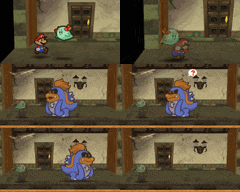 Tubba Blubba flees after Bow hides Mario with Outta Sight
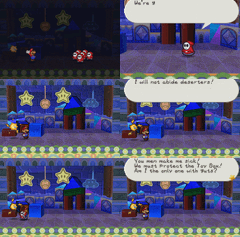 The Shy Squad flees after losing many members


Paper Mario: The Thousand-Year Door[edit]
In Paper Mario: The Thousand-Year Door and its remake, fleeing functions the same way as it did in the previous installment; by rapidly mashing  , Mario and his partner can run away from battle. In the original game, they will then start losing coins once they return to the overworld, but they will not lose any coins after fleeing in the remake. The returning Bandits and their derivatives may flee after they steal something from Mario, and other enemies, such as Amazy Dayzees, can also flee from battle.
Like in the previous installment, Mario cannot flee from mandatory encounters and boss battles. Unlike the first Paper Mario, a "Can't flee this fight!" message appears at the beginning of such battles.
When Mario is reduced to a shadow, he is required to flee when he enters a battle with Doopliss (who has taken Mario's appearance) after failing to guess the latter's real name (due to having removed the lower-case letter P), despite Doopliss ordering him not to run, because neither side can damage each other (Doopliss is able to damage Mario in the remake).
 A Crazee Dayzee flees from battle

Super Paper Mario[edit]
In Super Paper Mario, due to the lack of turn-based combat throughout most of the game, fleeing can only be performed during the battle against the Underchomp. Unlike the previous two Paper Mario games, fleeing does not cause the player to lose coins, and no longer displays a gauge for whether or not the player will successfully be able to escape.
Paper Mario: Sticker Star[edit]
In Paper Mario: Sticker Star, fleeing functions similarly to the first two Paper Mario games. Like in prior entries, the player must rapidly press  in order to flee a battle. However, Mario has a chance of tripping over while trying to flee, causing it to waste a turn. Unlike the previous games, Mario's success rate of escaping a battle is visually conveyed by the background darkening, rather than a meter charging. Like Super Paper Mario, Mario does not drop coins upon successfully fleeing, and the enemy he fled from disappears from the overworld. Mario is capable of fleeing from bosses, though this usually fails. Using a Secret Door sticker will also allow Mario to escape from most battles, and generally has a higher success rate than normal fleeing. Certain enemies, such as Scaredy Rats are also capable of fleeing.
Paper Mario: Color Splash[edit]
In Paper Mario: Color Splash, fleeing works similarly to how it did in Paper Mario: Sticker Star, albeit without the screen darkening effect. Mario Sombrero Guys have a high chance of fleeing from battle but can be defeated with powerful cards. Scaredy Rats also retain their ability to flee as well. Mario cannot flee during battles where Kamek messes with Mario's cards, including during Kamek's boss battle in Sacred Forest, unless all available cards are used in the fight. Like the previous game, using the Compass will allow Mario to escape most encounters, including boss fights, although for some bosses, such as Black Bowser, it cannot work at all.
When Mario is battling the Steak, the "Flee" command is renamed "Done".
Paper Mario: The Origami King[edit]
- “If running away seems like your best option, it looks like you just need to hold down
 ! It won't always work, though, and some battles won't let you run away at all. Try not to depend on it!”
 - —Olivia, Paper Mario: The Origami King

In Paper Mario: The Origami King, fleeing is performed by holding the button in battles. The flee command is only available during the lineup phase of a battle. Like in the first two Paper Mario games, he cannot flee from bosses or mandatory encounters, and he must charge a meter in order to successfully flee. Like the previous three games, Mario does not lose any coins from fleeing a battle.
Mario's chance of fleeing is determined by a variable in the save file called "escape_rate," which varies from 0 to 100. If Mario fails to flee, the escape rate will be increased by 20. If he flees successfully, the rate is halved. This rate persists between battles.
Mario & Luigi series[edit]
Mario & Luigi: Superstar Saga / Mario & Luigi: Superstar Saga + Bowser's Minions[edit]

In Mario & Luigi: Superstar Saga, Mario and Luigi can flee battle by selecting the flee Command Block. When they do, they will start to run away from the enemies, losing coins in the process. When this happens, the player must rapidly mash  and
and  to make them run off-screen. Occasionally, they will trip and fall over, losing even more coins. When they successfully flee from battle, the game returns to the overworld. When a brother is down, the other brother will carry them on their shoulders when fleeing. Enemies like Gold Beanies have a high chance of fleeing if not defeated quickly, Ice Snifits and Clumphs can flee if their parkas and wigs, respectively, are burnt off by Mario's Firebrand moves. Bosses like Popple and Jojora can also flee if their respective partners are defeated before them.
In the remake, Mario & Luigi: Superstar Saga + Bowser's Minions, fleeing works exactly like it did in the Mario & Luigi titles following Mario & Luigi: Bowser's Inside Story, meaning the player does not lose coins when fleeing, and does not need to mash the respective buttons in order to flee.
Mario & Luigi: Partners in Time[edit]
In Mario & Luigi: Partners in Time, in addition to Mario and Luigi, Baby Mario and Baby Luigi can also flee from battle. Fleeing itself works similarly to how it did previously, though now the player can cancel the action by pressing  , though this wastes a turn. Enemies like Pidgits with a sack and Gold Koopeleons have a high chance of fleeing the battle. Dark Boos will flee after stealing an item for the Bros. on the next turn if not defeated quickly.
Mario & Luigi: Bowser's Inside Story / Mario & Luigi: Bowser's Inside Story + Bowser Jr.'s Journey[edit]
In Mario & Luigi: Bowser's Inside Story, fleeing works the same way as it did in the previous two games, and since Bowser is a playable character, he can also flee from battle. While Mario and Luigi jump a bit towards the enemies before fleeing when they flee, the screen pans left when Bowser flees. Chuboombas can flee from battle once Bowser inhales their lollipops, Trashures and Dark Trashures have a chance of fleeing once they open up and are not defeated quickly, Mechawful Heads may flee if not inhaled, and Dark Mechawful Heads will flee if all enemies are defeated before they are inhaled.
In the remake, Mario & Luigi: Bowser's Inside Story + Bowser Jr.'s Journey, fleeing works similar to how it did in the 3DS Mario & Luigi games.
Mario & Luigi: Dream Team[edit]
In Mario & Luigi: Dream Team, fleeing works differently than it did previously, as Mario and Luigi now instantly run away from the enemies without penalty. A few enemies, like Gold Beanies if the player fails to counterattack them properly and Bandits after stealing coins from the brothers, both respectively flee the battle on the following turn.
Mario & Luigi: Paper Jam[edit]
In Mario & Luigi: Paper Jam, fleeing is similar to how it is done in Mario & Luigi: Dream Team, with Paper Mario being able to flee as well since he is a new playable character. Enemies like Ant Troopers, Urchins, and Paper Sombrero Guys can also flee from the battle.
Mario & Luigi: Brothership[edit]
Mario & Luigi: Brothership brings back the option to run from the fight, just as in previous games. Some enemies also flee, such as the Seedlusa. Additionally, when practicing Bros. Attacks, the Bros. use this block to terminate the session, although the block is renamed "End Practice."
Gallery[edit]
 The Run Command Block in Mario & Luigi: Superstar Saga
 The Flee Command Block in Mario & Luigi: Partners in Time
 The Flee Command Block in Mario & Luigi: Bowser's Inside Story
 The Flee Command Block in Mario & Luigi: Dream Team
 The Flee Command Block in Mario & Luigi: Paper Jam
 The Flee Command Block in Mario & Luigi: Superstar Saga + Bowser's Minions
 The Flee Command Block in Mario & Luigi: Bowser's Inside Story + Bowser Jr.'s Journey
 The Flee Command Block in Mario & Luigi: Brothership


Names in other languages[edit]
| Language | Name | Meaning | Note(s) | Ref. |
|---|---|---|---|---|
| Japanese | にげる Nigeru | Flee | [2] | |
| Chinese | 逃跑 Táopǎo | Flee | [3] | |
| French | Fuite | Escape | [4] | |
| Fuir | Flee | [5] | ||
| Courir | Run | [6] | ||
| German | Flucht | Escape | [?] | |
| Italian | Fuga | Flee | [?] | |
| Scappa | Run | [7] | ||
| Korean | 도망 Domang | Escape | [?] | |
| Portuguese (Europe) | Fugir | Flee | Mario & Luigi: Paper Jam | [?] |
| Spanish | Huir | Flee | [?] | |
| Escapar (Paper Mario) | Escape | [?] |
References[edit]
- ^ 1996. Super Mario RPG: Legend of the Seven Stars instruction booklet. Nintendo of America (American English). Page 29.
- ^ 1996. スーパーマリオRPG (Sūpā Mario RPG) instruction booklet. Nintendo (Japanese). Page 29.
- ^ From iQue's localization of Paper Mario: gladJonas (November 13, 2015). The Only Footage of Paper Mario on the Chinese iQue! (30:05). YouTube (English). Retrieved July 1, 2024.[dead link]
- ^ 2001. Paper Mario instruction booklet (PDF). Nintendo of Europe (French). Page 64.
- ^ 2014. Mario & Luigi: Les Frères du temps Instruction booklet (PDF). Nintendo of Europe (French). Page 88.
- ^ 2012. Paper Mario: Sticker Star French instruction booklet (PDF). Nintendo.com (French). Page 12. Archived April 2, 2019, 12:24:36 UTC from the original via Wayback Machine. Retrieved July 1, 2024.
- ^ Super Mario RPG: Legend of the Seven Stars, Italian e-manual. Page 9.