Shova
| Shova | |||
|---|---|---|---|
_-_SMBW.png) Model from Super Mario Bros. Wonder | |||
| First appearance | Super Mario Bros. Wonder (2023) | ||
| Latest appearance | Super Mario Bros. Wonder – Nintendo Switch 2 Edition + Meetup in Bellabel Park (2026) | ||
| Variant of | Koopa | ||
| |||
| |||
Shovas are large Koopas wearing giant black and red gloves that first appear in Super Mario Bros. Wonder. They have yellow skin, black helmets, and black Buzzy Beetle-esque shells, making them resemble the Hammer Bros. of Super Mario Bros. 3. They have a large body size much like Sledge Bros. and Sumo Bros. (which also share their squinted eyes), but unlike most Koopas, they lack a noticeable snout or beak, instead possessing a mostly-flat face with a heavily-built lower jaw.
History[edit]
Super Mario Bros. Wonder[edit]
In Super Mario Bros. Wonder, Shovas slowly shove objects such as pipes and boxes forward with their large gloved hands, as indicated by their name. If the player approaches them head-on, the Shova will push them away without causing damage, though they can still inflict damage like any other enemy if touched from the back or from the bottom (if not in Drill form). It takes three stomps or three fireballs to defeat a Shova, though they can be instantly taken out with a ground pound, a single stomp or trunk strike in elephant form, a drill attack, or contact with a player made invincible by a Super Star.
Shovas are introduced in Swamp Pipe Crawl and are featured prominently in the eponymous Secrets of Shova Mansion, where they pursue the player by pushing a giant golden Bowser Statue during the level's Wonder Effect.
Mario Tennis Fever[edit]
In Mario Tennis Fever, one of the Fever Rackets, the Shova Racket, is designed after a Shova's glove and features an emblem of one. When its Fever Shot is used, it causes subsequent shots to push back the opponent upon hit. Each time the opponent is pushed back, the effect is visualized by a Shova's gloves appearing in front of them.
Gallery[edit]
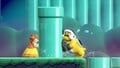
A Shova being pushed against a pipe by Daisy in Super Mario Bros. Wonder
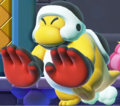
A Shova in Super Mario Bros. Wonder
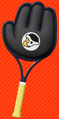
The Shova Racket in Mario Tennis Fever
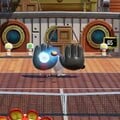
The pushback effect caused by the Shova Racket in Mario Tennis Fever


Naming[edit]
"Shova" is derived from "shover", referring to their main method of attack, respelled phonetically to match "Koopa Troopa".
Internal names[edit]
| Game | File | Name | Meaning
|
|---|---|---|---|
| Super Mario Bros. Wonder | G:/romfs/Model/EnemyOsukun.bfres.zs | Osukun | Portmanteau of「押す」(osu, to push) and the honorific「~くん」(-kun) |
Names in other languages[edit]
| Language | Name | Meaning | Note(s) | Ref. |
|---|---|---|---|---|
| Japanese | オシダシー Oshidashī |
From 「 |
[1][2][3] | |
| Chinese (Simplified) | 推推手 Tuītuīshǒu (Mandarin) Tēuitēuisáu (Cantonese) |
Partial repetition of "推手" (tuīshǒu / tēuisáu, "pusher") | [1] | |
| Chinese (Traditional) | 推推手 Tuītuīshǒu (Mandarin) Tēuitēuisáu (Cantonese) |
Partial repetition of「推手」(tuīshǒu / tēuisáu, "pusher") | [1][4] | |
| Dutch | Shova | - | [1] | |
| French | Poussumo | From pousser ("to push") and "sumo" or Frère Sumo ("Sumo Bro") | [1] | |
| German | Schiebemax | From schieben ("to shove") and the masculine given name "Max"; comparable to Football-Chuck ("Chargin' Chuck") | [1] | |
| Italian | Spintarello | Faux masculine form of spintarella ("nudge") | [1] | |
| Korean | 미러내 Mireonae |
From "밀어내다" (mireonaeda, "to push out") | [5] | |
| Polish | Spychomir | From spychać ("to push") and Polish name Sławomir | [1] | |
| Portuguese (Brazil) | Edu Empurrão | "Edu", a nickname for the masculine given name "Eduardo", and empurrão ("shove"); comparable to Toni Trombada ("Chargin' Chuck") | [1] | |
| Portuguese (Europe) | Empurrikoopa | From empurrar ("to push") and "Koopa"; comparable to Demolikoopa ("Chargin' Chuck") | [1] | |
| Russian | Толкайка Tolkayka |
From толкать (tolkat', "to shove") and the diminutive suffix -ка (-ka) | [6] | |
| Spanish | Empujapum | From empujar ("to shove") and the onomatopoeia pum (punching sound); comparable to Placapum ("Chargin' Chuck") | [1] | |
| Thai | โชวา Choowaa |
Shova | [1] |
References[edit]
- ^ a b c d e f g h i j k l In-game name for Secrets of Shova Mansion from Super Mario Bros. Wonder.
- ^ Kazuma, Sakurai, Sato Tomoya, Nakatani Itaru, Kojima Katsuyuki, and Hashiguchi Yuya (2023). 『スーパーマリオブラザーズ ワンダー かんぺき攻略本』. Tokyo: Kadokawa (Japanese). ISBN 4-047337-02-1. Page 42.
- ^ Sawada, Yukio (2025). Super Mario-kun, vol. 61. Tokyo: Shogakukan (Japanese). ISBN 978-4-09-154073-7. Page 82.
- ^ 23 Feb. 2024. 阻擋瑪利歐一行人的去路。將為您介紹花花王國充滿個人特色的敵方角色。~第一篇~【前往驚奇的世界 Vol.13】. Nintendo Official Site (Traditional Chinese). Retrieved 31 Mar. 2025. (Archived April 28, 2025, 08:10:34 UTC via Wayback Machine.)
- ^ 8 Feb. 2024. 마리오와 친구들을 방해한다. 플라워 왕국에서 만날 수 있는 개성 넘치는 적 캐릭터를 소개. ~제1편~【원더의 세계로 Vol.13】. Nintendo Official Site (Korean). Retrieved 13 Feb. 2024. (Archived July 12, 2025, 14:54:22 UTC via Wayback Machine.)
- ^ Name stored within Super Mario Bros. Wonder (Russian). (Stored internally as
EnemyOsukunin message fileG:/romfs/Mals/Name_Enemy.msbt).
| Miscellaneous Koopas | |
|---|---|
| Characters | Boom Boom • Boss Sumo Bro • Gattai monster • Jr. Troopa • KK Robo • Kuppaemon • Motley Bossblob • Pom Pom |
| Species | Chargin' Chuck • Dark Striker • Koopa Striker • Shova • Soopa Striker • Sumo Bro • Toopa Striker • Wonder Shova |
| Relatives | Conkdor • Rocky Wrench • Shellcreeper • Skedaddler • Yoshi |
| Subfamilies | |
| Buzzy Beetles • Hammer Bros. • Koopas • Koopa Troopas (Koopa Paratroopas · Dry Bones) • Lakitus • Magikoopas • Spikes • Spinies | |

