Smackerel
From the Super Mario Wiki, the Mario encyclopedia
Jump to navigationJump to search
- Not to be confused with Snackeral.
- This article is about the enemy in Super Mario Bros. Wonder. For the weapon in Mario + Rabbids Kingdom Battle, see List of weapons in Mario + Rabbids Kingdom Battle § Smackerel.
| Smackerel | |||
|---|---|---|---|
 Screenshot from Super Mario Bros. Wonder | |||
| First appearance | Super Mario Bros. Wonder (2023) | ||
| Latest appearance | Super Mario Bros. Wonder – Nintendo Switch 2 Edition + Meetup in Bellabel Park (2026) | ||
| |||
| |||
Smackerels are enemies that appear in Super Mario Bros. Wonder. They resemble flatfish, with both eyes on the same side of their body. They have large, sharp-toothed jaws. Smackerels appear only in the level Leaping Smackerel where they burrow through the sand, periodically jumping out vertically to attack the player character. They can also defeat enemies such as Cheep Cheeps and Sluglugs when they leap out to attack. Additionally, Smackerels can destroy ? Blocks, Hard Blocks, and ! Blocks. During the Wonder Effect of the level, a Wonder Smackerel appears, which is able to bite through part of the level to help the player collect Wonder Tokens.
Gallery[edit]
 Model
Model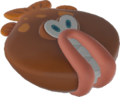 Model
Model A Smackerel descending
 A Smackerel digging down


Naming[edit]
"Smackerel" is a portmanteau of "smack" (alluding to their large lips) and "mackerel".
Names in other languages[edit]
| Language | Name | Meaning | Note(s) | Ref. |
|---|---|---|---|---|
| Japanese | ハイデン Haiden | From Chinese「海底」(hǎidǐ / hóidái, "seabed"), English "hide", and the onomatopoeic「デーン」(dēn, "something dramatic happening") | [1][2][3] | |
| Chinese (Simplified) | 海蹬 Hǎidēng (Mandarin) Hóidāng (Cantonese) | Transliteration of the Japanese name | [1] | |
| Chinese (Traditional) | 海蹬 Hǎidēng (Mandarin) Hóidāng (Cantonese) | [1][4] | ||
| Dutch | Smackerel | - | [1] | |
| French | Limange | From limande ("dab") and manger ("to eat") | [1] | |
| German | Sandhecht | Sand pike | [1] | |
| Italian | Sfondalone | From sfondare ("to break through") and boccalone ("largemouth bass") | [1] | |
| Korean | 넙쩍이 Neopjjeogi | From "넙적" (neopjeok, "flat"), "넙치" (neopchi, "olive flounder"), and the onomatopoeic "쩍쩍" (jjeok-jjeok, "jaws opening") with the nominative suffix "~이" (-i) | [1][5] | |
| Polish | Chapacz | From chapać (colloquial term meaning "to eat something quickly") and the noun-forming suffix -acz | [1] | |
| Portuguese (Brazil) | Linguiado | From linguado ("flounder") and guiado ("guided") | [1] | |
| Portuguese (Europe) | Perseguiçolha | From perseguir ("to pursue") and solha ("flatfish") | [1] | |
| Russian | Нямбала Nyambala | From камбала (kambala, "flatfish") and ням (nyam, "nom") | [1] | |
| Spanish | Soterraballo | From soterrar ("to bury") and rodaballo ("turbot") | [1] | |
| Thai | สแม็กเคอเรล Sàmɛ́kkəəreel | Smackerel | [1] |
References[edit]
- ^ a b c d e f g h i j k l m n In-game name for Leaping Smackerel from Super Mario Bros. Wonder.
- ^ Kazuma, Sakurai, Sato Tomoya, Nakatani Itaru, Kojima Katsuyuki, and Hashiguchi Yuya (2023). 『スーパーマリオブラザーズ ワンダー かんぺき攻略本』. Tokyo: Kadokawa (Japanese). ISBN 4-047337-02-1. Page 47.
- ^ Sawada, Yukio (2025). Super Mario-kun, vol. 61. Tokyo: Shogakukan (Japanese). ISBN 978-4-09-154073-7. Page 8.
- ^ 15 Mar. 2024. 阻擋瑪利歐一行人的去路。將為您介紹花花王國充滿個人特色的敵方角色。~第二篇~ 【前往驚奇的世界 Vol.14】. Nintendo Official Site (Traditional Chinese). Retrieved 21 Feb. 2026. (Archived January 17, 2025, 11:42:25 UTC via Wayback Machine.)
- ^ 23 Feb. 2024. 마리오와 친구들을 방해한다. 플라워 왕국에서 만날 수 있는 개성 넘치는 적 캐릭터를 소개. ~제2편~【원더의 세계로 Vol.14】. Nintendo Official Site (Korean). Retrieved 13 Feb. 2024. (Archived May 25, 2025, 12:10:31 UTC via Wayback Machine.)

