Noknok
- This article is about the door enemy from Super Mario Bros. Wonder. For the weapon mistranslated as "NokNok Shell" from Super Mario RPG: Legend of the Seven Stars, see Koopa Shell § Super Mario RPG: Legend of the Seven Stars.
| Noknok | |||
|---|---|---|---|
 Model from Super Mario Bros. Wonder | |||
| First appearance | Super Mario Bros. Wonder (2023) | ||
| Latest appearance | Super Mario Bros. Wonder – Nintendo Switch 2 Edition + Meetup in Bellabel Park (2026) | ||
| |||
| |||
Noknoks[1][2] are teal enemies with sharp teeth, yellow feet, and purple legs that disguise as doors. They are introduced in Super Mario Bros. Wonder and appear only in Light-Switch Mansion, KO Arena Fungi Funk and The Final Battle! Bowser's Rage Stage. Noknoks do not move in their "calm" state, but when the player approaches a disguised Noknok, the enemy reveals itself by screaming and rushing toward the player (if the player has the Invisibility badge equipped, it will simply bounce the player back). It can jump one block and may try to jump to a player on a different platform even if it cannot reach them, only stopping when the player is far away. The enemy can be stunned by being attacked by a character in Elephant, Drill or Flower form, hit by a Spike Ball, or stomped. While stunned, players can enter it. Upon doing so, it functions as a regular Door (and remains as one) or it is defeated and releases a coin. However, if the player stuns it without interacting with the door, after a while, the enemy will start chasing the player again. Noknoks are impervious to fireballs and bubbles, though they can be used to determine if a door is real or not when the projectiles disappear upon making contact with it.
Some Noknoks can be seen singing and dancing in place during the Wonder Effect in Light-Switch Mansion and The Final Battle! Bowser's Rage Stage.
An unused variant of Noknoks is present in the game's files. This variant chases the player from further away and stays stunned for longer when attacked.[3]
Gallery[edit]
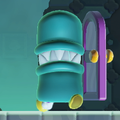 A Noknok chasing the player
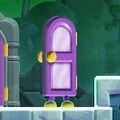 A closed Noknok with its legs visible
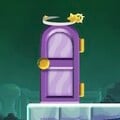 A stunned Noknok after being stomped


Naming[edit]
"Noknok" is a respelling of "knock-knock", the beginning of the traditional knock-knock joke, which involves a door.[1]
Internal names[edit]
| Game | File | Name | Meaning
|
|---|---|---|---|
| Super Mario Bros. Wonder | Model/EnemyDoorMoving.bfres.zs | DoorMoving | Moving Door |
| Pack/Actor/EnemyChaseDoor.pack.zs | ChaseDoor | Chase Door |
Names in other languages[edit]
| Language | Name | Meaning | Note(s) | Ref. |
|---|---|---|---|---|
| Japanese | トビー Tobī | Clipping of「 | [4][1] | |
| Chinese (Traditional) | 牙門 Yámén (Mandarin) Ngàhmún (Cantonese) | Literally "Teeth Door", also a historic form of「衙門」("yamen"); may also incorporate「門牙」(ményá / mùhnngàh, "incisor") | [5] | |
| Korean | 무니 Muni | From "문" (門 / mun, "door") and the nominative suffix "~이" (-i) | [6] |
References[edit]
- ^ a b c Kai, editor (26 Jan. 2024). マリオたちの行く手を阻む。フラワー王国の個性豊かな敵キャラクターをご紹介。~その1~【ワンダーの世界へ Vol.13】. Nintendo Official Site (Japanese). Retrieved 23 Mar. 2025. (Archived February 26, 2024, 19:47:04 UTC via Wayback Machine.)
- ^ 2025. Super Mario Bros. Wonder. Mario Portal. Retrieved 6 Feb. 2026. (Archived September 13, 2025, 23:31:51 UTC via Wayback Machine.)
- ^ Rimea (30 Oct. 2024). Another Unused Mario Wonder Enemy. YouTube. Retrieved 3 Nov. 2024.
- ^ Kazuma, Sakurai, Sato Tomoya, Nakatani Itaru, Kojima Katsuyuki, and Hashiguchi Yuya (2023). 『スーパーマリオブラザーズ ワンダー かんぺき攻略本』. Tokyo: Kadokawa (Japanese). ISBN 4-047337-02-1. Page 47.
- ^ 23 Feb. 2024. 阻擋瑪利歐一行人的去路。將為您介紹花花王國充滿個人特色的敵方角色。~第一篇~【前往驚奇的世界 Vol.13】. Nintendo Official Site (Traditional Chinese). Retrieved 31 Mar. 2025. (Archived April 28, 2025, 08:10:34 UTC via Wayback Machine.)
- ^ 8 Feb. 2024. 마리오와 친구들을 방해한다. 플라워 왕국에서 만날 수 있는 개성 넘치는 적 캐릭터를 소개. ~제1편~【원더의 세계로 Vol.13】. Nintendo Official Site (Korean). Retrieved 13 Feb. 2024. (Archived July 12, 2025, 14:54:22 UTC via Wayback Machine.)

