Horsetail (scenery)

|
It has been suggested that this article be moved to Field horsehair plant, Horsehair plant. Reason: Names used in the original Super Mario Bros. manual and the How to win at Super Mario Bros. guide, respectively. The object hadn't actually been properly called "horsetail" (discuss) |
This article needs Super Mario improvement. Specifically:
- Proper history sections?
| Horsetail | |||
|---|---|---|---|
 Sprite from Super Mario Maker | |||
| First appearance | Super Mario Bros. (1985) | ||
| Latest appearance | Super Mario Maker 2 (2019) | ||
| |||
| |||
Horsetails, also known as field horsehair plants in Super Mario Bros., are narratively relevant plants from the original Super Mario Bros. They have made occasional appearances in contexts alluding to the original Super Mario Bros., such as the Super Mario Bros. style in Super Mario Maker or in the background of Piranha Plant Slide in Mario Kart 7.
History[edit]
Super Mario series[edit]

According to the original manual for Super Mario Bros., Bowser turned the citizens of the Mushroom Kingdom into horsetail plants and bricks. However, the English manual renders this as "field horsehair plants."[1] They are the ovoid tree-like plants seen throughout the game[2] (specifically, Worlds 2, 3, 5, 7, and 8), which come in two sizes, and depending on the level's palette, can be either green or white (in Super Mario All-Stars, the white ones' appearance is due to snow), with both having a tan segmented stem. These plants are also seen in Super Mario Bros.: The Lost Levels (specifically, the odd-numbered and -lettered worlds), where they are now segmented themselves and have eyes; additionally, the ones in World A-1 appear in orange (but not in All-Stars). They also appear in several other games borrowing graphics from or basing certain stages on Super Mario Bros.; for example, in Super Mario Maker, horsetails occasionally pop up in the ground theme in the Super Mario Bros. style when placing ground tiles.
Mario Kart series[edit]
As part of the course's "retro" aesthetic, horsetails appear in the final turn of Piranha Plant Slide in Mario Kart 7. They are replaced with standard trees in the course's reappearance in Mario Kart 8 and Mario Kart 8 Deluxe, though they return to the course in Mario Kart Tour.
Gallery[edit]
 Super Mario Bros.
 Super Mario Bros.
 Super Mario Bros.
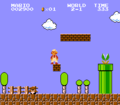 Super Mario Bros.
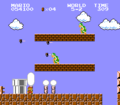 Super Mario Bros.
 Super Mario Bros. Special (PC-88)
 Super Mario Bros. Special (PC-88)
 Super Mario Bros. Special (PC-88)
 Super Mario Bros. Special (PC-88)
 Super Mario Bros. Special (Sharp X1)
 Super Mario Bros. Special (Sharp X1)
 Super Mario Bros. Special (Sharp X1)
 Super Mario Bros. Special (Sharp X1)
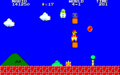 Super Mario Bros. Special (Sharp X1, World 4-1)
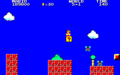 Super Mario Bros. Special (Sharp X1, World 5-1)
 Super Mario Bros.: The Lost Levels
 Super Mario Bros.: The Lost Levels
 Super Mario Bros.: The Lost Levels
 Super Mario Bros.: The Lost Levels
 Super Mario Bros.: The Lost Levels
 Super Mario Bros.: The Lost Levels
 Super Mario Bros.: The Lost Levels
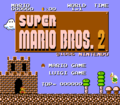 Super Mario Bros.: The Lost Levels
 Super Mario All-Stars
 Super Mario All-Stars
 Super Mario All-Stars
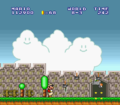 Super Mario All-Stars (Super Mario Bros.)
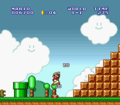 Super Mario All-Stars (Super Mario Bros.: The Lost Levels)
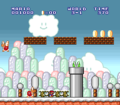 Super Mario All-Stars (Super Mario Bros.: The Lost Levels)
 NES Remix 2
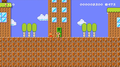 Super Mario Maker


Names in other languages[edit]
| Language | Name | Meaning | Note(s) | Ref. |
|---|---|---|---|---|
| Japanese | つくし Tsukushi | Horsetail shoot | [3] | |
| Dutch | Onkruid | Weed | [4] | |
| Finnish | Horsma | "Willowherb", possibly chosen for its phonetic similarity to the English word "horse" | [5] | |
| German | Unkraut | Weed | [6] | |
| Italian | Erba cavallina | Horse grass | [7] | |
| Spanish (Europe) | Cactus | - | [8] | |
| Swedish | Hästtagel | "Horse tail", from a literal translation of the English word "horsetail"; a horsetail is known as a fräken in Swedish | [9] |
References[edit]

- ^ Legends of Localization comparing the Japanese and North American storylines of Super Mario Bros.
- ^ Sase, Shinji, Howard Phillips, and Lynn Griffes, editors (1987). How to win at Super Mario Bros. (U.S. Edition). Redmond: Tokuma Shoten, Nintendo of America. ISBN 4-19-720003-XC. Page 6.
- ^ 1985. 『Super Mario Bros. 取扱説明書』 (PDF). Kyoto: Nintendo Co., Ltd. (Japanese). Page 4.
- ^ Super Mario Bros. — NL
- ^ Super Mario Bros manuaali
- ^ 1990. Super Mario Bros. Spielanleitung. Großostheim: Nintendo of Europe GmbH (German). Page 2.
- ^ 1987. Super Mario Bros. Libretto di Istruzioni. Oleggio Castello: Nintendo (Italian). Page 2. (Archived 29 Apr. 2019 via Mario's Castle by Alessandro "Stormkyleis" Imbesi.)
- ^ 1987. Super Mario Bros. Manual de Instrucciones. Madrid: Nintendo (European Spanish). Page 2.
- ^ 1987. Super Mario Bros. Instruction Booklet. Kungsbacka: Nintendo (English, Swedish). Page 20.
| Super Mario Bros. Special | |
|---|---|
| Protagonists | Mario • Mushroom retainer • Princess Peach |
| Worlds | World 1 • World 2 • World 3 • World 4 • World 5 • World 6 • World 7 • World 8 |
| Items and objects | 1 up Mushroom • Clock • Coin • Fire Flower • Hachisuke • Hummer • Island • Lucky Star • Magic Mushroom • Starman • Wing |
| Enemies | Barrel • Bloober • Bullet Bill • Buzzy Beetle • Cheep-cheep • Fighterfly • Fireball • Fire-Bar • Hammer Brother • Icicle • Koopa Paratroopa • Koopa Troopa • Lakitu • Little Goomba • Piranha Plant • Podoboo • Sidestepper • Spiny • Spiny's egg • Turtle Cannon |
| Boss | Bowser |
| Miscellaneous | Ax • Beanstalk • Bridge • Cloud Block • Coin Heaven • Coral • Fireworks • Fortress • Flagpole • Gallery • Glitches • Hard Block • Horsehair plant • Jumping board • Multimedia • Staff |

