Remote-Controlled Clown Car
The title of this article is from the English Super Mario Bros. Encyclopedia, which reportedly sourced some names from fan wikis.
If a higher-priority source is found, then the article should be moved to the new title.
| Remote-Controlled Clown Car | |
|---|---|

| |
| Appears in | New Super Mario Bros. Wii (2009) |
| Variant of | Koopa Clown Car |
A Remote-Controlled Clown Car[1] is a type of Koopa Clown Car that Mario, Luigi, Blue Toad, and Yellow Toad can use in New Super Mario Bros. Wii. This vehicle is used only during Bowser Jr.'s boss battle in World 6- Airship. A Remote-Controlled Clown Car resembles a usual Clown Car, except it has a question mark symbol instead of a clown face. If a character hops into one, its symbol changes to either Mario's red "M," Luigi's green "L," or a yellow or blue mushroom for Yellow Toad and Blue Toad, respectively. While riding a Remote-Controlled Clown Car, players have full vertical and horizontal movement on the screen, and can shake their Wii Remote to use the same spin attack as Bowser Jr.'s Junior Clown Car. This attack does not damage Bowser Jr., but can knock him back, potentially into electric rails.
In Mario Party 9, two minigames have players use vehicles very similar to Remote-Controlled Clown Cars. In Bumper Sparks, the vehicles are used to bump into Bowser Jr. to try to get him to hit the electric barrier, like in New Super Mario Bros. Wii. In Pair of Aces, they are equipped with cannons.
Gallery[edit]
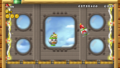
A Remote-Controlled Clown Car and the Junior Clown Car in New Super Mario Bros. Wii

Mario in a Remote-Controlled Clown Car

A Remote-Controlled Clown Car controlled by Mario

A Remote-Controlled Clown Car controlled by Luigi

A Remote-Controlled Clown Car controlled by Blue Toad

A Remote-Controlled Clown Car controlled by Yellow Toad


Names in other languages[edit]
| Language | Name | Meaning | Note(s) | Ref. |
|---|---|---|---|---|
| Japanese | リモコンクラウン Rimokon Kuraun |
Remote Control Clown | [2] | |
| French | Soucoupe télécommandée | Remote-controlled saucer | [3] | |
| German | Remote-Kopter | Remote-Copter (short for Remote Helicopter) | [4] | |
| Italian | Auto Clown Koopa | Koopa Clown Car | Super Mario Bros. Encyclopedia (first edition) | [5] |
| Clown Koopa | Super Mario Bros. Encyclopedia (second edition) | [6] |
References[edit]
- ^ October 23, 2018. Super Mario Bros. Encyclopedia: The Official Guide to the First 30 Years. Dark Horse Books (English). ISBN 978-1-50670-897-3. Page 151.
- ^ Sakai, Kazuya (Ambit), et al. (October 19, 2015). 『スーパーマリオブラザーズ百科: 任天堂公式ガイドブック』 (Super Mario Bros. Hyakka: Nintendo Kōshiki Guidebook). Tokyo: Shogakukan (Japanese). ISBN 978-4-09-106569-8. Page 151.
- ^ July 4, 2018. Super Mario Encyclopedia. Soleil Productions (French). ISBN 2302070046. Page 151.
- ^ --- (October 12, 2017). Super Mario Encyclopedia - Die ersten 30 Jahre (Deutsche Ausgabe). Hamburg: Tokyopop (German). ISBN 978-3842036536. Page 151.
- ^ Sakai, Kazuya (ambit), kikai, Akinori Sao, Junko Fukuda, Kunio Takayama, Ko Nakahara (Shogakukan), and Marco Figini, editors (2018). "New Super Mario Bros. Wii" in Super Mario Bros. Enciclopedia. Translated by Marco Amerighi. Milan: Magazzini Salani (Italian). ISBN 889367436X. Page 151.
- ^ Sakai, Kazuya (ambit), kikai, Akinori Sao, Junko Fukuda, Kunio Takayama, Ko Nakahara (Shogakukan), and Marco Figini, editors (2025). "New Super Mario Bros. Wii" in Super Mario Bros. Enciclopedia (2nd ed.). Translated by Alessandro Apreda. Milan: Magazzini Salani (Italian). ISBN 979-1259575760. Page 151.

