Super Mario (series)
- This article is about the main series of platform games. For the entire franchise, see Super Mario (franchise).
| Super Mario | |
|---|---|
 The current version of the logo, introduced in Super Mario 3D Land | |
| First installment | Super Mario Bros. (1985) |
| Latest installment | Super Mario Bros. Wonder (2023) |
| Number of installments | 50 (22 main, 16 ports, 9 remakes, 2 compilations, 1 promotional) |
| Subseries | Super Mario Advance, New Super Mario Bros. |
| Franchise | Super Mario |
| Key staff | Shigeru Miyamoto, Takashi Tezuka, Koji Kondo, Yoichi Kotabe, Yoshiaki Koizumi, Koichi Hayashida, Shigehisa Nakaue |
The Super Mario series is a line of platform games and the biggest and most prominent series in the Super Mario franchise. It started in 1985 with Super Mario Bros. on the Family Computer and subsequently the Nintendo Entertainment System, and the game has been followed by many sequels released on almost every Nintendo video game console to date, with the exception of the Game Boy Color and the Game Boy Advance, on which only remakes, ports, or other spin-offs were released. The series can be divided into "2D Mario" games, which are side-scrolling platformers (the first of these being the aforementioned Super Mario Bros.), and "3D Mario" games, which are 3D platformers (the first of these being Super Mario 64).[1] The Super Mario Bros. series, a subset of the greater Super Mario series, comprises 2D side-scrolling games such as Super Mario Bros., Super Mario World, and Super Mario 64.
Most of these games follow the story of Mario, usually accompanied by his brother Luigi and sometimes his friends Toad (usually Yellow Toad and Blue Toad) and Yoshi, in his quest to rescue Princess Peach from Bowser, who has kidnapped her and wants to conquer the Mushroom Kingdom or another location. The Mario Bros. must adventure through several areas and defeat Bowser's Minions on their journey. Some of the games deviate from this in some way, such as Bowser having a different evil plan that does not involve kidnapping Peach (as in Super Mario 3D World and Super Mario Bros. Wonder), or being entirely absent in favor of a different villain (as in Super Mario Bros. 2 and Super Mario Land).
The series is developed by several Nintendo divisions. The main games have been developed by Nintendo Entertainment Analysis and Development, with the exception of the Super Mario Land titles, which were handled by Nintendo R&D 1. Following its merge with Nintendo Software Planning & Development in September 2015, the series is now handled by Nintendo Entertainment Planning and Development.
In 2010, the series celebrated the Super Mario Bros. 25th Anniversary. The celebration involved a series of videos showing various tricks throughout the series' games on the Wii's Nintendo Channel, as well as releasing a Wii port of Super Mario All-Stars, which included a history booklet of the Super Mario series and a CD containing several songs from games in the series. In 2015, the series celebrated the Super Mario Bros. 30th Anniversary with the commemorative game being Super Mario Maker. Special amiibo based on Mario's sprite from Super Mario Bros. with both classic and modern color schemes were released as well. 2020 marked the Super Mario Bros. 35th Anniversary with several games released, including Super Mario 3D All-Stars. The series is currently celebrating the Super Mario Bros. 40th Anniversary with Super Mario Galaxy + Super Mario Galaxy 2 being released.
List of games
Main games
| Title | |
|---|---|
| Cover, original release, and system | Synopsis |
| Super Mario Bros. | |
  September 13, 1985[2] September 13, 1985[2]NES |
Super Mario Bros. is the first entry of this series. In the story, Mario and his brother, Luigi, set out on an adventure across the Mushroom Kingdom to rescue Princess Toadstool and the mushroom retainers from the villainous King Bowser. Super Mario Bros. was the best-selling video game for the NES in 1999[3] and, until being surpassed by Wii Sports in 2009, the best-selling video game of all time. Super Mario Bros. also had a major part in both the takeoff of the NES and the revival of the American video game industry after the video game crash of 1983, and it earned Mario a permanent position as Nintendo's mascot. |
| Super Mario Bros.: The Lost Levels | |
 June 3, 1986[4][5] June 3, 1986[4][5]Disk System |
After the success of Super Mario Bros., a sequel was released one year later in Japan for the Family Computer Disk System. It uses a slightly altered version of Super Mario Bros.' engine, with different levels and new features, including altered graphics, Luigi's higher jump and lower traction, original obstacles such as the Poison Mushroom and wind, and five bonus worlds.
While the game was titled Super Mario Bros. 2 in Japan, Nintendo of America originally deemed it too challenging and too much like the original to sell well internationally.[6] Instead, another game was released as Super Mario Bros. 2 outside Japan, and the Japanese Super Mario Bros. 2 became known as Super Mario Bros.: The Lost Levels when included in the Super Mario All-Stars remake years later. The first release of the original game outside Japan was its Virtual Console release in 2007. |
| Super Mario Bros. 2 | |
  October 9, 1988[7] October 9, 1988[7]NES |
Owing to Nintendo of America's decision not to release the Japanese Super Mario Bros. 2 outside Japan, the company instead altered the game Yume Kōjō: Doki Doki Panic, which was otherwise never released outside Japan, to replace the main characters with Mario, Luigi, Princess Toadstool, and Toad, releasing this version of the game as Super Mario Bros. 2 outside Japan. This game was released in Japan a few years later as Super Mario USA.
Several enemies first featured in this game, such as Shy Guys, Bob-ombs, Pokeys, and Birdo, would go on to become recurring in the franchise. Super Mario Bros. 2 is also the first game in the series to feature four distinct playable characters, as Mario, Luigi, Princess Toadstool, and Toad must save the dream world of Subcon from the villainous Wart. After fighting their way through seven worlds, they eventually save Subcon, and Mario wakes up from his dream. |
| Super Mario Bros. 3 | |
 October 23, 1988[8] October 23, 1988[8]NES |
Super Mario Bros. 3 was the final Super Mario platformer released for the NES. It was the most expansive Super Mario game on the system, featuring 88 levels and four new power-ups (its flagship one being the Super Leaf, granting Mario his flying Raccoon form) and introducing elaborate world maps, becoming a huge critical and commercial success. Many of the new species would become staples of the series, including Boos, Thwomps, and Dry Bones. The plot follows Mario and Luigi traversing through eight distinctly themed worlds to rescue Princess Toadstool and defeat Bowser and the debuting Koopalings, who have turned all the kings of the Mushroom World into various animals. |
| Super Mario Land | |
 April 21, 1989[9] April 21, 1989[9]Game Boy |
Super Mario Land is the first portable Super Mario game, and the first one not developed by Nintendo EAD but rather its partner division, Nintendo R&D1. The game features a similar aesthetic and gameplay to Super Mario Bros., adapting it to the limited technology of the Game Boy at the time. This installment has Mario venture through the four kingdoms of Sarasaland to rescue its ruler, Princess Daisy, from the evil alien Tatanga. This game is unique in that it features auto-scrolling shooting sections where Mario rides a Marine Pop or a Sky Pop.
Although Super Mario Land and its sequel, Super Mario Land 2 - 6 Golden Coins, were originally excluded from the main Super Mario series, they were included alongside the more traditional games in material for the 30th and 35th anniversaries of Super Mario Bros.,[10] as well as the history page from the Mario Portal and "The official home for Mario" websites.[11][12] |
| Super Mario World | |
 November 21, 1990[13] November 21, 1990[13]SNES |
Super Mario World was a launch title for the Super Nintendo Entertainment System, representing the series' leap from 8-bit to 16-bit graphics. The game's plot is largely similar to that of past games, but it places the characters on the new setting of Dinosaur Land. Super Mario World features a highly detailed and interconnected world map and introduces the Cape Feather power-up. Its main contribution to the franchise, however, is the debut of the Yoshi species, who became popular enough to receive their own line of games. |
| Super Mario Land 2 - 6 Golden Coins | |
 October 21, 1992[14] October 21, 1992[14]Game Boy |
Being a sequel to the original Super Mario Land, Super Mario Land 2 - 6 Golden Coins features aesthetics and gameplay reminiscent of Super Mario World. With the game directly following the ending of the predecessor, Mario discovers that Wario has seized his realm of Mario Land and taken control of his castle by scattering his six Golden Coins, which Mario must retrieve to have access to the castle. Aside from introducing Wario to the greater Super Mario universe, the ideas of Super Mario Land 2 have remained largely contained to this game. |
| Super Mario 64 | |
 June 23, 1996[15] June 23, 1996[15]Nintendo 64 |
Super Mario 64 was a launch title for the Nintendo 64. As the first fully three-dimensional title in the series, it is regarded as one of the most important games of all time, and it has sold over eleven million copies worldwide as of 2015.[16] This was also the second game to call Princess Peach by her current name (with Yoshi's Safari being the first). In the game, Mario is invited to the Mushroom Castle to have cake with Peach, but he soon discovers that Bowser has taken the castle over and stolen its Power Stars. By jumping into paintings and surfaces around the castle, Mario gains access to self-contained courses that he can explore for Power Stars. Super Mario 64 heavily expands Mario's moveset: He is given a punch attack and several stunts that became series staples, such as the Pound the Ground attack and the Wall Kick. |
| Super Mario Sunshine | |
 July 19, 2002[17] July 19, 2002[17]GameCube |
Super Mario Sunshine is a 3D Super Mario game that follows Mario and his new companion FLUDD in the tropical vacation destination of Isle Delfino, where Peach is threatened by Shadow Mario, who is impersonating Mario. Mario is also framed for polluting the land with goop and bringing darkness upon it. Shadow Mario is later revealed to be Bowser Jr., Bowser's son and a constant presence in the series from this point on. The gameplay revolves around the use of FLUDD, a versatile water pack, to optimize Mario's movement and interact with enemies and stage elements. Super Mario Sunshine is currently the only Super Mario game to feature full voice acting for cutscenes. |
| New Super Mario Bros. | |
 May 15, 2006[17] May 15, 2006[17]Nintendo DS |
New Super Mario Bros. was the first Super Mario game since Super Mario World to feature the classic 2D playstyle of the Super Mario Bros. games, substantially building upon it. The title features a solo story mode with Mario or Luigi, a two-player wireless game called Mario vs. Luigi, and a minigame mode for up to four players. It introduced various enemies and obstacles to the franchise alongside new power-ups: the Mega Mushroom, Mini Mushroom, and Blue Shell. New Super Mario Bros. received three sequels, forming their own subset of Super Mario games. |
| Super Mario Galaxy | |
 November 1, 2007[18] November 1, 2007[18]Wii |
Super Mario Galaxy is a 3D Super Mario game themed around space travel, and it diverges from past 3D games by being much more linear in level design. In the story, Mario attends the Star Festival at the request of Princess Peach, when the town comes under attack by Bowser's air forces. He abducts Peach's entire castle and warps it to the center of the universe, prompting Mario to save her. Most of the game's levels consist of many small planets and planetoids; Mario's interaction with gravity, a new spin ability, and the independently controlled Star Pointer are new and important aspects of the gameplay. New power-ups this time include the Bee Mushroom, Boo Mushroom, and Spring Mushroom. Super Mario Galaxy has a hub area in the Comet Observatory, home of the Lumas and Rosalina, who have since gained prominence in the franchise. |
| New Super Mario Bros. Wii | |
  November 12, 2009[19] November 12, 2009[19]Wii |
Being the indirect follow-up to New Super Mario Bros. for the DS, New Super Mario Bros. Wii adapts that game's format to a home console experience. This installment was the first to allow for four players to simultaneously control their characters, a feature Shigeru Miyamoto had wanted for years. In the story, Bowser and the Koopalings kidnap Peach by using cake as a disguise, so Mario, Luigi, Yellow Toad, and Blue Toad set off to rescue her. This game sees the return of the Koopalings in their first 3D models, absent since Mario & Luigi: Superstar Saga, as well as rideable Yoshis, which this time are limited to designated stages. The Penguin Suit and the Propeller Mushroom are new power-ups in this game. |
| Super Mario Galaxy 2 | |
 May 23, 2010[20] May 23, 2010[20]Wii |
Super Mario Galaxy 2 is the direct sequel to Super Mario Galaxy, borrowing most of its gameplay from its predecessor but streamlining it to fit a simpler narrative. Instead of an elaborate hub area, this game utilizes a world map similarly to the side-scroller games. Yoshi returns as a rideable character, and he can now use power-ups designed for him: the Blimp Fruit, the Dash Pepper, and the Bulb Berry. Mario also receives new power-ups in the Cloud Flower and the Rock Mushroom. |
| Super Mario 3D Land | |
 November 3, 2011[21] November 3, 2011[21]Nintendo 3DS |
Super Mario 3D Land is a hybrid game described as a "3D game that plays like a 2D game," and therefore its levels are much more linear and compact than in the other 3D titles, more along the lines of the side-scrolling games. This title served as a showcase of the stereoscopic 3D feature of the Nintendo 3DS, and as such, several bonus areas are specifically designed to be played with that feature on. Another theme is the returning Super Leaf item (which now grants Mario his Tanooki form), and the Boomerang Flower is a new item. |
| New Super Mario Bros. 2 | |
 July 28, 2012[22] July 28, 2012[22]Nintendo 3DS |
New Super Mario Bros. 2 is the third game in the New Super Mario Bros. line and a direct sequel to New Super Mario Bros. The game's main focus is coins, with the primary goal being to collect one million of them. For this purpose, levels feature a large number of coins and several forms of generating them, including the new power-up, the Gold Flower. New Super Mario Bros. 2 borrows most of its graphics, music, and assets from New Super Mario Bros. Wii, while also featuring some elements from classic games, such as Raccoon Mario from Super Mario Bros. 3 and Reznors from Super Mario World. A side mode, Coin Rush, included the first instance of downloadable content in a Super Mario game. |
| New Super Mario Bros. U | |
 November 18, 2012[23] November 18, 2012[23]Wii U |
New Super Mario Bros. U was released as a launch title for the Wii U, and it was the first Super Mario game to be released in high-definition. In this game, Bowser takes over Peach's Castle and launches Mario, Luigi, and the Toads across the Mushroom Kingdom, forcing them to make their way back while battling Bowser Jr. and the Koopalings once again. It plays very similarly to New Super Mario Bros. Wii, including its four-player mode—however, a player with a Wii U GamePad can create platforms in what Nintendo refers to as "Boost Mode." A single-player Challenge Mode is also featured. Several elements of this game pay homage to Super Mario World: its continuous world map, Baby Yoshis, and returning enemies such as Sumo Bros and Bony Beetles, among others. The new power-up of the game is the Super Acorn, with which Mario can become Flying Squirrel Mario. |
| Super Mario 3D World | |
 November 21, 2013[24] November 21, 2013[24]Wii U |
Super Mario 3D World is the home console follow-up to Super Mario 3D Land. The game's main feature is the new Cat form, caused by picking up a Super Bell, alongside simultaneous four-player multiplayer. Other new power-ups include the Double Cherry and the Lucky Bell. The game features the entire playable cast of Super Mario Bros. 2 as playable characters, including the same abilities they have in said game, as well as Rosalina as an unlockable playable character. The story follows Mario, Luigi, Princess Peach, and Toad as they attempt to rescue the Sprixie Princesses that Bowser has captured and free the Sprixie Kingdom. |
| Super Mario Maker | |
 September 10, 2015[25] September 10, 2015[25]Wii U |
Super Mario Maker is a game creation system that allows players to create their own 2D Super Mario levels. Players can choose between four different styles based on Super Mario Bros., Super Mario Bros. 3, Super Mario World, and New Super Mario Bros. U for their levels, each adapting certain mechanics and power-ups exclusive to the original games. Level creations could be submitted to the internet so players could share their levels worldwide. |
| Super Mario Run | |
 December 15, 2016 iOS |
Super Mario Run is an auto-runner platform game and the first dedicated Super Mario title for mobile devices. It was released first on iOS in December 2016, and it was released for Android in March 2017. The game is free-to-start, with optional in-app content to purchase at a one-time fee. Its gameplay is similar to that of the New Super Mario Bros. subseries but with a different control style. Like Super Mario 3D World, it features the cast of Super Mario Bros. 2 as playable characters, alongside Yoshi, Toadette, and Princess Daisy, who all make their first fully playable appearances in a 2D Super Mario game. |
| Super Mario Odyssey | |
 October 27, 2017 Nintendo Switch |
Super Mario Odyssey released for the Nintendo Switch in late 2017. As a new entry in the 3D games and a new sandbox-style 3D Super Mario game after Super Mario 64 and Super Mario Sunshine, it focuses on Mario and a new character named Cappy (who takes the form of the Mario Cap) visiting kingdoms far from the Mushroom Kingdom and collecting Power Moons, ultimately in an attempt to prevent Bowser from force-marrying Princess Peach and to rescue Cappy's sister Tiara. Cappy has multiple uses, such as being thrown like a boomerang (which can be used to control life forms and inanimate objects) and jumping off him in midair like a platform. In addition, this is the first main Super Mario game to be compatible with amiibo, and it was launched alongside a trio of amiibo based on the game. |
| Super Mario Maker 2 | |
 June 28, 2019 Nintendo Switch |
Super Mario Maker 2 is the sequel to the Wii U title Super Mario Maker. This sequel introduces many new additions and improvements, such as slopes, more level themes, and a Super Mario 3D World style. |
| Super Mario Bros. Wonder | |
 October 20, 2023 Nintendo Switch |
Super Mario Bros. Wonder is a side-scroller and the successor to the New Super Mario Bros. line. Its plot involves Mario and his allies setting out to save the Flower Kingdom from Bowser. The game plays similarly to the New Super Mario Bros. subseries with its four-player mode. The game's central mechanic is Wonder Effects, temporary world-changing events that are triggered by collecting Wonder Flowers. Another debuting feature is a badge system that allows players to customize gameplay with additional abilities. The game also introduces three new power-ups: the Elephant Fruit, Bubble Flower, and Drill Mushroom.
This is the first game to feature Kevin Afghani voicing Mario and Luigi instead of Charles Martinet |
Related games
These original games are related to the Super Mario series while not being considered part of it by official Nintendo websites. Several of the games feature the adventures of characters other than Mario, sometimes leading into their own series. Shigeru Miyamoto stated that he considered Super Mario World 2: Yoshi's Island to be part of the core Super Mario franchise in an interview published in 2012.[26]
| Title | |
|---|---|
| Cover, original release, and system | Synopsis |
| Mario Bros. | |
 June 21, 1983[27] June 21, 1983[27]Arcade machine |
Mario Bros. is an arcade game where Mario and Luigi must defeat various enemies while plumbing. The game introduces various mechanics that would later appear in Super Mario games, such as coins, Warp Pipes, and POW Blocks. Shellcreepers would serve as inspiration for Koopa Troopas in later games, and Fighter Flies would reappear in Super Mario Land. The game is also recreated in various Super Mario games and other related reissues. Super Mario Bros. 3 has a 2 Player Game mode that is a recreation of it. This version of the game replaces the Shellcreepers with Spinies, presumably to avoid confusion of players jumping on them, similar to Koopas. Super Mario All-Stars's remake of the aforementioned game contains a version of the 2 Player Game that can be played from the start. Another remake of it appears in all the Super Mario Advance games. An edited version of the NES version, Luigi Bros., appears in Super Mario 3D World. A platform inspired by the one that the Mario Bros. used to flip enemies upside down would appear in New Super Mario Bros. and New Super Mario Bros. U. It is also referenced in other Super Mario games. In New Super Mario Bros.'s Mario Vs. Luigi mode, the jingle that plays when one of the Mario Bros. spawns out of the pipe is the same one that plays when they respawn in the original game. In New Super Mario Bros. Wii, the Coin Battle course World  Coin-1 has its first area homage the game. Another recreation of the arena appears in New Super Mario Bros. 2's Gold Classics Pack in its second course. Super Mario Maker has costumes based on the game, with the inclusion of Mario, Shellcreeper, Sidestepper, and Fighter Fly. Super Mario Bros. Wonder uses the opening theme for the KO Arena courses. Coin-1 has its first area homage the game. Another recreation of the arena appears in New Super Mario Bros. 2's Gold Classics Pack in its second course. Super Mario Maker has costumes based on the game, with the inclusion of Mario, Shellcreeper, Sidestepper, and Fighter Fly. Super Mario Bros. Wonder uses the opening theme for the KO Arena courses.
|
| Super Mario Bros. (Game & Watch) | |
 June 25, 1986[28] June 25, 1986[28]Game & Watch |
In 1986, one year after the release of Nintendo's first biggest commercial success, the company released a simplified version of the game on its Game & Watch system. It essentially has the same plot, reduced down to only eight levels; however, after every level is beaten, they have to be repeated. Mario has to go through nine loops, avoiding Lakitus and Bullet Bills, each time with the levels increasing in difficulty. There are also two types of levels: scroll screen levels, in which Mario has to reach a certain point to advance, and timer screen levels, in which Mario must get through the level in a given amount of time. Additionally, another difference between the original and this remake is that Mario finds Princess Toadstool at the end of every level, without having to fight a boss. |
| Super Mario Bros. Special | |
 August 1986[29] August 1986[29]NEC PC-8801, Sharp X1 |
Super Mario Bros. Special is a game made by Hudson Soft and licensed by Nintendo for the NEC PC-8801 and Sharp X1 series of Japanese PCs, and later released in South Korea for the Samsung SPC-1500 in 1987. Super Mario Bros. Special is the second follow-up to Super Mario Bros., released a few months after Super Mario Bros.: The Lost Levels in 1986. While superficially very similar to the original Super Mario Bros., the game features original levels but scrolls screen by screen rather than smoothly. Jumping and running physics also differ from those of the original, providing a more challenging experience than Super Mario Bros. Due to the computers' technology being slightly inferior to that of the NES/Famicom, the graphics and audio differ from those of the original NES game as well, with the X1 utilizing more colors and smoother scrolling than the PC-88, and the game does not include Luigi or a multiplayer mode. |
| Yume Kōjō: Doki Doki Panic | |
 July 10, 1987[30] July 10, 1987[30]Family Computer Disk System |
Yume Kōjō: Doki Doki Panic started development as a vertically scrolling Super Mario Bros.–style game, eventually gaining horizontal scrolling as well to be more similar. Due to a licensing agreement with Fuji Television, it starred a family of Arabian characters owned by the network. This game would go on to become the Western Super Mario Bros. 2, with the Arabian characters replaced with Mario and friends, though with other characters (namely enemies and bosses) remaining; many would become recurring to the series. |
| Super Mario Bros. (Nelsonic Game Watch) | |
 June 1, 1989[31][32] June 1, 1989[31][32]Nelsonic Game Watch |
Super Mario Bros. is a simplified reinterpretation of the original game released on the Nelsonic Game Watch. Mario has to struggle up a castle to rescue the princess and defeat the Koopa Dragon. |
| Super Mario Bros. 3 (Nelsonic Game Watch) | |
 December 31, 1990[33] December 31, 1990[33]Nelsonic Game Watch |
Super Mario Bros. 3 is a direct sequel to the previous watch and a tie-in product to the North American release of the original game. It is also known as Super Mario 3 and Super Mario III. This installment contains the Super Leaf, which transforms Mario into long tail Mario. |
| Super Mario World (Nelsonic Game Watch) | |
 December 31, 1991[34] December 31, 1991[34]Nelsonic Game Watch |
The Super Mario World game watch is also a tie-in product for the North American release of the original game. This sequel is also known as Super Mario Bros. 4 and Super Mario 4. Mario rides a dinosaur to rescue the princess from Koopa. |
| Wario Land: Super Mario Land 3 | |
 January 21, 1994[35] January 21, 1994[35]Game Boy |
Wario Land: Super Mario Land 3 is the third and final original Super Mario Land title and the first installment in the Wario Land series, released in 1994, five years after its first predecessor and two years after its second predecessor. With the game taking place after his defeat in Super Mario Land 2 - 6 Golden Coins, Wario decides to go on a quest to earn himself enough money and riches to get himself a castle of his own. During his quest, he finds many treasures as he battles Captain Syrup and her army, the Black Sugar Gang. The gameplay in Wario Land differs slightly from that of the previous Super Mario Land installments. For example, if the player holds down the B Button, Wario does not run. His speed does increase, however, if he is using the Jet Wario power-up, which allows him to temporarily fly through the air at super speed. His other power-ups include Bull Wario, which gives him super strength and the ability to stick to ceilings and conveyor belts, and the Dragon Wario power-up, which allows him to breathe fire. Wario is also able to hold and throw enemies (as well as coins, which are usually required to exit a stage). |
| Super Mario World 2: Yoshi's Island | |
 August 5, 1995[36] August 5, 1995[36]SNES |
While the title suggests it being a sequel to Super Mario World, Super Mario World 2: Yoshi's Island is in fact the prequel to the Super Mario series as well as chronologically the first game of the whole Super Mario franchise. The game starts off on the day the Mario Bros. were born and are to be delivered to their parents by a dedicated stork. With the game foretelling the threat they will represent to the Koopa clan in the future, Kamek tries to kidnap the babies from the stork but manages to snatch only one baby (Baby Luigi) and imprisons the stork as well. The other baby (Baby Mario) falls on Yoshi's Island, where he is picked up by the Yoshis that reside there. The Yoshis come to the decision to aid the baby to rescue his brother and the stork from the Koopa clan led by Baby Bowser. |
| BS Super Mario USA | |
 March 31, 1996[37] March 31, 1996[37]Satellaview |
Being a follow-up to Super Mario USA (Super Mario Bros. 2), BS Super Mario USA was released as four installments, and each one involved the player heading into each world to collect a gold Mario statue and defeat the bosses until finally reaching and defeating Wart. Each level could be replayed until the clock reached 50 minutes. As the player progressed, St.GIGA's Satellite radio would stream an audio drama to tell the story. After the events of Super Mario Bros. 2, the King of Subcon had golden Mario statues put up all around Subcon, to thank him and his friends for their deeds. However, three Birdos, Mouser, Tryclyde, Fryguy, and Clawgrip have stolen them, and now Mario must get them back and defeat Wart again. |
| 1-Up Hunt! | |
 December 30, 2006[?] December 30, 2006[?]Adobe Flash |
1-Up Hunt!, fully titled New Super Mario Bros. 1-Up Hunt!, was an online advergame developed in Adobe Flash and published by Nintendo to promote New Super Mario Bros.. Little is known about the game, other than it was playable on the Nintendo Arcade section of nintendo.com from December 30, 2006 until the website was taken down in late 2007.[38] |
| New Super Luigi U | |
 June 19, 2013[39] June 19, 2013[39]Wii U |
New Super Luigi U is an additional content pack for New Super Mario Bros. U that was also released as a standalone game to celebrate the Year of Luigi, available at retail until the end of 2013. It has all-new levels, and Luigi supplants Mario as the lead character, with Nabbit becoming the fourth playable character, taking Mario's place. |
| Super Luigi Bros. | |
 April 24, 2014[40] April 24, 2014[40]Wii U (Nintendo eShop) |
Super Luigi Bros. is a game mode of NES Remix 2 and NES Remix Pack that is a modification on the original Super Mario Bros. It features both players 1 and 2 as Luigi, with his physics from Super Mario Bros.: The Lost Levels, traveling through stages right-to-left. Otherwise, the game is near-identical to the original. |
| Captain Toad: Treasure Tracker | |
 November 13, 2014[41] November 13, 2014[41]Wii U |
Captain Toad: Treasure Tracker is a puzzle-platform game in addition to a spin-off and prequel of Super Mario 3D World based on Captain Toad's Adventures stages from the latter but featuring extensive depth and variety. The game also features Toadette as a new playable character, but she also takes the role of damsel-in-distress. A port was released on July 13, 2018, for the Nintendo Switch and Nintendo 3DS, and it replaces the bonus stages based on Super Mario 3D World with stages based on kingdoms from Super Mario Odyssey. |
| Super Mario Bros. 35 | |
 October 1, 2020 Nintendo Switch |
Super Mario Bros. 35 was a side-scrolling battle royale platform game where 35 players competed against each other until one player remained. According to the official Mario Portal website, this game is part of the Super Mario series.[42] On April 1, 2021, Super Mario Bros. 35's servers were discontinued.[43] |
Reissues and compilations
| Title | |
|---|---|
| Cover, original release, and system | Synopsis |
| VS. Super Mario Bros. | |
 March 7, 1986[44] March 7, 1986[44]VS. System |
VS. Super Mario Bros. is a two-player arcade game released in North America in 1986. The game is mostly the same as the original Super Mario Bros.; Mario or Luigi went on a quest to save the princess from Bowser and restore order to the Mushroom Kingdom. The game is made harder than Super Mario Bros. in that it has fewer Warp Zones and more enemies, along with options for the arcade owner to make it more difficult still and thus restrict the time an average player got for their money. The game replaced "duplicate" levels from the original with levels that would later be used in the Japanese Super Mario Bros.: The Lost Levels. |
| All Night Nippon: Super Mario Bros. | |
 December 20, 1986[45] December 20, 1986[45]Disk System |
All Night Nippon: Super Mario Bros. is an officially licensed retool of Super Mario Bros.: The Lost Levels. Gameplay is the same, but many characters such as the mushroom retainers are replaced with Japanese celebrities from the radio show All Night Nippon. Other changes are also made for this game, such as World 1 being set during nighttime and Princess Peach's outfit being changed. The game was released only in Japan. |
| Super Mario All-Stars | |
 July 14, 1993[46] July 14, 1993[46]SNES |
Super Mario All-Stars, known as Super Mario Collection in Japan, was released in 1993 for the Super Nintendo Entertainment System. It is a compilation featuring 16-bit versions of the first four main Super Mario–series games: Super Mario Bros., Super Mario Bros. 2, Super Mario Bros. 3, and, in its first release outside Japan, Super Mario Bros.: The Lost Levels. This game updated the four games' graphics and sound to enhance them, with certain changes to the mechanics. A Wii rerelease, called Super Mario All-Stars Limited Edition, occurred in 2010. |
| Super Mario All-Stars + Super Mario World | |
 December 1994[47] December 1994[47]SNES |
Super Mario All-Stars + Super Mario World is an America/Europe-only reissue of Super Mario All-Stars that also includes Super Mario World for the Super Nintendo Entertainment System. |
| BS Super Mario Collection | |
 December 28, 1997[48] December 28, 1997[48]Satellaview |
Being a remake of Super Mario Collection (Super Mario All-Stars), BS Super Mario Collection is a game for the Super Famicom add-on Satellaview. Like with BS Super Mario USA, as the player progressed through the game, voice acting and music would be streamed to the system using the Satellaview's Soundlink capabilities. |
| Super Mario Bros. Deluxe | |
 May 10, 1999[49][50] May 10, 1999[49][50]Game Boy Color |
Super Mario Bros. Deluxe is a Game Boy Color remake that includes the first two Super Mario games ever released: Super Mario Bros. and Super Mario Bros.: The Lost Levels (that last under the name of Super Mario Bros. for Super Players). Besides those games, it also featured many other collectibles, including images that could be printed with the Game Boy Printer, Cable Link interface multiplayer, records sharing by infrared connection, a calendar, a fortune teller, etc. Unlike other remakes, it was not developed by Nintendo EAD but rather by Nintendo R&D2. |
| Super Mario Advance | |
 March 21, 2001[51] March 21, 2001[51]Game Boy Advance |
Super Mario Advance is a remake of Super Mario Bros. 2 made for the Game Boy Advance, and it was released in 2001. Like the Super Mario All-Stars remake, Super Mario Advance has updated graphics, alongside various gameplay additions and improvements such as a point-scoring system and collectable Ace Coins. Additionally, Mario Bros. is included with the game. It spawned a series of similar remakes, all featuring Mario Bros. as well. |
| Super Mario World: Super Mario Advance 2 | |
 December 14, 2001[52] December 14, 2001[52]Game Boy Advance |
Super Mario World: Super Mario Advance 2 is a reissue of Super Mario World made for the Game Boy Advance. It is the second title in the Super Mario Advance series and was released in 2001. There are various differences between the original Super Mario World and Super Mario Advance 2, such as Luigi's sprite being changed and made taller than Mario's to match his normal appearance. The game was a massive hit for Nintendo and the Game Boy Advance, selling 5,690,000 copies worldwide.[53] |
| Yoshi's Island: Super Mario Advance 3 | |
 September 20, 2002[54] September 20, 2002[54]Game Boy Advance |
Yoshi's Island: Super Mario Advance 3 is a reissue of Super Mario World 2: Yoshi's Island for the Game Boy Advance. The game features similar visuals to the original game, though due to the lack of the Super FX chip, the game tracks behind some graphical aspects. Super Mario Advance 3 has six new levels as well as Yoshi's Story voice acting and sound effects. |
| Super Mario Advance 4: Super Mario Bros. 3 | |
 July 11, 2003[55] July 11, 2003[55]Game Boy Advance |
In 2003, the fourth and final Super Mario Advance installment, Super Mario Advance 4: Super Mario Bros. 3, was released for the Game Boy Advance. It boasted similar graphics and sound to the Super Mario All-Stars version of Super Mario Bros. 3, and it made use of the e-Reader. A few e-Reader cards came included with new copies of the game, while two sets (referred to as "series") of cards were released and sold alongside the game. By scanning special cards into the e-Reader, players were able to upload items, videos, and new levels into the game. One item was the Cape Feather from Super Mario World, which allowed Mario to transform into Caped Mario. There were also two Switch cards that the player could activate (and deactivate) the effects of by scanning them: the Orange Switch and the Blue Green Switch. Scanning these switches triggered small functions in the game. The e-Reader feature is still coded in the European version, but it is disabled by default. The Virtual Console and Game Boy Advance - Nintendo Classics versions have all e-Reader levels and features unlocked by default for all regions. |
| Classic NES Series: Super Mario Bros. | |
 February 14, 2004[56] February 14, 2004[56]Game Boy Advance |
The original NES version of Super Mario Bros. was released for the Game Boy Advance as part of the Classic NES Series of games in commemoration for the 20th anniversary of the release of the original Famicom and NES. It is a direct port, and as a result, it features no new additions or bugfixes. Consequently, the only significant difference is that the graphics were downscaled to fit the GBA screen resolution. |
| Famicom Mini: Super Mario Bros. 2 | |
 August 10, 2004[57] August 10, 2004[57]Game Boy Advance |
In Japan, the Classic NES Series was known as Famicom Mini. The original Super Mario Bros. 2 (or Super Mario Bros.: The Lost Levels) was released only in Japan. Much like Super Mario Bros., it did not feature any new additions, the bugs were left untouched, and the graphics were downscaled. |
| Super Mario 64 DS | |
 November 21, 2004[58] November 21, 2004[58]Nintendo DS |
Super Mario 64 DS is a remake of Super Mario 64. It was released in 2004 for the Nintendo DS. It is also the first game of the Super Mario franchise released for the Nintendo DS. Though it is a remake, there are many differences between it and the original (four playable characters and 30 new Power Stars are two examples of this). The game begins the same as the old one: Peach invites Mario to the castle for cake. However, instead of just Mario, Wario and Luigi also come for cake, while Yoshi sleeps on the roof of the castle. Bowser then takes over the castle, captures Peach, and locks Mario, Luigi, and Wario inside three rooms. One of the Lakitu Bros. then wakes Yoshi up, and now he has to save Mario and the others in order to save Peach once again, this time through teamwork. |
| Super Mario All-Stars Limited Edition | |
 October 21, 2010[59] October 21, 2010[59]Wii |
Released for the Wii in 2010, Super Mario All-Stars Limited Edition is a port of Super Mario All-Stars that celebrates the Super Mario Bros. 25th Anniversary. |
| New Super Mario Bros. U + New Super Luigi U | |
 November 1, 2013[60] November 1, 2013[60]Wii U |
New Super Mario Bros. U + New Super Luigi U is a compilation of both New Super Mario Bros. U and New Super Luigi U on the same disc, initially released exclusively with the Mario & Luigi Deluxe Wii U set (known as the Premium Pack in Europe). New Super Mario Bros. U + New Super Luigi U features changes to the originals, including a new title screen and over 200 videos included as bonus content. This compilation was released separately as a Nintendo Selects title in 2016. |
| Super Mario Maker for Nintendo 3DS | |
 December 1, 2016[61] December 1, 2016[61]Nintendo 3DS |
Being a port of the Wii U's Super Mario Maker released in 2015, Super Mario Maker for Nintendo 3DS was released on December 2, 2016. Despite being a Nintendo 3DS title, the game does not support stereoscopic 3D, and gameplay is, therefore, strictly available in 2D. Due to hardware limitations for the 3DS, players can no longer share their levels online, and other elements from the Wii U version, such as the Mystery Mushrooms and amiibo compatibility, have been removed. The game features Super Mario Challenge, a single-player mode with 100 pre-installed courses designed by Nintendo, with medal objectives included for each course. Much like Super Mario Bros. 35, according to the Mario Portal website, Super Mario Maker for Nintendo 3DS is part of the Super Mario series.[42] |
| New Super Mario Bros. U Deluxe | |
 January 11, 2019 Nintendo Switch |
New Super Mario Bros. U Deluxe is a combined port of New Super Mario Bros. U and New Super Luigi U, enhanced with exclusive features. This port is described as part of the main series for the Super Mario Bros. 35th Anniversary and in the Mario history section of Nintendo's website.[12] |
| Super Mario 3D All-Stars | |
 September 18, 2020 Nintendo Switch |
Super Mario 3D All-Stars is a rerelease of Super Mario 64, Super Mario Sunshine, and Super Mario Galaxy with revamped controls, HD resolution, and a music player that released as part of the Super Mario Bros. 35th Anniversary. Much like New Super Mario Bros. U Deluxe, on Nintendo's website, this game is considered part of the main series.[12] As of March 31, 2021, Super Mario 3D All-Stars cannot be bought on the Nintendo eShop. |
| Game & Watch: Super Mario Bros. | |
 November 13, 2020 |
Unlike the Game & Watch game Super Mario Bros. released in 1987, Game & Watch: Super Mario Bros. is a direct port of Super Mario Bros. and Super Mario Bros.: The Lost Levels fit into a Game & Watch system with full-color screen display. The system also features a Super Mario–themed version of Ball. |
| Super Mario 3D World + Bowser's Fury | |
 February 12, 2021 Nintendo Switch |
Super Mario 3D World + Bowser's Fury is a port of Super Mario 3D World that was released for the Nintendo Switch in 2021. It contains new features, such as quicker movement speed, higher resolution, and amiibo compatibility. The game also has a new Bowser's Fury mode, in which Mario and Bowser Jr. aim to save Lake Lapcat from Fury Bowser. Like New Super Mario Bros. U Deluxe, the port is described as part of the main series in the Mario history section of Nintendo's website.[12] |
| Super Mario Galaxy + Super Mario Galaxy 2 | |
 October 2, 2025 Nintendo Switch |
Super Mario Galaxy + Super Mario Galaxy 2 is a bundle that includes ports of Super Mario Galaxy and Super Mario Galaxy 2 on the same game card with revamped controls, HD resolution, and a music player that released as part of the Super Mario Bros. 40th Anniversary. |
Canceled
| Title | |
|---|---|
| Cover, original release, and system | Synopsis |
| Super Mario's Wacky Worlds | |
 Philips CD-i |
Super Mario's Wacky Worlds is a canceled Philips CD-i game developed by NovaLogic. It is thought to follow-up on Super Mario World after a Nintendo sales executive suggested that the CD-i could play simple Nintendo games,[62] which is a result of Philips acquiring the rights to several Nintendo characters for use on the former company's platform. The game was to feature a game world mostly based on real-life Earth locations, with themed old and new enemies in the Super Mario World sprite style. However, despite NovaLogic impressing Nintendo with the former company's work in progress, it was canceled due to the commercial failure of the CD-i.[62] |
| VB Mario Land | |
 Virtual Boy |
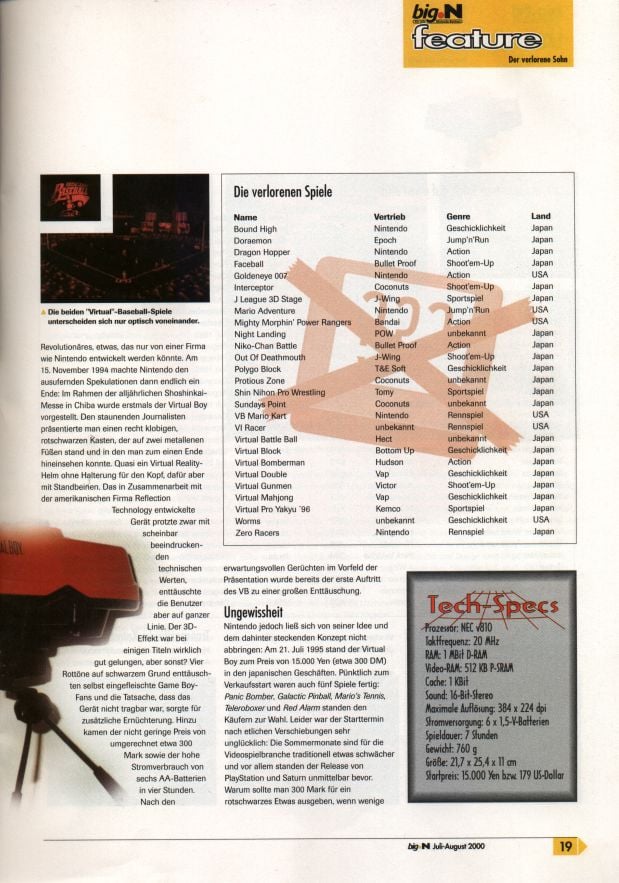
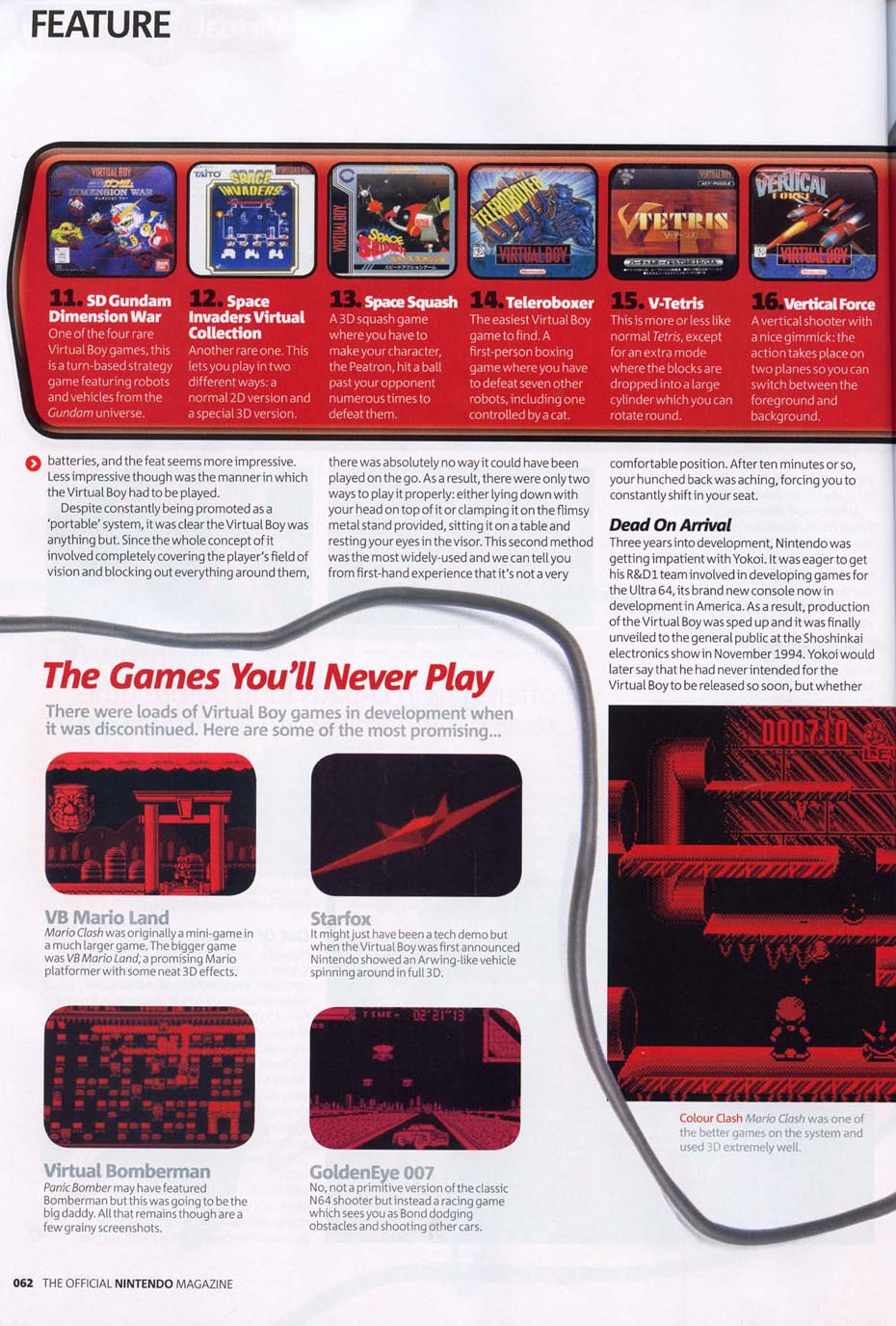
VB Mario Land, also known as Mario Adventure,[63] was a canceled Virtual Boy game that was revealed at the Winter Consumer Electronics Show in early 1995.[64] A Wario-like object can be seen in one of the released screenshots, so the game is thought to be an unproduced follow-up to Super Mario Land 2 - 6 Golden Coins. The game was to use two-dimensional side-scrolling elements, as well as the use of three-dimensional movement between the background and foreground of the stage. Its three-dimensional Mario Bros.–style minigame was repurposed as Mario Clash.[65] |
| Super Mario 64 2 | |
 64DD |
Super Mario 64 2, the direct sequel to Super Mario 64, is a canceled 64DD game. Luigi[66] and a rideable Yoshi[67] were set to appear, which were ideas unused during the creation of the original game.[68] Shigeru Miyamoto stated in 1999 that the game's actual development got only as far as a two-player demo level featuring Mario and Luigi.[69][better source needed] An unreleased port of Super Mario 64 to the 64DD demoed at Space World 1996, known as Super Mario 64: Disk Ban, may be related.[70] |
Major characters
Main protagonists
| Character(s) | |||
|---|---|---|---|
| Image | Brief biography | First appearance | First playable appearance in the Super Mario series |
| Mario | |||
 |
Mario is the main protagonist in his titular series of games. Many characters have fought alongside him in his adventures in platformers and RPGs, but many have also fought against him during those times. Mario has gone through many physical changes, from his original 8-bit appearance to his current 128-bit appearance. Mario commonly rescues Princess Peach as well as several others, such as Toads, as his adventures continue. Mario has even been accepting enough to team up at times with his greatest foe, Bowser. | ||
| Luigi | |||
_-_Super_Mario_3D_World.png) |
Luigi is Mario's younger, taller twin brother. Luigi debuted in Mario Bros. for the Game & Watch in 1983, packaging off bottles alongside Mario as a factory worker, before reappearing in the arcade game Mario Bros. and later in Super Mario Bros. for the NES, where he is playable only in the two-player mode of the game. He later appeared in Super Mario Bros. 2, being playable in one-player mode for the first time along with Toad and Peach. Luigi has appeared in many of Mario's games, but there were some from which he was excluded—among which are Super Mario Land and Super Mario 64. | ||
| Princess Peach | |||
 |
Princess Peach—originally known as Princess Toadstool in localization—is the damsel-in-distress of the series. She is the ruler of the Mushroom Kingdom and is protected by many Toads. However, her protection commonly fails and eventually results in her being kidnapped, be it by Bowser or by another villain. In Super Mario Bros. 2, Super Mario 3D World, Super Mario Run, and Super Mario Bros. Wonder, Peach is one of the playable characters and one of the main protagonists. | ||
| Princess Daisy | |||
 |
Princess Daisy initially served as the damsel-in-distress in her debut game, Super Mario Land. She is the ruler of Sarasaland, which is inhabited by many various species not found in the Mushroom Kingdom. Although she is the only known ruler, her father was mentioned by her in Mario Party 3. She was kidnapped by the evil alien Tatanga, who took her and hypnotized the inhabitants of Sarasaland. After Tatanga's defeat by Mario, Daisy was rescued and Sarasaland was restored. Since Daisy's return to the Super Mario series overall (starting with the Nintendo 64 version of Mario Tennis), she has been a frequent participant in a majority of spin-off installments. 28 years after Super Mario Land, Daisy officially made her reintroduction in the Super Mario series by appearing in Super Mario Run as a playable protagonist. | ||
| Toad | |||
 |
Toad originally played the role of Princess Peach's assistant; however, he has been reduced to lesser roles since his debut appearance, with his role in main games having sometimes been replaced by Toadsworth. Toad's first playable appearance was in Super Mario Bros. 2. Though he appears identical to many others in his species, Toad is actually an entirely different character; this causes much confusion as to whether or not certain Toads are the Toad discussed. Similar confusion occurs regarding whether he is the same as the character resembling Blue Toad in Super Mario 3D World. | ||
| Yoshi | |||
 |
Yoshi is Mario's dinosaur-like companion and one of his most trusty allies during his adventures. In many games Yoshi is present, he is always disposed to give Mario a ride on his back; while riding him and under Mario's command, Yoshi can use his long chameleon-like tongue to swallow a diverse variety of objects, including enemies. Yoshi also supports additional abilities Mario is unable to do on his own, such as Yoshi's signature Flutter Jump. Super Mario 64 DS features Yoshi as a standalone playable character. In fact, the game opens with Yoshi as the sole playable character that needs to rescue Mario and company. Though Yoshi lacks power, he compensates this with his ability to swallow enemies and turn them into eggs, which in turn serve as homing projectiles to take out several enemies at once. In Super Mario Run and Super Mario Bros. Wonder, Yoshi is a standalone playable character, along with his colored species. | ||
| Wario | |||
 |
Wario is Mario's yellow-clad, greedy friend and rival. Though he has antagonized Mario since his debut in Super Mario Land 2 - 6 Golden Coins, Wario proved to be a valuable ally in Super Mario 64 DS, where he, alongside Luigi, originally came to "crash the party" of Mario and Peach. Wario is the strongest character in that game, being able to destroy some obstacles the other player characters cannot. | ||
| Rosalina | |||
 |
Rosalina makes her first overall Super Mario–franchise appearance by playing a supporting role in Super Mario Galaxy. In that game (and Super Mario Galaxy 2), she is the adoptive mother of the Lumas. Her main duty is to watch the Lumas and help keep the galaxies safe. Throughout the Super Mario Galaxy installment, Rosalina gives helpful and important advice/tips to Mario on his journey to save the galaxies in crisis and rescue Peach from Bowser's capture.
Rosalina makes her first playable appearance for the Super Mario series overall in Super Mario 3D World, making her the second female protagonist, following Princess Peach. |
||
| Captain Toad | |||
 |
Captain Toad is a red Toad dressed with an oversized backpack and a headlamp. He is the leader of the Toad Brigade, a group of Toads that provide help to Mario in Super Mario Galaxy and Super Mario Galaxy 2. Captain Toad subsequently appears in Super Mario 3D World as a playable character in special levels called Captain Toad's Adventures; additionally, this resulted in him getting the starring role in the game's prequel (Captain Toad: Treasure Tracker), along with Toadette. | ||
| Toadette | |||
 |
Toadette was originally introduced as a playable racing partner for Toad in Mario Kart: Double Dash!! She has since appeared in other games as a playable character and has played supporting roles in several titles. Her first prominent role in the series was in the Super Mario 3D World prequel Captain Toad: Treasure Tracker, where she played a main character in the game's storyline. Toadette officially debuted in the Super Mario series by appearing in Super Mario Run as a referee and later becoming playable in the game. Toadette makes a return to the Super Mario series by playing a role in Super Mario Odyssey as an archivist for the Toad Brigade. Her most recent appearance for the Super Mario series is Super Mario Bros. Wonder. In New Super Mario Bros. U Deluxe, she gains a unique Princess Peach–like form known as Peachette after obtaining a Super Crown. She also makes an appearance in Super Mario Maker 2, where she is featured as one of the four playable characters alongside Mario, Luigi, and Toad. She is featured as a supporting character in the game's Story Mode, where she is called "Chief" and is in charge of rebuilding Peach's Castle after it is erased by Undodog. | ||
| Yellow Toad and Blue Toad | |||
  |
Yellow Toad and Blue Toad appear in New Super Mario Bros. Wii as main protagonists along with Mario and Luigi. They reprise the same role in New Super Mario Bros. U and Super Mario Bros. Wonder. In New Super Mario Bros. U Deluxe, they share a character slot under the name "Toad." | ||
| Nabbit | |||
 |
Nabbit debuted in New Super Mario Bros. U, where he steals items from Toad Houses. He appears as one of the four main playable characters in New Super Luigi U, replacing Mario from the original game; unlike the other player characters, Nabbit is invincible to enemies and cannot use power-ups (except for Super Stars), which instead become 1-Up Mushrooms at the end of the level. In New Super Mario Bros. U Deluxe, he can be played in the New Super Mario Bros. U levels for the first time (though he is not playable in Challenge Mode). | ||
Supporting characters
| Character(s) | ||
|---|---|---|
| Image | Brief biography | First appearance |
| Kings | ||
 |
The kings are the rulers of seven kingdoms in Super Mario Bros. 3, where each king was turned into a different creature by the Koopalings. | |
| Lakitu Bros. | ||
 |
The Lakitu Bros. are a pair of cameraman Lakitus that monitor Mario's progress throughout Super Mario 64. One of them acts as the camera throughout the game and is thus never directly seen aside from areas in mirrors, and the other appears in the opening and gives information at the start of certain courses. | |
| Hoot | ||
 |
Hoot is a friendly owl from Whomp's Fortress in Super Mario 64. If Mario wakes him up, he will allow Mario to grab his talons to get a lift. In Super Mario 64 DS, Hoot also appears in all missions of Cool, Cool Mountain and later missions of Snowman's Land, Tiny-Huge Island, and Tall, Tall Mountain. | |
| Dorrie | ||
 |
Dorrie is a large blue plesiosaur-like creature found in the Hazy Maze Cave in Super Mario 64. He later appears in World 4 of New Super Mario Bros. In both games, ground-pounding his back causes him to lower his head for Mario to climb upon; in the latter, Dorrie also briefly gains speed. | |
| Toadsworth | ||
 |
Toadsworth is an elderly Toad and Princess Peach's longtime steward. In his debut in Super Mario Sunshine, he comes along with Mario and Peach to Isle Delfino. | |
| FLUDD | ||
 |
FLUDD (short for "Flash Liquidizer Ultra Dousing Device") is Mario's partner in Super Mario Sunshine. Invented by Professor E. Gadd, FLUDD is a sapient water-shooting apparatus that comes equipped with a Hover Nozzle, which can be swapped out for a Turbo Nozzle and Rocket Nozzle. FLUDD is used primarily to clean up the graffiti left around Isle Delfino by Shadow Mario. | |
| Baby Luma | ||
 |
Baby Luma is Mario's main companion in Super Mario Galaxy and Super Mario Galaxy 2. He differentiates from his brethren due to his unique beige coloration. He assists Mario by taking residence under Mario's cap, allowing Mario to star-spin. | |
| Ray | ||
 |
Ray is a friendly Manta Ray that penguins ride for sport in Super Mario Galaxy. Mario can also ride him at two points in the game. | |
| Lubba | ||
 |
Lubba is a pudgy purple Luma and the head honcho of the Lumas in Super Mario Galaxy 2. After Lubba sees Baby Luma's trust in Mario, Lubba and the other Lumas transform a planetoid into Starship Mario, with Mario being named the captain. | |
| Co-Star Luma | ||
 |
The Co-Star Luma is an orange Luma that can be controlled by a second player in Super Mario Galaxy 2 when in Co-Star Mode. However, its movement is normally limited to following Mario, although it is capable of immobilizing enemies and picking up items from afar. | |
| Fluzzard | ||
 |
Fluzzard is a large bird that is quite shy in Super Mario Galaxy 2. Mario can ride from Fluzzard's talons, similarly to Hoot, but he only ever seems to glide. | |
| Cosmic Spirit | ||
 |
The Cosmic Spirit is an entity resembling both Rosalina and Cosmic Mario, although it is unknown if she has any connection to either of them. She can assist Mario by taking control of his body; however, any Stars received will be bronze. | |
| The Chimp | ||
 |
The Chimp is a rather competitive monkey from Super Mario Galaxy 2. He appears in many levels, having set up challenges for Mario to beat. If Mario succeeds, The Chimp awards him a Star. | |
| Sprixie Princesses | ||
 |
Sprixie Princesses are a group of seven characters from Super Mario 3D World. They act as the rulers of the Sprixie Kingdom and the Sprixies, a race of fairies who play a major role in the story. | |
| Plessie | ||
 |
Plessie is a rideable dinosaur resembling both Yoshis and Dorrie. Plessie helps the heroes by swimming rapidly through rivers with them on his back. | |
| Cappy | ||
 |
Cappy is Mario's main ally throughout Super Mario Odyssey. Cappy assists him in various ways, especially including being able to be used to control certain characters, enemies, and objects. | |
| Pauline | ||
 |
Pauline was originally introduced as the original damsel-in-distress Mario had to rescue from Donkey Kong. With Pauline presented as Mario's girlfriend, this has long been retconned in her modern appearances that describe her simply as a close friend to Mario instead. Despite being the first female character introduced to the Super Mario franchise, she did not appear in a mainstream Super Mario game until 36 years later in Super Mario Odyssey, where she is presented as the mayor of New Donk City. | |
| Jaxi | ||
 |
A Jaxi is a living statue resembling both a lion and a jaguar that Mario can ride in Super Mario Odyssey. It destroys any breakable objects it touches, and it defeats small enemies in the same way. | |
| Glydon | ||
 |
Glydon is a friendly globetrotting lizard who aspires to glide to and from all the highest places in Super Mario Odyssey. If Mario captures him, Mario can use him to glide. | |
| Prince Florian | ||
 |
Prince Florian is the prince of the Flower Kingdom in Super Mario Bros. Wonder. He journeys with the heroes as a guide in their adventure to stop Bowser, and wears badges that bestow additional abilities upon them. | |
Main antagonists
| Character | ||
|---|---|---|
| Image | Brief biography | First appearance |
| Bowser | ||
 |
Bowser is the main antagonist throughout the Super Mario series. He is the king of all Koopas, and he appears as the final boss in almost all platformers. Commanding his army, Bowser sets to conquer the Mushroom Kingdom by kidnapping its rightful ruler, Princess Peach, and holding her captive on his heavily guarded castle. He deploys a countless number of minions to stop anyone that opposes him. Mario and Luigi have to traverse his castle in order to reach the final confrontation against Bowser. | |
| Wart | ||
 |
Wart is the main antagonist and final boss of Super Mario Bros. 2. He is the leader of the 8 bits, an evil organization that sets to conquer the land of dreams known as Subcon; to do so, Wart uses a device called the Dream Machine to create countless monsters. Wart has one weakness, though: He is highly allergic to vegetables. Mario and company use this to their advantage when they finally confront Wart. With vegetables provided by the Dream Machine, Mario and company are able to defeat Wart and free the Subcons that were imprisoned by him, bringing peace to Subcon. | |
| Tatanga | ||
 |
Tatanga is the main antagonist and final boss in Super Mario Land. Tatanga invaded the kingdom of Sarasaland with the intention of conquering it, brainwashed its inhabitants to do his bidding, and captured Princess Daisy to marry her. Using the Sky Pop, Mario eventually takes down Tatanga on the skies of the Chai Kingdom and rescues Daisy. Tatanga comes back in Super Mario Land 2 - 6 Golden Coins to serve as the boss of the Space Zone, where he has been entrusted by Wario with one of the 6 Golden Coins, so Mario has to battle him once more to retrieve it. | |
| Wario | ||
 |
Wario made his debut in Super Mario Land 2 - 6 Golden Coins as the main antagonist and final boss. Mario explains that Wario has always been jealous of his popularity since they were children and has tried to steal his castle several times. Wario was able to succeed when Mario was away to free Sarasaland from Tatanga's invasion. To prevent Mario from entering the castle, Wario scattered the 6 Golden Coins all over Mario Land, and the coins are now guarded by his underlings. Mario eventually recovers all the Golden Coins, enters his castle, and confronts Wario in the throne room. Wario engages Mario in battle using several power-ups, but despite his best efforts, he is ultimately defeated and flees. Wario would later appear in other titles in the series, including many Super Mario spin-offs, and even star in his own franchise. | |
| Bowser Jr. | ||
 |
Bowser Jr. is Bowser's son and first appears as the main antagonist in Super Mario Sunshine, where he takes the persona of Shadow Mario and kidnaps Princess Peach, who he thinks is his mother. He has then appeared throughout the Super Mario series as one of the main bosses. He is the heir to the Koopa throne. | |
| Dry Bowser | ||
 |
Dry Bowser is the undead and skeletal version of Bowser. He made his debut in New Super Mario Bros., where he came about as the result of Mario defeating Bowser by dropping him into lava at the end of New Super Mario Bros.'s first castle. However, in both New Super Mario Bros. 2 and Super Mario 3D Land, Dry Bowser appears even though Bowser is not turned into a skeleton when he falls into the lava at the end of the final boss battles.[71][72] | |
Supporting antagonists
| Character(s) | ||
|---|---|---|
| Image | Brief biography | First appearance |
| Fake Bowser | ||
 |
Fake Bowsers are members of Bowser's Minions that have been turned into copies of Bowser by his black magic. They are fought at the end of each castle, barring the final, in Super Mario Bros. and Super Mario Bros.: The Lost Levels. In Super Mario 3D Land, derivatives known as Tail Bowsers have spiky striped tails due to contact with a Super Leaf. However, they are less common in this game. | |
| Fake Bowser (Blue) | ||
 |
Fake Bowser (Blue) is the apparent twin of Bowser. He is distinct from fake Bowsers, as he does not transform upon defeat. He is also noted for his dark turquoise color, which was removed from Super Mario All-Stars. There is a fake iteration of him as well in Super Mario Bros.: The Lost Levels. While certain materials interpret him as Bowser's actual sibling, various sources offer conflicting explanations. | |
| Birdos | ||
 |
Birdo, along with other members of her species, works for Wart in Super Mario Bros. 2. Members of the Birdo species have funnel-shaped snouts from which they shoot projectiles. The pink ones shoot eggs, green and gray ones shoot fireballs, and red ones can shoot both. Birdos can be defeated by throwing eggs back at them or with Mushroom Blocks. Birdos appear at the ends of most levels. | |
| Mouser | ||
 |
Mouser is a bomb-tossing rat with sunglasses from Super Mario Bros. 2. He can be beaten by throwing bombs back at him. A version with pink ears, gloves, and shoes appears in World 1, and a version with green details appears in World 3. A white one with red details appears in World 5 in Yume Kōjō: Doki Doki Panic, but it was deemed too difficult when it was being translated and was replaced with Clawgrip. Both Mousers appear identical in Super Mario All-Stars and Super Mario Advance. | |
| Triclyde | ||
 |
Triclyde is a large three-headed snake from Super Mario Bros. 2. Two of the heads spit fireballs. The only way to defeat him is with Mushroom Blocks. He appears in World 2 and World 6 in most versions of the game, but he appears only in World 2 in Super Mario Advance. | |
| Boom Boom | ||
 |
Boom Boom is one of Bowser's henchmen and a frequently fought mid-boss. He debuted in Super Mario Bros. 3, where he battles Mario or Luigi in fortresses. Boom Boom then later made his reappearance in Super Mario 3D Land as one of the game's main antagonists who often appears on airships, along with his partner Pom Pom; he and his identically named species have returned in many games since. | |
| Koopalings | ||
 |
The Koopalings are introduced as Bowser's children in Super Mario Bros. 3 and then considered Bowser's minions from New Super Mario Bros. Wii onwards. They are bosses in various games. Their names are Larry Koopa, Morton Koopa Jr., Wendy O. Koopa, Iggy Koopa, Roy Koopa, Lemmy Koopa, and Ludwig von Koopa. | |
| Reznors | ||
 |
Reznors are fire-breathing Triceratops that made their debut in Super Mario World. According to the game's instruction manual, they were cursed by Bowser. Reznors are mid-bosses that Mario and Luigi fight in fortresses found on Dinosaur Land. Reznors are now found in the Mushroom Kingdom since their appearance in New Super Mario Bros. 2. Similar to how the Koopalings are named after various musicians, Reznors are named after Trent Reznor of the industrial rock band Nine Inch Nails. | |
| Kamek | ||
 |
Kamek is a powerful Magikoopa and an apparent advisor to Bowser (or at least a high-ranking member in his army), as well as the archenemy of Yoshi. Kamek is the main antagonist in the Yoshi franchise while being one of the main bosses in the Super Mario series. | |
| King Bob-omb | ||
 |
King Bob-omb, formerly called the Big Bob-omb, is a large Bob-omb with a crown, a mustache, and no key. He first appears in Super Mario 64, where he is the first boss. He is fought twice in Super Mario 64 DS, and he has appeared semi-frequently in spinoffs. | |
| Whomp King | ||
 |
The Whomp King is a large crowned Whomp who debuts in Super Mario 64, where he is the boss of Whomp's Fortress. He reprises his role in Super Mario 64 DS and returns in Super Mario Galaxy 2 as the boss of the Throwback Galaxy. | |
| Petey Piranha | ||
 |
Petey Piranha is a mutant Piranha Plant from Super Mario Sunshine. He appears twice in that game, once in New Super Mario Bros., and semi-regularly in spinoffs. He can fly and spit muddy goop, among other things. His head is similar to that of Dino Piranha, Fiery Dino Piranha, and Peewee Piranha from later games. | |
| King Boo | ||
 |
King Boo is a large crowned Boo who debuted in Luigi's Mansion as the main antagonist and Luigi's arch-nemesis. Since then, King Boo would make frequent appearances in spinoffs and eventually make his Super Mario–series debut in Super Mario 64 DS (mistakenly under the name Big Boo), where he appears as the boss Mario must defeat in order to free Luigi. King Boo would not make his second mainstream appearance until Super Mario Bros. Wonder, where he appears during certain Wonder Effects. | |
| Cosmic Mario and Cosmic Clones | ||
 |
Cosmic Mario is a dark-blue entity shaped like Mario from Super Mario Galaxy. He looks similar to Shadow Mario, but Mario must race him for the Star. He is capable of many of Mario's moves. If the player is using Luigi, Cosmic Luigi will appear instead and use more shortcuts. In Super Mario Galaxy 2 and Super Mario 3D Land, similar creatures called Cosmic Clones appear. However, they follow Mario or Luigi's exact movements, which can be troublesome if one needs to hold still for a moment or cross a previously walked path. | |
| Pom Pom | ||
 |
Pom Pom is a partner to Boom Boom who often appears on airships and trains where she must be battled. She uses throwing-based projectile weapons to attack, and she can slam down while spinning in her shell. She can also teleport and copy herself with ninja hand signs. | |
| Broodals | ||
 |
The Broodals are a group of rabbit wedding planners in Super Mario Odyssey. Their group name seems to be a portmanteau of "brood," "bridal," and possibly "brutal." Bowser hires them to arrange the wedding between him and Peach and to stop Mario when he tries to stop the wedding from happening. Their boss is Madame Broode, an obese red-clad rabbit with a pet Chain Chomp, while their leader is Topper, the squat Broodal in green attire. The other Broodals are Spewart (in blue), Rango (in yellow), and Hariet (in purple). | |
Friendly species
| Species | ||
|---|---|---|
| Image | Brief biography | First appearance |
| Toads | ||
 |
Toads are the major residents of the Mushroom Kingdom and many other parts of the Mushroom World; most are loyal subjects of Princess Peach. Unlike the Toads that serve as playable characters, these non-playable Toads usually bring assistance to Mario and company in their adventures, such as hosting the Toad House minigames to earn power-ups or extra lives. In their original appearance in Super Mario Bros., many Toads were transformed into inanimate objects such as bricks by Bowser's black magic, while seven important Toads were held captive at the ends of castle levels. Some Toads seen in Super Mario Bros. 3 seem to serve the kings of each world. In Super Mario 64, Toads were imprisoned within the Mushroom Castle's walls and paintings, providing some hints to Mario when finally found. A group of six Toads accompanied Mario and Peach on their vacation on Isle Delfino in Super Mario Sunshine. The Toad Brigade was introduced in Super Mario Galaxy, where each member was given a distinctive personality. In Super Mario Run, winning rallies awards the player numerous Toads to habitate the player's kingdom. | |
| Subcons | ||
 |
Subcons are peaceful fairy-like folk in Super Mario Bros. 2. They reside in and protect the dream world, Subcon. | |
| Yoshis | ||
 |
Yoshis are a species of friendly dinosaur-like creatures native to Yoshi's Island. Originally, only three colored Yoshis were introduced in Super Mario World: Green, Red, Blue, and Yellow. Except for the green one, each colored Yoshi has a unique ability when they swallow a Koopa Shell. While it seems Yoshis may be invaluable on their own unless commanded by Mario, they have proved otherwise in many games of the series, such as in Super Mario World 2: Yoshi's Island, where a group of them agreed on taking Baby Mario on a journey to rescue his captured brother. Regular Yoshis reprise their ridable role in games such as New Super Mario Bros. Wii and New Super Mario Bros. U. | |
| Piantas | ||
 |
Piantas are a species of palm-like humanoids who were originally residents of Isle Delfino. | |
| Nokis | ||
 |
Nokis are a race of mollusk-like beings who originate from Isle Delfino. | |
| Lumas | ||
 |
Lumas are star-like creatures that first appear in Super Mario Galaxy. | |
| Sprixies | ||
 |
Sprixies are fairy-like creatures appearing in Super Mario 3D World. They are the inhabitants of the Sprixie Kingdom, ruled by the seven Sprixie Princesses. | |
| Poplins | ||
 |
Poplins are inhabitants of the Flower Kingdom in Super Mario Bros. Wonder. Several of them gift Wonder Seeds to the heroes, while others operate shops. | |
| Talking Flowers | ||
 |
Talking Flowers are inhabitants of the Flower Kingdom in Super Mario Bros. Wonder. They are small flowers that talk to the player when approached. The messages they say are small reactions to what is currently ongoing in the level, which may serve as hints. | |
Common and recurring enemies and obstacles
| Species | |||
|---|---|---|---|
| Image | Brief biography | First appearance | Relatives in the series |
| Goomba | |||
 |
Goombas are shiitake-like creatures that were once members of the Mushroom Kingdom, but they turned traitor and defected to Bowser's legions when he attacked. Goombas are the most basic and common enemies in the Super Mario games, serving as very easily defeated standard enemies (they can be defeated with a single jump). They appear in the vast majority of games; however, Super Mario Bros. 2, Super Mario Land, Super Mario World, and Super Mario Sunshine do not feature Goombas, with their role being given to the Goombo in Super Mario Land and the Strollin' Stu in Super Mario Sunshine. Super Mario World features the related Galoomba, but Galoombas are tougher. |
| |
| Koopa Troopa | |||
 |
Koopa Troopas belong to the turtle-like Koopa race that Bowser himself leads. Their key gameplay characteristic is that they retreat into their shells or, in some cases, get knocked out of them when jumped upon. Koopa Troopas are among the most basic and common enemies (only Goombas are more ubiquitous) in the franchise, being particularly numerous in the 2D side-scrolling games. Koopa Troopas were originally depicted as quadrupedal, but starting with Super Mario World, they begin to walk on two legs, with some exceptions, such as in Super Mario Galaxy. Typically, green Koopa Troopas walk off ledges they come to, while red ones turn away from them. While they are sometimes simply known as "Koopas," not all Koopas are Koopa Troopas. | ||
| Koopa Paratroopa | |||
 |
Koopa Paratroopas are Koopa Troopas with wings. With some exceptions, the green ones either hop along or move left and right, while the red ones fly up and down. The rare yellow ones in Super Mario World instead chase Mario on foot, and they jump over obstacles. Jumping on them causes them to lose their wings. | ||
| Piranha Plant | |||
 |
Piranha Plants are carnivorous plants that often live in pipes, although they are also found planted in the ground, especially in the 3D games. Normally, they cannot be jumped upon, but this is not the case in the 3D games after Super Mario 64. |
| |
| Cheep Cheep | |||
 |
Cheep Cheeps are fish that are typically depicted with wing-like fins and mohawks, although there has been some variation. While they normally swim or jump, their exact behavior may vary drastically by game or even within the same game. | ||
| Blooper | |||
 |
Bloopers, formerly called Bloobers, are white squid-like creatures that usually follow Mario through the water with dangerous speed and accuracy. The ones of Isle Delfino instead travel on land near water, and spit ink, and die if they fall in the water. | ||
| Lakitu | |||
 |
Lakitus are cloud-riding Koopas that drop Spiny Eggs, which become Spinies upon hitting the ground. In some games, the cloud can be ridden in after they are defeated. | ||
| Spiny Egg | |||
 |
Spiny Eggs are dropped by Lakitus and become Spinies when they hit the ground. There is also a green type that does not hatch and a type that turns into Piranha Plants. | ||
| Spiny | |||
 |
Spinies are small spiked Koopas that cannot be jumped upon. They are dropped by Lakitus as eggs, though some can be found in other places, such as upside down in caves. | ||
| Buzzy Beetle | |||
 |
Buzzy Beetles are small yet tough Koopas that are immune to fire, and they tend to live in caves. They sometimes crawl on ceilings, in which case they drop when Mario and Luigi come nearby. | ||
| Hammer Bro | |||
 |
Hammer Bros. are Koopas that are commonly found in pairs, and they tend to jump while throwing an endless supply of hammers. | ||
| Bullet Bill | |||
 |
Bullet Bills are ammunition that usually travels in a straight line. In some of the 3D games, they follow Mario, a behavior that is similar to that of the Bull's-Eye Bills in the 2D games. | ||
| Bill Blaster | |||
 |
Bill Blasters are two-sided cannons that shoot Bullet Bills. Bill Blasters are usually emblazoned with a skull. In Super Mario 64 and Super Mario 64 DS, they are gray cubes with a scrap metal-like texture and only one cannon. Super Mario 64 has only one of these enemies in the entire game; it is located at the beginning of the staircase to the top of Whomp's Fortress. Super Mario 64 DS, however, adds another in a new area behind Whomp's Fortress, as well as some in Dire, Dire Docks. | ||
| Lava Bubble | |||
 |
Lava Bubbles, formerly called Podoboos, are balls of fire that leap out of lava. Starting in Super Mario World, their design sometimes includes eyes. | ||
| Fire Bar | |||
 |
Fire Bars are rows of fireballs rotating around blocks. Fire Bars' length varies greatly, and they are commonly found in castle levels. | ||
| Wind | |||
 |
Wind pushes Mario around, potentially into a pit. However, it can also push him out of a pit or across a gap. Wind appears in many levels of Super Mario 64, and it makes an appearance in World 2-4 of New Super Mario Bros. Wii. | ||
| Shy Guy | |||
 |
Shy Guys are Wart's main troops in Super Mario Bros. 2. They have a number of derivatives, but they have mostly been relegated to spinoffs, particularly the Yoshi franchise. In Super Mario Bros. 2, the red Shy Guys walk off ledges, and the pink ones turn around. The pink ones are blue in the remakes. | ||
| Bob-omb | |||
 |
Bob-ombs are walking bombs. In some games, they actively chase Mario before exploding; in others, they do not ignite until Mario attacks them. Japanese material typically refers to the Super Mario Bros. 2 ones under a different name, "Bob." | ||
| Pokey | |||
 |
Pokeys are tall segmented cacti. While it has been inconsistent as to whether or not it is safe to jump upon them, the head is usually the weak point. | ||
| Spike Trap | |||
 |
Spike Traps are areas of sharp, pointy spikes that can power down the Mario Bros. and can take away health and lives. Spike Traps are either stationary, retractable, attached to a moving object, or any combination of these positions. Yoshi, however, is normally immune to their harmful effects. | ||
| Paragoomba | |||
 |
Paragoombas are winged Goombas. Some of them jump, some fly back and forth, and others drop parasitic Mini Goombas. Jumping on Paragoombas causes them to become Goombas. | ||
| Dry Bones | |||
 |
Dry Bones are skeletal Koopa Troopas that often appear in castles. When jumped upon, Dry Bones temporarily fall apart, putting themselves back together after a few moments. | ||
| Cannon | |||
 |
Cannons are commonly found on airships and shoot cannonballs. | ||
| Boo | |||
 |
Boos, formerly known as "Boo" Diddlys and Boo Buddies, are shy spherical ghosts that attack only when Mario's back is turned from them due to their shy personalities. | ||
| Thwomp | |||
 |
Thwomps are floating stone faces that crash down either when Mario gets close or in a set pattern. | ||
| Chain Chomp | |||
 |
Chain Chomps, sometimes just called "Chomps," are large iron balls that act similarly to guard dogs, with chains holding them back. Sometimes they lack chains, commonly rolling around like boulders instead. | ||
| Burner | |||
 |
Burners, also known as Rocket Engines, are fire-shooting cannons commonly found on airships. | ||
| Rocky Wrench | |||
 |
Rocky Wrenches are depicted either as mole-like Koopas or as a possible relative of Monty Mole. Regardless, they hide under manhole cover–like lids and throw wrenches. | ||
| Spike | |||
 |
Spikes are Koopas that throw an endless supply of Spike Balls from their mouths, or spiked rollers in Super Mario 3D World. | ||
| Spike Ball | |||
 |
Spike Balls are huge metal spheres covered in spikes, and they were initially depicted as being thrown by Spikes. Since then, Spike Balls have appeared independently. | ||
| Falling spike | |||
 |
Falling spikes are spikes on the ceiling, sometimes stalactites, that fall down. | ||
| Galoomba | |||
 |
Galoombas, formerly called Goombas, are a relative of Goombas that are not squished by jumping on them, instead stunning them. In Super Mario 3D World, they can be crushed with a Ground Pound, but they cannot be picked up and carried like in Super Mario World. | ||
| Monty Mole | |||
 |
Monty Moles are creatures that pop out of the ground to either give chase or throw rocks at the player and then quickly hide back underground. | ||
| Chargin' Chuck | |||
 |
Chargin' Chucks are American football-playing Koopas that take multiple hits to defeat. In Super Mario World, they also have a very wide variety of attacks. | (N/A) | |
| Swoop | |||
 |
Swoops, also known as Swoopers, are bats that often hang from the ceilings of caves. When Swoops see Mario, they swoop down upon him. | ||
| Spinner | |||
 |
Spinners, also known as Ball 'n' Chains, are spiked balls on the ends of chains that swing around in a circle, similarly to Roto-Discs. | ||
| Urchin | |||
 |
Urchins are spiny blue or purple echinoderms that move around by either rolling or floating. | ||
| Magikoopa | |||
 |
Magikoopas are Koopa wizards that can summon other enemies or fireballs with their magic. One member is Kamek. | ||
| Fuzzy | |||
 |
Fuzzies are black spiny creatures that usually follow tracks in the air. They are not to be confused with the psychedelia-causing creature of the same name. | ||
| Wiggler | |||
 |
Wigglers are cheerful yet easily irritable caterpillars with flowers on their heads. | ||
| Skewer | |||
 |
Skewers, also known as Spike Pillars, are large spiked beams that shoot out to attack. | ||
| Grinder | |||
 |
Grinders are large saw blades that follow tracks, although even larger versions exist as well. In Super Mario Galaxy 2, they instead cut up Puzzle Plank Galaxy, and in Super Mario Maker, placing them off a track causes them to simply spin in one place. | ||
| Boulder | |||
 |
Boulders make their first appearance being dug up by Diggin' Chuck. They later appear in various other games, and Mario can even become one with the Rock Mushroom. | ||
| Mechakoopa | |||
 |
Mechakoopas are windup toys resembling Bowser. Jumping on them usually causes them to go into a dormant state, where they can be picked up and thrown. | ||
| Maw-Ray | |||
 |
Maw-Rays, formerly known as Unagi, are large moray eels that often hide away in caves. Eely-Mouth of Super Mario Sunshine is comparable. | ||
| Amp | |||
 |
Amps are electric spheres that are often found circling things. | ||
| Scuttlebug | |||
 |
Scuttlebugs are spiders that often jump or hang by webs. | ||
| Bully | |||
 |
Bullies are spherical enemies that attack by pushing Mario around. He must do the same to beat them. | ||
| Skeeter | |||
 |
Skeeters are water-strider creatures. Their appearance and aggressiveness, along with the effect of jumping on them, have varied. | ||
| Tox Box | |||
 |
Tox Boxes are cube enemies with one hollow side Mario can stand under without getting crushed. The ones in Super Mario 64 and the ones in Super Mario Galaxy have vastly different appearances, as well as slightly different Japanese names. | ||
| Cataquack | |||
 |
Cataquacks are blue creatures resembling both ducks and Wiggler segments, and they are native to Gelato Beach. When they see Mario, they chase him and fling him up in the air, but they are unlikely to damage him. In Super Mario Galaxy, they are outright unable to damage Mario, but he is unable to defeat them. Also in Super Mario Galaxy, they respawn if they fall in water. Super Mario Sunshine also has an aggressive red type that damages Mario much more easily. | ||
| Volcanic debris | |||
 |
Volcanic debris refers to rocks that fall from the sky after being launched from volcanoes. It is highly destructive, being able to break through any kind of block as well as set off Kab-ombs. | ||
| Octoomba | |||
 |
Octoombas, formerly known as Electrogoombas, are alien octopuses that attack by headbutting or shooting projectiles. Octoombas and their relatives also make up an "Octo-Army" led by King Kaliente and Prince Pikante. | ||
| Pulse Beam | |||
 |
Pulse Beams are round laser-using robots, which come in numerous varieties. | ||
| Magmaargh | |||
 |
Magmaarghs are a variant of the Blargg enemy from Super Mario World, and they are much more common. They either lunge up from underneath lava in an attempt to eat the player or slowly make their way through the platform they are standing on from the side. | ||
| Biddybud | |||
 |
Biddybuds are variously colored ladybug-like creatures found marching around in groups, and they can be defeated instantly with any attack. | ||
| Stingby | |||
 |
Stingbies are bees that chase the player around, attempting to hit them with the stinger on the front. | ||
| Coin Coffer | |||
 |
Coin Coffers are walking purses that give out coins when attacked. | ||
| Peepa | |||
 |
Peepas are Boo relatives that move along a predetermined, typically circular path. Unlike Boos, Peepas do not react if the player looks directly at them. | (N/A) | |
Gallery

Horizontal version of the logo
Previous logo used from 1996 to 2011`

Horizontal version of the previous logo
The current logo of the series (print vector)

The current logo of the series (print vector)
The current Japanese logo of the series

The current Japanese logo of the series

The previous·simplified Chinese logo of the series
The current simplified Chinese logo of the series
The previous·traditional Chinese logo of the series
The current traditional Chinese logo of the series


.png)


Names in other languages
| Language | Name | Meaning | Note(s) | Ref. |
|---|---|---|---|---|
| Japanese | スーパーマリオ Sūpā Mario |
Super Mario | [?] | |
| Chinese (Simplified) | 超级马力欧 Chāojí Mǎlì'ōu |
Super Mario | [?] | |
| Chinese (Traditional) | 超級瑪利歐 Chāojí Mǎlì'ōu |
Super Mario | [?] | |
| Korean | 슈퍼 마리오 Syupeo Mario |
Super Mario | [?] |
See also
References

- ^ July 15, 2025. Ask the Developer Vol. 19: Donkey Kong Bananza — Part 1. Nintendo. Retrieved March 16, 2026.
- ^ スーパーマリオブラザーズ. Nintendo Japan (Japanese). Retrieved August 13, 2024.
- ^ Best-selling Video Games. Guinness World Records. Archived March 17, 2006, 00:55:03 UTC from the original via Wayback Machine.
- ^ Promotional flyer with final street date.
- ^ Super Mario Bros. 2 Disk System instruction booklet. Page 2. Archived March 15, 2016, 14:42:48 UTC from the original via Wayback Machine.
- ^ Thomas, Lucas M. (October 3, 2007). Super Mario Bros.: The Lost Levels Review. IGN. Archived January 25, 2009, 01:07:51 UTC from the original via Wayback Machine. Retrieved May 6, 2024.
- ^ https://mario.nintendo.com/history/
- ^ スーパーマリオブラザーズ3. Nintendo Co., Ltd (Japanese). Retrieved August 13, 2024.
- ^ スーパーマリオランド. Nintendo Co., Ltd. (Japanese). Retrieved May 31, 2018.
- ^ Official Japanese artwork for the 30th Anniversary of Super Mario Bros. illustrating the games part of the Super Mario series.
- ^ ソフトコレクション | マリオポータル | Nintendo. Mario Portal (Japanese). Archived February 9, 2019, 09:23:40 UTC from the original via Wayback Machine.
- ^ a b c d The official home for Mario - Super Mario games. Nintendo.com (American English).
- ^ November 23, 1990. スーパーマリオワールド [スーパーファミコン] (Famitsu issue 115)]. ASCII Corporation. Page 10. Retrieved December 10, 2024.
- ^ Nintendo Co., Ltd. 『スーパーマリオランド2 6つの金貨』. Nintendo Official Site (Japanese). Retrieved 13 Mar. 2025. (Archived August 22, 2007, 10:34:24 UTC via Wayback Machine.)
- ^ Scullon, Chris (June 23, 2021). The Nintendo 64 and Super Mario 64 Turn 25 Years Old Today. Gamer Network. Retrieved December 18, 2024 from Video Games Chronicle. (Archived July 26, 2021 via Wayback Machine.)
- ^ O'Malley, James (September 11, 2015). 30 Best-selling Super Mario Games of All Time on the Plumber's 30th Birthday. Gizmodo. Retrieved August 2, 2022. (Archived September 14, 2015, 17:26:24 UTC via Wayback Machine.)
- ^ a b Super Smash Bros. Brawl Chronicle
- ^ スーパーマリオギャラクシー. Nintendo Co., Ltd. (Japanese). Retrieved October 2, 2007.
- ^ Wildgoose, David (October 28, 2009). New Super Mario Bros. Wii Is Out Nov. 12. Retrieved December 20, 2024 from Kotaku Australia. (Archived May 10, 2021 via Wayback Machine.)
- ^ JC Fletcher (February 24, 2010). Super Mario Galaxy 2 flies into retail space May 23. Joystiq. Retrieved March 21, 2026. (Archived February 27, 2010, 01:16:40 UTC via Wayback Machine.)
- ^ https://www.nintendo.com/jp/character/mario/en/history/3d_land/index.html
- ^ vini64 (September 30, 2020). New Super Mario Bros. 2 - Commercials Collection. YouTube. Retrieved October 10, 2024.
- ^ New Super Mario Bros. U – Game Info. Nintendo of America (American English). Archived September 16, 2012, 23:36:46 UTC from the original via Wayback Machine. Retrieved July 26, 2024.
- ^ http://www.nintendo.co.jp/wiiu/ardj/index.html#
- ^ Super Mario Maker - Pokémon in Other Games - Serebii.net. Serebii.net. Retrieved September 26, 2025.
- ^ "Interview with Shigeru Miyamoto" - Game Informer issue 234. Retrieved September 5, 2016.
- ^ List of Famicom Software. Nintendo DREAM. Retrieved December 3, 2024.
- ^ Super Mario Bros.. In the Attic (British English). Archived December 10, 2003, 06:35:19 UTC from the original via Wayback Machine. Retrieved August 11, 2020.
- ^ September 1986. Mycom Basic Magazine. Mycom. Page 300.
- ^ 夢工場ドキドキパニック. Agency for Cultural Affairs. Retrieved May 19, 2025 from Media Arts Database. (Archived June 24, 2021 via Wayback Machine.)
- ^ Mario Bros. (wristwatch) (GW). GameSpy. Retrieved September 24, 2025. (Archived December 17, 2007 via Wayback Machine.)
- ^ Mario Bros. Game Watch. IGN. Retrieved September 25, 2025.
- ^ Super Mario Brothers 3 Game Watch. IGN (English). Retrieved September 24, 2025.
- ^ Super Mario World Game Watch. IGN (English). Retrieved September 24, 2025.
- ^ スーパーマリオランド3 ワリオランド. Nintendo Co., Ltd. (Japanese). Retrieved January 18, 2010.
- ^ スーパーマリオ ヨッシーアイランド. Nintendo Co., Ltd. (Japanese). Retrieved April 23, 2022.
- ^ BS Super Mario USA: Power Challenge (1996) | IGDB.com. IGDB. Retrieved September 26, 2025.
- ^ Nintendo Arcade. nintendo.com. Archived September 11, 2007, 00:46:47 UTC from the original via Wayback Machine. Retrieved December 23, 2017.
- ^ https://youtu.be/77IT-rWMl3s
- ^ Official NES Remix 2 Japanese website
- ^ Romano, Sal (November 4, 2014). 10 minutes of Captain Toad: Treasure Tracker gameplay. Gematsu. Retrieved September 26, 2025. (Archived May 24, 2022 via Wayback Machine.)
- ^ a b https://www.nintendo.com/jp/character/mario/en/history/index.html
- ^ Scullion, Chris (March 11, 2021). Nintendo discounts Mario games as 35th anniversary nears its end. VGC. Retrieved October 2, 2025.
- ^ December 13, 2017. VS. Super Mario Bros. releasing next week. Japanese Nintendo. Retrieved December 14, 2017.
- ^ BAD君 (March 29, 2022). オールナイトニッポンスーパーマリオブラザーズのプレゼントはあったのか? 前編. Hatena Blog (Japanese). Retrieved November 26, 2022.
- ^ スーパーマリオコレクション. Nintendo Co., Ltd. (Japanese). Retrieved January 13, 2025.
- ^ Super Mario All-Stars & Super Mario World (Game) - Giant Bomb. Giant Bomb. Retrieved September 26, 2025.
- ^ BS Super Mario Collection (1997) | IGDB.com. IGDB. Retrieved September 26, 2025.
- ^ Nintendo: Game Boy Game List. Nintendo of America (American English). Archived April 27, 1999, 03:17:02 UTC from the original via Wayback Machine. Retrieved May 31, 2024.
- ^ Game Boy Color News Release sheet. Nintendo of America (American English). Archived July 25, 2019, 22:24:07 UTC from the original via Wayback Machine. Retrieved May 31, 2024.
- ^ スーパーマリオアドバンス. Nintendo Co., Ltd. (Japanese). Retrieved June 28, 2024.
- ^ スーパーマリオアドバンス2. Nintendo Co., Ltd. (Japanese). Retrieved January 14, 2025.
- ^ James O'Malley (September 11, 2015). 30 Best-Selling Super Mario Games of All Time on the Plumber's 30th Birthday. Gizmodo (American English). Archived September 14, 2015, 17:26:24 UTC from the original via Wayback Machine. Retrieved January 13, 2026.
- ^ スーパーマリオアドバンス3. Nintendo Co., Ltd. (Japanese). Retrieved September 20, 2022.
- ^ スーパーマリオアドバンス4. Nintendo Co., Ltd. (Japanese). Retrieved July 12, 2018.
- ^ Classic NES Series - Super Mario Bros. Eurogamer. Retrieved September 29, 2025.
- ^ Famicom Mini: Super Mario Bros. 2 Prices JP GameBoy Advance. Price Charting. Retrieved September 29, 2025.
- ^ Super Mario 64 DS (2004) - Games - Nintendo Life. Nintendo Life. Retrieved September 26, 2025.
- ^ スーパーマリオコレクション スペシャルパック. Nintendo Co., Ltd. (Japanese). Retrieved September 13, 2010.
- ^ New Super Mario Bros. U + New Super Luigi U Reviews - Metacritic. Metacritic. Retrieved September 26, 2025.
- ^ Nintendo (September 1, 2016). Nintendo 3DS Direct 2016.9.1 プレゼンテーション映像. YouTube (Japanese). Retrieved July 2, 2024.
- ^ a b Warner, Silas. Statement by Silas Warner - Programmer on Super Mario's Wacky Worlds. The Black Moon Project. Retrieved May 6, 2024.
- ^ July–August 2000. Big N magazine. German. Page 19.
- ^ March 1995. Nintendo Power Volume 70. Nintendo of America (English). Page 29.
- ^ January 2010. Official Nintendo Magazine (UK) Issue #51. British English. Page 62.
- ^ Super Mario 64 II video game. IGN (American English). Archived August 3, 2002, 15:26:35 UTC from the original via Wayback Machine.
- ^ Owsen, Dan (January 1998). Nintendo Power volume 104, "Insider Collector's Edition". Nintendo of America (English). Page 16.
- ^ Super Mario 64 – 1996 Developer Interviews originally featured in the official strategy guides. shmuplations.com. Retrieved September 10, 2018.
- ^ Servo5678 (July 3, 2002). Super Mario 64 2. Everything2 (English).
- ^ Kim, Byungsuk (June 24, 2014). Super Mario 64DD Version Discovered in Japan. Gaming After Hours.
- ^ GameXplain (August 17, 2012). New Super Mario Bros 2: Ending & Credits (Spoilers!). YouTube. Retrieved April 22, 2016.
- ^ ❤Sunny❤ (February 17, 2016). Super Mario 3D Land - Final Boss Battle & Ending. YouTube. Retrieved April 22, 2016.


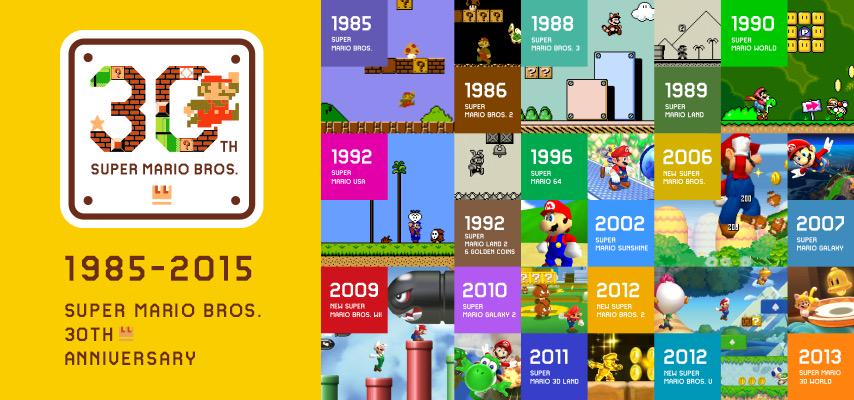
_VB.jpg)