Super Mario Advance 4: Super Mario Bros. 3
- This article is about the Game Boy Advance remake. For the original NES game, see Super Mario Bros. 3. For other uses, see Super Mario Bros. 3 (disambiguation).
| Super Mario Advance 4: Super Mario Bros. 3 | |||||||||
|---|---|---|---|---|---|---|---|---|---|
 American box art For alternate box art, see the game's gallery. | |||||||||
| Developer | Nintendo EAD | ||||||||
| Publisher | Nintendo | ||||||||
| Platform(s) | Game Boy Advance Virtual Console (Wii U) Game Boy Advance - Nintendo Switch Online | ||||||||
| Release date | Game Boy Advance: July 11, 2003 July 11, 2003 October 17, 2003 October 17, 2003 October 21, 2003 October 21, 2003 October 24, 2003[1] October 24, 2003[1]Virtual Console (Wii U): December 29, 2015[2] January 21, 2016 March 10, 2016[3] March 11, 2016Game Boy Advance - Nintendo Switch Online: February 8, 2023 February 9, 2023 February 9, 2023 February 9, 2023 February 9, 2023 February 9, 2023 February 9, 2023 February 9, 2023 | ||||||||
| Language(s) | Deutsch English (United States) Español (España) Français (France) Italiano 日本語 | ||||||||
| Genre | 2D platformer | ||||||||
| Rating(s) |
| ||||||||
| Mode(s) | Single player, multiplayer | ||||||||
| Media | Wii U:  Digital download Digital downloadNintendo Switch: Digital downloadGame Boy Advance:  Game Pak Game Pak | ||||||||
| Input | Wii U:  Wii Remote (horizontal) Wii Remote (horizontal)Nintendo Switch: Game Boy Advance:
| ||||||||
 - Everyone
 - Three years and older
 - All ages
 - General



Super Mario Advance 4: Super Mario Bros. 3 is a reissue of the 1988 NES game Super Mario Bros. 3 for the Game Boy Advance and is the fourth and final entry in the Super Mario Advance series. It boasts similar graphics and sound to the Super Mario All-Stars version, and it makes use of the e-Reader to support additional content. It features a remake of Mario Bros. identical to that found in the Super Mario Advance games that came before it. It also has rumble support if played on a Game Boy Player.
The first release of the game was bundled with two e-Reader cards. Two groups of cards, referred to as series, were also sold as separate products. By scanning these special cards into the e-Reader, players are able to unlock items, videos, and, most significantly, new levels in the game. One notable item is the Cape Feather from Super Mario World, which allows Mario to transform into Caped Mario. There were also two Switch cards that the player could activate and deactivate the effects of by scanning them: the Orange Switch and the Blue Green Switch. The e-Reader feature is still present in the European version, but it is disabled and inaccessible, despite being fully translated. This is due to the e-Reader not releasing in Europe, despite being planned to. The e-Reader's functionality can be forcibly accessed in the European version by corrupting a save file.[4]
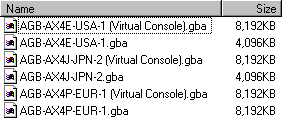
The game was rereleased on the Wii U's Virtual Console service in Japan on December 29, 2015,[2] and later in North America on January 21, 2016; in Europe on March 10, 2016; and in Australia on March 11, 2016. All releases on the Wii U automatically include all levels that were accessible via e-Reader cards, including levels that had previously been released only in Japan. The ROM size was also increased from 32 megabits to 64.[5] It was also rereleased for the Nintendo Switch's Game Boy Advance - Nintendo Switch Online service as one of its launch titles on February 8, 2023, worldwide, which also includes all of the e-Reader levels.
Story[edit]
The story, from the instruction booklet:
The Mushroom Kingdom has remained a peaceful place, thanks to the brave deeds of Mario and Luigi. However, the Mushroom Kingdom forms an entrance to the Mushroom World, a place where all is not well. Bowser sent his seven children to make mischief in this normally peaceful land. As their first order of business, they stole the royal magic wands from each country in the Mushroom World and used them to turn the kings into animals. Mario and Luigi must recover the royal magic wands from Bowser's seven kids to return the kings to their true forms. As Mario and Luigi set off on their journey deep into the Mushroom World, Princess Peach and Toad have but one thing to say: “Good-bye, and good luck!”
Controls[edit]
| In a level | On the world map |
|---|---|
|
|


List of changes[edit]
There are many changes between the original and All-Stars versions of Super Mario Bros. 3 and Super Mario Advance 4.
- Like in Super Mario World: Super Mario Advance 2, after the game boots up, a cutscene telling the story leading up to the game was added.
- If the player warps to World 8, Bowser's letter will appear on-screen as if the player completed World 7.
- If the player defeats Bowser before defeating all of the Koopalings and enters a skipped world's castle, a cutscene will play that will show the respective Koopaling breaking into the castle, stealing the King's scepter, transforming the King, and leaving just as Mario arrives at the castle, similar to the intro.
- When the player first enters the second part of the World 8 map, Princess Peach is shown above the second pipe. She yells, "Mario!" (if the player is Mario) or simply screams (if the player is Luigi) before disappearing. Her voice clip is recycled from Super Mario Sunshine.
- The ending scene of Mario/Luigi rescuing Peach is omitted after the game is cleared.
Gameplay changes[edit]
Several items and enemies have been changed for the remake:
- Upside-down Spiny Shells can be safely grabbed, stomped, and/or kicked without taking damage; in the previous versions, even an immobile, upside-down Spiny Shell would hurt Mario if he landed on top of it.
- Big Blocks in normal courses can be hit with a tail swipe as Raccoon or Tanooki Mario (Mega ? Blocks in bonus rooms are still immune to tail whips.).
- Coin Blocks generally give more than ten coins if hit fast enough, and up to 20 if a P-Wing is used.
- Spade Panels change suits if won, which gives the player the chance to earn more lives. The order is Spade> Heart (offering up to a 7-Up)> Club (up to a 10-Up)> Diamond (guaranteed win), before looping back.
- The maximum number of lives is now 999 rather than 100 (in the NES version) or 99 (in All-Stars).
- Tail-swiping a Muncher will not turn it into an Empty Block.
- All Lakitus are one block (16 pixels) lower than they were in the previous versions due to the smaller resolution on the GBA.
- Kicked shells and White Blocks can collect coins. Coins collected this way are usually worth double.
- Jelectros bob up and down in-place rather than being completely still.
- Magic Balls and Magic wands now bounce upwards upon being hit with fireballs, hammers, or tail whips.
- The Hammer Brothers' hammer-throwing frequency is lowered; the only exception is while they are jumping.
- Boss Bass takes longer to respawn (if the Orange Switch is not used).
- Bowser (whose lower half is now harmful) becomes intangible upon defeat (if he is beaten with fireballs or hammers).
- The Power Meter does not run out if Mario keeps running, and in Raccoon or Tanooki form, he can replenish it by landing and taking off again.
- Attempting to potentially warp backwards from World 6 back to World 5 via the Magic Whistle is no longer possible. Attempting to "warp" to either Worlds 5, 6, or 8 from within will no longer result in those worlds' progress being reset upon arrival.
- After Mario/Luigi defeats Bowser, he automatically turns into Super Mario/Luigi regardless of whatever power-up he is using, to fit with the ending cutscene.
- Defeating Bowser the first time lets the player revisit any world (besides World 9), and clearing all 90 levels allows the player to revisit any panel they choose.
- Due to the inclusion of the Mario Bros. remake, and the fact that it is not possible for two players to play on a single console, the Battle Mode in 2 Player Game (and the Battle Game from the title screen) has been removed.
Additionally, several gameplay changes to items and enemies match their functions in Super Mario World and Super Mario Advance 2:
- Invincible Mario's point chain is the same as that of kicking a shell through many enemies or stomping many foes without landing on the ground.
- The time bonus countdown is shown after the player clears any stage, and like in Super Mario Advance 2, the time bonus is x100, x200, and x500 for beating Boom Boom, the Koopalings, and Bowser, respectively.
- Obtaining a Fire Flower or Super Leaf as Small Mario will change him to Fire Mario or Raccoon Mario respectively instead of only changing him to Super Mario.
- The player can now carry items (like shells and White Blocks) through pipes to new areas.
- Shelled enemies (like Koopa Troopas and Buzzy Beetles) can now be stomped underwater.
- Holding an item underwater lets Mario swim faster and float to the surface.
- Like Caped Mario, Raccoon or Tanooki Mario can now tail-swipe mushrooms away from him.
- Mario can climb beanstalks faster by holding
 or
or  . He can also aim his fireballs/hammers by moving left or right while on one.
The controls have been slightly altered to accommodate the GBA's button layout:
- On the map screen,
 is used to open the inventory window rather than , which instead swaps lives in Mario & Luigi mode (as in Super Mario World).
- Due to the removal of the current world and the player's lives from the inventory window, it can hold eight more items, increasing the allowed number from 28 to 36.
- After the player beats the game, can also be used to select a world (as in Super Mario Bros. and Yoshi's Island: Super Mario Advance 3), although in Mario & Luigi mode, both brothers must be in different places for it to work.
- can be used as an additional run/attack button during levels, while on the map screen, it brings up the e-Reader menu.
- On the map screen,
 opens a new replay menu, which can be used to watch or save a replay of the most recent level playthrough (provided the player did not pause).
Level design changes[edit]
- Main article: Super Mario Bros. 3#Worlds

Entire structures in some levels are altered to accommodate for the GBA's smaller screen, such as shortened rooms, lower ceilings, higher lava pits, and slightly different stairs.
- The world map pipes were redesigned to fit completely on the GBA's screen.
- Before facing Boom Boom, the entrance is closed. As such, the fortress boss arenas are slightly shorter.
- Likewise, Bowser's rooms are also shorter.
Many of the changes to levels have made the gameplay easier for the player to complete.
- In World 6, the path to the second Toad House was changed so that clearing World 6-5 is not required to access it.
- Several platforms were made longer.
- Several blocks containing coins, power-ups, and 1-Up Mushrooms were added.
- Several enemies, obstacles, and pits were changed to be less threatening or removed.[6]
Some levels also received changes to the placements of items and/or coins.
- The end of World 2-
 Pyramid is now at the other side of the pyramid, and a Blue Coin-revealing Switch Block has been added behind the pipe.
 - In World 5, the bricks directly attached to Warp Pipes and Turtle Cannons now contain coins.
- As this is Super Mario Advance 4, the second of the two "3's" made of blue coins in World 5-1 was changed to a "4."
- After beating the game, in levels that unlock White Mushroom Houses, there is a Mushroom Coin at the start that, when hit, shows how many coins Mario needs to unlock the house.
Graphical changes[edit]
The sprites have a slightly brighter color, but it is not as noticeable as in the other Super Mario Advance games. The invincibility palettes are even brighter, making Mario/Luigi colored like they were in Super Mario Advance. This can be reverted by using a Warp Pipe, taking damage, powering-up, or exiting/clearing the course. If the game is played on a Game Boy Player, however, the palettes revert to those of the All-Stars version.
Beyond being brightened, a few of the game's sprites were slightly redesigned to fit the GBA's capabilities:
- As in the other games in Super Mario All-Stars, Mario and Luigi now wear their white gloves instead of being bare-handed (the coloring in the NES version was due to NES sprites only allowing for three colors at a time; the All-Stars version did not fix this for unknown reasons), matching their official artwork. Mario's lighter tail stripes are also thinner.
- Unless he is holding an item, Luigi now scuttles when he jumps, regardless of whether the yellow switch card is active or not.
- Luigi's Statue form is as tall as he normally is, instead of matching Mario's.
- Frog Mario/Luigi is upright when holding the magic wand, rather than in his normal jumping pose.
- When Raccoon/Tanooki Mario/Luigi glides/flies while crouching or holding an object, his tail is now animated.
- Princess Peach received new sprites for this version, matching her official artwork.
- Pile Driver Micro-Goombas are colored differently and do not shine like actual bricks (as in the original NES version).
- In World 4, the Sledge Brothers on the world map now have unique sprites. Prior to this, their map icon was either an actual Hammer Brother (NES) or merely a green Hammer Brother (SNES).
- The bonus rooms in Worlds 6-9, 6-10, and 8-1 are made of bonus room terrain, rather than using the cave tileset.
- The floating Turtle Cannon in World 8-1 is flipped and now looks attached to the block it is on.
- As in the official artwork, Boom Boom's head is now rounded.
- Bricks that contain something do not turn into a "fake" coin after a Switch Block is activated.
- Bricks and coin stay animated while a Switch Block is active.
- Spade Panels and N-Mark Spade Panels got a major design change, now having a zoomed-out view of the original area, a more detailed background, and a door which Mario enters to play the minigame.
- Instead of being a mostly static slideshow, the worlds in the end credits now show a short animation, followed by the screen freezing and the world's name, number, and map sliding onto the screen. Additionally, the "World #" font was changed to look like it did on the original status bar, but bigger.
Some effects were added to the sprites for extra detail:
- Coins sparkle when collected.
- Shooting a fireball at Bowser or Boom Boom causes them to flash for an instant.
- Using a Magic Whistle causes the screen to blur out, like it does when warping in the remakes of Super Mario Bros. 2.
- After a Switch Block is activated, it disappears in a puff of smoke after one game second.
- When an extra life is earned, the "1UP" icon grows bigger before it disappears.

The world maps have been edited, mostly due to the lack of borders on the map screen. Most maps scroll vertically, due to the GBA's resolution, and some of the maps have been updated.
- The end section of World 3's map is even more like Japan, as a island that resembles Sado Island is added.
- In World 5, the map of the ground seen from the sky is fixed, now matching the actual ground part of the world's map. Also, moving clouds replace the stationary ones.
- After World 8-
 Fortress is cleared, the spotlight briefly expands when the lock is removed.
 - On the last part of World 8, Bowser's Castle was redesigned again, as it was during the NES-to-All-Stars transition. Also, the path-connecting coin icons sparkle, and a "Help!" word balloon comes from the castle before beating the game.
- The border from the All-Stars version returns on the new World Select screen.
- After beating the game, the castles' word balloons change to "!" if all the stages in the world haven't been cleared, "OK" if they have, and "CLEAR!" if the game is fully completed.
Many levels are given more fitting backgrounds, like the All-Stars version. However, most level backgrounds (except for underground levels, airships, and fortresses) lack horizontal parallax scrolling, although this did appear in a pre-release trailer shown at E3 (vertical parallax scrolling can still be seen as Mario flies upward).
- In World 3-7's background, which is moved up, the clouds are all in front of the hills.
- In World 3, all block backgrounds are replaced by waterfall backgrounds (except for the ground Hammer Bros. stages).
- As in the All-Stars version of Super Mario Bros., underwater level backgrounds now have a distorted wavy effect.
- The steel background of World 5-1's secret area and the block background of World 5-7's secret area were both changed to a sky background.
- The sky in World 6's athletic background is white, rather than purple.
Some of the game menus have been changed to compensate for a smaller screen and different button controls.
- The status bar is only 16 pixels tall (only showing the current world, and the player's lives, coins, score, and cards) and is in front of the map on the map screen, but it is replaced by a normal HUD in courses (the Power Meter and cards stay on the bottom; the cards are shown briefly at the start of each stage, and reappear near the goal).
- In both cases, the word "World" is taller (to match the number font), and the "M" & "L" symbols are shorter.
- The item inventory shows all four rows at once, rather than one row at a time.
- Small blue & icons are added to the top corners of the map screen.
- Within levels, the cards are now squares instead of rectangles.
- A new Game Over screen appears before the Continue/Quit menu, and it is impossible to save after a Game Over (as in the NES version). Any levels cleared before getting a Game Over stay that way upon continuing.
- If the player finishes all the levels, staff credits are shown at the end along with the cutscenes and world names, along with the alternate ending music mentioned below.
Some of the letters look slightly different:
- Peach's letters are smaller and have a cyan background. Additionally, she does not wink, unlike in the All-Stars and NES versions.
- Bowser's letter is written on different paper with a gray background, instead of looking the same as Peach's letters. It also flashes slower than the All-Stars version, likely to reduce the risk of seizures.
Textual changes[edit]
Some of the dialogue was updated or fixed.
- Upon clearing a level, "COURSE CLEAR! YOU GOT A CARD" was changed to "LEVEL CLEARED! YOU GOT A PANEL." "LEVEL CLEARED!" also appears after boss fights.
- In World 1-3's secret Toad House, "faraway" is spelled correctly as one word.
- In the N-Mark Spade Panel instructions, "Miss twice and your out" from the earlier NES versions and Super Mario All-Stars was corrected to "Miss twice, and you're out!"
- World 9's welcome message is now "World 9 Warp Zone!" rather than "Welcome to Warp Zone."
- World 8's name was changed from "Castle of Kuppa" (or "Castle of Koopa") to "Bowser's Castle" (the Japanese version instead renders all world names in hiragana, and are closer to the "Land" set).
- Peach's speech in the ending has been reverted to the one found in the Japanese versions, instead of the joke featured in the previous North American and PAL versions.
The dialogue in the kings' castles were slightly changed:
- In Toad's initial pleas, "King" is spelled in lowercase.
- If the player visits the castle after failing in an airship stage, "Little Koopa." in Toad's message is replaced by "the Koopalings!"
- Kings start their thanks with "Oh, splendid! Splendid!" instead of "Oh, thank heavens!", "I'm" was changed to "I am", and "Princess" is now lowercase.
- In the Kings' message to Tanooki Mario, a comma was added after "Please."
- The interrobang (?!) in the Kings' message to Hammer Mario was reversed.
- If the player defeats a Koopaling after beating Bowser, the King's speech will omit any reference to Peach's letters.
The post-world letters have had their wordings redone:
- Peach's second and third letters are swapped back to their original Famicom positions,[7] though the attachments remained the same. Also, as in the revised NES version, "Kuribo" is changed to "Goomba."
- In her fourth letter, "Sand Dunes" is now fully lowercase.
- The space between the first and second sentences of her fifth letter is removed.
- Her last letter has "goal of the first" added in-between "Third" and "world", and "Third" is in lowercase.
- In Bowser's letter, "Ha ha ha" is changed to "Gwa ha ha ha", and "Koopa" to "Koopas."
Audio changes[edit]
Mario and Luigi have voice acting performed by Charles Martinet. Other added voice clips include Peach's cries for help in Bowser's Castle, cackling Boos, and Toad's yelp in the intro and castle cutscenes. Along with this, several new sound effects have been added.
- The music quality has been decreased due to the GBA's inferior sound chip; most tracks were rearranged as a result.
- Luigi's jumps are joined with a new sound effect for his scuttling, similar to Super Mario World: Super Mario Advance 2.
- As in the All-Stars version of Super Mario Bros., Bonus Areas feature new upbeat music, rather than the underground theme.
- As in Super Mario Advance 2, a sliding sound effect was added.
- Certain sounds were changed/removed. For example, in levels, the "poof" sound Super Leaves make when grabbed is replaced with the typical "power-up" sound, and the "block hit" sound is absent when hitting bricks or blocks with coins in them.
- In the Spade Panel minigame, a drumroll starts when two-thirds of a picture are lined up, and new victory music plays if a picture is lined up.
- The Power Meter beeps in a lower pitch if the player is not in Raccoon or Tanooki form.
- The short tune heard after defeating Bowser was changed from the same one heard after saving the Kings to a cover of the tune heard after defeating him and his fakes in Super Mario Bros.
- An alternate ending song, which features the Super Mario Bros. ending theme remixed, is played when the player finishes all the game's levels. The original ending song is only heard if the player beats Bowser without finishing all the levels.
e-Reader cards[edit]

For a complete listing of the cards themselves, see here. The list of features added to Super Mario Advance 4 by the cards is as follows:
Exclusive features[edit]
- See-saw platforms
- Rock Blocks (can only be destroyed by Hammer Mario or Statue Mario)
- !-Switches
- Checkered blocks that rotate 90°
- Sideways Venus Fire Traps
- Advance Coins
- e-Coins
- Vanishing Blocks (only visible when Mario is Statue Mario)
- ? Block with Goomba's Shoe
- Gray spike Donut Lifts
- Blue boomerangs
Features and enemies from past titles[edit]
- Super Mario Bros.
- Super Mario Bros.-styled Lifts
- Super Mario Bros.-styled Hard Blocks
- Fire-Bars
- Balance Lifts
- Flagpoles
- Fake Bowser
- Axe
- Super Mario Bros.: The Lost Levels
- Super Mario Bros. 2
- Super Mario World
- Cape Feather/Caped Mario
- Stretch Blocks
- Triangular Blocks
- Snake Blocks
- Springboards
- Roulette Blocks
- 3-Up Moon
- Keys
- Spike Tops
- Cross-shot Bullet Bills
- Lil Sparkies
- Hotheads
- Bony Beetles
- Thwimps
- Magikoopas
- Amazing Flyin' Hammer Brothers
- Rip Van Fishes
- Jumping Piranha Plants
- Monty Moles
- Wigglers
- Goombas
- Para-Goombas
- Bowser Statues
- Falling spikes
- Big Boos
- Chargin' Chucks
- ? Blocks with Control Coins
- Super Mario World 2: Yoshi's Island
- Super Mario Advance
- Giant Vegetables
- Items trapped in bubbles
Staff[edit]
- Main article: List of Super Mario Advance 4: Super Mario Bros. 3 staff
Super Mario Advance 4 was developed by Nintendo EAD, with Hiroyuki Kimura as its director and Takashi Tezuka as the producer. The new graphics were designed by Emi Tomita, and the new music tracks were composed by Taiju Suzuki. Very few of the original game's staff were involved in the production of this remake; even Super Mario creator Shigeru Miyamoto goes uncredited here, when he had previously produced Super Mario World: Super Mario Advance 2 with Tezuka as his supervisor.
Gallery[edit]
- For this subject's image gallery, see Gallery:Super Mario Advance 4: Super Mario Bros. 3.
Logo
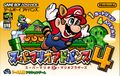
Japanese box art
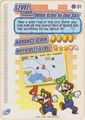
Wild Ride in the Sky e-Reader card
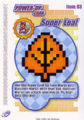
Super Leaf e-Reader card
Prima Games official guide


Media[edit]
- For a complete list of media for this subject, see List of Super Mario Advance 4: Super Mario Bros. 3 media.
 Title Screen Title Screen | File info 0:30 |
| Overworld Theme | File info 0:30 |
| Athletic Theme | File info 0:30 |
| Underground Theme | File info 0:30 |
| Underwater Theme | File info 0:30 |
| Starman | File info 0:11 |
| Airship Theme | File info 0:30 |
Pre-release and unused content[edit]
The game's logo looked different than it did in the E3 trailer. Gray switches were also found in the game's data and also includes pressed versions of these switches. Compressed Super Mario World graphics were found in game data, these include an animation frame for the Koopa Clown Car, three frames of a Koopa Troopa walking, and two frames of a Goomba from Super Mario World walking.
Glitches[edit]
- It is possible to get Mario or Luigi to run backwards in the game. To get this to happen the player needs to hold left and right at the same time.
- If the player is on the map and uses a Starman and goes to a pipe, after the Starman is done, the underground music will play very fast.
Reception[edit]
Super Mario Advance 4: Super Mario Bros. 3 has received very positive reviews, and has been considered one of the best Game Boy Advance games ever made. It is the third highest-rated GBA game on Metacritic, with an aggregate score of 94 based on 25 reviews,[8] and also that site's fourth highest-rated game in the Super Mario franchise, behind only Super Mario Galaxy, Super Mario Galaxy 2, and Super Mario Odyssey.[9]
Both Pocket Gamer and Play Magazine gave the game perfect scores. The former called the game "Mario hop-'n'-bop action at its finest", while the latter lauded the challenge in the gameplay, the quick save feature, and the e-Reader functionality. Meanwhile, Electronic Gaming Monthly praised Super Mario Advance 4: Super Mario Bros. 3 for its controls, stages, and visuals, stating that it looked good for an "old, trippy 2D game", and Yahoo! Games stated that the game surpassed both the original NES/Famicom version and the Super Mario All-Stars release.[8]
| Reviews | |||
|---|---|---|---|
| Release | Reviewer, Publication | Score | Comment |
| Game Boy Advance | Benjamin Turner, Gamespy | 4.5/5 | "Given the short list of negatives above, I'd have to say that this is technically the least desirable version of Super Mario Bros. 3. However, the least accomplished version of an awesome game can still be pretty damn great, and such is the case here. Players who missed the first two editions probably won't even notice the shortcomings, and this is the only version of SMB3 that can easily be played on the go. SMB3 is almost as fun today as it was 13 years ago, and is among the top platformers on the GBA. That makes Super Mario Advance 4 an excellent choice for series veterans who want a portable Mario game, and an even better one for fresh-faced newbies who won't notice the port's technical shortcomings." |
| Game Boy Advance | Joao Diniz Sanches, Pocket Gamer | 4/5 | "Playing Super Mario Bros. 3 is a dizzying experience. As one of the finest exponents of the genre, the ride it takes you on is as memorable as it is extraordinary, making it a vital acquisition for lovers of platform games." |
| Aggregators | |||
| Compiler | Platform / Score | ||
| Metacritic | 94 | ||
| GameRankings | 92.25% | ||
Sales[edit]
The game was commercially successful in North America, with sales in excess of 2.88 million copies.[10] By the end of 2006, it had sold more copies in that region than any other Game Boy Advance game.[11]
Awards[edit]
Super Mario Advance 4: Super Mario Bros. 3 won IGN's 2003 award for best Game Boy Advance platform game,[12] and GameSpot nominated it for best platform game of the year.[13]
Names in other languages[edit]
| Language | Name | Meaning |
|---|---|---|
| Japanese | スーパーマリオアドバンス4 Sūpā Mario Adobansu 4 |
Super Mario Advance 4 |
| Chinese (traditional) | 超級瑪利歐ADVANCE 4[14] Chāojí Mǎlì'ōu Advance 4 |
Super Mario Advance 4 |
Trivia[edit]
- This is the first Super Mario franchise release, and first Nintendo-published handheld game in general, to carry Nintendo of America's current-era universal seal, which covers all products and merchandise licensed by the company. Previously, Nintendo had two seals—the Official Nintendo Seal of Quality, which covered hardware, games, and accessories; and a secondary seal saying "Official Nintendo Licensed Product", which only covered licensed merchandise.
- Despite this, the instruction booklet's copyright information page uses the text box for the former seal, in its last appearance in a Nintendo game manual.
- Many of this game's mechanics (like obtaining an extra life if a Goal Pole's top is reached) became the standard in the series since New Super Mario Bros.
- Despite gaining new sprites in this game, part of Luigi's power-up animation is a palette swap of Mario's. His somersaulting sprites are also recolored versions of Mario's.
External links[edit]

References[edit]
- ^ Date info for GBA from TMK, retrieved 6-30-2008
- ^ a b https://www.nintendo.co.jp/titles/20010000008346
- ^ Nintendo Download: 10th March (Europe). Nintendo Life. Retrieved March 7, 2016.
- ^ Super Mario Advance 4: Super Mario Bros. 3 - The Cutting Room Floor
- ^ File:SMA4 GBA Size.png
- ^ https://www.youtube.com/watch?v=m9H7ulK4Cbw
- ^ https://themushroomkingdom.net/mario-in-japan/smb3#letters
- ^ a b Super Mario Advance 4: Super Mario Bros. 3 reviews at Metacritic.com, dated 10-20-2003
- ^ "Best and Worst Mario Games" at Metacritic.com, dated 5-20-2010
- ^ "US Platinum Chart Games" at The Magic Box, dated 12-27-2007
- ^ News - "Sailing the World: Eye of the Hurricane" at Gamasutra
- ^ [1]
- ^ [2]
- ^ 介紹Nintendo Switch Online的最新資訊!「Nintendo Switch Online」的新成員Game Boy及 「Nintendo Switch Online + 擴充包」的新成員Game Boy Advance現已登場。 Nintendo HK. Retrieved February 9, 2023.