Super Mario Bros.: The Lost Levels
- This article is about the game called "Super Mario Bros. 2" in Japanese. For the game given that title elsewhere (named Super Mario USA in Japanese), see Super Mario Bros. 2.
| Super Mario Bros.: The Lost Levels | |||||||||||
|---|---|---|---|---|---|---|---|---|---|---|---|
 Western cover art from Nintendo Switch Online For alternate box art, see the game's gallery. | |||||||||||
| Developer | Nintendo EAD | ||||||||||
| Publisher | Nintendo | ||||||||||
| Platform(s) | Family Computer Disk System, Game Boy Advance, Virtual Console (Wii, 3DS, Wii U), Nintendo Entertainment System - Nintendo Switch Online | ||||||||||
| Release date | Family Computer Disk System: June 3, 1986[1][2] June 3, 1986[1][2]Game Boy Advance: August 10, 2004Virtual Console (Wii): May 1, 2007 September 14, 2007 September 14, 2007 September 14, 2007 September 14, 2007 October 1, 2007 October 1, 2007Virtual Console (3DS): July 25, 2012 December 27, 2012 December 27, 2012 December 27, 2012 July 6, 2016 July 6, 2016Virtual Console (Wii U): August 8, 2013 January 23, 2014 January 23, 2014 March 13, 2014Nintendo Entertainment System - Nintendo Switch Online: April 10, 2019[3] April 10, 2019[4] April 10, 2019 April 10, 2019 April 23, 2019 April 23, 2019 April 23, 2019 April 23, 2019 | ||||||||||
| Language(s) | English (United States) | ||||||||||
| Genre | 2D Platformer | ||||||||||
| Rating(s) |
| ||||||||||
| Mode(s) | Single-player | ||||||||||
| Media | FDS:
Floppy disk Wii:  Digital download Digital downloadWii U: Digital downloadNintendo Switch: Digital downloadGame Boy Advance:  Game Pak Game PakNintendo 3DS: Digital download | ||||||||||
| Input | NES:
Wii:  Wii Remote (horizontal) Wii Remote (horizontal)Wii U: Wii Remote (horizontal)Nintendo Switch: Game Boy Advance: Nintendo 3DS:
| ||||||||||
 - Everyone
 - Three years and older
 - All ages
 - General
 - All ages







Super Mario Bros.: The Lost Levels, also known as Super Mario Bros. 2, and alternatively Super Mario Bros. 2: For Super Players in the Japanese version of Super Mario All-Stars and Super Mario Bros. for Super Players in Super Mario Bros. Deluxe, is a direct sequel to the NES game Super Mario Bros. It is the second entry in the Super Mario series.[5]
The game was initially released in 1986 for the Japan-only Family Computer Disk System. It uses a slightly altered version of Super Mario Bros.'s engine, with some new features, altered graphics and new enemy behavior, and different, significantly more challenging levels. Nintendo of America originally deemed this game too difficult and too much like the original to sell well in Western countries, so in order to prevent the early series being associated with frustration and staleness, it adapted Yume Kōjō: Doki Doki Panic and released it as Super Mario Bros. 2. This game was later released in Japan under the title Super Mario USA.
The first time this game was released outside of Japan was its remake in Super Mario All-Stars, where it gained the title Super Mario Bros.: The Lost Levels in 1993. Then, as part of Super Mario Bros. Deluxe, it was redone and renamed Super Mario Bros. for Super Players. The original unaltered release was not available worldwide until the debut of the Virtual Console, over two decades later.
Story[edit]
The story of Super Mario Bros.: The Lost Levels is identical to the first game and is said to be set in a "parallel world" to it.[2][6] The following text is translated from the Japanese instruction booklet.[7]
One day, the peaceful kingdom where Mushrooms live was invaded by the tribe of the huge turtle Koopa, whom possesses powerful magic. Said magical power transformed all the quiet Mushroom People into rocks, bricks and horsetails among other forms, and the Mushroom Kingdom fell into ruin.
The only one who can undo this magic on the Mushrooms and revive them is the Mushroom Kingdom's own Princess Peach. She is presently in the hands of King Koopa.
Mario has stood up to defeat the Turtle Tribe, rescue Princess Peach, and rebuild the peaceful Mushroom Kingdom.
The Mario in the TV is you. Only you can bring this adventure quest (expedition) to a conclusion.
Gameplay[edit]

Super Mario Bros.: The Lost Levels is divided into 13 new worlds of the Mushroom Kingdom, each of which have four levels like in Super Mario Bros. Mario and Luigi have to get to the end of the level by jumping over various gaps and avoiding or defeating the members of the Turtle Empire on their way. The Mario Bros. can use several platforms (some of them collapse when Mario or Luigi lands on them), stairs in the level, as well as Jumping Boards. There are also Warp Pipes along the way, some of which Mario can enter to visit various secret coin rooms before returning to the level, a bit further ahead than when he left. At the end of each level, a castle stands with a flagpole nearby. When Mario reaches the flagpole, he takes down the enemy flag and enters the castle, completing the level. The higher the spot that Mario hits the flagpole, the more points he receives.
Unlike Super Mario Bros., Super Mario Bros.: The Lost Levels does not have two-player mode in the game. Mario or Luigi has to be played alone. Mario retains the same abilities as Super Mario Bros., but Luigi returns with the ability to jump higher than Mario can (which is retained in Super Mario Bros. 2 and some other Super Mario games). On the downside, Luigi has slippery traction, so he could prove to be unruly at times.
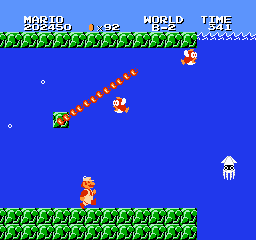
Super Mario Bros.: The Lost Levels includes the same enemies from Super Mario Bros.: Goombas, Koopa Troopas, Buzzy Beetles, Koopa Paratroopas, Bullet Bills, Hammer Brothers, and leaping Cheep Cheeps. All these enemies can be defeated when Mario jumps on them once, except for Koopa Troopas and Buzzy Beetles, which now run faster than in Super Mario Bros. and hide in their shell when jumped on, which Mario can kick to defeat other enemies and hit blocks or bricks. Koopa Paratroopas lose their wings and fall to the ground when Mario or Luigi jumps on them. Other enemies include Piranha Plants (including new red Piranha Plants, which have replaced green ones in later games) found in pipes, the Spiny-throwing Lakitus and the Hammer Brothers. There are a few levels which take place underwater. In the water, Mario can swim freely from the top to the bottom of the screen. The enemies in underwater levels are Bloopers and Cheep Cheeps, with the inclusion of Goombas, Koopa Troopas, Buzzy Beetles, Koopa Paratroopas, Hammer Brothers, Lava Bubbles, Fire-Bars, and Piranha Plants; Mario can only defeat these creatures by shooting them with fireballs. In some levels, Bloopers are found floating in the air.

Mario or Luigi can get special power-ups out of ?s or, uncommonly, bricks. Most of the ?s in which Mario can find these items are visible, but some are hidden and only become visible when hit from below. With the Super Mushroom, he turns into Super Mario. As Super Mario, he can survive the hit of an enemy one time, at the cost of turning back to Small Mario. He may also destroy empty bricks by jumping beneath them. Lost Levels introduces a harmful version of the Super Mushroom, the new Poison Mushrooms, which injure Mario or Luigi by simply touching one. Additionally, he can also get the Fire Flower. With the Fire Flower, Super Mario turns into Fire Mario, which allows him to shoot fireballs at enemies to defeat them from a distance. With the 1-Up Mushroom, he gains a life; he can also get an extra life by collecting 100 coins. With the rarest item of all, the Super Star (which can only be found in bricks), Mario turns invincible for short of time and can kill enemies by touching them. As with Super Mario Bros., with the exception of coins, only one item can appear on the screen, and when a new item appears, the previous one will disappear.
If Mario takes a hit or Poison Mushroom while Small, falls down a pit, or if the Time Limit runs out, he loses a life and restarts the level. The point where Mario continues depends on his progress through the level before getting defeated; either from the beginning, or at one of several invisible "checkpoints" throughout the level.
The fourth level of each world plays inside a castle. They are usually filled with Fire-Bars and Lava Bubbles. At the end of a castle level, Mario is confronted with a fake Bowser in every world except World 8, where the real Bowser is confronted. To defeat a fake Bowser or the real Bowser, Mario has to either touch the axe to destroy the bridge, causing either the fake Bowser or the real Bowser to fall into the lava, or hit Bowser with a number of fireballs, which produces the same result and reveals the true forms of the fakes.
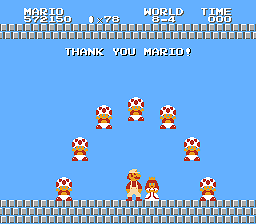
After defeating a fake Bowser, Mario frees one of the seven Toads from the castle, at which point they say their iconic sentence: "Thank you Mario/Luigi! But our princess is in another castle!" and Mario proceeds to the next world. At the end of the castle in World 8, Mario or Luigi frees the grateful Princess Peach and completes the adventure.
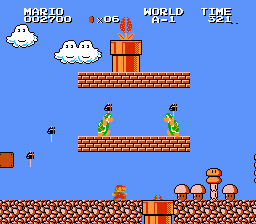
Unlike the first game, there are hidden worlds to discover. Playing through the game without warping forward takes the player to the Fantasy World. Completing the game eight times also unlocks Worlds A-D, with Princess Peach waiting to be rescued from a fake Bowser (the actual Bowser in Super Mario All-Stars version) in the last level.
Differences and additional features[edit]
Although the mechanics in Super Mario Bros.: The Lost Levels adhere closely to those of Super Mario Bros., the game does feature some significant changes and additions.
Graphical and sound additions and changes[edit]
- The background graphics, block tiles, and ground tiles are different (mountains now have jagged slopes, cloud and bushes have faces, horsehair plants/trees are now segmented, fences and lifts are now mushrooms, ground is rockier, bricks have shading, etc.).
- Mushroom sprites (including Super Mushrooms, Poison Mushrooms, and 1-Up Mushrooms) are changed to have eyes, a feature that has stuck with the franchise since.
- The giant mushroom platforms (found in 4-3 and the 4-2 Warp Zone of Super Mario Bros.) are changed into a new cloud shape that is not found in any other port of any of the 8-bit Super Mario games, and form the level theme of World 8-3 and World A-3 (actual Super Mario Bros.: The Lost Levels-style mushroom platforms would appear in All Night Nippon: Super Mario Bros., where they now have segmented stalks). Similarly, the grass platforms found in every other third level except for World D-4 now have a fringe-like appearance.
- A skidding sound for Mario and Luigi's sliding is added. This would later be reused in Super Mario Bros. 3.
- An animation when Mario comes out of a pipe into water is added.
- Shadows are added to the text font.
- Digits are one pixel shorter than the ones in the original game, and the "0" is shaped like the "O", rather than the rounder, slanted version seen originally. VS. Super Mario Bros. and All Night Nippon: Super Mario Bros. also use the Super Mario Bros.: The Lost Levels font, while Super Mario Bros. Special retains the Super Mario Bros. font.
- The "Ending" theme has a second verse four steps above the original pitch, and uses the FDS's hardware capabilities to make it richer in sound. It was first composed as the ending theme of Super Mario Bros., before being shortened due to storage limitations.[8] A similar version appeared earlier in VS. Super Mario Bros.
- Princess Peach is given a new sprite.
New game features[edit]
- Poison Mushrooms are introduced. Touching one is equivalent to colliding with an enemy, except the mushroom is consumed as usual. They can be found in either ?s or invisible blocks. Their color palette matches the Goombas of that level (brown on overworlds, blue in undergrounds, gray in castles).
- Red Piranha Plants are introduced, a more aggressive variant of the usual green Piranha Plant that attacks even if the player is standing next to their pipe. They stop attacking only if the player is anywhere above the pipe (except if on the two outermost pixels of its edges). These first appear in World 4.
- Upside-down pipes are introduced, appearing first in World 5.
- Red Piranha Plants may be found in upside-down pipes. They attack and retreat more frequently than those in right-side up pipes, and there is no way to stop them from attacking (since the player cannot stand on top of their pipe; they continue to attack even if the player stands directly underneath their pipe). These also appear in underwater stages.
- A strong wind blows in certain parts of some levels. It usually blows the player forward, enabling longer jumps but making it difficult to space them.
- While the original Super Mario Bros. only had three Warp Zone areas, Super Mario Bros.: The Lost Levels features a total of 11, all of which have only one destination pipe. Two of them are fake, and now take Mario back to a previous world: 3-1 to 1-1 and 8-1 to 5-1. Like World 4-2 of the original game, some levels have more than one Warp Zone location.
- Two-player mode has been removed, and the player can instead choose between Mario and Luigi on the title screen. Mario controls as in Super Mario Bros., while Luigi can jump higher than Mario, but has significantly worse traction. These characteristics would be carried over to many future Super Mario games, including Super Mario Galaxy, Super Mario Galaxy 2, Super Mario 3D Land, and Super Mario 3D World.
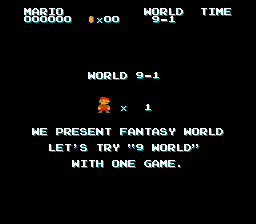
- If the player beats the game while completing all 32 of the game's standard levels without using any Warp Zones, they unlock World 9, a secret world. They have only one life to complete it with: if they fail, they are brought back to the main menu after getting a special Game Over message, and if they succeed, the world loops back on itself upon completion, meaning they can keep playing it until they die or decide to quit the game. The world features bizarre underwater landscapes not found in any other level, such as an underwater Goal Pole and castle. In the Super Mario All-Stars remake, the player may keep any lives they had left after World 8-4. All secret worlds were removed in the Super Mario Bros. Deluxe port.
- In the original version and Virtual Console releases, the game adds a star on the title screen each time the player beats World 8-4. The number of stars the player earns is saved on the disk, and the title card can display up to 24 stars.
- If the player earns a total of eight stars on the title card, they can unlock four more secret worlds, Worlds A through D, by holding the
 button at the title screen (or the
  button in the GBA version) before pressing Start. In the Super Mario All-Stars re-release, the levels may be accessed after just one successful playthrough, beginning automatically after World 8-4 (or 9-4 if the player unlocks World 9). All secret worlds were removed in the Super Mario Bros. Deluxe port.
 - Green Super Springs are introduced, appearing in Worlds 2, 3, 7, B, and C. These bounce Mario/Luigi so high that he disappears from view for several seconds, allowing the player to cover great distances without touching the ground but also making it very difficult to track his trajectory.
Tweaked game features[edit]
- A significant physics modification is added: Mario now bounces much higher after stomping on an enemy, and Luigi bounces even higher than Mario now does. This extra height is sometimes critical to clearing large gaps. If Mario or Luigi manages to stomp the top of an enemy while moving upwards at the right trajectory, the changed physics cause them to soar very high, sometimes off the top of the screen. This "Super Jump" would later be properly introduced in Super Mario Bros. 3.
- Invisible blocks may now hold any kind of power-up (instead of solely 1-Up Mushrooms, like in Super Mario Bros.), including Poison Mushrooms. These are either put in secret areas to aid the player, or (in the case of Poison Mushrooms) sometimes placed in locations easy to accidentally hit in order to obstruct the player.
- Bloopers can float above water. They behave the same way they do underwater and can be stomped for 1000 points.
- Koopa Troopas (and more rarely, a few other enemies) can be found in the water in some levels, such as World 3-2. They walk more slowly than usual and like other underwater enemies, cannot be stomped (Mario/Luigi instead take damage; they cannot be defeated without a Fire Flower or Super Star). Due to the palettes assigned to the underwater stages, the green enemies appear gray (they are still colored normally in the Super Mario All-Stars version). Additionally, this also renders underwater Buzzy Beetles invincible, as Buzzy Beetles cannot be defeated with fireballs, and cannot be stomped underwater.
- The "right path, wrong path" system now occurs in some non-castle levels, looping the level until the correct path is chosen. These levels include World 5-3 and World 7-2.
- In Worlds 7 and 8, Hammer Brothers now continuously charge forward while still throwing Hammers, making them extremely difficult to dodge. If Mario passes over them, they turn around and then behave normally (they continue to jump and throw hammers, but no longer run). In Super Mario All-Stars, this behavior also occurs in Worlds A-D. Hammer Brothers also occasionally appear underwater.
- Lakitus now sometimes appear underwater, along with Spinies. In certain levels, they also appear at lower altitudes, making them easier to stomp.
- An unusually-colored version of Bowser can be found in the corridors of two castles. He has a darker, greenish blue coloration, similar to Koopa Troopas and Piranha Plants found in cave or castle levels, and does not stand on a bridge over lava. The player can avoid this Bowser without defeating him. In the Super Mario All-Stars version, encountering this enemy cues the SNES-exclusive boss music until finishing the level. These palette changes are due to not being close to the axe, where the overworld green palette is used instead. Unlike the fake Bowsers in Worlds 1-7 and Worlds A-C, these do not change into generic enemies when defeated (with five Fireballs as usual); they will still look like the real Bowser.
- Beanstalk vines can lead to not only a Coin Heaven or a Warp Zone, but even to the flagpole.
- Luigi's increased jump height sometimes enables him to jump over the Goal Pole. In a few cases, this leads to a Warp Zone beyond the pole; in most other cases, the screen simply stops scrolling after the pole. It is no longer possible to get stuck behind the Goal Pole like it was in the original Super Mario Bros.
- Fireworks are no longer triggered by having the last digit of the timer be 1, 3, or 6, but rather by having the last digit of the timer match the last digit of the coin counter. Additionally, if both digits of the coin counter match the last digit of the timer, Mario/Luigi receives a 1-Up.
- In overworld and underground levels, some Piranha Plant pipes are now flush with the floor rather than extending above it, making them more difficult to notice and avoid.
- In addition to the obvious Poison Mushrooms, many actual power-ups are now traps: in castles with ceilings, a Super Mushroom may make Mario too tall to make some long jumps (as his head hits the ceiling and causes him to fall into a pit or lava); and in athletic levels, a Super Star may prevent Mario from stomping atop Koopa Paratroopas in midair to complete some extra long jumps (causing him to fall into the pit below).
- Holding A+Start on the title screen is no longer a continue code; instead, the player is directly given the option to Continue on the Game Over screen, and cannot return to the title screen without being forced to restart from World 1-1. (As the secret World 9's Game Over screen features a special message in place of any options, the player effectively cannot use any continues at all in that world; this does not hold true in Super Mario All-Stars.)
- In the GBA version, holding A+Start on the title screen once again allows the player to continue, but only from Worlds 1 to 8. This is saved (along with the player's high score) even when the game is powered off, if the player saves his/her high score beforehand. This change also makes it possible to switch between Mario or Luigi without having to restart on World 1, which was not possible in the FDS version.
- After beating the game, pressing B on the title screen no longer allows the player to start from any world, and there is no "new quest" where the player travels through the same levels but with tougher enemies. (The latter is essentially replaced by the secret worlds A-D.)
- The Game & Watch: Super Mario Bros. version of the game restores the world selection feature, allowing the player to access the highest world achieved in gameplay and all prior ones. Unlocking World A only does not unlock World 9 on the world select feature.
- A new ending cutscene, reused from VS. Super Mario Bros., is included: After Bowser (or Fake Bowser in World D) is defeated, Mario/Luigi finds Peach inside a separate room instead of simply being in the area behind the Bowser battle bridge, who then thanks him by reciting a poem, followed by the sky lighting up and turning blue and the seven Toads Mario/Luigi rescued earlier on reappearing and circling him and Peach (five of them are depicted floating in mid-air) and exclaiming "Thank you[sic] Mario/Luigi!" Much like the case with Bowser's wristbands, the ending cutscene confirms the fact that Peach and the Toads' eyes appearing as black pixels is due to them actually being transparent and formed from the background color due to the NES' color palette being limited to having just three colors each. The ending is also reused after completing World D-4, despite Mario/Luigi only rescuing just three Toads there, as well as in All Night Nippon: Super Mario Bros., where all of the Toads are replaced with caricatures of celebrities (again, even in World D-4) and Peach dressed as a geisha. In Super Mario All-Stars version, however, the ending is the same as the altered ending in the All-Stars version of Super Mario Bros., which instead features Mario rescuing Peach from a cage suspended over lava.
Controls[edit]
| Action(s) | Famicom Controller / Famicom Mini Controller / Nintendo Switch Online NES Controller | Game Boy Advance | Nintendo GameCube Controller | Wii Remote | Wii Classic Controller | Nintendo 3DS | Wii U GamePad / Wii U Pro Controller (default) | Nintendo Switch (Dual Joy-Con / Pro Controller) | Nintendo Switch (Single Joy-Con) |
|---|---|---|---|---|---|---|---|---|---|
| Move; change position on a beanstalk |  (left and right) (left and right)
|
 (left and right) (left and right)
|
 (left and right) or (left and right) or  (left and right) (left and right)
|

|
 (left and right) or (left and right) or
|
 (left and right) or (left and right) or 
|
 (left and right) or (left and right) or 
|
 (left and right) or (left and right) or  (left and right) (left and right)
|
 (left and right) (left and right)
|
| Duck; enter Warp Pipe | (down)
|
(down)
|
(down) or (down)
|

|
(down) or
|
(down) or 
|
(down) or 
|
(down) or (down)
|
(down)
|
| Climb beanstalk | (up and down)
|
(up and down)
|
(up and down) or (up and down)
|

|
(up and down) or
|
(up and down) or 
|
(up and down) or 
|
(up and down) or (up and down)
|
(up and down)
|
| Jump; swim upwards |
|

|

|

|

|

|

|

|

|
| Dash; throw fireball | 
|
|

|

|

|

|

|

|
 or or 
|
| Pause; confirm selected option on title or Game Over screens | 
|

|

|

|
|

|

|

|
 + + 
|
| Select options on title or Game Over screens | 
|

|

|

|
|

|

|

|
+ 
|
| Start World A from title screen (after earning at least 8 stars) | Press while holding down
|
Press while holding down
|
Press while holding down
|
Press while holding down
|
Press while holding down
|
Press while holding down
|
Press while holding down
|
Press while holding down
|
Press while holding down
|
| Continue in the same world after the Game Over screen | N/A | Press while holding down
|
N/A | N/A | N/A | N/A | N/A | N/A | N/A |
Items[edit]
Super Mario Bros.: The Lost Levels features the same collectible elements as the original Super Mario Bros.:
| Coin | 
|
A very common item, with each Coin giving 200 points. For every 100 coins Mario or Luigi manage to collect, they receive an extra life. |
|---|---|---|
| Super Mushroom | 
|
When one of the Mario Bros. collect one of these, he turns into their Super form. It grants 1,000 points. |
| Fire Flower | 
|
This flower grants the Mario Bros. the ability to shoot fireballs. Like the Super Mushroom, it grants 1,000 points. |
| 1-Up Mushroom | 
|
A rare item; once collected, it grants the Mario Bros. an extra life. It does not give any points. |
| Super Star | 
|
Makes the Mario Bros. invincible for a short amount of time. Like the Super Mushroom and the Fire Flower, it grants 1,000 points. |
Transformations[edit]
| Small Mario |  |
Mario's weakest form, used when a new game begins. If Mario touches an enemy or obstacle, Mario loses a life. |
| Super Mario |  |
The form Mario turns into after obtaining a Super Mushroom or Fire Flower in small form. Mario gains the ability to destroy bricks in this state; also, all Super Mushrooms are replaced by Fire Flowers. If Mario touches an enemy or obstacle, he returns to Small form. |
| Fire Mario |  |
If Super Mario collects a Fire Flower, he turns into Fire Mario, giving him the ability to defeat enemies by shooting fireballs at them. If Mario touches an enemy or obstacle, he returns to Small form. |
| Invincible Mario |  |
After getting a Super Star, Mario becomes invincible, being unable to be harmed by any enemies or obstacles. Along with the bonus of invincibility, Mario can also defeat most enemies without jumping on or throwing projectiles at them. However, Mario still dies if he falls into an pit or lava. This lasts for a short period of time. |
Cast[edit]
Playable Characters[edit]
Supporting Characters[edit]
Enemies[edit]

| Name | Sprite | Description |
|---|---|---|
| Bloober |  
|
A squid-like sentry that persistently pursues the player. The pink ones are found floating in above-ground levels. |
| Bowser's Brother | 
|
A turquoise-tinted doppelgänger of Bowser who appears in Worlds 8-4, 9-3, and D-4, acting like the normal one, but as a mid-level enemy instead of a boss. The one in D-4 is also an impostor. |
| Bullet Bill | 
|
A slow but steady bullet that has eyes and arms. They come from Turtle Cannons, and the only way to defeat them is to stomp on them or hit them while under the influence of a Starman. |
| Buzzy Beetle | 
|
A small Koopa that hides in its shell when jumped on, just like Koopa Troopas; unlike them, however, it is immune to fireballs. |
| Cheep-cheep |  
|
A red or gray fish normally found swimming in water. The gray ones are slightly slower. In certain levels, starting with World 2-3, the red ones will leap from the water, trying to hit Mario or Luigi. |
| Fire-Bar | 
|
Various fireballs stacked together moving either clockwise or counterclockwise. Their length may vary. Beginning in World 7-2, they can be found outside castles. |
| Hammer Brother | 
|
A green biped, helmeted Koopa. They throw an endless number of hammers towards Mario, and at certain times, they jump. |
| Koopa Paratroopa |  
|
A Koopa Troopa with wings. Green ones jump towards the player or fly back and forth, while red ones fly up and down. |
| Koopa Troopa |  
|
A soldier of the Turtle Empire that marches onwards. If stomped, it retreats in its shell, which can be kicked to hit other enemies and gain points. Green ones walk off ledges just like Little Goombas, and red ones turn around when they find a pit. |
| Lakitu | 
|
A bespectacled Koopa hiding in a small cloud. It throws an infinite number of Spiny's eggs towards the player. |
| Little Goomba | 
|
A mushroom traitor that walks back and forth. They are the weakest enemies in the game, and can be stomped or hit with fireballs or a Starman. |
| Piranha Plant |  
|
A carnivorous plant that lives in a pipe. It rises up trying to hit Mario and retreats. If Mario is near or on its pipe, it will not rise up. The red versions, however, are much quicker and emerge from their pipes even if the player stands next to them. |
| Podoboo | 
|
A fireball guardian of the Koopa King's lair. It jumps from the lava, trying to hit Mario. |
| Poison Mushroom | 
|
A poisonous item that reduces a Super or Fire Mario/Luigi back to their standard form. If Mario or Luigi are already in their standard form, they lose a life. |
| Spiny | 
|
Lakitu's small yet tough pet with a red, spiked shell. If Mario tries to stomp it, he will get damaged. |
| Spiny's egg | 
|
A red, spiked egg thrown by Lakitus. Once it hits the ground, it immediately hatches into a Spiny. |
| Turtle Cannon | 
|
An indestructible cannon. It shoots an endless number of Bullet Bills; however, it does nothing if the player is near or on it. |
Bosses[edit]
- Fake Bowser (Worlds 1 - 7, A - D)
- Bowser (World 8)
List of levels[edit]
Six levels in the game are reused from VS. Super Mario Bros. Additionally, 22 levels from the game appear in All Night Nippon: Super Mario Bros., including those in Worlds A-D.
| World | Level | Setting | Enemies found |
|---|---|---|---|
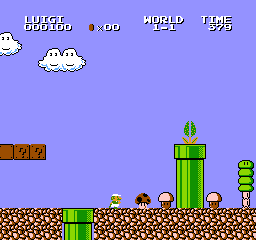 |
World 1-1 | Overworld | Goomba, Koopa Troopa, Koopa Paratroopa, Piranha Plant |
| World 1-2 | Underground | Goomba, Koopa Troopa, Piranha Plant, Buzzy Beetle | |
| World 1-3 | Athletic | Blooper, Koopa Troopa, Koopa Paratroopa | |
| World 1-4 | Castle | Fire-Bar, Koopa Troopa, fake Bowser | |
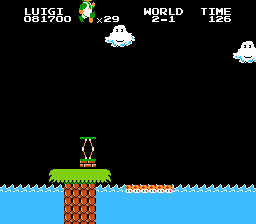 |
World 2-1 | Overworld | Goomba, Koopa Troopa, Koopa Paratroopa, Piranha Plant |
| World 2-2 | Overworld | Koopa Troopa, Koopa Paratroopa, Goomba, Piranha Plant | |
| World 2-3 | Athletic | Cheep Cheep, Koopa Troopa, Koopa Paratroopa, Blooper | |
| World 2-4 | Castle | Koopa Troopa, Goomba, Fire-Bar, Lava Bubble, fake Bowser | |
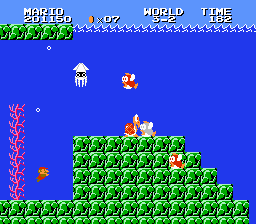 |
World 3-1 | Overworld | Hammer Brother, Koopa Troopa, Koopa Paratroopa, Bullet Bill, Piranha Plant |
| World 3-2 | Underwater | Blooper, Cheep Cheep, Koopa Troopa, Koopa Paratroopa | |
| World 3-3 | Athletic | Koopa Troopa, Koopa Paratroopa, Piranha Plant | |
| World 3-4 | Castle | Fire-Bar, Lava Bubble, Piranha Plant, fake Bowser | |
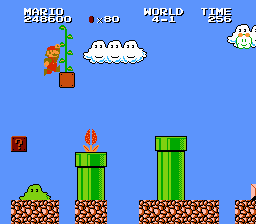 |
World 4-1 | Overworld | Piranha Plant, Lakitu, Spiny |
| World 4-2 | Overworld | Koopa Troopa, Piranha Plant, Buzzy Beetle, Lakitu, Spiny, Goomba | |
| World 4-3 | Athletic | Koopa Paratroopa, Koopa Troopa, Bullet Bill | |
| World 4-4 | Castle | Fire-Bar, Goomba, Koopa Troopa, Hammer Brother, Piranha Plant, Lava Bubble, fake Bowser | |
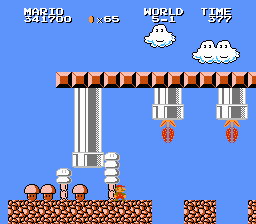 |
World 5-1 | Overworld | Buzzy Beetle, Piranha Plant, Koopa Troopa, Koopa Paratroopa, Goomba |
| World 5-2 | Underground | Piranha Plant, Goomba, Koopa Troopa, Buzzy Beetle | |
| World 5-3 | Athletic | Koopa Paratroopa, Piranha Plant, Bullet Bill, Blooper | |
| World 5-4 | Castle | Lava Bubble, Fire-Bar, fake Bowser | |
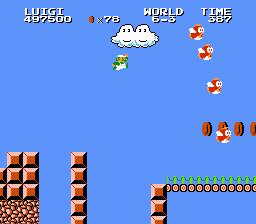 |
World 6-1 | Overworld | Piranha Plant, Buzzy Beetle, Koopa Troopa, Koopa Paratroopa, Goomba, Bullet Bill, Hammer Brother, Blooper |
| World 6-2 | Underwater | Blooper, Cheep Cheep, Koopa Troopa, Koopa Paratroopa | |
| World 6-3 | Athletic | Koopa Troopa, Koopa Paratroopa, Cheep Cheep | |
| World 6-4 | Castle | Lava Bubble, Fire-Bar, Piranha Plant, Hammer Brother, fake Bowser | |
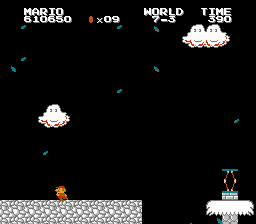 |
World 7-1 | Overworld | Koopa Troopa, Koopa Paratroopa, Piranha Plant, Hammer Brother, Bullet Bill |
| World 7-2 | Overworld/Athletic | Blooper, Cheep Cheep, Piranha Plant, Fire-Bar | |
| World 7-3 | Athletic | Koopa Troopa, Koopa Paratroopa, Piranha Plant, Fire-Bar | |
| World 7-4 | Castle | Lava Bubble, Fire-Bar, fake Bowser | |
 |
World 8-1 | Overworld | Goomba, Koopa Troopa, Koopa Paratroopa, Piranha Plant, Buzzy Beetle |
| World 8-2 | Overworld | Goomba, Koopa Paratroopa, Piranha Plant, Buzzy Beetle, Lakitu, Spiny, Bullet Bill | |
| World 8-3 | Athletic | Koopa Troopa, Koopa Paratroopa, Piranha Plant, Bullet Bill, Hammer Brother | |
| World 8-4 | Castle | Goomba, Koopa Paratroopa, Piranha Plant, Fire-Bar, Lava Bubble, Buzzy Beetle, Hammer Brother, Blooper, Cheep Cheep, Bowser's Brother, Bowser | |
 |
World 9-1 | Underwater | Piranha Plant, Koopa Paratroopa, Bullet Bill, Lakitu, Spiny, Hammer Brother, Blooper, Buzzy Beetle |
| World 9-2 | Underwater | Piranha Plant, Lakitu, Spiny | |
| World 9-3 | Overworld Castle | Bowser's Brother | |
| World 9-4 | Underwater | Goomba, Koopa Troopa, Buzzy Beetle, Koopa Paratroopa, Hammer Brother, Blooper, Lava Bubble | |
 |
World A-1 | Overworld | Koopa Troopa, Koopa Paratroopa, Piranha Plant, Hammer Brother |
| World A-2 | Underground | Piranha Plant, Hammer Brother, Bullet Bill | |
| World A-3 | Athletic | Cheep Cheep, Blooper, Koopa Paratroopa | |
| World A-4 | Castle | Fire-Bar, Lava Bubble, Koopa Troopa, Bullet Bill, fake Bowser | |
 |
World B-1 | Overworld | Buzzy Beetle, Koopa Troopa, Piranha Plant, Koopa Paratroopa |
| World B-2 | Underwater | Blooper, Cheep Cheep, Koopa Paratroopa, Koopa Troopa, Fire-Bar, Piranha Plant | |
| World B-3 | Athletic | Koopa Paratroopa, Piranha Plant, Bullet Bill, Koopa Troopa | |
| World B-4 | Castle | Piranha Plant, Fire-Bar, fake Bowser | |
 |
World C-1 | Overworld | Koopa Paratroopa, Piranha Plant, Hammer Brother, Buzzy Beetle |
| World C-2 | Athletic | Koopa Paratroopa, Cheep Cheep, Blooper, Koopa Troopa, Bullet Bill | |
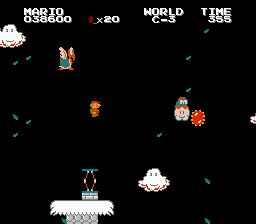
| World C-3 | Athletic | Lakitu, Spiny, Koopa Paratroopa, Piranha Plant, Fire-Bar | |
| World C-4 | Castle | Fire-Bar, Koopa Troopa, Buzzy Beetle, Lava Bubble, Fake Bowser | |
 |
World D-1 | Overworld | Hammer Brother, Koopa Paratroopa, Bullet Bill, Buzzy Beetle, Koopa Troopa, Piranha Plant |
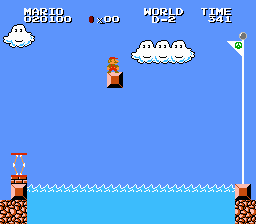
| World D-2 | Overworld | Koopa Troopa, Buzzy Beetle, Koopa Troopa, Piranha Plant, Bullet Bill | |
| World D-3 | Overworld | Bullet Bill, Piranha Plant, Hammer Brother, Koopa Paratroopa | |
| World D-4 | Castle | Piranha Plant, Fire-Bar, Lava Bubble, Koopa Paratroopa, Cheep Cheep, Hammer Brother, Blooper, fake Bowser's Brother (original) / Bowser's Brother (All-Stars), fake Bowser (original) / Bowser (All-Stars) |
Development[edit]
- “As I continued to play, I found that Super Mario Bros. 2 asked me again and again to take a leap of faith and that each of those leaps resulted in my immediate death. This was not a fun game to play. It was punishment. Undeserved punishment. I put down my controller astonished that Mr. Miyamoto has chosen to design such a painful game.”
- —Howard Phillips[9]
In an interview, Shigeru Miyamoto stated that Super Mario Bros.: The Lost Levels was made due to how much fun the development team had creating new, difficult levels for VS. Super Mario Bros.[10] Six of the levels in the game (1-4, 2-2, 4-3, 5-4, 6-2, and 6-3) were reused from VS. Super Mario Bros.
Nintendo of America's product analyst, Howard Phillips, disliked the game when he was assigned to test it, feeling it was far too punishing to be fun.[11] On Phillip's recommendation, Nintendo of America president Minoru Arakawa would pass on releasing the Japanese Super Mario Bros. 2, and instead commissioned the Japanese headquarters to retool the loosely related platforming game Yume Kōjō: Doki Doki Panic into a Super Mario Bros. sequel to continue promoting the successful Super Mario franchise.[12]
After The Lost Levels was refused for a western retail release, marketing head Gail Tilden proposed a program where a NES version of the game would be given as a bonus for Nintendo Power subscribers. Though a NES cartridge of The Lost Levels was produced, the plan was abandoned due to concerns over brand confusion.[13]
Pre-release and unused content[edit]

- Some unused ground textures, along with a cactus for a background decoration, can be found in the SM2CHAR1 graphics file.[14]
- As with the previous game, RAM address 03F0 keeps track of the number of blocks hit, though no routine ever reads the value stored here.[14]
Re-releases[edit]
An emulation of Super Mario Bros.: The Lost Levels was released in Japan for the Game Boy Advance as part of the Famicom Mini series on August 10, 2004.
It was released on the Virtual Console in Japan on May 1, 2007 for the Wii, on July 25, 2012 for the Nintendo 3DS and the Wii U in Japan on August 8, 2013. It was also released for the Wii in Europe and Australia on September 14, 2007 along with Mario's Super Picross and Neutopia II as the part of the Japanese Hanabi Festival, and in North America on October 1, 2007, making the first time the original version of the game was available to most international audiences. It costs 100 Wii Points more, as usual for imported games. Unlike other games, however, it was removed from the European/Australian Wii Shop Channel on October 1, 2007, before being re-added permanently on August 22, 2008. It became available for the Nintendo 3DS outside Japan on December 27, 2012. It was released for the Wii U in Europe and Australia on January 23, 2014 and in North America on March 13, 2014.
It was released on the Nintendo Entertainment System - Nintendo Switch Online application for the Nintendo Switch in April 2019.
It is included in Game & Watch: Super Mario Bros., which was released on November 13, 2020.
Remakes[edit]
Super Mario All-Stars[edit]

The Super Mario All-Stars (as well as Super Mario All-Stars + Super Mario World and Super Mario All-Stars Limited Edition) version of this game had a few differences from the original:
- Super Mario Bros. and Super Mario Bros.: The Lost Levels do not have the same graphics as each other to begin with. For instance, the ground is covered by blocks in most of the levels of the original, whereas the ground is mainly covered by dirt in this version. In Super Mario All-Stars, the graphics of all the games were improved, and Super Mario Bros.: The Lost Levels was made to look exactly the same as the graphically-improved version of Super Mario Bros. released on the same cartridge. The endings of both games were also made uniform.
- Many levels that had snow in the original Japanese Super Mario Bros. 2 do not have it in the Super Mario Bros.: The Lost Levels edition: 3-3, 7-1, 7-2, 7-3, 8-1, C-3, D-1, D-2, and D-3. Likewise, one level that did not have snow originally has snow in the Super Mario All-Stars remake: C-1. However, the snow is only an aesthetic difference.
- If the player decides to continue after a Game Over, they will start over at the beginning of the current level, rather than the current world as in the original version.
- The game can be saved at any time. Unlike in Super Mario Bros. on the same cartridge, the game remembers the exact level the player is on, and not just the world. This is because the game is much harder than the original.
- In the secret section of World 1-2 (where the player enters the pipe to World 4), the water pools were replaced by lava. However, the effects are the same: if Mario falls in, he loses one life. Similarly, the water in the first pit encountered in the level (after the Koopa Paratroopa) is removed in the SNES version.
- The player would get a positive or negative audio cue to indicate if they were going the right or wrong way in the mazes of World 3-4, 6-4, and 8-4, making navigation slightly easier in those levels.
- In World 8, the Hammer Brothers perpetually charge at the player. On the SNES, this behavior was added to Worlds 7, 9, and A-D as well.
- The castle walls of World 9-3 (whose background is sky blue instead of black) are now recolored brown instead of gray like in the original (and in the ending cutscene).
- Players only have to beat the game once to reach worlds A through D.
- In the original game, Bowsers use hammers in only Worlds 6-9. The SNES remake gives them hammers in Worlds A-D, as well. Strangely enough, these Bowsers lose their Fire Breath.
- Super Springs in World B have been replaced with regular Springs.
- The fake Bowsers in Worlds A-C now have new true forms (a red Koopa Troopa, a Cheep Cheep, and a Bullet Bill, respectively), and the fake Bowser's death animation in World D is changed to make him into a real Bowser.
Super Mario Bros. Deluxe[edit]
Super Mario Bros. Deluxe was marketed as a Game Boy Color enhancement of Super Mario Bros., but if a player gets on the high score table with 300,000 points or more, a Luigi head appears on the main menu. Players may select the Luigi head to play Super Mario Bros.: The Lost Levels under the name of Super Mario Bros. for Super Players.
In this game, as in the Super Mario All-Stars version, the player may save and resume at any level. However, most changes removed features from the original release. This remake removes the graphical changes from Super Mario Bros.: The Lost Levels and thus looks just like Super Mario Bros. Additionally, Luigi's higher jump and lower traction are removed, as is wind. As a result of the lack of wind, some levels are modified to make the jumps possible. Another change is the removal of Worlds 9 and A-D, although they are all at least somewhat present within the game's coding.
Descriptions[edit]
Wii Shop Channel
"Originally released in Japan as Super Mario Bros.® 2, this game has previously made only brief cameo appearances in the Western hemisphere. Now available on the Virtual Console in all of its original splendor, Mario fans will appreciate the familiar look and feel of the game, while finding that its updated game play creates an entirely new challenge. No longer content just to wear different-colored overalls, Mario and Luigi also possess different skill sets (Mario can stop quicker, while Luigi can jump higher). In addition to the classic enemies already known to fans worldwide, there are also Poison Mushrooms, backward Warp Zones, and the occasional wind gust (which can help or hinder your progress) to take into account. And if that's somehow not enough, expert players can go looking for the game's secret worlds. So get ready to put your Mario skills to the ultimate test, and save the Princess again. Just don't be surprised if she's in another castle!"
Nintendo eShop
"This game was originally released in Japan as Super Mario Bros. 2. Mario fans will appreciate the familiar look and feel of the game while finding that its updated gameplay creates an entirely new challenge as compared to the first Super Mario Bros. In addition to the classic enemies already known to fans worldwide, there are also Poison Mushrooms, backward Warp Zones, and the occasional wind gust (which can help or hinder your progress). Players can also choose to control Luigi as the main protagonist. If that's somehow not enough, expert players can go looking for the game's secret worlds. So get ready to put your Super Mario skills to the ultimate test and save the princess again. Just don't be surprised if she's in another castle!"
Reception[edit]
The Japanese Super Mario Bros. 2 served as one of the flagship titles for newly released Famicom Disk System in 1986, alongside The Legend of Zelda. Super Mario Bros. 2 was intended to be a game for expert gamers that had mastered the original Super Mario Bros. and were looking for a new challenge. It was the most popular Famicom Disk System game, selling about 2.5 million copies. Japanese critics at the time, however, characterized the game as an "expansion pack" or "update" to the original rather than an actual sequel.[citation needed]
| Reviews | |||
|---|---|---|---|
| Release | Reviewer, Publication | Score | Comment |
| Wii | Marcel van Duyn, Nintendo Life | 8/10 | "But is it worth shelling out the money again for what is essentially version 2 of Super Mario Bros.? If you're a fan, yes. The completely different levels, slightly changed visuals and Luigi mode make the game feel like a little more than "just an update". If you're not a big Mario fan, though, I would suggest sticking with the original (Unless you like extremely hard games). Another thing to take into consideration is that this game, in it's original NES/Famicom form, was never released in Europe and America. The All-Stars version had upgraded graphics and sound (And slightly lowered the difficulty), while the DX version cut out Worlds 9 and A-D. This means this is the first time you can own this game in it's original, complete form (Unless you live in Japan or imported a Famicom Disk System and the game!)." |
| Wii U | Robert Hughes, Nintendo Life | 8/10 | "Those who hated The Lost Levels on its inclusion in Super Mario All-Stars, due either to its difficulty or lack of originality, may find that they have a new-found appreciation for this underrated gem. It's not without flaws, but when played in tandem with the Wii U's save state functionality in short doses to alleviate frustration, there's a lot to enjoy here. Some of the level design and intentional placement of obstacles and enemies is almost frighteningly devious, a sense of playful teasing that is perhaps sorely lacking from present-day Nintendo's 'games for everybody' line-up. Super Mario Bros.: The Lost Levels will constantly taunt the player with its level of challenge and meticulously sinister design, but those who enjoy triumph through adversity and can handle a little frustration will enjoy every second of it." |
| Wii | Lucas M.Thomas, IGN | 8.5/10 | "A fairly popular trend on the Internet now is hacking old Mario games to make new levels, then challenging friends to try to beat the purposefully too-difficult designs. You can find videos of the subculture scattered on YouTube and similar sites, and watch as players try over and over to get through seemingly impossible side-scrolling challenges. Super Mario Bros.: The Lost Levels is a lot like that." |
| Wii | Frank Provo, GameSpot | 6.5/10 | "At 600 Wii points, the original, unedited rendition of Super Mario Bros. 2 is a decent buy, provided that you're the sort of masochist who wants to play Super Mario Bros. with the difficulty cranked to the breaking point." |
References in later games[edit]
- Super Mario Bros. 3: The skidding sound effect is reused.
- Super Mario Kart - The computer-controlled Toad and Peach are able to throw Poison Mushrooms, which are not usable by the player.
- Super Smash Bros. series - Luigi's physics carry over into these games. From Super Smash Bros. Melee onward, Poison Mushrooms appear as items.
- Super Smash Bros. for Nintendo 3DS / Wii U - Bowser's eighth coloration is based on the appearance of the blueish Bowser's Brother from Super Mario Bros.: The Lost Levels. In Super Smash Bros. for Wii U, Super Mario Bros.: The Lost Levels is available as a masterpiece, and an orchestrated medley of songs from that game can play on the Mushroom Kingdom U stage.
- Super Smash Bros. Ultimate - When taking on Peach's Classic Mode route cooperatively, Bowser is joined by another Bowser with the blue palette, another reference to Bowser's Brother.
- Super Mario Galaxy / Super Mario Galaxy 2: Luigi's physics carry over into these games.
- Super Mario 3D Land - Poison Mushrooms return, working as they do in Super Mario Bros.: The Lost Levels. Luigi's physics once again return. Goal Poles appear after boss fights in airships and castles, like in World 9-3 of Super Mario Bros.: The Lost Levels. The true final level ends with a "Thank You!" message (like in World 9-4 of Super Mario Bros.: The Lost Levels), though it is translated.
- Paper Mario: Sticker Star - Princess Peach's theme in this game is an arrangement of the ending theme from Super Mario Bros.: The Lost Levels.
- Super Mario 3D World - Luigi's physics, Goal Poles after boss fights, and the true last level's "Thank You" message once again return.
- NES Remix 2 / Ultimate NES Remix: Several challenges are based on this game.
- Paper Mario: Color Splash - When Huey finds out the Mini Paint Star in Ruddy Road has most of its color missing, he exclaims "What in the Lost Levels is going on here?"
- Super Mario Odyssey: The skidding sound is reused for the 2-D sections. The words "Thank You" are peppered throughout the true last mission.
- Mario Kart Tour: The color scheme of Luigi (Classic) in this game is based on Luigi's artwork in Super Mario Bros.: The Lost Levels.
Staff[edit]
Like the original Super Mario Bros., Super Mario Bros.: The Lost Levels does not feature a staff roll or any sort of credits. Unlike its predecessor, however, very little has been written about the game's development, leaving its precise staff composition a mystery. In a promotional interview for the NES Classic Edition, the game is referred to as Takashi Tezuka's directorial debut.[15]
Media[edit]
 Super Mario Bros.: The Lost Levels - World 1-1 speedrun. Super Mario Bros.: The Lost Levels - World 1-1 speedrun. | File info 0:38 |
 Super Mario Bros.: The Lost Levels - Ending theme Super Mario Bros.: The Lost Levels - Ending theme | File info 0:30 |
Glitches[edit]

- Main article: List of Super Mario Bros.: The Lost Levels glitches
Super Mario Bros.: The Lost Levels contains several glitches; the most famous glitch is the Infinite 1-Up Trick, which can be performed several ways using a Koopa Shell. Another glitch can be performed by touching the Axe while the timer is at zero, looping it to 999.
Gallery[edit]
- For this subject's image gallery, see Gallery:Super Mario Bros.: The Lost Levels.


Quotes[edit]
- "Peace is paved / with kingdom saved / Hurrah to Mario/Luigi / our only hero / This ends your trip / of a long friendship." - Poem recited by Princess Peach after defeating Bowser, after which the player is rewarded with 100,000 points for each life left (also seen in VS. Super Mario Bros. and All Night Nippon: Super Mario Bros.)
- "Thank you Mario/Luigi!" - Princess Peach and Toads, following the above
- "We present Fantasy World / Let's try "9 World" with one game." -- World 9 intro screen
- 「アリガトウ!」 (Arigatō!, meaning "Thank you!" when translated from Japanese) -- Coral in World 9-4
- "You're a super player! We hope we'll see you again. Mario and staff." -- Game Over screen for World 9
Names in other languages[edit]
| Language | Name | Meaning |
|---|---|---|
| Japanese | スーパーマリオブラザーズ2 Sūpā Mario Burazāzu Tsū |
Super Mario Bros. 2 |
| Chinese (simplified) | 超级马力欧兄弟2[16] Chāojí Mǎlì'ōu Xiōngdì 2 |
Super Mario Bros. 2 |
| Chinese (traditional) | 超級瑪利歐兄弟2[17] Chāojí Mǎlì'ōu Xiōngdì 2 |
Super Mario Bros. 2 |
| Italian | Super Mario Bros.: I Livelli Perduti (Super Mario All-Stars only)[18] |
Super Mario Bros.: The Lost Levels |
| Korean | 슈퍼 마리오 브라더스 더 로스트 레벨즈 Syupeo Malio Beuladeoseu Deo Loseuteu Lebeljeu 슈퍼 마리오브라더스 2[19] Syupeo Malio Beuladeoseu 2 |
Super Mario Bros. The Lost Levels Super Mario Bros. 2 |
Trivia[edit]
- Dummied data for the game Dōbutsu no Mori+ indicated that Super Mario Bros.: The Lost Levels (or, more accurately, Super Mario Bros. 2) as well as Mario Open Golf would have been included as a playable Famicom game, but it ultimately was cut with not even a ROM or models available inside.[20]
- At the end of the Mario Kart 8 April 30 Nintendo Direct, when the Nintendo fan pulls out his "Things to do before I die" list to write "Buy Mario Kart 8", one of the other notes on the list is "Beat SMB2: The Lost Levels",[21] a reference to how difficult the game is compared to other Super Mario games.
- The worlds that take place at night (2 and 7) and the worlds with an underwater level (3 and 6) are the inverse of the worlds' placements in the original Super Mario Bros.
- In the Family Computer Disk System version only, the disk drive is automatically activated at the end of Worlds 4 and 8. Additionally, after World 5 starts, if the player resets the game, the disk drive is activated and the game returns to the title screen.[22]
External links[edit]


References[edit]
- ^ Promotional flyer with final street date.
- ^ a b Super Mario Bros. 2 Disk System instruction booklet, page 2.
- ^ Nintendo. (April 2, 2019). ファミリーコンピュータ Nintendo Switch Online 追加タイトル [2019年4月]. YouTube. Retrieved April 2, 2019.
- ^ Nintendo. (April 2, 2019). Nintendo Entertainment System - April Game Updates - Nintendo Switch Online. YouTube. Retrieved April 2, 2019.
- ^ Kazuya Sakai (Ambit), kikai, Akinori Sao, Junko Fukuda, Kunio Takayama, and Ko Nakahara (Shogakukan) (ed.). Encyclopedia Super Mario Bros. Milwaulkie: Dark Horse Books, 2018. ISBN: 978-4-09-106569-8.
- ^ Japanese Virtual Console website
- ^ Super Mario Bros. 2 Disk System instruction booklet, page 3.
- ^ shmuplations, "Koji Kondo – 2001 Composer Interview". Retrieved November 29, 2016
- ^ Gaming Historian (July 10, 2015). The Story of Super Mario Bros. 2. YouTube. Retrieved May 22, 2020.
- ^ Nintendo (December 7, 2010), [NC US] Super Mario Bros. 25th Anniversary - Interview with Shigeru Miyamoto #2. YouTube. Retrieved December 21, 2015.
- ^ Jon Irwin (October 6, 2014). p. VIII. Super Mario Bros. 2 Retrieved January 15, 2020
- ^ Jon Irwin (October 6, 2014). p. 41. Super Mario Bros. 2 Retrieved January 15, 2020
- ^ Jon Irwin (October 6, 2014). p. 109. Super Mario Bros. 2 Retrieved January 15, 2020
- ^ a b Super Mario Bros. 2 (Famicom Disk System). The Cutting Room Floor. Retrieved October 8, 2020.
- ^ Sao, Akinori. NES Classics Edition Developer Interview: SUPER MARIO BROS.™ & SUPER MARIO BROS.™ 3. Nintendo.com. Retrieved October 08, 2018. (Archived January 7, 2017, 06:07:44 UTC via Wayback Machine.)
- ^ 1980年登场的《Game & Watch》复活!与迎接35周年的《超级马力欧兄弟》合作!. Nintendo.com.hk. Retrieved September 4, 2020.
- ^ 1980年登場的《Game & Watch》復活!與迎接35週年的《超級瑪利歐兄弟》合作!. Nintendo.com.hk. Retrieved September 4, 2020.
- ^ Super Mario All-Stars Italian instruction booklet. Page 5.
- ^ From the Korean version of Super Smash Bros. Ultimate
- ^ https://tcrf.net/Animal_Crossing#Removed_Games
- ^ Wii U - Mario Kart 8 Direct 4.30.2014 - YouTube
- ^ Japanese instruction manual


