New Super Luigi U

|
It has been requested that at least one audio and/or video file related to this article be uploaded. Please upload music, sound effects, voice clips, or any videos for this article. See the help page for help getting started. |
| New Super Luigi U | |||||||||||||||
|---|---|---|---|---|---|---|---|---|---|---|---|---|---|---|---|
 North American box cover For alternate box art, see the related gallery. | |||||||||||||||
| Developer | Nintendo EAD | ||||||||||||||
| Publisher | Nintendo | ||||||||||||||
| Platform | Wii U | ||||||||||||||
| Release dates | As DLC: June 19, 2013[1] June 19, 2013[1] June 19, 2013[2] June 19, 2013[2] June 20, 2013[3] June 20, 2013[3] June 21, 2013[4] June 21, 2013[4]As standalone: July 13, 2013[1] July 26, 2013[3] July 27, 2013[4] August 25, 2013[5] | ||||||||||||||
| Languages | English (United States) English (United Kingdom) Japanese Dutch French (Canada) French (Europe) German Italian Portuguese (Europe) Russian Spanish (Latin America) Spanish (Europe) | ||||||||||||||
| Genre | Platformer | ||||||||||||||
| Ratings |
| ||||||||||||||
| Modes | Single player Multiplayer | ||||||||||||||
| Format | Wii U:  Optical disc Optical disc Digital download Digital download | ||||||||||||||
| Input | Wii U:  Wii Remote (horizontal) Wii Remote (horizontal) | ||||||||||||||
| Serial code | WUP-ARSJ-JPN | ||||||||||||||
 - Everyone
 - All ages
 - Three years and older
 - All ages
 - General audience
 - General
 - Parental guidance
New Super Luigi U (stylized as New Super Luigi Bros. U) is an expansion game for New Super Mario Bros. U, released as part of the Year of Luigi, celebrating the thirtieth anniversary of Luigi's initial debut. It features Luigi as the main player, with Yellow Toad, Blue Toad, and Nabbit (who replaces Mario from the original game) playable in multiplayer mode.[2] Although it refers to him, the game does not feature Mario himself at all.
The title was first released on the Nintendo eShop on the Wii U for region price as downloadable content for New Super Mario Bros. U; the game must be updated to version 1.3.0 before New Super Luigi U can be accessed in-game, and requires 731.4 MB of memory to be installed. Once the game is downloaded, the prompt to access the Nintendo eShop to download the expansion is replaced with a prompt to go to the main menu for New Super Luigi U. Support for the Wii U Pro Controller is also included in addition to  and the
 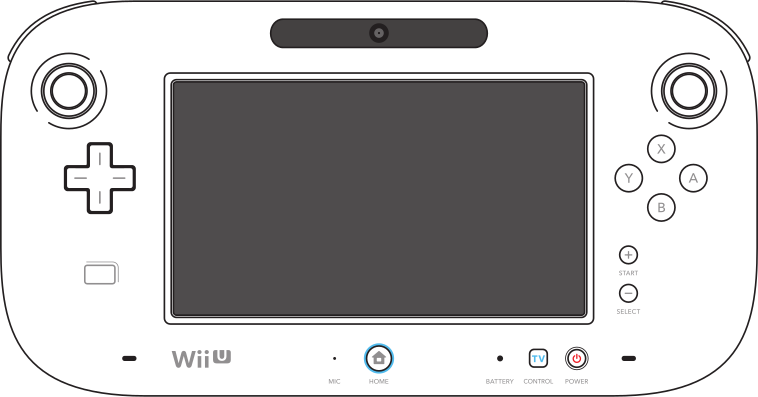 controls in New Super Mario Bros. U. The game was later released at retail as a standalone game for region price, not requiring New Super Mario Bros. U to play. Both games were later released in a compilation known as New Super Mario Bros. U + New Super Luigi U, initially included exclusively in the Mario & Luigi Wii U Deluxe Set bundle, but later released as a standalone Nintendo Selects disc at a price cheaper than either game individually (the precise price is dependent on the region). This game was also included in New Super Mario Bros. U Deluxe for the Nintendo Switch. The DLC was later removed from the Wii U eShop due to its discontinuation on March 27, 2023, making it no longer possible for players to purchase it. However, players who purchased the DLC before this date can still play it as long as it is on their Wii U device.
Gameplay[edit]
This section needs Super Mario improvement. Specifically:
- What power-up does the player get at 099? The possibility is there even if it's functionally impossible to obtain.

The gameplay is largely similar to its base game, except that the playable characters retain Luigi's higher jump and lower traction from Super Mario Bros.: The Lost Levels. The game has been designed to be more difficult, with each stage starting at only 100 seconds; due to this, however, the courses have also been made shorter than normal while also being packed with enemies and obstacles. While the levels have all been altered from the base game, the world map itself has not been. Elements like items, power-ups, Star Coins, Toad Houses, Enemy Courses, and bosses are retained as such.
The multiplayer of New Super Luigi U is also retained from New Super Mario Bros. U. However, because Mario is not featured in this game, Nabbit is instead used as the fourth playable character. As Nabbit, the player cannot take damage from enemies, but cannot use most power-ups, Yoshis, or hold items. Any power-ups Nabbit collects but cannot use are converted to 1-Ups at the end of each stage. Only eight 1-Ups can be earned per course through this method.[7]
Players can earn power-ups from Toad if the last two digits of the timer have the same number (excluding two 0s) upon completion of a level. At 088, a Super Star is given; at 077, a Super Acorn; at 066, a Mini Mushroom; at 055, an Ice Flower; at 044, a Fire Flower; and at 033, 022, and 011, a 1-Up Mushroom.
Controls[edit]
Stages[edit]
| Action(s) | Wii U GamePad | Wii U Pro Controller | Wii Remote |
|---|---|---|---|
| Move, swim (Baby Yoshi) |  / / 
|

| |
| Jump, swim, glide (hold), wall jump, Flutter Jump (Yoshi; hold), double/triple jump (press right upon landing) | Option 1:  / /  Option 2: / 
|

| |
| Run, carry objects (hold); shoot fireballs/iceballs, extend tongue (Yoshi) | Option 1:  / / Option 2: /
|

| |
| Ground Pound (normal, simultaneous*) | Jump + (down) / 
|
+ 
| |
| Crouch, slide (on slopes) | (down) /
|
| |
| Climb (on fences, ladders, poles) | (up) / 
|

| |
| Bubble* | N/A | 
|

|
| Enter door/Warp Pipe | Door: (up) / Pipe: / (in direction of entrance)
|
Door: Pipe: (in direction of entrance)
| |
| Spin Jump, Baby Yoshi abilities, dismount Yoshi, Flying Squirrel jump, spin underwater (Baby Yoshi) | (shake) /  / /  / /  / / 
|
/ / /
|
(shake)
|
| Grab other players*/frozen enemies | Run + (shake) / / / / (release run button to throw) |
Run + / / / (release run button to throw) |
+ (shake) (release to throw)
|
| Tilt Tilt Lifts | Tilt GamePad | Alternate between pressing and
|
Tilt Wii Remote |
| Pause | 
| ||
| Boost Mode* | 
|
N/A | |
* Multiplayer only.
[edit]
| Action(s) | Wii U GamePad/Pro Controller | Wii Remote |
|---|---|---|
| Move, select option | /
|
|
| Open inventory |
|
|
| View map |
|
|
| Pause |
| |
| Zoom in/out (map view) | /
| |
| Confirm, hide/show Miiverse posts (map view) |
|
|
| Back |
|
|
Changes[edit]

The world map itself is unchanged from New Super Mario Bros. U, but the levels have received a drastic makeover. As mentioned above, playable characters and their abilities have changed. The timer for each level is also set to start from 100 seconds and a 100-seconds time bonus is added to the timer after going to the boss door in the towers and castles (150 seconds in All Aboard! and 250 seconds in The Final Battle). Items in Red Toad Houses may vary as well. For example, a 1-Up Mushroom is in place of a Super Mushroom. Similarly, Enemy Courses contain only Mini Mushrooms and Propeller Mushrooms, as opposed to only Super Stars. Some enemies such as Grrrols and Sumo Bros. may appear earlier than their equivalent levels in New Super Mario Bros. U, while some others such as Rocky Wrenches and Amps are completely absent from the game. There are no Checkpoint Flags in any of this game's levels. Many elements of the game are colored green to emphasize Luigi, and all of the levels have a hidden Luigi in a wall or platform (Flying Squirrel Ovation has two).

After the game is completed, a Luigi Block appears at the beginning of each level. This allows the player to switch to New Super Mario Bros. U's physics, with lower jumps and better traction. Nabbit is not affected by the block. Nabbit is also playable in single player mode if the player holds down / on the / or
or  on the while selecting a level. If the same trick is done on the Flying Squirrel Ovation level in Superstar Road, the player's Mii is played as instead of Nabbit.
After defeating Bowser, if one of the player characters is Nabbit, he will appear in the background of the room where the other characters (or just Luigi in single player) rescue Peach, and run away when she gives one of them a kiss. Nabbit also replaces Mario during the credits, though he does not clap to the beat of the music.
Worlds[edit]
This section needs Super Mario improvement. Specifically:
- Should be in the same format as New Super Mario Bros. U#Worlds.
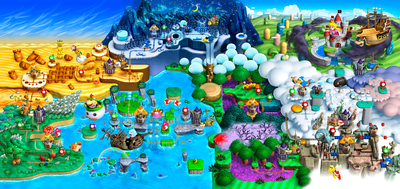
There are 82 new courses replacing the original courses from New Super Mario Bros. U with different level names, while the world names are retained.


Characters[edit]
Playable characters[edit]
| Name | Description |
|---|---|
 Luigi |
The game's protagonist. Luigi is flung from Peach's Castle by Bowser when sieges the castle. Unlike New Super Mario Bros. U, Luigi scuttles his legs when he jumps and has poor traction on the ground, similar to his appearance in some prior games. Unlike the prior game, his brother is not in this game. |
 Yellow Toad and Blue Toad |
These Toads were having tea at Peach's Castle with Luigi when they were tossed. They have all the same moves and physiques as Luigi, and are only available to play as in multiplayer. |
 Nabbit |
A masked rabbit-like thief. When the player is controlling Luigi in Story Mode, Nabbit appears in certain levels with stolen items and they are given to him when caught. If the player presses  on a Wii U controller or on a Wii Remote while selecting a level, they play as Nabbit instead. In multiplayer, he is one of the four playable characters. Unlike Luigi and the Toads, he cannot use most power-ups, ride Yoshi, carry items, and carry other players. Further, other players cannot carry Nabbit. However, Nabbit is nearly invincible. He can walk through enemies and across spikes, though he receives knockback when he makes contact with tough enemies or bosses. He loses a life only when he falls down pits or environmental hazards like lava. He can use Super Stars. Up to eight non-Super Star power-ups he collects become 1-Ups at the end of each course.[7] on a Wii U controller or on a Wii Remote while selecting a level, they play as Nabbit instead. In multiplayer, he is one of the four playable characters. Unlike Luigi and the Toads, he cannot use most power-ups, ride Yoshi, carry items, and carry other players. Further, other players cannot carry Nabbit. However, Nabbit is nearly invincible. He can walk through enemies and across spikes, though he receives knockback when he makes contact with tough enemies or bosses. He loses a life only when he falls down pits or environmental hazards like lava. He can use Super Stars. Up to eight non-Super Star power-ups he collects become 1-Ups at the end of each course.[7]
|
.png) Mii |
If the player chooses to play as Nabbit in Story Mode while selecting Flying Squirrel Ovation, they appear as a green-clad Mii instead. This is because the Flying Squirrel form is required to complete this level, which is unavailable to Nabbit, as with all other power-ups. |
Yoshis[edit]
The game features three differently-colored Baby Yoshis, each one with a special ability. They differ from the adult Yoshi in terms of gameplay. Being babies, they cannot be ridden, so characters must carry them throughout the levels. Baby Yoshis instantly eat almost any enemy that is in front of them. Unlike Super Mario World, Baby Yoshis cannot mature into adults after eating enemies, instead remaining infants. Two types of Baby Yoshis found on the world map can be taken into any course, with the exception of towers, airships, and castles.
| Name | Description | Locations |
|---|---|---|
 Yoshi |
A dinosaur-like creature with a long tongue that can be ridden. Yoshi has a meter that tracks how many fruits he eats. Eating five makes him lay an egg containing an item. Unlike Baby Balloon Yoshis and Baby Bubble Yoshis, Yoshi cannot be taken to other levels, instead waving goodbye to the player character once they reach the Goal Pole. In multiplayer, the number of Yoshis that appear in a level equals the number of player characters. | Rolling Yoshi Hills, Underground Grrrols, Beanstalk Jungle, Fire and Ice, Above the Bouncy Clouds |
 Balloon Baby Yoshis |
Magenta Baby Yoshis that expand like balloons and gently float in the air. Up to four player characters can grab onto one Balloon Baby Yoshi, by grabbing their legs. This slows the player down though. | Acorn Plains, Sparkling Waters |
 Bubble Baby Yoshis |
Blue Baby Yoshis that blow bubbles from their mouths. Enemies caught in these bubbles will turn into three coins, a power-up, or a 1-Up Mushroom. These bubbles can also be used as small platforms. | Frosted Glacier, Rock-Candy Mines |
 Glowing Baby Yoshis |
Yellow Baby Yoshis that light up dark areas and can stun enemies with their light attack. Unlike the other two Baby Yoshis, Glowing Baby Yoshis are not found on the world map and are found only in levels. Instead of following the characters throughout the courses, they give an extra life when reach the end of the level that they appear in. | Piranhas in the Dark |
Non-playable characters[edit]
| Name | Description | Locations |
|---|---|---|
 Princess Peach |
The ruler of the Mushroom Kingdom. Her castle is sieged by Bowser while she is having tea with Luigi, Yellow Toad, and Blue Toad. The game follows their quest to return to Peach's Castle to save her. | The Final Battle |
 Toads |
Toads appear throughout the game in Toad Houses, at the end of the level when the player catches Nabbit, and past the end-of-level castles to give Luigi a power-up if they complete a stage with the last two digits of the Time Limit being the same. | Toad Houses, All levels |
Enemies and obstacles[edit]
Enemies[edit]
| Name | Description | Levels | Pts. | Exc. | New | |
|---|---|---|---|---|---|---|
| First | Last | |||||
 Waddlewing |
Orange flying-squirrel enemies that glide through stages. Some Waddlewings carry Super Acorns that can be collected once the enemy is defeated. | Waddlewing Warning! | Flying Squirrel Ovation | 200 | — | — |
 Piranha Plant |
Plants that move in and out of Warp Pipes and some grounded. | Waddlewing Warning! | Above the Bouncy Clouds | 200 | — | — |
 Piranha Pod |
A projectile thrown by a Lakitu that turns into a Piranha Plant in contact with ground. | Spinning Sandstones | Beanstalk Jungle | 200 | — | — |
 Big Piranha Plant |
Large variants of Piranha Plants. | Piranha Heights | Flame Chomp Ferris Wheel | 200 | — | — |
 Fire Piranha Plant |
Piranha Plants that aim at Luigi and shoot fireballs. | Slippery Rope Ladders | Spine Coaster Stowaways | 200 | — | — |
 Big Fire Piranha |
Large variants of Fire Piranha Plants. | Piranhas in the Dark | Rising Piranhas | 200 | 
|
— |
 Ice Piranha Plant |
A Piranha Plant that can shoot ice balls from its mouth, like Fire Piranha Plants. | Broozers and Barrels | 200 | — | — | |
 Stalking Piranha Plant |
A Piranha Plant that walks around and stretches up and down on a regular basis. | Spinning Sandstones | Rising Piranhas | 200 | — | — |
 River Piranha Plant |
A stationary Piranha Plant that blows a green spiked ball up and down, similar to a Ptooie. | Spinning Sandstones | Fliprus Floes | 200 | — | — |
 Muncher |
An invincible black plant that is normally harmful, but can be walked on by Yoshi. | Lemmy's Lights-Out Castle | Wiggler Rodeo | 
|
— | — |
 Koopa Troopa (Red) |
Turtle enemies that go into their shells when attacked, then can be picked up or thrown. Red Koopa Troopas turn around. | Crooked Cavern | Magma Moat | 200 | — | — |
.png) Koopa Troopa (Green) |
Green-shelled Koopa Troopas that walk off ledges. | Piranha Gardens | Magmaw River Cruise | 200 | — | — |
 Koopa Paratroopa (Red) |
Wing Koopa Troopas that fly back and forth in the air. | Dancing Blocks, Poison Swamp | 200 | — | — | |
 Koopa Paratroopa (Green) |
These Koopa Paratroopas appear only the battle with the Magikoopa in magical platforms. They hop along the ground in small arcs when freed. | Stonecrush Tower | 200 | — | — | |
 Big Koopa Troopa |
Large variants of Koopa Troopas. | Giant Swing-Along | 200 | — | — | |
 Dry Bones |
Skeleton Koopa Troopas that collapse when attacked, but later rebuild themselves. | Flame-Gear Tower | Stonecrush Tower | 200 | — | — |
 Big Dry Bones |
Large variants of Dry Bones. A mere stomp will only stun them; they only collapse with a Ground Pound. | Iggy's Swinging-Chains Castle | 200 | — | — | |
 Hammer Bro |
Enemies that throw hammers and jump. | Piranha Gardens | All Aboard! | 1000 | — | — |
 Fire Bro |
Hammer Bros that throw fireballs which bounce along the ground. | Piranhas in the Dark | Magmaw River Cruise | 1000 | — | — |
 Boomerang Bro |
Hammer Bros that use damaging boomerangs, which return to them after being thrown. | All Aboard! | Above the Bouncy Clouds | 1000 | — | — |
 Ice Bro |
An enemy that throws ice balls at the ground, which can freeze Luigi and even other enemies. | All Aboard! | Frozen Fuzzies | 1000 | — | — |
 Sledge Bro |
Larger variants of Hammer Bros that stun Luigi after they jump. | All Aboard! | 1000 | — | — | |
 Sumo Bro |
Giant Koopas that stomp the ground and create electric waves in two directions. | Sumo Bro Bridge | Sumo Bro's Spinning Tower | 200 | — | — |
 Lakitu |
Enemies that throw Spiny Eggs. If Luigi defeats a Lakitu, their cloud can be ridden on until it disappears. | Spinning Sandstones | Cloudy Capers | 1000 | — | — |
 Spiny |
Enemies that hatch from Spiny Eggs and cannot be jumped on. | Cloudy Capers | 200 | — | — | |
 Spiny Egg |
The furled form of Spinies dropped by Lakitus. Direct contact damages Luigi. Spiny Eggs turn into Spinies when they make contact with the ground. | Cloudy Capers | 200 | — | — | |
 Bony Beetle |
Skeleton variants of Buzzy Beetles that walk around and occasionally stop to stick out their spikes, making them invulnerable to jumps. | Icicle Tower | Impossible Pendulums | 200 | — | — |
 Buzzy Beetle |
Shelled enemies that can be kicked or thrown after being jumped on, and can walk on ceilings. | Ice-Slide Expressway | 200 | — | — | |
 Spike Top |
Buzzy Beetle variants that have spikes on their shells, preventing them from being jumped on. | Switch-Lift Express | 200 | — | — | |
 Para-Beetle |
Para-Beetles are winged Buzzy Beetles. However, their back can be ridden on, unlike with other winged foes. | Para-Beetle Parade |
|
— | — | |
 Heavy Para-Beetle |
A Para-Beetle that descends if stood on, unlike their smaller counterparts. | Para-Beetle Parade |
|
— | — | |
 Spike |
Green turtles which pull spiked balls out of their mouths and throw them directly downwards from the ledges on which they stand on. | Spike's Tumbling Desert | Spike's Seesaws | 200 | — | — |
 Stone Spike |
A Spike that throws stone rocks downwards. | Stone Spike Conveyors | 200 | — | — | |
 Cheep Cheep |
Red fish that are found swimming aimlessly in underwater levels. | Cheep Chomp Chase | Star Coin Deep Dive | 200 | — | — |
 Big Cheep Cheep |
Large variants of Cheep Cheeps. | Cheep Chomp Chase | Star Coin Deep Dive | 200 | — | — |
 Eep Cheep |
Orange Cheep Cheeps that swims away when Luigi comes near it. Most often found in schools. | Cheep Chomp Chase | 200 | — | — | |
 Big Eep Cheep |
Large variants of Eep Cheeps. | Cheep Chomp Chase | Urchin Reef Romp | 200 |
|

|
 Deep Cheep |
Green Cheep Cheeps that swim towards Luigi when he comes near. | Cheep Chomp Chase | 200 |
|
— | |
 Big Deep Cheep |
Large variants of Deep Cheeps. | Cheep Chomp Chase | 200 |
|
— | |
 Spiny Cheep Cheep |
Fast-swimming purple Cheep Cheeps that chase Luigi when he comes near (similar to Deep Cheeps). | Haunted Cargo Hold | Star Coin Deep Dive | 200 | — | — |
 Cheep Chomp |
A large fish that, once approached, begins pursuing Luigi indefinitely. It periodically lunges in an attempt to eat him, which makes him instantly lose a life. When defeated, it drops three 1-Up Mushrooms. | Cheep Chomp Chase | Star Coin Deep Dive | 200 | — | — |
 Porcupuffer |
An aggressive fish that moves in a surface of water bodies, following Luigi by his horizontal position and occasionally leaping from the water to attack. | Porcupuffer Cavern | 200 | — | — | |
 Fish Bone |
Skeletal fish that charge towards Luigi, but crumble into pieces if they hit any surface. | Haunted Cargo Hold | Deepsea Stone-Eyes | 200 | — | — |
 Monty Mole |
A mole that pops out of semisolid platforms and gives chase. | Rolling Yoshi Hills | Stonecrush Tower | 200 | — | — |
 Pokey |
Living cacti that appear in desert levels and move slowly. | Underground Grrrols | 200 | — | — | |
 Big Pokey |
Large variants of Pokeys. | Morton's Lava-Block Castle | None | — | — | |
 Grrrol |
Round, Thwomp-like enemies that roll on the ground. | Underground Grrrols | Smashing-Stone Tower | 200 | — | — |
 Mega Grrrol |
A bigger Grrrol with the same behavior. | Underground Grrrols | Smashing-Stone Tower | 200 | — | — |
 Goomba |
Common enemies that walk in a single direction, turning when they encounter an obstacle. They can be defeated with a single stomp. | Layer-Cake Desert Enemy Course | Magmaw River Cruise | 200 | — | — |
 Mini Goomba |
Small Goombas that weigh Luigi down until he either attacks or walks for a few seconds. | Stonecrush Tower | Magmaw River Cruise | 200 | — | — |
 Prickly Goomba |
A Goomba that hides inside a spiked chestnut shell until it is hit with a fireball, which is when it turns into a regular Goomba. | Fire and Ice | 200 | — | — | |
 Goombrat |
A Goomba that resembles a persimmon and turns at ledges. | Wiggler Rodeo | Hot Cogs | 200 | — | — |
 Huckit Crab |
A crab that throws rocks on loop. These can be jumped on and used as a temporary platform. | Huckit Beach Resort | Porcupuffer Cavern | 200 | — | — |
 Urchin |
Stationary enemies that appear in underwater levels. | Urchin Reef Romp | 200 | — | — | |
 Big Urchin |
A gigantic Urchin that can be defeated only with a Star. | Urchin Reef Romp | 200 | — | — | |
 Boo |
Ghosts that follow Luigi when his back is turned, but hide their face when he looks at them. Groups of Boos occur floating in circles in some levels. | Peek-a-Boo Ghost House | Vanishing Ghost House | 200 | — | — |
 Big Boo |
Bigger variants of Boos that have the same behavior. | Peek-a-Boo Ghost House | 200 | — | — | |
 Dragoneel |
A long eel that attacks Luigi by chasing him. Dragoneels defeat Urchins that make contact with their bodies. | Dragoneel Depths | 200 | — | — | |
 Bullet Bill |
Bullets that fly straight forward, moving out of the way when they make contact with one another. They are shot from Bill Blasters and Bill Blaster Turrets or appear from the edges of the screen. | Larry's Trigger-Happy Castle | Rainbow Skywalk | 200 | — | — |
 Missile Bill |
Bullet Bills that target Luigi after being shot. | Roy's Ironclad Castle | 200 | — | — | |
 Banzai Bill |
Large Bullet Bills that fly straight forward, defeating regular Bullet Bills in their path. They are always found being shot from Banzai Bill Blasters. | Larry's Trigger-Happy Castle | Para-Beetle Parade | 200 | — | — |
 King Bill |
A nearly invincible enemy that charges forward, taking up most of the screen. | Larry's Trigger-Happy Castle | Para-Beetle Parade | 200 | — | — |
 Torpedo Ted |
A slow-moving torpedo that flies in one direction. | Larry's Trigger-Happy Castle | All Aboard! | 200 | — | — |
 Targeting Ted |
Red Torpedo Teds that home into their target, much like Bull's-Eye Bills. | Larry's Trigger-Happy Castle | All Aboard! | 200 | — | — |
 Broozer |
A walking, boxing ghost. Broozers spin Star Lifts and launch barrels with their punches. It can be defeated by jumping on its head three times, or being hit with a fireball. | Broozers and Barrels | 200 | — | — | |
 Cooligan |
An enemy that slides on ice and slows down when hit, requiring a second hit to defeat. If frozen with an ice ball, it can be used as a sliding platform. | Cooligan Shrooms | 200 | — | — | |
 Fliprus |
A walrus-like creature that throws snowballs that can be jumped on. | Fliprus Floes | Hammerswing Hangout | 200 | — | — |
 Thwomp |
Large rocks that fall when Luigi gets close. | Wendy's Thwomp Castle | 200 | — | — | |
 Big Thwomp |
Large Thwomps that can break through stone tiles. | Wendy's Thwomp Castle | 200 | — | — | |
 Mechakoopa |
A mechanical Koopa. After stomping it, Luigi can pick it up and use it as a weapon. | All Aboard! | 200 | — | — | |
 Bramball |
An enemy that moves around in a set pattern and is mostly covered in spikes, with the head being the only safe part to jump on. It can be forced to move if jumped into from below. | Heart of Bramball Woods | 200 | — | — | |
 Big Wiggler |
Large variants of Wigglers. | Wiggler Floodlands |
|
— | — | |
 Wiggler |
Caterpillars that turn angry after being jumped on, moving faster in the process. | Wiggler Rodeo | 200 | — | — | |
 Magmaargh |
Lava monsters that attacks by moving towards Luigi in a wave-like movement. | Iggy's Swinging-Chains Castle |
|
— | — | |
 Magmaw |
Lava monsters that lunges at Luigi, then dips back into the lava. | Magmaw River Cruise | The Final Battle |
|
— | — |
 Fuzzy |
Enemies that follow tracks and hurt Luigi upon contact. | Mount Fuzzy | Cloudy Capers | 200 | — | — |
 Big Fuzzy |
Large variants of Fuzzies. | Frozen Fuzzies | Spine Coaster Connections | 200 | — | — |
 Fire Snake |
Flames that jump in a high arc. | Light-Up-Lift Tower | 200 | — | — | |
 Lava Bubble |
Fireballs that jump out of lava. | Roy's Ironclad Castle | Hot Cogs | 200 | — | — |
 Chain Chomp |
Enemies tied to posts that lunge at Luigi at regular intervals. If their post is ground-pounded three times, they are set free and can be used to break through blocks. | Wiggler Rodeo | 200 | — | — | |
 Flame Chomp |
Black spheres that chase Luigi. If they spot him, they hurl a giant fireball at him, before chomping in place and detonating soon afterward. | Flame Chomp Ferris Wheel | 200 | — | — | |
 Foo |
An enemy that blows fog in order to obscure Luigi's view. | Three-Headed Snake Block | 200 | — | — | |
 Bob-omb |
Bombs that ignite if they are jumped on or have a fireball thrown at them, then explode shortly after. When ignited, they can be picked up and thrown to defeat other enemies. While inactive, Luigi can carry them, but he will still take damage if they go off in his hands. | Bowser Jr. Showdown | The Final Battle | 200 | — | — |
 Parabomb |
Parachuting Bob-ombs with the same behavior. | Bowser Jr. Showdown | Current Event | 200 | — | — |
 Blooper |
Underwater enemies that move in an erratic pattern and follow Luigi. | Star Coin Deep Dive | 200 | — | — | |
Obstacles[edit]
| Name | Description | Levels | |
|---|---|---|---|
| First | Last | ||
 Ash |
Ash enshrouds the left of the screen in Magmaw River Cruise. Contact makes Luigi lose a life. | Magmaw River Cruise | |
 Banzai Bill Cannon |
Bill Blasters that shoot Banzai Bills. | Weighty Waddlewings | |
 Big gun |
Horizontal, pipe-sized cannons that shoot giant cannonballs. | Bowser Jr. Showdown | |
 Bill Blaster |
Cannons that shoot Bullet Bills. | Larry's Trigger-Happy Castle | Rainbow Skywalk |
 Bill Blaster Turret |
Stacks of Bill Blasters that rotate and shoot Bullet Bills. | Larry's Trigger-Happy Castle | |
 Bob-omb Cannon |
Mortars that fire Bob-ombs. | Bowser Jr. Showdown | |
 Bowser Stunner |
An electric statue that resembles Bowser's head and carries electrical currents. | Current Event | |
 Bowser's Flame |
Fireballs spewed by Bowser. | The Final Battle | |
.png) Bowser's Flame (big) |
Balls of fire that fall slowly and break upon hitting either the ground or a block. The player character can reduce their size if they toss ice balls at them. | Magma Moat | The Final Battle |
 Burner |
Constant streams of fire that are fastened to cogs. | Flame-Gear Tower | |
 Current |
Downward currents that pull Luigi into a pit, making him lose a life. | Cheep Chomp Chase | Urchin Reef Romp |
 Fire Bar |
A series of fireballs that rotate infinitely, either clockwise or counterclockwise. | Sumo Bro's Spinning Tower | Ludwig's Block-Press Castle |
 Ghost Block |
A ? Block that floats and charges at the player character, breaking if it hits a floor or a platform. | Vanishing Ghost House | |
 Huge Fire Bar |
A larger version of the Fire Bar. | Fire Bar Sprint | |
 Ice |
Icy terrain that reduces Luigi's traction, making it difficult to make precise jumps and avoid oncoming hazards. | Cooligan Shrooms | Ice-Slide Expressway |
 Icicle |
Icicles that fall when the player character gets close underneath. | Icicle Tower | Wendy's Thwomp Castle |
 Lava |
Pools of molten rock that cause the player character to instantly lose a life upon contact. | Morton's Lava-Block Castle | The Final Battle |
 Lava swell |
Lava that moves up in waves. | Iggy's Swinging-Chains Castle | |
 Mecha Hand |
A large mechanical hand modeled after Bowser's own hand that attempts to crush the player characters while they are on board. Bowser Jr. also uses the Mecha Hand in The Mighty Cannonship after the player character defeats him here. | Bowser Jr. Showdown | |
 Moving block |
Stones that move in set patterns and come in various sizes. They can either help or hinder the player character. | Morton's Lava-Block Castle | |
 Moving torch |
Cannon-like Burners that pivot back and forth. | Flame-Gear Tower | |
 Poison Bog |
A liquid hazard that causes the player character to instantly lose a life. | Giant Swing-Along | Under Construction |
 Quicksand |
Sand that sinks the player character. | Spike's Tumbling Desert | Spinning Sandstones |
 Skewer |
Spiked columns that extend out of walls and retract at regular intervals. Both vertical and horizontal Skewers appear. | Shish-Kebab Tower | |
 Spikes |
Beds of spikes appear in two Special Challenges. Touching them will have the player take damage, failing the challenge in the process. | Icicle Tower | |
 Spinner |
A large, undefeatable spiked ball on a chain. Some of the ones in Impossible Pendulums are much larger. | Stone-Snake Tower | Impossible Pendulums |
 Torpedo Base |
Red torpedo tubes that fire Targeting Teds. | Larry's Trigger-Happy Castle | |
Bosses[edit]
| Name | Description | Levels | |
|---|---|---|---|
| First | Last | ||
| Tower bosses | |||
 Boom Boom |
The tower boss from Acorn Plains to Rock-Candy Mines. He does not change in the first battle, especially in Acorn Plains. However, following his first defeat, the Magikoopa gives him special abilities. In Layer-Cake Desert, the Magikoopa will grant him the ability to spin jump. In Sparkling Waters and Frosted Glacier, the Magikoopa grants him the ability to jump, similar to Super Mario Bros. 3. In Soda Jungle, the Magikoopa will make him larger. In Rock-Candy Mines, the Magikoopa transforms his arms into wings, similar to Super Mario Bros. 3. | Flame-Gear Tower | Smashing-Stone Tower |
 Boss Sumo Bro |
Boss Sumo Bro was a regular Sumo Bro until the Magikoopa made him grow in size. He is normally immune to attacks from the top due to the spike on his head, but he will jump between platforms which the player can hit from the bottom. Knocking him off a platform makes him vulnerable to jump attacks. | Sumo Bro's Spinning Tower | |
 Magikoopa |
The Magikoopa teleports most of the time when Luigi gets too close. However, when he stops to attack Luigi, he is left vulnerable to stomps. He also casts spells on Boom Boom, Boss Sumo Bro, and Bowser granting them extra power before their battles, such as causing them to grow in size. | Stonecrush Tower | |
| The Koopalings | |||
 Lemmy |
Lemmy Koopa is fought in Acorn Plains and attempts to throw bombs at Luigi. | Lemmy's Lights-Out Castle | |
 Morton |
Morton Koopa Jr. is fought in Layer-Cake Desert and uses a large hammer that is apparently filled with magic to knock Big Pokey segments in the player's way after shaking the ground by stomping on it. He can knock Pokey segments straight at the player or knock them in high arcs. | Morton's Lava-Block Castle | |
 Larry |
Larry Koopa is fought on in Sparkling Waters and blasts spells and use water blasts from the pool below the arena. When Larry is spinning in his shell, the water geysers give his shell a boost upwards, making it a bit tricky to avoid. After two stomps, Larry begins to cast two spells in quick succession. | Larry's Trigger-Happy Castle | |
 Wendy |
Wendy O. Koopa is fought in Frosted Glacier and skates around the arena, shooting out two energy rings that ricochet off of walls and can knock down the Icicles on the ceiling of the airship. She also spin jumps from walls. After she is jumped on twice, she will shoot out three rings instead. | Wendy's Thwomp Castle | |
 Iggy |
Iggy Koopa is fought in Soda Jungle and uses the four Warp Pipes to run around the room and on the ceiling to make it trickier for the player to stomp on him as he uses his Magic Wand to shoot three spells, with some being his usual green flame, and the other being red skeleton orbs that generate Magmaarghs when they land in the lava below. When Iggy is stomped on, he will dash around the room in his shell using the pipes on the walls, which will switch him to the other side of the room. Unlike the other Koopalings where they spin in their shells and change directions at the edges or walls of the room, Iggy can actually change directions anywhere around the room during his duration in his shell. | Iggy's Swinging-Chains Castle | |
 Roy |
Roy Koopa is fought in Rock-Candy Mines and shoots Bullet Bills with his cannon and jump between platforms that move around during the fight. Occasionally, he shoots Missile Bills. He can also jump high in the air and ground pound the floor or platform, which makes him fire Bullet Bills on both sides of his blaster. The ground pound can also make the floating platforms appear after he comes out of his shell. | Roy's Ironclad Castle | |
 Ludwig |
Ludwig von Koopa is fought in Meringue Clouds and levitates in the air while making two clones of himself, and all three Ludwigs will blast spells at Luigi before dropping onto the ground. If one of the clones is jumped on, it will simply disappear. There are four ways to find out which is the real one. The one that is the real one fires three spells, while the clones fire two. The clones keep their eyes half-open, and tend to assume the real Ludwig's pre-battle idle pose while not levitating. The real Ludwig will also drop to the ground last, after the clones, as well as laugh while dropping. Finally, Luigi always looks at the real Ludwig if he can see him directly, just as he does with the other bosses. When the fight starts off, after shooting their spells, the clones disappear before landing. After the first stomp, the clones do not disappear. After the second stomp, not only do all three Ludwigs shoot faster, but swap positions, though the real Ludwig still shoots three spells. | Ludwig's Block-Press Castle | |
| Other bosses | |||
 Bowser Jr. |
Bowser Jr. is fought on airships. In Soda Jungle, Bowser Jr. uses his Junior Clown Car as a submarine, in which the player character must guide the Targeting Teds that Bowser Jr. shoots into his submarine. With every hit, he summons three Torpedo Teds from the left and right or from the ceiling and the floor. In Meringue Clouds, Bowser Jr.'s boss battle involves him in his Clown Car equipped with boxing gloves, which he uses to destroy the blocks the player is standing on. Bowser Jr. periodically throws Bob-ombs, which the player can use against him. However, in Peach's Castle, he cannot be defeated. | All Aboard! | The Final Battle |
 Bowser |
Bowser is fought inside Peach's Castle. The first part of his battle is similar to Super Mario Bros., where the player has to get to the other side and press the switch; alternatively, shooting several spellsalso works. This causes the axe to fall and make the bridge collapse, making Bowser fall. The gate then opens and Luigi moves on. When Luigi reaches the top of the castle, Peach is being held up in the tower. After this, Bowser Jr. shows up in his Junior Clown Car, and Bowser hops on top of the castle while he is huge. Bowser Jr. also fights the player. In order to defeat them, the player must jump on Bowser Jr., causing him to fall out of his Junior Clown Car. This allows the player to jump in and hover over Bowser to harm him. Like the Koopalings, he curls into his shell and spins around when hit. He is defeated after being hit three times by the Clown Car. | The Final Battle | |
Items and objects[edit]
Items[edit]
These are collectibles, pickups, and health-restoring objects.
| Name | Description |
|---|---|
 Coins |
Collecting 100 of these gives the player an extra life. |
 Hidden Coins |
An outline of a coin that will materialize into a normal coin if Luigi passes through it. |
 Red Coins |
Collecting all eight Red Coins that appear after passing through a Red Ring gives a Super Mushroom, Fire Flower, or 1-Up Mushroom, depending on what power-up the player is currently using. |
 Blue Coins |
These coins are just like normal coins, but they appear by hitting a P Switch. |
 Green Coins |
Collecting all five groups of Green Coins that appear after passing through a Green Ring gives a Super Mushroom, Fire Flower, or 1-Up Mushroom, depending on what power-up the player is currently using. |
 Star Coins |
Three of these are located in every course in hard-to-reach or hidden areas. |
 1-Up Mushrooms |
Gives the player an extra life. |
 3-Up Moons |
Gives the player three extra lives. It only appears in Boost Mode. |
 Koopa Shells |
Koopa Troopas temporarily retreat into their shells when stomped, which can then be kicked, picked up, or thrown. They bounce off of opposing walls and can damage the player character character on the rebound, but they can be stopped with a well-timed jump or fireballs. The Giant Shells of Big Koopa Troopas can also be sent sliding by jumping on them, but are too large to hold. |
 Buzzy Shells |
These work like Koopa Shells, but they are impervious to fire. |
 Spiny Shells |
These work like Koopa Shells and, because they are upside down, they can be stomped. |
 Barrels |
An item that the player can pick up and throw at enemies to defeat them and at coins to collect them. Broozers can also throw them. Another player who touches a barrel while it rolls will take damage. |
 POW Blocks |
A block that causes a large tremor on the ground when thrown. |
 Ice blocks |
A block that is created by an enemy that was frozen with an ice ball. This block can be picked up and thrown like a barrel. |
 Trampolines |
A spring that lets the player jump high into the air. It can be picked up and carried around. |
 Yoshi's Eggs |
An egg that Yoshi comes out of or produces after eating five fruits, which contain power-ups. They come in two different colors: green releases the adult Yoshi. |
 Glowing Baby Yoshi's Eggs |
This golden egg releases a Glowing Baby Yoshi. |
 Fruits |
A fruit that can be eaten by Yoshi. When Yoshi eats five fruits, he makes an egg that contains an item. |
 Boost Stars |
A purple star that only appears during Boost Mode. |
Power-ups[edit]
| Power-up | Form | Description | |
|---|---|---|---|

|

| ||

| |||
 / /  [a] [a]
| |||
| N/A |  Small Luigi |
 Small Yellow Toad |
The player character's weakest form. They start each life in their Small form. If they are touched by an enemy or obstacle, they lose one life. |
 Small Blue Toad | |||
 Super Mushroom |
Super Luigi |
 Super Yellow Toad |
Turns Luigi into Super Luigi. |
 Super Blue Toad | |||
 Super Acorn |
 Flying Squirrel Luigi |
 Flying Squirrel Yellow Toad |
Turns Luigi into Flying Squirrel Luigi. |
 Flying Squirrel Blue Toad | |||
 Fire Flower |
 Fire Luigi |
 Fire Yellow Toad |
Turns Luigi into Fire Luigi. |
 Fire Blue Toad | |||
 Ice Flower |
 Ice Luigi |
 Ice Yellow Toad |
Turns Luigi into Ice Luigi. Luigi can shoot ice balls to freeze most enemies. |
 Ice Blue Toad | |||
 Mini Mushroom |
 Mini Luigi |
 Mini Yellow Toad |
Turns Luigi into Mini Luigi. |
 Mini Blue Toad | |||
 Propeller Mushroom |
 Propeller Luigi |
 Propeller Yellow Toad |
Turns Luigi into Propeller Luigi and gives him some short flight. |
 Propeller Blue Toad | |||
 Penguin Suit |
 Penguin Luigi |
 Penguin Yellow Toad |
Turns Luigi into Penguin Luigi. He can shoot ice balls and slide on his belly, along with having an improved swimming ability. |
 Penguin Blue Toad | |||
 Super Star |
 Invincible Luigi |
 Invincible Yellow Toad |
Turns Luigi into Invincible Luigi. |
 Invincible Blue Toad | |||
 Invincible Nabbit | |||
 P-Acorn |
 Power Squirrel Luigi |
 Power Squirrel Yellow Toad |
Turns Luigi into Power Squirrel Luigi. |
 Power Squirrel Blue Toad | |||
 Power Squirrel Mii | |||
- ^ Nabbit and Miis are not affected by all power-ups and are listed only when applicable.
Objects[edit]
Objects are interactable elements of the environment that cannot be picked up or collected by Luigi. For objects that primarily function as obstructions or hazards, see above.
| Name | Description | |
|---|---|---|
| Blocks and containers | ||
 ? Block |
Contains a coin or item when hit. Some ? Blocks are invisible and also become visible when struck. Emptying any ? Block turns it into an Empty Block that can be stood on like a platform. | |
 3-Up Moon Block |
A very rare block that contains a 3-Up Moon. | |
 Big Block |
A large Brick Block that mostly has the same properties as a normal-sized Brick Block. | |
 Boost Block |
Blocks that appear when touching the screen on the Wii U GamePad. | |
 Brick Block |
Breaks or contains coins when hit. The player character cannot break Brick Blocks in their Small or Mini forms. | |
 Cracked block |
These blocks make up the floor in the battle against Bowser Jr. A block will fall away if struck by Bowser Jr. twice, but reappears after a brief period of time. | |
 Crate |
A wooden box Luigi can break via a Ground Pound. It can sometimes contain a coin or power-up. | |
 Donut Block |
A platform that falls under weight if the player stays on it for too long. However, this is not the case in Mini form. | |
 Flying ? Block |
A type of ? Block that flies in a rhythmic pattern to the music of a stage. Once hit, it becomes an Empty Block. | |
 Luigi Block |
This red block appears at the beginning of levels after The Final Battle is completed. Striking it changes Luigi's physiques to those of the original New Super Mario Bros. U. It does not appear if the player is controlling Nabbit. | |
.png) Magical platform (A) |
These blocks appear during the battle with the Magikoopa. When his spells strike these blocks, they turn into Donut Blocks. | |
.png) Magical platform (B) |
Some of these airborne magical platforms contain enemies. They slam downward on Kamek's command, damaging the player character if they are in their path. The platforms that contain enemies release them when they collide with the ground, freeing them onto the field. | |
 Mega ? Block |
A giant ? Block. It functions like the smaller ones and becomes a big Empty Block when emptied. | |
 Note Block |
A block that makes Luigi jump higher when he jumps or steps on it. | |
 Roulette Block |
A block with various items scrolling on it. Luigi can hit it and release the power-up shown. | |
 Snake Block |
Green blocks that move in a set path once Luigi steps on them. | |
 Snake Block (big) |
A large type of Snake Block. | |
 Stone block |
A block that can only be destroyed by Bob-omb explosions or large enemies like Grrrols or Big Thwomps. | |
 Stretch Block |
A block made up of five segments that stretches to act as a bridge in certain levels. | |
 Treasure chest |
Chests award the player character a Super Star that goes into their inventory. In Enemy Courses, Nabbit steals the Star if the character does not grab it in time. If Nabbit is being played as, the course fades out instead. | |
| Trigger objects | ||
 ! Switch |
Activating the switch enables the axe to destroy the bridge, causing Bowser to fall. | |
 ? Switch |
Changes or adds things to an area, such as platforms, for a limited time. | |
 Blue Ring |
Makes Blue Coins appear and transforms all normal coins into Brick Blocks for a brief period of time. | |
 Green Ring |
Makes fifteen Green Coins appear. If the player collects all five groups of green coins before they disappear, they receive either a power-up, which varies in between levels, or a 1-Up Mushroom, depending on the player's current size. | |
 P Switch |
A blue switch that causes blue coins to appear. Bricks will also turn into coins (and vice versa) during the effect. | |
 Red Ring |
Makes eight Red Coins appear. If the player collects all eight coins before they disappear, they receive either a power-up, which varies in between levels, or a 1-Up Mushroom, depending on the player's current size. | |
| Pipes | ||
 Giant pipe |
Larger pipes that house Big Piranha Plants. None of them can be used as Warp Pipes. | |
 Jet Pipe |
These underwater pipes expel strong currents that push the player character. | |
 Pipe |
Pipes going through the ground that transport the player to new areas. | |
 Pipe Cannon |
Pipes that launch players to another location or a platform that they are unable to reach. | |
 Small pipe |
Mini variants of warp pipes that can be accessed with a Mini Mushroom. | |
| Climbable objects | ||
 Beanstalk |
Used to reach Coin Heavens or other secret places. They emerge from Vine Blocks, which resemble Invisible Blocks or Brick Blocks. | |
 Hanging chain |
Chains that the player character can swing back and forth on like rope swings. | |
 Hanging vine |
Hanging vines found in Soda Jungle. They function like rope swings. | |
 Pole |
Striped poles that the player can climb up and slide down after jumping onto them. | |
 Rope ladder |
A climbable object used to get on top of platforms. | |
| Platforms | ||
 Arrow lift |
Lifts that appear turn from blue to red when activated, causing them to move in the opposite direction from where they are pointing while idle. | |
 Bean Platform |
Large beans serving as platforms that periodically coil and uncoil. | |
 Bouncy Cloud |
Cloud platforms that makes the player and enemies bounces very high. | |
 Clockwork Block |
A platform with gears that moves left and right. | |
 Cloud Lift |
Long platforms that move to the right when initially landed on. | |
.png) Cog |
Gear-like platforms that the player must go under to pass. If they remain under one, they will be squished and lose a life. | |
 Conveyor Belt |
Moving platforms that carry the player and other objects such as Iron Blocks. | |
 Flatbed Ferry |
Lifts that travel along tracks. Some tracks are self-connected or lead to a rounded end that sends the Flatbed Ferry back the way it came. Others lack an obstruction at the end, causing the lift to fall. | |
 Floating crate |
These large wooden crates float in water and sink when stood on. They float back into place once jumped off of. | |
 Floor |
Platforms that the player can bump from below to stun enemies. | |
 Ice platform |
Columnar lifts made of ice. Some move back and forth. | |
 Iron Block |
An iron box that drops on Conveyor Belts. They are indestructible and causes the player to lose a life if crushed. | |
 Leaf Platform |
Leaves that serve as platforms appearing on giant beanstalks. When they first sprout, they appear to be green, but turn red and brown before slowly floating down after some time has passed. | |
 Lift |
Wooden platforms that are suspended above ground. Many of them move in set paths and are of varied lengths. | |
 Light-Up-Lift |
A block-like platform that shines light in dark areas. | |
 Limited Lift |
A lift that the player can travel with a limited capacity of at least five enemies. It stops once the counter reaches 0. | |
.png) Limited Lift (Remote-Control) |
Girder-like Limited Lifts that begin to rise once a player character is on top of it. The player can tilt the lift, but stops if the counter on it reaches 0. | |
 Nut |
A set of nuts that are screwed onto a very long bolt that serve as platforms. The player must continually jump to avoid falling. | |
 Palm tree |
Trees of varying heights that serve as platforms. | |
 Pendulum Platform |
Chained platforms that sway from side to side indefinitely. | |
 Rocking Platform |
Wooden platforms in the air that tilt back and forth on their own. | |
 Sand Geyser |
Pillars of sand that rise up from pits at regular intervals, and can be used as platforms. | |
 Scale Lift |
Scale-like platforms that causes one platform to rise if the player lands on the parallel one. It will fall off if they stand on it for too long. | |
 Screwtop Lift |
A lift with a Screwtop that the player can move in a set direction by spinning. | |
 Screwtop Platform |
A platform with a Screwtop that the player can move in a set direction by spinning. | |
 Seesaw Log Bridge |
Solid wooden platforms that teeter to one side when a player or element stands on the opposite side. | |
 Seesaw Shroom |
A mushroom platform that acts as a seesaw. | |
 Spine Coaster |
Rideable creatures made of bone used to aid Luigi and company to pass through pits and pits. | |
 Star Lift |
Star-shaped platforms that spin depending on which side of them is weighed down by the player. | |
 Stone-Eye |
Giant gray stone heads that either move in different patterns, or stay completely stationary. While a purely cosmetic detail, their eyes constantly stare at the player. | |
 Swinging Hammer |
Hammer-like platforms that swing back and forth in a 180-degree arc. | |
 Switch-Lift |
Metal lifts of varying shapes and sizes. They rapidly move when a nearby ? Switch is pressed. | |
 Turning Floor |
Continually moving objects that turn clockwise or counterclockwise, moving anything on them. | |
 Water Geyser |
Pillars of water that rise from below and serve as platforms. | |
| Other objects | ||
 Boss cannon |
Cannons found at the end of enemy castles. Boss cannons launch the player character to a nearby airship to battle one of the Koopalings. | |
 Door |
Doors bring the player character to another area. One-way boss doors occur at the end of every fortress that bring the player character to a boss battle. | |
 False wall |
Hidden alcoves found throughout many levels. False walls often conceal blocks, pipes, or Star Coins. | |
 Flower |
A common background object that releases a coin when spun next to. | |
 Goal Pole |
Flagpoles found at the end of every level. Touching one completes the level. | |
 Goal Pole (secret) |
Flagpoles with red flags, found at the end of some levels. Touching one completes the level and leads to secret exits. | |
 Mist |
Dense mist that obscures the player's view and conceals objects. They can temporarily be blown away through various means, such as Spin Jumping. Enemies sometimes are concealed in mist. | |
 Trick door |
Fake doors found Ghost House levels. Attempting to open one makes it disappear and releases a coin. | |
Luigi sightings[edit]
- Main article: List of Luigi sightings in New Super Luigi U
In every level within New Super Luigi U there is one Luigi image hidden somewhere within the level. There are a total of 83 Luigi sightings, a reference to Luigi's debut year. These images range from 8-bit Super Mario Bros.-esque to his various artworks throughout the series. The way these Luigis are placed in the level ranges from being in the open to being a background detail.
Staff[edit]
- Main article: List of New Super Luigi U staff
Profiles and statistics[edit]
Nintendo Today![edit]
The Super Mario Galaxy Movie Collectible Cards[edit]
- Featured Game Title:
- English (United States):
This downloadable content for the New Super Mario Bros. U game was released on Luigi's 30th anniversary. Play as Luigi, and Nabbit for the first time in multiplayer, in 82 courses where Mario does not appear at all! - English (United Kingdom):
This downloadable content for New Super Mario Bros. U was released on Luigi's 30th anniversary. Play as Luigi, and Nabbit for the first time in multiplayer, in 82 courses where Mario does not appear at all! - Other languages:
- Japanese:
ルイージ30周年に発売した『New スーパーマリオブラザーズ U 』の追加コンテンツ。マリオは登場しない。全82の新作コースを遊べるほか、マルチプレイ用のキャラクターとして「トッテン」が初登場した。 - Chinese (Traditional):
在路易吉30周年時發售的《New 超級瑪利歐兄弟U》的新增內容,瑪利歐不會登場。除了可以遊玩一共82個新作關卡外,多人遊玩專用角色「偷天兔」也首次登場。 - Dutch:
Deze downloadbare content voor New Super Mario Bros. U werd uitgebracht toen Luigi 30 jaar bestond. Speel als Luigi, en voor het eerst als Nabbit tijdens multiplayer, in 82 levels waarin Mario totaal niet voorkomt! - French (Europe):
Ce contenu téléchargeable pour New Super Mario Bros. U est sorti à l'occasion des 30 ans de Luigi. Incarnez Luigi et Carottin pour la première fois en multijoueur dans 82 niveaux où Mario ne fait pas la moindre apparition ! - German:
Dieser herunterladbare Inhalt für New Super Mario Bros. U erschien zum 30. Jubiläum von Luigi. Erstmals können Spieler als Luigi (und als Mopsie im Mehrspielermodus) spielen – in 82 Leveln, in denen Mario kein einziges Mal zu sehen ist! - Italian:
Questo contenuto scaricabile per New Super Mario Bros. U è stato pubblicato in occasione del 30º anniversario di Luigi. Gioca nei panni di Luigi (e di Ruboniglio per la prima volta in multiplayer) in 82 livelli in cui Mario non appare mai! - Korean:
루이지 30주년을 기념하여 발매된 『New Super Mario Bros. U』의 추가 콘텐츠. 마리오는 등장하지 않는다. 새로 제작된 82개의 코스를 즐길 수 있으며, 멀티 플레이용 캐릭터로 「톳텐」이 처음으로 등장했다. - Portuguese (Brazil):
Esse conteúdo adicional para o jogo New Super Mario Bros. U foi lançado no 30º aniversário do Luigi. Jogue como Luigi e Ledrão pela primeira vez no modo multijogador, em 82 fases nas quais Mario não aparece em momento algum. - Spanish (Latin America):
Este contenido descargable del juego New Super Mario Bros. U fue lanzado durante el 30.º aniversario de Luigi. ¡Juega como Luigi y Caco Gazapo (disponible por primera vez para el modo multijugador) en 82 niveles donde Mario no aparece para nada! - Spanish (Europe):
Este contenido descargable para New Super Mario Bros. U se lanzó con motivo del 30.º aniversario de Luigi. Encarnas a Luigi y, por primera vez en el modo multijugador, al Caco Gazapo. A lo largo de estos 82 niveles... ¡Mario no hace acto de presencia ni una sola vez!
- Japanese:
- English (United States):
Gallery[edit]
- For this subject's image gallery, see Gallery:New Super Luigi U.

Luigi, Yellow Toad, Blue Toad, and Nabbit
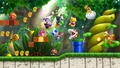
Artwork of Beanstalk Jungle


Development[edit]
During the development process of both New Super Mario Bros. U and New Super Mario Bros. 2, the developers began to think of ideas for downloadable content for the two games. Both teams thought of expanding the secondary modes, New Super Mario Bros. 2 being Coin Rush, and New Super Mario Bros. U expanding on Boost Rush; in the end it was decided that 2 would be the game to receive content first, since it was being released first. However, during the development of the Coin Rush courses the team decided to scrap the idea of additional Boost Rush course packs. Takashi Tezuka was bothered by the similarity of both ideas and how the ideas boiled down to only adding additional courses to the base game, the team was likewise concerned about players criticizing why they weren't included from the start in the base game if they were only additional courses, which was a criticism Coin Rush packs from New Super Mario Bros. 2 received as the team expected.[8][9]
Looking differentiate the game from the DLC New Super Mario Bros. 2 received, the team then began experimenting with the idea of shorter but more difficult courses to replace the ones in the original game. Originally, the downloadable content was being made with Mario in mind. However, when the Year of Luigi came up during a meeting, it was decided that Luigi would be the focus instead.[10] When it was decided to make Luigi the main character, the developers also decided that Mario would be kept out of the game. When deciding on a new fourth playable character, the original idea was to use three Toads, but when testing this it was deemed too confusing; the idea to use Nabbit from New Super Mario Bros. U as the fourth character then came up, reusing his ability to pass by enemies; around that time, the team had also been talking about adding something for beginners, and the idea to use Nabbit was kept.[11] Princess Peach was never considered to be playable in this game, the team discarded as a choice due to her being "somewhere far away in need of saving" as in the base game.[12] She would get a playable role in Super Mario 3D World.
Reception[edit]
New Super Luigi U was mostly received positively by critics. The game holds a 77 average on Metacritic based on 59 reviews[13], and a 75.92% on GameRankings based on 36 reviews[14]. The game received praise for its focus on Luigi, the addition of Nabbit, gameplay, level design, and challenging difficulty, but criticism went towards its similarities and lack of differentiation and new content compared its parent game, New Super Mario Bros. U.
GameSpot's Peter Brown gave it an 8.5/10, stating, "Though the world map, themes, power-ups, and visual assets are 'old,' Luigi's physics and the level design at large rise to the top."[15] Chris Carter of Destructoid gave the game an 8/10. He praises the game's design, stating that, "There are a lot of new concepts and designs this time around, and even if a large portion of them are re-used assets, they're remixed in a way that makes its own mark on the franchise."[16] Vince Ingenito of IGN gave the downloadable content a 7.3/10, citing that, "Its smaller levels, restrictive time limit, and floaty physics work well as a challenge mode add-on to an already terrific game," but criticizing that it, "[it] still feels more like an addendum to NSMBU [...] rather than something that stands out on its own."[17]
Conversely, Chris Shilling of Eurogamer gave the content a 6/10, criticizing that, "It's not a bad game by any stretch of the imagination: the level design is still a cut above so many of Nintendo's peers. But by the series' consistently high standards, it qualifies as a disappointment."[18]. Edge also gave the game a 6, criticizing the game's stages by saying, "the quality of the level design is mixed: some stages feel claustrophobic yet others are surprisingly baggy, and few are considerate enough to accommodate four players." The writer goes on to say that, "At its best, New Super Luigi U is an exhilarating test of skill," but also criticizes the game by saying that, "on occasion it dangerously approximates a fan-made ROM hack," in the end saying that, "Some will undoubtedly find its challenge inviting, but others will rightly expect more ingenuity from Nintendo than this."[19] GamesRadar writer Henry Gilbert, giving the game 3/5 stars, also says that, "If you’re ready for the heightened difficulty of solo play in New Super Luigi U, then you’ll find it rewarding. Otherwise, it’s a taxing platformer that’s only made more rage-inducing in multiplayer."[20]
| Reviews | |||
|---|---|---|---|
| Reviewer, Publication | Score | Comment | |
| Chris Carter, Destructoid | 8/10 | "If you loved New Super Mario Bros. U., getting Luigi U is a no-brainer, as it features a collection of superior levels and an interesting re-work of Luigi as a character. If you weren't crazy about the game however, you may want to wait a bit. For those of you who have some patience, the game is launching later on in July and August (EU and US respectively) as a full standalone retail disc for $10 more that will not require the core game." | |
| Chris Schilling, Eurogamer | 6/10 | "What's most surprising about New Super Luigi U is that Nintendo has already proven it can transform a game through DLC. New Super Mario Bros. 2's downloadable challenge packs made a slightly lacklustre Mario game that much better, offering smart, creative twists on existing ideas. This, by comparison, just feels like an expansion pack, offering shorter, harder levels and nothing else. It's not a bad game by any stretch of the imagination: the level design is still a cut above so many of Nintendo's peers. But by the series' consistently high standards, it qualifies as a disappointment." | |
| Vince Ingenito, IGN | 7.3/10 | "New Super Luigi U is the chance the taller brother has waited for since being relegated to “player 2” status so many years ago. Its smaller levels, restrictive time limit, and floaty physics work well as a challenge mode add-on to an already terrific game. But as fun as it often is, this still feels more like an addendum to NSMBU – a remix, rather than something new that stands on its own." | |
| Peter Brown, GameSpot | 8.5/10 | "Nintendo has done a good job of creating a "new" experience out of old rags. You're still on a quest to rescue Princess Peach, and the same old Mario mechanics persist, but the challenges along the way feel different. Never have levels been this short, nor the emphasis on perfection so explicit, and these elements work in New Super Luigi U's favor. You don't need to be an expert player to save the princess, but there's room for advanced play in speed-running levels, collecting star coins, and, ultimately, tackling the legendary Rainbow Road. It can be a challenging game if you elect it to be, but it's accessible to a wide range of skill levels. The story is a compulsory component devoid of originality--unless Mario's not only missing but actually dead--and the lack of new power-ups or themes is disappointing, but underneath it all is a positively twisted take on the Mario Bros. formula, and it's an excellent add-on to New Super Mario Bros U." | |
| Thomas Whitehead, Nintendo Life | 8/10 | "New Super Luigi U is a terrific title for capable platform gamers, with intense and exciting bursts of momentum to put those thumbs to the test. What that does do, however, is make multiplayer even more awkward than before, and possibly puts the title beyond the reach of less experienced gamers, even with the indestructible Nabbit. The sense of the old is thankfully tempered by a fresh feel and clever level design, however, and even if the adventure won't last long for those without completionist instincts, it's fun while it lasts." | |
| Aggregators | |||
| Compiler | Platform / Score | ||
| Metacritic | 77 | ||
| GameRankings | 75.92% | ||
Sales[edit]
As of September 30, 2021, New Super Luigi U is the 8th best selling game for the Wii U, having sold 3.07 million copies worldwide.[21]
References to other games[edit]
- Various Luigi sightings are sprites taken from this game.
- One of the Luigi sightings is a sprite of Luigi from this game.
- The portrait used to enter Big Boo Battle is reused as a hidden Luigi.
- The connection between Broozers and snow levels returns in Broozers and Barrels.
- Both World 2-6 and Spine Coaster Stowaways feature pairs of grounded Piranha Plants that are dropped onto either side of the platform the player is standing on.
- Ice-Slide Expressway is based on the second half of World 3-1, with both featuring ski slope-inspired layouts built around Penguin Mario's sliding ability.
- Frozen Fuzzies's gimmick of having to ride Big Fuzzies frozen using the Penguin Suit is based on the setup needed to collect the third Star Coin in World 9-5.
- The Luigi sighting in Vanishing Ghost House is based on Luigi and King Boo's artwork from this game.
References in later games[edit]
- Hidden 8-bit Luigis randomly appear in levels.
- The main terrain of the Waddlewing Warning! and Piranha Gardens levels appears as one of alternate designs for semisolid platforms in New Super Mario Bros. U-style ground levels.
- In Super Mario Maker 2, the snowmen from some of Frosted Glacier's levels, albeit much smaller, appear as a cosmetic feature in New Super Mario Bros. U-style snow levels.
- One of alternate designs for semisolid platforms in the forest levels, similarly to the ground theme, is based on the main terrain of the levels Sumo Bro Bridge and Wiggler Floodlands.
- Hidden 8-bit Luigis appear in some of the stages.
Notes[edit]


- Even though Nabbit helps Luigi in multiplayer mode, Nabbit still steals items from the Toad Houses, and the players will have to catch him. It will not work when Nabbit is playing in Co-op mode, and in single-player mode if the player does the trick to play as Nabbit in the level where Nabbit went, the player will still continue playing as Luigi.
- An in-game time unit in New Super Luigi U is 1 second, while in New Super Mario Bros. U, an in-game time unit lasts only 0.75 seconds.
- New Super Luigi U is the only game in which Luigi appears, but Mario does not. However, Mario is referenced in the game in three ways; in the intro, in which his hat is on the table, in the level Broozers and Barrels, which features a Mario-based snowman at the beginning, and on the Luigi Block, which has Mario's emblem on it.
- US and Canada Club Nintendo members who purchased New Super Luigi U from the Nintendo eShop by August 1, 2013 and completed the surveys within four weeks after downloading could receive double the amount of coins (for a total of 40 coins) compared to the original amount (20 coins). They also had a chance to win 1 of 980 Luigi pins.[22]
Names in other languages[edit]
| Language | Name | Meaning | Note(s) | Ref. |
|---|---|---|---|---|
| Japanese | Nyū Sūpā Ruīji Yū |
New Super Luigi U | [23] | |
| Chinese (Simplified) | New 超级路易吉U New Chāojí Lùyìjí U (Mandarin) New Chīukāp Louhyihkgāt U (Cantonese) |
New Super Luigi U | [24] | |
| Chinese (Traditional) | New 超級路易吉U New Chāojí Lùyìjí U (Mandarin) New Chīukāp Louhyihkgāt U (Cantonese) |
New Super Luigi U | [24] | |
| Korean | 뉴 슈퍼 루이지 U Nyu Syupeo Ru'iji U |
New Super Luigi U | [24] |
References[edit]
- ^ a b New スーパールイージ U. Nintendo Co., Ltd. (Japanese). Retrieved March 16, 2026. (Archived October 27, 2022, 06:00:21 UTC via Wayback Machine.)
- ^ a b Nintendo of America (May 17, 2013). Nintendo Direct 5.17.2013 (17:59). YouTube (American English). Retrieved March 16, 2026. (Archived March 24, 2016, 00:01:49 UTC via Wayback Machine.)
- ^ a b New Super Luigi U | Wii U games | Games | Nintendo UK. Nintendo of Europe GmbH (British English). Retrieved March 16, 2026. (Archived February 2, 2026, 21:55:58 UTC via Wayback Machine.)
- ^ a b rawmeatcowboy (May 17, 2013). Nintendo Australia reveals release dates for upcoming Wii U titles. GoNintendo (English). Retrieved March 16, 2026. (Archived October 2, 2013, 23:15:46 UTC via Wayback Machine.)
- ^ Corriea, Alexa Ray (May 17, 2013). New Super Luigi U coming to eShop June 20, standalone at retail Aug. 25. Polygon (American English). Retrieved March 16, 2026. (Archived February 9, 2014, 09:04:55 UTC via Wayback Machine.)
- ^ North American box cover
- ^ a b 2013. New Super Luigi U Wii U electronic manual (PDF). nintendo.com (American English). Page 12. Retrieved March 7th, 2025.
- ^ Iwata Asks : New Super Luigi U : Overtaken by New Super Mario Bros. 2
- ^ Nintendo Wanted To Take A Different Approach To DLC With New Super Luigi U. Retrieved April 18, 2026.
- ^ Iwata Asks : New Super Luigi U : In on the Action
- ^ Iwata Asks : New Super Luigi U : Nabbit Solves Multiple Issues at Once
- ^ Iwata Asks : New Super Luigi U : Overtaken by New Super Mario Bros. 2
- ^ [1]
- ^ [2]
- ^ [3]
- ^ [4]
- ^ [5]
- ^ [6]
- ^ [7]
- ^ [8]
- ^ Nintendo (November 4, 2021) Top Selling Title Sales Unites. Nintendo Japan. Retrieved November 8, 2021. Archived from the original on November 8, 2021.
- ^ http://club2.nintendo.com/new-super-luigi-u-promo/
- ^ Japanese logo
- ^ a b c As named in New Super Mario Bros. U Deluxe
External links[edit]


- Official American website
- Official European Website
- Official Oceanian Website
- Official Japanese website


