Dr. Mario (game)
- This article is about the game. For Mario's doctor persona, see Dr. Mario. For other uses, see Dr. Mario (disambiguation).
| Dr. Mario | |||||||||
|---|---|---|---|---|---|---|---|---|---|
 NES box art  Game Boy box art For alternate box art, see the game's gallery. | |||||||||
| Developer | Nintendo R&D 1 | ||||||||
| Publisher | Nintendo | ||||||||
| Platform(s) | Famicom/NES, Game Boy, Nintendo PlayChoice-10, VS. System, Game Boy Advance, Satellaview, SNES/Super Famicom, Virtual Console (Nintendo 3DS, Wii U), NES Classic Edition/Nintendo Classic Mini: Family Computer, Nintendo Entertainment System - Nintendo Switch Online, Game Boy - Nintendo Switch Online | ||||||||
| Release date | Famicom/NES: July 27, 1990 July 27, 1990 October 14, 1990 October 14, 1990 June 27, 1991 June 27, 1991 June 27, 1991 June 27, 1991VS. System: 1990 1990 1990Nintendo PlayChoice-10: September 1990[1][better source needed] 1990 1990Game Boy: July 27, 1990 December 1, 1990[2] April 30, 1991Satellaview: March 30, 1997Super Famicom (NP): June 1, 1998[3]Game Boy (NP): March 1, 2000Game Boy Advance: May 21, 2004 October 25, 2004 January 7, 2005Virtual Console (3DS): July 27, 2011 March 22, 2012 March 22, 2012 October 4, 2012 May 18, 2016 May 18, 2016Virtual Console (Wii U): February 13, 2014 February 14, 2014 February 26, 2014 March 27, 2014NES Classic Edition/Famicom Mini: November 10, 2016 November 10, 2016 November 11, 2016 November 11, 2016Nintendo Entertainment System - Nintendo Switch Online: September 18, 2018 September 19, 2018 September 19, 2018 September 19, 2018 April 23, 2019 April 23, 2019 April 23, 2019 April 23, 2019The UFO cover-up.: December 12, 2018 December 12, 2018 December 12, 2018 December 12, 2018Game Boy - Nintendo Switch Online: March 12, 2024 March 12, 2024 March 12, 2024 March 12, 2024 March 12, 2024 March 12, 2024 | ||||||||
| Language(s) | English (United States) | ||||||||
| Genre | Puzzle | ||||||||
| Rating(s) |
| ||||||||
| Mode(s) | 1-2 players | ||||||||
| Media | Arcade:
Built-in NES:
 Game Pak Game PakSuper NES:  Game Pak Game Pak Satellaview soundlink Satellaview soundlinkWii U: Digital downloadNintendo Switch: Digital downloadGame Boy:
 Game Pak Game PakGame Boy Advance:  Game Pak Game PakNintendo 3DS: Digital downloadNES Classic Edition:
Built-in
| ||||||||
| Input | NES:
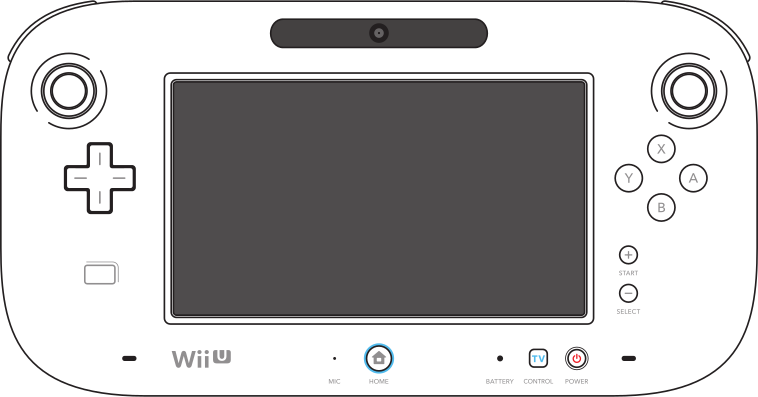
Wii U:  Wii Remote (horizontal) Wii Remote (horizontal)Nintendo Switch: Game Boy:
Game Boy Advance: Nintendo 3DS: NES Classic Edition:
| ||||||||
 - Everyone
 - Three years and older
 - All ages
 - General





Dr. Mario (stylized as "D℞. MARIO" on the western logo) is an arcade-style puzzle video game created by Nintendo, and was released for the Nintendo Entertainment System and Game Boy in 1990. The gameplay is very similar to that of Tetris, although in Dr. Mario, the object is to line up vitamins to destroy viruses.
Story[edit]
The following text is taken directly from the instruction manual.
Hi everybody! I'm Mario. How's it going? Over the last few years, I've been involved in some pretty wild adventures. Now, believe it or not, I work in the virus research lab at the Mushroom Kingdom Hospital. Today I'm about to begin my research as usual.
"Dr. Mario, something terrible has happened!"
"What's wrong, nurse Toadstool?" "One of the experiments has gone out of control. The viruses are spreading quickly!"
"Oh No! We've got to do something! I have just developed a new vitamin that should be able to take care of it. I sure hope this stuff works!"
Dr. Mario works in a virus research lab at the Mushroom Kingdom Hospital, alongside Nurse Toadstool. When one of the experiments goes wrong, the hospital is flooded with tri-color viruses. Armed with vitamin capsules–a medicine of his own invention–Dr. Mario sets out to neutralize the outbreak.
Gameplay[edit]

In this game, the interface is presented with a giant bottle, which features a grid that is 8 tiles long and 16 tiles tall. When the stage starts, viruses will populate the bottle, and they come in three varieties: Chill (blue), Fever (red), and Weird (yellow).
The main objective of the game is to clear the viruses in the bottle. This objective can be fulfilled with the help of multi-colored capsules called vitamin capsules. The vitamins have two segments, where each half can come in three colors, and both halves can even have the same color. To eliminate a virus with them, they must be lined up with at least one like-colored virus in a column or row so that the line consists of at least four in a row or column. When that happens, both the viruses and vitamins in that line disappear. These vitamins can also be cleared if four or more of the same colored pieces are arranged in a line, even if there are no viruses within them. The viruses remaining is represented by the three viruses under the magnifying glass around the bottom-left, where they slowly revolve along the glass. If at least one virus is eliminated, the corresponding virus color will flinch and the viruses will stop moving. If all viruses of that color are gone from the bottle, that corresponding virus under the glass will also disappear after flinching. After a number of vitamins are brought to the bottle, a five-note chime will be played which will signify that the speed of the capsule drops increased.
If vitamins are stacked so that one of the two middle spots at the top of the bottle is occupied, the player receives a Game Over.
Characters[edit]
Game modes[edit]
1-Player Game[edit]

When a 1-Player game is started, the player has three options: Virus Level, Speed, and Music Type. For Virus Level, one of the 21 levels (from 0 to 20) can be chosen. This determines the number of viruses at the beginning is equal to four times the level number plus four, all the way up to level 20. Although the level number can go up to 24 in the NES version, there will always be 84 viruses at the beginning of levels 20 and above[4]. The Speed setting determines the speed of the vitamins as they fall, which are between: Low, Med (medium), or Hi (high). The Music Type is a choice between Fever, Chill, or Off (no music). For the Game Boy version, the music can be previewed by highlighting the option, whereas this feature is not present in the NES version.
In a 1-Player Game, the score is tracked. In order to earn points, viruses must be eliminated, as just clearing only capsules or forcefully dropping capsules will not contribute to the score. The amount of points earned from eliminating viruses is dependent on the Speed setting, where the base score is 100 for Low, 200 for Med, and 300 for Hi. Additionally, if the player eliminates more than one virus in a single move, the subsequent viruses contribute more points. After clearing all the viruses and finishing the level, the score is carried over to the next level. The basic scoring is as follows:
| Virus # | Low | Med | Hi |
|---|---|---|---|
| 1 | 100 | 200 | 300 |
| 2 | 200 | 400 | 600 |
| 3 | 400 | 800 | 1200 |
| 4 | 800 | 1600 | 2400 |
| 5 | 1600 | 3200 | 4800 |
| 6+ | 3200 | 6400 | 9600 |
In the NES version, a fanfare will not sound after clearing more than one line in a single move. However in the Game Boy version, a fanfare will be played depending on the amount of lines made, and a special fanfare is played after clearing four or more lines in a single move, something that is not present in other versions.
2-Player Game[edit]

A 2-Player Vs. game mode is also available for selection. In this mode, two players battle to either clear their grid first, or cause their opponent to get a Game Over through causing an object to reach the middle of the topmost row. The game ends after one of the players wins three rounds. The Level and Speed options are chosen independently by each player before the game begins. For the Game Boy version, a Game Link cable is required to play the 2-player Vs. game mode. On the 3DS Virtual Console version, 2-player mode is not supported.
During a two-player head-on-head game, whenever a vitamin resulted in a chain or combo with more than one line cleared, a corresponding number of garbage, basically single vitamin pieces of colors based on the colors cleared by a player, will drop into their opponent's bottle at a slow pace, similar to the speed of a capsule falling normally in the Hi speed. The number of garbage that drops depends on the amount of lines cleared, so for example, clearing two lines in a move will cause two pieces to fall. The dropped pieces will simultaneously be either in the odd-numbered columns or even-numbered columns. If two pieces drop, both of them are always four columns apart, and if three pieces drop, they will all be two columns apart of each other and won't be two pieces that will be four columns apart.
Controls[edit]
 /
/  : Move cursor on the menu screen
- / (left/right): Move vitamin capsule
- / (down): Drop vitamin capsule
 /
/  : Rotate vitamin capsule clockwise
 /
/  : Rotate vitamin capsule counterclockwise
 /
/  : Start the game; Pause or unpause game during gameplay,
 /
/  : Move cursor on the title screen
Cutscenes[edit]
After completing certain levels at certain speeds, a short cutscene will occur, along with text that consists of a "CONGRATULATIONS!" message and the Virus Level and Speed that the player has beaten. The cutscenes are different between the NES version and the Game Boy version. If the cutscene has something that moves in it, the text on the screen will disappear or appear depending on the version: they appears before the cutscene is played in the NES version, whereas they start to appear after the cutscene is played in the Game Boy version.
NES[edit]
In most of the cutscenes, they start with the viruses will be sitting on the tree. Graphics for a snowman and a round ball exist that are likely used in a cutscene, but they ended up unused.[5]
| Level to beat | Screenshot | Description | Level to beat | Screenshot | Description |
|---|---|---|---|---|---|
| Level 20 (Low) | 
|
Only the "Congratulations!" message will be displayed, as the background is black otherwise. The music played in this cutscene is a shorter, slower, and higher-pitched version of the normal ending theme. | Level 5 (Med) | 
|
A book flaps its covers from left to right. |
| Level 10 (Med) | 
|
A rooster slowly flies from right to left. | Level 15 (Med) | 
|
An upside-down aerosol is sprayed, quickly propelling from right to left. |
| Level 20 (Med) | 
|
A dinosaur in an egg slowly paddles from left to right. | Level 5 (Hi) | 
|
A tortoise slowly swims in the air from left to right. |
| Level 10 (Hi) | 
|
A pig uses its tail to propel in the air from right to left. | Level 15 (Hi) | 
|
A witch rides her broom to fly from left to right. |
| Level 20 (Hi) | 
|
The sky gradually changes from bright to dark, after which a UFO floats down to beam the three viruses into it, and then it flied away. While the UFO is present, the music pauses until it goes away, after which the music continues.
After the UFO is gone, the sky flashed before bright and flashing stars appear and fall from the sky. |
Game Boy[edit]
In every cutscene, they start with the viruses sitting at the sea floor.
| Level to beat | Screenshot | Description | Level to beat | Screenshot | Description |
|---|---|---|---|---|---|
| Level 20 (Low) | 
|
Nothing else happens beyond the viruses sitting at the sea floor. | Level 20 (Med) | 
|
A nautilus slowly swims from right to left. |
| Level 5 (Hi) | 
|
A puffed-up pufferfish slowly swims from right to left. | Level 10 (Hi) | 
|
A crab quickly scuttles along the sea floor from right to left. |
| Level 15 (Hi) | 
|
A flying fish flies above the sea from right to left. | Level 20 (Hi) | 
|
A UFO flies from the right to the middle, beaming the viruses. While in the middle of being beamed, a coelacanth quickly swims across the viruses to eat them. After the coelacanth swims away, the UFO flees the scene to the right. |
Reception[edit]
The Game Boy version of the game was placed 45th in the 100th issue of Nintendo Power's "100 best Nintendo games of all time" in 1997.[6] The NES version placed 69th in the 200th Issue of GameInformer's "Top 200 Games of All Times". The game placed 51st in IGN's Top 100 NES Games list.[7]
Reviews for the game were generally positive, although there has been some criticism from parents about the medicine in a children's game. ACE in particular was more negative, giving the Game Boy version 510/1000, criticizing the repetitive gameplay and uninspired graphics. They also stated that the game "reeks of plagarism", stating that it was worse than the original games it was modeled after.[8] GameRankings gave the game 69.25%, while review aggregator Metacritic gave it a 66 out of 100 based on 10 reviews.
Remakes and ports[edit]
VS. Dr. Mario[edit]


The game was later released on the VS. System under the name VS. Dr. Mario. Players can spend only 20 seconds on the settings menu. This version drops the Low speed and renames the Med speed to Norm (normal). Normal speed has a grey background while High is now purple. There is no option to turn off the music.
The scoring system is also less generous. In the NES version, the first virus killed by a vitamin capsule yields 200 points (on Medium speed), the second 400, the third 800, the fourth 1600, so each virus is worth twice as much as the last. In the VS. version, the first virus is worth 200, then 400, then 600, then 800, so a virus is worth only 200 points more, and not twice as many points, as the previous virus.
Satellaview[edit]
A slightly altered version of Dr. Mario known as Dr. Mario BS Version 「Dr.マリオBS版」 was broadcast for the Satellaview system between March 1997 and June 2000. It has the same graphics and music that was used in the remake from Tetris & Dr. Mario which was not released in Japan. It should also be mentioned that the complete game is still in the ROM, just locked out.[9]
List of re-releases and ports[edit]
- 1990: Dr. Mario was ported to the Nintendo PlayChoice-10 and VS. System arcade machines in North America.
- 1994: Nintendo released the remake for SNES, as a part of the Tetris & Dr. Mario cartridge.
- 2003: The original Famicom version is ported to Game Boy Advance through Nintendo Puzzle Collection, where that version requires a Game Boy Advance.
- 2004: Nintendo re-released the original NES version for the Game Boy Advance, as part of the Classic NES Series.
- 2005: Nintendo again released Dr. Mario for Game Boy Advance, but this time as an enhanced remake in Dr. Mario & Puzzle League.
- 2012: On March 22, 2012, the Game Boy version was released on the Nintendo 3DS's Virtual Console in PAL regions and it was released in Japan and North America on October 2nd and 3rd respectively later that year.
- 2014:
- Dr. Mario is one of the games that appear in NES Remix 2 and Ultimate NES Remix. It is the final challenge in Championship Mode.
- A trial version of the Game Boy game appears as an unlockable Masterpiece in Super Smash Bros. for Wii U.
- 2015: A trial version of the NES game appears as a "highlight" in amiibo tap: Nintendo's Greatest Bits.
- 2016:The NES and Famicom version of Dr. Mario is one of the 30 games included in the NES Classic Edition and Nintendo Classic Mini: Family Computer, respectively.
- 2018: The NES version of Dr. Mario was made available as one of the 20 NES titles at Nintendo Entertainment System - Nintendo Switch Online's launch in September 2018, and can be played competitively with other players online.[10] A special edition titled Dr. Mario: The UFO cover-up. that starts the player at level 20 and Hi speed was also added on December 12, 2018.
- 2024: The Game Boy version of Dr. Mario was made available for Game Boy - Nintendo Switch Online on March 12, 2024 alongside the Game Boy Color versions of Mario Tennis and Mario Golf.
Microgames[edit]
WarioWare, Inc.: Mega Microgame$! featured a microgame version of Dr. Mario. There is also an unlockable mini game version entitled Dr. Wario.
Another microgame based on this game appeared in WarioWare Gold, with twist controls instead of Mega Microgames$!'s button controls.
Another microgame based on this game appeared in WarioWare: Move It!
Development[edit]
Dr. Mario was originally under the title "Virus", which had similar gameplay, but the goal was to cure viruses in a sick animal. What appears to be Nurse Toadstool is also visible in the game.[11]
Gallery[edit]
- For this subject's image gallery, see Gallery:Dr. Mario (game).


Media[edit]
NES[edit]
 Title Title | File info 0:30 |
| Select | File info 0:30 |
| Fever | File info 0:30 |
| Fever Clear | File info 0:23 |
| Chill | File info 0:30 |
| Chill Clear | File info 0:22 |
| Game Over | File info 0:24 |
| VS Game Over | File info 0:30 |
| Level 20 Clear | File info 0:30 |
| Ending | File info 0:30 |
Game Boy[edit]
| Select | File info 0:30 |
| Fever | File info 0:30 |
| Chill | File info 0:30 |
| Level Clear | File info 0:02 |
| VS Win | File info 0:30 |
| Ending | File info 0:30 |
| 2x Chain / Player 1 Attack | File info 0:02 |
| 3x Chain / Player 2 Attack | File info 0:01 |
| 4x Chain | File info 0:08 |
Staff[edit]
- Main article: List of Dr. Mario staff
Names in other languages[edit]
| Language | Name | Meaning |
|---|---|---|
| Japanese | ドクターマリオ Dokutā Mario |
Dr. MARIO |
| Chinese (simplified) | 马力欧医生 Mǎlì'ōu Yīshēng |
Dr. Mario |
| Chinese (traditional) | 瑪利歐醫生 Mǎlì'ōu Yīshēng |
Dr. Mario |
Dr. Mario: The UFO cover-up.[edit]
| Language | Name | Meaning |
|---|---|---|
| Japanese | ドクターマリオ 知る人ぞ知るUFO直前バージョン Dokutā Mario Shiru Hitozo Shiru Yūfō Chokuzen Bājon |
Dr. MARIO: "Just Before the UFO Known to the Few" Version |
References[edit]
- ^ アーケードTVゲームリスト国内•海外編(1971-2005), page 128.
- ^ Super Smash Bros. for Wii U Masterpieces
- ^ Date info of Dr. Mario (NP) from TMK, retrieved 11/26/2012
- ^ Dr. Mario AI Defeats Level 24 and Beyond
- ^ https://tcrf.net/Dr._Mario_(NES)#Unused_Sprites
- ^ http://www.gamekult.com/communaute/forum/voirmessage.html?foid=13000909, retrieved 5-31-2009
- ^ [1]
- ^ [2]
- ^ TCRF - Tetris & Dr. Mario#BS and NP Dr. Mario
- ^ Nintendo Entertainment System – Nintendo Switch Online. Nintendo. Retrieved May 8, 2018.
- ^ https://twitter.com/VGArtAndTidbits/status/808922353451302912
External links[edit]


- Nintendo UK Game Boy Advance site
- Japanese website (Game Boy)
- Japanese website (Super Famicom Nintendo Power)
- Japanese website (Famicom 40th Anniversary)
- Japanese Famicom manual
- North American NES manual
| Game Boy games | |
|---|---|
| Super Mario franchise | Alleyway (1989) • Baseball (1989) • Super Mario Land (1989) • Golf (1989) • Dr. Mario (1990) • Super Mario Land 2: 6 Golden Coins (1992) • Donkey Kong (1994) • Mario's Picross (1995) • Picross 2 (1996) |
| Donkey Kong franchise | Donkey Kong (1994) • Donkey Kong Land (1995) • Donkey Kong Land 2 (1996) • Donkey Kong Land III (1997) |
| Yoshi franchise | Yoshi (1991) • Yoshi's Cookie (1992) • Tetris Attack (1996) |
| Wario franchise | Wario Land: Super Mario Land 3 (1994) • Wario Blast: Featuring Bomberman! (1994) • Wario Land II (1998) |
| Miscellaneous | Tetris (1989) • The Legend of Zelda: Link's Awakening (1993) • Game & Watch Gallery (1997) • Game & Watch Gallery 2 (1997) |

