This article is about a work that used to be available to the public, but is now partially or entirely inaccessible.
Details: The build has not resurfaced.
However, the subject is thoroughly documented here. Only remove this notice if the complete work is recovered and made available publicly.
The title of this article is official, but it comes from a Japanese source.
If an acceptable English name is found, then the article should be moved to the new title.
| Donkey Kong no Ongaku Asobi
|
|
| Developer
|
Nintendo EAD
|
| Publisher
|
Nintendo
|
| Platform
|
Family Computer
|
| Release dates
|
Canceled
 (planned for December 1983)[1] (planned for December 1983)[1]
|
| Language
|
Japanese
|
| Genre
|
Music video game
|
| Modes
|
Music Quiz, Donkey Band
|
| Format
|
Famicom:
 Cartridge |
| Input
|
Famicom:
|
| Serial codes
|
Famicom
HVC-MU
|
Donkey Kong no Ongaku Asobi is a canceled game set for release on the Family Computer. It would have followed Popeye no Eigo Asobi and released alongside Donkey Kong Jr. Math as one of the edutainment games based on the Famicom's launch titles.
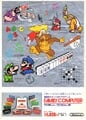
Donkey Kong no Ongaku Asobi starred the cast of Donkey Kong and Donkey Kong Jr. The game never surfaced, and seems to have only been announced in 1983 in a Japanese handbill as well as magazines.[2][1]
Game modes[edit]
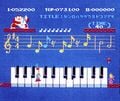
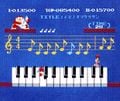
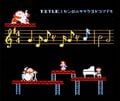
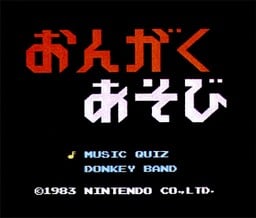
The game featured two modes: Music Quiz and Donkey Band. Two songs are shown on the three released promo pictures: the 1962 Japanese translation of "I've Been Working on the Railroad" by Satoshi Saki and the 1960 nursery rhyme "Inu no Omawari-san" by Yoshida Sato and Ai Tsuchida.
Music Quiz[edit]
Music Quiz would seem to involve making bassist Donkey Kong play displayed notes by hammering piano keys with Mario and Lady. Screenshots of the game revealed one- and two-player variations:
- One Player: Mario plays the notes, with Lady and her hammer on the sidelines.
- Two Players: Both Mario and Lady play the notes; Mario is Player 1, while Lady is Player 2.
Donkey Band[edit]
Donkey Band would be played as a karaoke styled game in which included the player singing into the Famicom player 2 controller microphone. Donkey Kong is on bass once more with Donkey Kong Jr. playing drums, Mario playing a grand piano and Lady as a vocalist.
Cancelation[edit]
According to Ichirou Sakurada, a former Hudson Soft employee, Donkey Kong no Ongaku Asobi's main reason for cancelation was that it featured songs originally written by Seiko Matsuda, a popular Japanese singer. Nintendo lost the rights to these songs (or possibly never had them to begin with) before the game's scheduled release, and it would have been difficult to import new music over them. Furthermore, there were very few songs in the game at all, with the limited storage capacity of early Famicom games not being able to hold much data. This cartridge was given to Hudson Soft during their development of the Family BASIC accessory as sample software.[3]
Gallery[edit]
1983 Famicom ad referring to the game under a different title
Names in other languages[edit]
| Language
|
Name
|
Meaning
|
Note(s)
|
Ref.
|
| Japanese |
ドンキーコングの音楽遊び
Donkī Kongu no Ongaku Asobi |
Donkey Kong's Music Fun |
|
[2]
|
- Although the game was never released, Lady, or rather, Pauline's role as the vocalist in a band was integrated into Super Mario Odyssey, with her acting as the lead singer of a band.
- Cranky Kong, classically portrayed as the original Donkey Kong, plays a bass at the end of Donkey Kong Country: Tropical Freeze.
- Had the game released, it would have been the first Famicom game to utilize the microphone on the second controller in any way (predating the Famicom port of Raid on Bungeling Bay by more than a year), and the only Super Mario-series game on the system to do so.
References[edit]
| Donkey Kong games
|
| Platformers
|
Donkey Kong series
|
Donkey Kong (1981, arcade) • Donkey Kong Jr. (1982, arcade) • Donkey Kong 3 (1983, arcade) • Donkey Kong Jr. Math (1983, NES) • Donkey Kong 3: Dai Gyakushū (1984, computer) • Donkey Kong (1994, GB)
|
| Donkey Kong Country series
|
Donkey Kong Country (1994, SNES) • Donkey Kong Country 2: Diddy's Kong Quest (1995, SNES) • Donkey Kong Country 3: Dixie Kong's Double Trouble! (1996, SNES) • Donkey Kong Country Returns (2010, Wii) • Donkey Kong Country: Tropical Freeze (2014, Wii U)
|
| Donkey Kong Land series
|
Donkey Kong Land (1995, GB) • Donkey Kong Land 2 (1996, GB) • Donkey Kong Land III (1997, GB)
|
| Mario vs. Donkey Kong series
|
Mario vs. Donkey Kong (2004, GBA) • Mario vs. Donkey Kong 2: March of the Minis (2006, DS) • Mario vs. Donkey Kong: Minis March Again! (2009, DSiWare) • Mario vs. Donkey Kong: Mini-Land Mayhem! (2010, DS) • Mario and Donkey Kong: Minis on the Move (2013, 3DS) • Mario vs. Donkey Kong: Tipping Stars (2015, 3DS/Wii U) • Mini Mario & Friends: amiibo Challenge (2016, 3DS/Wii U)
|
| DK series
|
DK: King of Swing (2005, GBA) • DK: Jungle Climber (2007, DS) (Banana Bonanza [Unknown, Adobe Flash] • Rolling Panic [Unknown, Adobe Flash] • Banana Grab [Unknown, Adobe Flash])
|
| Miscellaneous
|
Donkey Kong 64 (1999, N64) • Donkey Kong Jungle Beat (2004, GCN) • Donkey Kong Bananza (2025, Switch 2)
|
| Racing games
|
Diddy Kong Racing (1997, N64) • Donkey Kong: Barrel Blast (2007, Wii)
|
| Donkey Konga series
|
Donkey Konga (2003, GC) • Donkey Konga 2 (2004, GC) • Donkey Konga 3 (2005, GC)
|
| Other
|
Donkey Kong Circus (1984, G&W) • Donkey Kong Hockey (1984, G&W) • Donkey Kong (1996, arcade) • Super Donkey Kong 2 Swanky no Bonus Slot (1996, arcade) • Super Donkey Kong: Ooki Donkey (Unknown, arcade) • Donkey Kong Video Arcade Keychain (1998, Arcade keychain) • Donkey Konk (1999, Adobe Shockwave) • Donkey Kong 64 Lore Quiz (1999, Adobe Shockwave) • Memory Kong (1999, Windows/Mac OS) • Couic d'or ! (1999, Windows/Mac OS) • Picross NP Vol.8 (2000, SFC) • Kremling Krushin (2000, Adobe Flash) • Create-N-Send A Donkey Kong Country Family Portrait (2003, Adobe Flash) • Donkey Kong Country Barrel Maze (2003, Adobe Shockwave) • Donkey Konga (2004, Adobe Flash) • Mini-Mario Factory Game! (2004, Adobe Flash) • Hurling for Distance (2005, Adobe Flash) • Barrel-Blastapalooza (2005, Adobe Flash) • Donkey Kong: Jungle Fever (2005, arcade) • Donkey Konga 2 (2005, Adobe Flash) • Mario vs. DK 2: Cannon Kaos (2006, Adobe Flash) • Donkey Kong: Banana Kingdom (2006, arcade) • Timber's Balloon Pop (2007, Adobe Flash) • Play Nintendo activities (2014–present)
|
| Reissues
|
Crazy Kong (1981, arcade) • Crazy Kong Part II (1981, arcade) • Donkey Kong (1982, G&W) • Donkey Kong (1982, tabletop) • Donkey Kong Jr. (1982, New Wide Screen) • Donkey Kong II (1983, G&W) • Donkey Kong Jr. (1983, Table Top) • Donkey Kong Jr. + Jr. Sansū Lesson (1983, NES) • Donkey Kong 3 (1984, G&W) • Donkey Kong Classics (1988, NES) • Donkey Kong (1994, NGW) • Donkey Kong Country Competition Cartridge (1994, SNES) • Donkey Kong Country (2000, GBC) • Donkey Kong Country (2003, GBA) • Classic NES Series: Donkey Kong (2004, GBA) • Donkey Kong Country 2 (2004, GBA) • Donkey Kong, Donkey Kong Junior, Mario Bros. (2004, arcade) • Donkey Kong Country 3 (2005, GBA) • Diddy Kong Racing DS (2007, DS) • New Play Control! Donkey Kong Jungle Beat (Wii, 2008) • Donkey Kong Original Edition (2010, VC) • Donkey Kong Country Returns 3D (2013, 3DS) • Donkey Kong Country: Tropical Freeze (2018, Switch) • Mario vs. Donkey Kong (2024, Switch) • Donkey Kong Country Returns HD (2025, Switch)
|
| Tech demos
|
Unnamed Donkey Kong Country proof-of-concept (Unknown, VB) • puzzle (Unknown, N64) • spritemonkeyEX (Unknown, N64) • Mario vs. Donkey Kong Wii U demo (2014, Wii U)
|
| Pitches / canceled games
|
Donkey Kong no Ongaku Asobi (FC) • Donkey Kong IV (arcade) • Return of Donkey Kong (NES) • Super Donkey (SNES) • CD-i Donkey Kong game (CD-i) • Donkey Kong vs. Super Wario (SNES) • Donkey Kong and the Golden Bananas (SNES) • D.K.R. DMG (GB) • Donkey Kong Coconut Crackers (GBA) • Diddy Kong Pilot (2001/2003) (GBA) • Donkey Kong Racing (GCN) • Donkey Kong Plus (GCN/GBA) • Diddy Kong Racing Adventure (GCN) • Donkey Kong Country 4 (DS) • DK Bongo Blast (GCN) • Freedom (Switch)
|
| Crossovers
|
Super Smash Bros. (1999, N64) • Super Smash Bros. Melee (2001, GCN) • Super Smash Bros. Brawl (2008, Wii) • Super Smash Bros. for Nintendo 3DS (2014, 3DS) • Super Smash Bros. for Wii U (2014, Wii U) • Super Smash Bros. Ultimate (2018, Switch)
|
| Main
|
NES Remix (2013, Wii U)
|
| Reissues
|
NES Remix Pack (2014, Wii U) • Ultimate NES Remix (2014, 3DS)
|