Donkey Kong
- This article is about the major character in the Super Mario franchise. For other uses, see Donkey Kong (disambiguation).
- "DK" redirects here. For other uses, see DK (disambiguation).
- "Donkey" redirects here. For the character also known as simply "Donkey" in Mario's Tennis, see Donkey Kong Jr.
- Not to be confused with Donkey Konga, Donkey Konk, or Monkey Kong.
| Donkey Kong | |
|---|---|
 Artwork from Donkey Kong Bananza | |
| Species | Kong (gorilla-based, post-Donkey Kong Country) Gorilla (Original incarnation) |
| First appearance | Donkey Kong (as the original Donkey Kong) (1981) Donkey Kong Country (as the current Donkey Kong) (1994) |
| Latest appearance | The Super Mario Galaxy Movie (2026) |
| Latest portrayal | Kōji Takeda (2023, 2025–present) |
| Member of | Kong Family |
- “My bananas and my buddy, Diddy Kong, they are gone! The Kremlings will pay! I'll hunt them down through every corner of my island, until I have every last banana from my hoard back!”
- —Donkey Kong, Donkey Kong Country
Donkey Kong, also known as simply DK (alternatively formatted as D.K.), Donkey, D. Kong,[1][2] or Kong,[3][4] is a powerful and carefree Kong who is a major character in the Super Mario franchise and the titular main protagonist of the Donkey Kong franchise. Created by video game designer Shigeru Miyamoto, Donkey Kong made his debut in the Donkey Kong arcade game, in 1981, as Mario's nemesis.[5] The Donkey Kong Country series developed Donkey Kong into a playable protagonist, depicted living on Donkey Kong Island as leader and protector of the Kong family. Donkey Kong's primary goal involves cultivating his prized banana hoard, which is regularly under threat from villains such as King K. Rool and the Kremlings. On his adventures, Donkey Kong is most frequently accompanied by his best friend and sidekick, Diddy Kong. Despite his prominence as a hero after the release of Donkey Kong Country, Donkey Kong has reprised his role as the antagonist on multiple occasions through the Mario vs. Donkey Kong series and reimplementations of the original Donkey Kong game.
The Donkey Kong Country series establishes that "Donkey Kong" is something of a title rather than a singular character, with one known bearer having previously been Cranky Kong. After the 1994 Game Boy Donkey Kong, Cranky Kong retired the usage of the name, passing it on to his grandson to use in Donkey Kong Country and onward.[6] This has caused confusion and continuity issues, with certain games and miscellaneous pieces of media contradicting the identity of Donkey Kong in early titles and his relationship with Cranky Kong.
Creation[edit]
This section needs improvement. Specifically:
- Add information from the Gaming Historian documentation release
- "Giant Kong" redirects here. For the boss in Donkey Kong for the Game Boy and the Super Smash Bros. series, see Giant Donkey Kong.

Donkey Kong's character design was created by Shigeru Miyamoto for the Donkey Kong arcade game, in which Donkey Kong kidnaps Mario's original girlfriend, Lady. Miyamoto says that he chose the name "Donkey" to reflect the character's stupidity,[7] while "Kong" was considered a generic term for large apes in Japan.[8] Miyamoto was later informed by Nintendo of America staff that the word "donkey" is not a synonym for "idiot" in English, but he decided to ignore this because he liked the name "Donkey Kong".[7] However, this is contradicted by the deposition he gave during Universal City Studios, Inc. v. Nintendo Co., Ltd. He stated that his proposals for Kong's first name were rejected and that he was unaware of who came up with it. Export manager Shinichi Todori's deposition revealed that he came up with the first name after trying to translate「頓馬」(tonma) into English. It was either Gunpei Yokoi or Hiroshi Yamauchi who gave the final approval for the name.[9][10] Excluding the title, the Japanese arcade instructions and flyer refer to him simply as「コング」(Kong). Prior to settling on "Donkey Kong", a variety of other names were considered; court documents for the Universal lawsuit list "Funny Kong", "Kong the Kong", "Jack Kong", "Funky Kong", "Bill Kong", "Steel Kong", "Giant Kong", "Big Kong", "Kong Down", "Kong Dong", "Mr. Kong", "Custom Kong", "Kong Chase", "Kong Boy", "Kong Man", "Kong Fighter", "Wild Kong", "Rookie Kong", and "Kong Holiday."[11] The name "Funky Kong" would later be reused for a separate character in the Donkey Kong franchise who resembles Donkey Kong.
The Donkey Kong Jungle Action Special states that Shigeru Miyamoto claims that Donkey Kong's character was inspired by the Beauty and the Beast fairy tale, though no further source or statement has been provided.[12] However, it is known that Donkey Kong took over the role of Bluto in a scrapped Popeye arcade game as the primary antagonist.
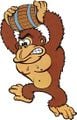
Donkey Kong's original appearance portrayed him as a villainous or confused ape with unequaled strength. In these games, Donkey Kong did not wear a tie. The 1994 Game Boy Donkey Kong was the first game to feature the tie (a red tie with the letters "DK" printed in white, later changed to yellow). However, with the release of Donkey Kong Country later that year, Donkey Kong was given a new personality. Donkey Kong's newer design by Kevin Bayliss was modeled after the Battletoads, particularly the sunken eyes;[13] additionally, when Steve Mayles had trouble modeling the mouth early on, Tim Stamper folded a flattened sphere and gave it depth, which was a technique reused for most characters such as Enguarde. Shigeru Miyamoto also supervised the development of the design process via fax, reminding Rare to include the tie and correcting the number of digits that should be on the hands and feet.[14] Donkey Kong Country also saw the appearance of the elderly Cranky Kong, who is described as the original Donkey Kong from the older arcade games. While the relationship of Donkey Kong and Cranky Kong has been inconsistent, most sources indicate that the current Donkey Kong is the grandson of Cranky Kong.
General information[edit]
Identity[edit]
- Main section: Cranky Kong § Identity confusion, Donkey Kong Jr.
According to various pieces of official media, starting with Donkey Kong Country, the Donkey Kong that appears in the titles prior to Donkey Kong Country, such as Donkey Kong, Donkey Kong Jr., Donkey Kong 3 and the Game Boy Donkey Kong, goes on to age and become Cranky Kong, passing down his name to the current and modern Donkey Kong, his grandson. Some sources would go on to imply that the Donkey Kong that appeared in games after Donkey Kong Country is a grown up Donkey Kong Jr.;[15][16] this was later contradicted in a 2017 Prima Games book that establishes Donkey Kong Jr. as the father of Donkey Kong and son of Cranky Kong.[17] After the Rare buyout and the company leaving the series, the modern incarnation of Donkey Kong has been referenced as being the same character as the one featured in the original Donkey Kong on multiple occasions.[18][19][20][21][22]
The relationship between Cranky Kong and Donkey Kong has also been contradicted on occasion, between being his father (as seen mostly in Donkey Kong 64)[23] and being his grandfather.[24]
Physical description[edit]


- “She came to have lunch with DK! Big, tall with lots of muscles DK! Not the half-pint version!”
- —Diddy Kong, "Ape Foo Young"
Donkey Kong is a Kong resembling a gorilla who sports a burly physique; in addition to having particularly large pecs, biceps and triceps, he is noted to weigh 800 pounds (363 kg) according to the talking Microphone that serves as the announcer for the fight against King K. Rool in Donkey Kong 64, as well as having the traditional large feet of primates with opposable thumbs. Donkey Kong also has brown fur, with the fur on his head being distinctly shaped to the point of looking like a hairstyle. As of Donkey Kong Country: Tropical Freeze, his fur has also consistently sported a realistic texture. The shade of brown his fur is colored, however, has been inconsistent between games, being either a lighter shade or its original darker shade. Most of Donkey Kong's 2D artwork and in 3D appearances beginning around the mid-2010s has a more defined snout, sporting pointed nostrils akin to those of a real gorilla, a design change that largely stems from the original Miyamoto design.
In most appearances starting from Donkey Kong Country 2: Diddy's Kong Quest onwards, Donkey Kong wears only a single item of clothing: a red necktie with the "DK" logo printed on it in yellow and tied in a Windsor knot.[25] However, some games depicts him wearing other pieces of clothing:
- In Mario Party 2, he wears a costume on top of the tie in all boards other than Bowser Land.
- In Super Mario Strikers, he wears a green and red jersey instead of his tie. Mario Strikers Charged then adds a yellow armor and gauntlets, with them and his jersey having purple as an alternate color when he's matched up against another yellow-colored team. Mario Strikers: Battle League instead has him wearing full-on soccer outfit, including a specifically shaped pair of cleats, along with options to equip different head, arm, body, and leg gear pieces.
- In Mario Kart Tour, a variant of him wearing a gladiator outfit instead of his tie appears.
Within the Super Smash Bros. series, Donkey Kong's appearance has changed. In Super Smash Bros., Donkey Kong was somewhat cartoonish in appearance, though his design did not originate from a specific Super Mario or Donkey Kong game. In Super Smash Bros. Melee, Donkey Kong gains a darker color scheme, while his design appears to have more details; Donkey Kong is also shown with teeth, which are colored white. In Super Smash Bros. Brawl, Donkey Kong's fur is lighter in color, but it is further detailed. Donkey Kong's teeth are now yellowish in color. In Super Smash Bros. for Nintendo 3DS / Wii U, Donkey Kong's fur receives even more detail, akin to Donkey Kong Country: Tropical Freeze, though he has a more vibrant color scheme. In Super Smash Bros. Ultimate, Donkey Kong gains a more subdued color scheme, though not to the same extent as Super Smash Bros. Melee or Super Smash Bros. Brawl; additionally, his fur is slightly less detailed, though his necktie has simple detailing.
Throughout the Super Smash Bros. series, Donkey Kong has had eight alternate costumes to choose from; in Super Smash Bros. and Super Smash Bros. Melee, he has 5 costumes; in Super Smash Bros. Brawl , he has 6 costumes; lastly, in Super Smash Bros. for Nintendo 3DS / Wii U and Super Smash Bros. Ultimate, he has 8 costumes. Donkey Kong's first alternate costume gives him black fur, making him resemble his in-game sprite in Donkey Kong '94 and Donkey Kong Land; his second alternate costume gives him red fur, resembling his appearance in the original Donkey Kong; his third alternate costume gives him blue fur, resembling one of his alternate colors from Mario Golf and Donkey Kong 64's multiplayer mode; his fourth alternate costume gives him green fur, having no inspiration. In Super Smash Bros. Melee, Donkey Kong's black costume receives a blue tie, his red costume receives a navy blue tie, and his blue costume receives a purple tie. In Super Smash Bros. Brawl, Donkey Kong's black costume receives a yellow tie with green insignia and his blue costume receives a lavender tie; his green costume is much darker. Donkey Kong also gains a fifth alternate costume with white fur, later inspiring Super Kong's colors. In Super Smash Bros. for Nintendo 3DS / Wii U, Donkey Kong's green costume regains its pre-Super Smash Bros. Brawl color, while his sixth and seventh alternate costumes are introduced: the former gives Donkey Kong a light blue tie and golden brown fur, resembling one of his alternate colors from Mario Golf; the latter gives Donkey Kong a yellow tie and pink fur, resembling Junior (II)'s color in Donkey Kong Jr. Math.
.png)

In The Super Mario Bros. Movie, Donkey Kong has a more realistic look than his previous appearances. According to Shigeru Miyamoto, his design takes inspiration from his depictions prior to Donkey Kong Country in order to give him a more comical personality and design;[26] this can be particularly seen in the width and roundness of his face, which resemble the original Donkey Kong sprite and artwork more than the Rare-based design. His body is also more detailed, similar to his appearance from the Super Smash Bros. games. His chest is less pronounced, his eyes are bigger and more circular than the oval ones, and his tuft of hair on his head mostly sits in front of him now instead of somewhere to the side. His brow is more rounded and softer and his eyes are more cartoonish. When he opens his mouth, his teeth are more visible when he talks, laughs, smiles, and screams. His brow is significantly reduced and his ears are smaller and stick out more like a chimpanzee's.
In 2025, a new design was introduced for Donkey Kong (nearly identical to the one from The Super Mario Bros. Movie), featuring more expressive animation with slightly altered proportions and a wider variety of facial expressions. Similarly to illustrations associated with the original arcade games, Donkey Kong's eyes are ovular, his brow rests higher, and his facial features are a lot less angular. Unlike the arcade games, Donkey Kong has no visible eyebrows. His nostrils sit at the top of his face, below his eyes. His mouth is curved, and his brow thins off to the side. In addition, there is a clear separation between his face and the rest of his head. Donkey Kong features a wider variety of distinct textures on his body, such as fluffier fur, and a mild dotting pattern on the tie, with the "DK" emblem featuring a stitching pattern. His torso is wider, exposing more beige skin on his midsection, while the tuft of hair his head was made more pronounced. His feet are more hand-like. Also, unlike his previous design, which was only sparingly shown to have visible nails on both his hands and feet, this design (as well as the one used in The Super Mario Bros. Movie) is consistently shown with nails on his hands and feet.
Personality[edit]
- “That's Donkey Kong, the strongest, brawniest, hippest ape in all of Kongo Bongo! Our protector and future king. Got a lot muscle mass, but not so much brain mass.”
- —Cranky Kong, "Bad Hair Day"


In the games, despite his carefree lifestyle, Donkey Kong is a brave and friendly hero who highly cares for his friends and banana hoard, and becomes enraged if either are threatened. He is always keen to be helpful and use his strength whenever possible. The Mario vs. Donkey Kong series portray him as prone to temper tantrums if he does not get what he wants, which leads to him and Mario clashing when he steals the Mini Mario Toys and even kidnaps Pauline, though he does show remorse once Mario resolves the matter. Donkey Kong is also shown as more aggressive and willing to fight in Donkey Kong Jungle Beat.
During Donkey Kong Bananza, DK shows a friendlier side than usual while being alongside Pauline, seen in actions like noticing that she is worried and giving her a reassuring smile to calm her in one of their idle animations, only shown at the beginning of the adventure in the Lagoon and Hilltop Layers, constantly giving her support to improve on her performances, being closer to her when she is scared in one of her Getaway dialogues, or happily playing along with her later in the game when she tickles him in another idle animation.
Donkey Kong is inconsistently depicted as somewhat dim-witted; in Fortune Street, Toad remarks that Donkey Kong is the brawn while Diddy Kong is the brains, and he speaks in broken, third-person English for his few lines in Donkey Kong 64; however, in other appearances, particularly during the Donkey Kong Country series, DK speaks fluent English much like the other Kongs. In The Subspace Emissary, Donkey Kong is shown to be more cautious, sensing the danger of the Dark Cannon Bowser wielded and electing to get the impulsive Diddy Kong to safety. In Solid Snake's codec conversation on Donkey Kong in Super Smash Bros. Brawl and Super Smash Bros. Ultimate, Otacon claims that Donkey Kong seems "pretty smart" for an ape. In a promotional video for the Donkey Kong Country: Tropical Freeze Banana Mania Contest, Donkey Kong inputs numbers on a calculator to make it display "BANANAS" when held upside down. This was in response to a request to the viewers to guess a number of bananas, which indicates Donkey Kong understands the prompt and chose to respond with a joke.[27]
In the TV series, Donkey Kong's personality is largely the same, albeit depicting him as lazy instead of carefree. Donkey Kong is shown to have a somewhat stronger moral back bone, as shown in "I Spy With My Hairy Eye" with his reluctance to use the Crystal Coconut to wish for more bananas until Diddy manipulated him into doing it. Donkey Kong also seems easier to startle and more sensitive overall, but maintains an aggressive wariness of King K. Rool, Kaptain Skurvy and their goons.
In The Super Mario Bros. Movie, Donkey Kong is portrayed as a fun-loving, sarcastic, arrogant, and relaxed character who enjoys his popularity, but also suffers from self-confidence issues when it comes to how his father Cranky Kong views him as a joke, as well as being heavily embarrassed at the fact he was defeated in battle and then had his life saved by Mario. He also throws a fit of rage when Mario calls him a "smash monkey", showing his frustration about being seen as nothing more than a mindless brute "who smashes things".
The Super Mario Galaxy Movie may imply that he also has a provocative side, as shown in one of Yoshi's flashbacks, where he can be seen jumping around a construction site, and not taking the authorities seriously.
Speech[edit]
In the Donkey Kong arcade game, the original Donkey Kong only spoke in growls as he took Lady (or Pauline) on top of a construction site, as well as when ascending further up the structure upon Mario completing a level (except for 100m). Saturday Supercade depicted him with the ability to speak broken English in contrast to Donkey Kong Jr., his son. While he mainly verbalized realistic ape noises in-game provided by Mark Betteridge, the instruction manuals for the Donkey Kong Country, Donkey Kong Land and Donkey Kong Country 2: Diddy's Kong Quest showed that the current Donkey Kong has the ability to speak rather intelligently, which was also seen during the ending of Donkey Kong Country 3: Dixie Kong's Double Trouble!. Donkey Kong later spoke intelligibly in a few Club Nintendo comics as well as Super Mario-kun. Donkey Kong first received voice acting in the 1998 computer-animated Donkey Kong Country television series, where he was portrayed by Richard Yearwood. Donkey Kong next received voice acting in Donkey Kong 64, where he was portrayed by Grant Kirkhope, a composer for Rare and the Donkey Kong franchise. Here, Donkey Kong had a few lines where he spoke broken English while referring to himself in the third person. Grant Kirkhope would provide a mixture of cartoonish gorilla noises and actual words, including "Yeah!", "Cool", "Hey!", and "OK!". After 2006, Takashi Nagasako took over as Donkey Kong's voice actor, first heard in Mario Power Tennis, though he mainly provided him with cartoonish gorilla noises, although he is able to say his name, "Let's go!", and "Come on!" In current games where Donkey Kong is intended to speak in full sentences, there is in-game text to signify what he is saying. In the early Mario Party games, Mario Kart 64, Mario Kart Super Circuit, Mario Tennis, Mario Golf, as well as the Super Smash Bros. series, Donkey Kong is instead given chimpanzee screams and realistic gorilla roars, respectively, instead of a voice actor; Donkey Kong's voice clips from the N64 era use the Chimpanzee Screeches and Vocalizes from The Hollywood Edge Sound Effects Library.[28] In The Super Mario Bros. Movie, Donkey Kong, as all other Kongs, is fully capable of speech and can normally talk to non-Kong characters, where he is portrayed by Seth Rogen.
Catchphrase[edit]
- "Banana slamma" redirects here. For the Emerald Perk in Donkey Kong Bananza: DK Island & Emerald Rush, see Emerald Perk § Banana Slamma.
- “What an odd thing to say when somebody's chasing you!”
- —King K. Rool, "It's a Wonderful Life"
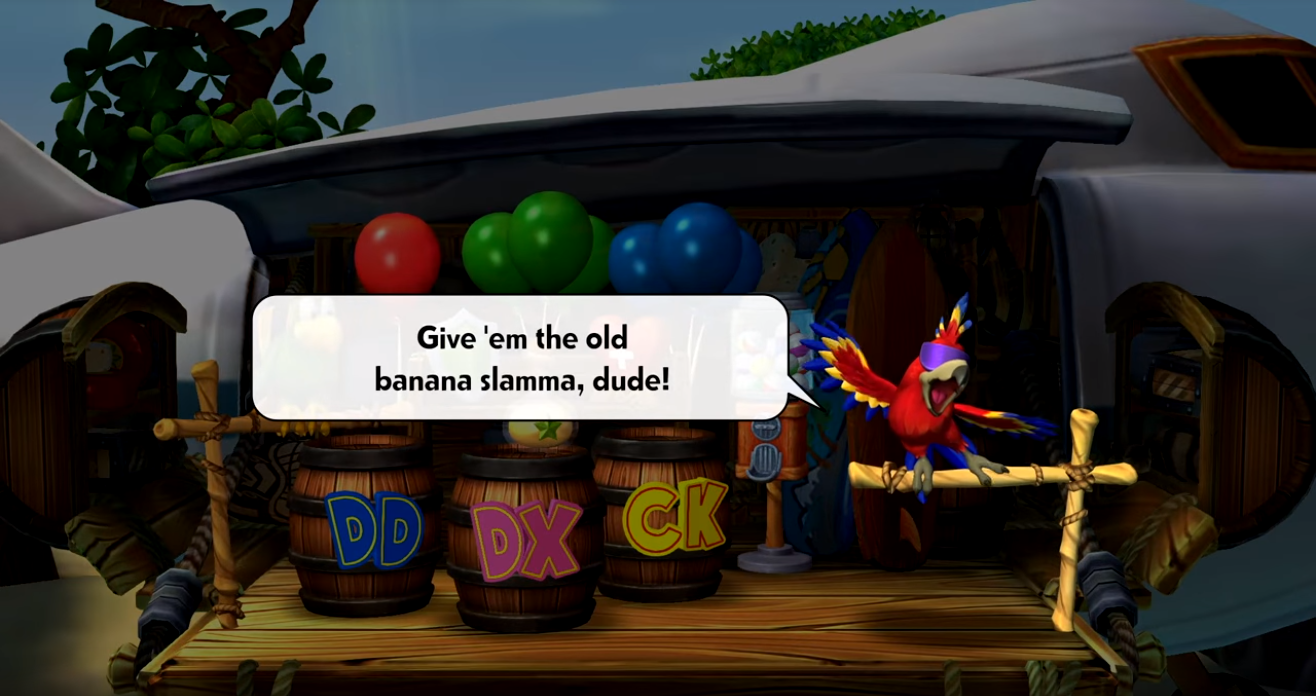
The Donkey Kong Country television series introduces a catchphrase that Donkey Kong frequently uses: "Banana slamma!". It is mostly used before DK attacks someone or if something positive happens to him. The theme song also uses the phrase. It is referenced in the Nintendo Switch port of Donkey Kong Country: Tropical Freeze by Tawks.[29]
Powers and abilities[edit]

Unlike most characters, who have some kind of special power, Donkey Kong relies mainly on his brute strength. He sometimes has the title of "The strongest of the Kongs", in spite of some Kongs like Chunky Kong and Sumo Kong being larger than Donkey Kong. In the original Donkey Kong he had a seemingly unlimited supply of Barrels, and could throw them easily. This carried on to the Donkey Kong Country games, where he can pick up and throw Barrels with ease. Also in Donkey Kong Country, he can defeat certain enemies that Diddy Kong cannot hurt with a single jump. In Donkey Kong: Jungle Beat, his strength is shown yet again, it makes him so strong that when he claps, a sound-wave is produced, which is his main attack throughout the game. In the ending of Donkey Kong Country Returns, Donkey Kong is shown to be strong enough to knock the moon out of its orbit and into the planet's atmosphere with a single punch (though the fact he was falling towards it at an alarming speed may have helped with it).
Donkey Kong also appears to either immune or highly resistant to hypnosis since the Kalimba Tiki was unable to hypnotize him when it was easily able to do so to other animals on the island. In Donkey Kong 64, he has a personal weapon, the Coconut Shooter, and has a special ability called Strong Kong which allows him to become invincible and use up more Crystal Coconuts the longer he maintains the form. Donkey Kong also has some skill with musical instruments, to the point that he can even weaponize music and song in combat. This is demonstrated in Donkey Kong 64, where Donkey Kong is talented in playing bongos and uses it to solve puzzles and attack surrounding enemies; the ability of playing bongos is also shown in the Donkey Konga games. In the Mario Strikers series, Donkey Kong is shown to wield electric powers, exerting bolts of lightning during his Super Strike and Mega Strike.
Though his size and weight may suggest otherwise, Donkey Kong is deceptively fast and agile; in Mario Strikers: Battle League, he break dances after scoring a goal and performs acrobatics while vine swinging in his victory scene. In Donkey Kong: Jungle Beat he is shown to be very proficient in hand to hand combat, delivering a vast amount of fast punches and kicks in a few seconds and is quick in countering the attacks he dodges, enabling him to contend with and defeat master martial artists like Karate Kong and Ninja Kong or physically stronger opponents like Sumo Kong. DK's speed and agility have also been consistently demonstrated throughout his appearances in the Super Smash Bros. franchise.
Relationships[edit]
Relatives[edit]

Cranky Kong is Donkey Kong's irritable and constantly rambling grandfather. He also originally had the name Donkey Kong until he turned it over to his replacement, and has not resumed the title since (with the sole exception being re-releases such as games in the Game & Watch Gallery series). He finds a way to help DK and his friends in their adventures, though it usually entails giving out advice or valuable items for a price. Although he frequently gets frustrated with DK's slow-witted nature, he does nonetheless look out and care for him. In Tropical Freeze, their relationship is shown in the most friendly; Cranky attends his grandson's birthday party, and their Kong POW shows them doing a fist bump. In the Donkey Kong Adventure, Donkey Kong works with a Rabbid counterpart of Cranky.
In the TV series, Cranky acts as a direct mentor to Donkey Kong, but still gets angry with him easily. Regardless, the two care about each other as family, as shown in "Message in a Bottle Show" where the two hugged each other (although they may be loathe to admit it at times), and Cranky even considering DK to be like a son to him, and that he loves him the most. Despite his low patience, Cranky has high faith in DK and views as the best hope for the well-being of Kongo Bongo and admits when Donkey Kong actually has a good idea.
In The Super Mario Bros. Movie, where Cranky is rather DK’s father, their relationship is less vitriolic. Cranky is shown embarrassed by DK’s showboating while the latter is deeply insecure of how his father thinks of him. Despite this, they do care for each other as Donkey Kong saves his father and many others Bowser holds captive from being lowered into lava.
Love interests[edit]
Candy Kong is one of Donkey Kong's closest friends who others believe he will marry one day, although he is not ready to settle down in Candy Kong's opinion. The Rarewhere website suggests that the two have known each other since childhood.[30] According to Super Smash Bros. Brawl, the idea of Candy being DK's girlfriend is only a rumor, which may be due to the fact Donkey Kong seems to spontaneously show romantic interest in Pauline. In Rare-developed games, DK tends to keep a framed photograph of Candy in his home. To explain Candy Kong's absence in later games, one official review of Donkey Kong Land 2 states that she broke up with Donkey Kong,[31] although the Donkey Kong 64 manual suggests otherwise.[32] In Donkey Kong Bananza, comments made by Dixie and Candy's picture being once again in DK's Tree House in the DK Island & Emerald Rush DLC suggest that they are still together.
In the TV series, Donkey Kong and Candy Kong are dating, but their affection tends to be very on-and-off. Donkey Kong is blindly in love with Candy even when she dismisses him, as she often gets angry with him for his foolishness as shown in several episodes. Candy even occasionally expresses romantic interest in Bluster Kong instead.
Friends[edit]

Diddy Kong is Donkey Kong's "little buddy" who looks up to him. Diddy Kong has gone on many adventures with his best friend (with DK showing excitement at having another adventure with his friend when selected as his ally character in Super Mario Party), and the two often look out for each other (with Diddy even saving him during the events of Donkey Kong Country 2: Diddy's Kong Quest), sharing a brotherly bond. In sports, Diddy Kong is often Donkey Kong's default partner. Diddy has rarely been suggested as a relative of DK's, though most sources do not claim that they are related.
Dixie Kong is one of Donkey Kong's closest friends, sometimes hanging out with him and Diddy Kong. She actively helped rescue him when he is kidnapped and joined him in retaking Donkey Kong Island from the Snowmads. Donkey Kong seems to act like a big brother to Dixie, similar to how he is with Diddy. He was very defensive of her when she was antagonized by a Dry Bones in Mario Super Sluggers. Dixie does show minor exasperation with DK when he is rash and stubborn, but they nonetheless have a close friendship.
Funky Kong is another one of Donkey Kong's recurring friends. The two share a good friendship, with Funky referring DK by the nickname "Donkey-dude". Though he prefers not adventuring, Funky does support Donkey Kong by giving him either transportation or weaponry, or acting as a shopkeeper.

Pauline also becomes one of Donkey Kong's closest friends during the events of Donkey Kong Bananza. While she was briefly scared of him at first after she was turned into the Odd Rock, after being saved by him, she decides to join him and becomes his friend after turning back into her human form. During the adventure, Pauline helps DK transform into the different Bananza forms to overcome the different challenges of the layers, DK helps her overcome her insecurities of performing in front of a large crowd, and both save each other from Void Kong's attacks in the later parts of the adventure. After arriving at New Donk City at the end of the adventure, DK also considers staying with her and continuing to help her to follow her dreams as a singer, but Pauline decides to let him follow his own dreams and not be tied to her all the time. Three months after the end of the main story, DK meets Pauline again and is willing to help her create a song and see her perform it at New Donk City Hall. Their friendship from Pauline's side is represented in the lyrics of the song "Breaking Through (Heart of Gold)."
Rivals[edit]

While Donkey Kong and Mario have had a rivalry for some time, the extent of it varies from game to game. In a 1994 interview with the development team of Donkey Kong for the Game Boy, series creator Shigeru Miyamoto stated that despite Mario and Donkey Kong's relationship appearing hostile in the original arcade game, it was actually intended to be much more amiable. Miyamoto elaborated that Donkey Kong was envisioned as Mario's pet, and that his decision to kidnap Pauline was purely to "get a rise out of Mario." Consequently, Donkey Kong's defeat in 100m is intended to be Mario "outwitting the prankster," with Miyamoto denying claims that the ape and plumber are meant to be enemies.[33]
In the Mario vs. Donkey Kong series, Mario and Donkey Kong's rivalry tends to be more antagonistic, though their clashes invariably end with them making amends with one another. Spinoff games, meanwhile, depict a friendlier rivalry, as implied in Super Smash Bros., and in Solid Snake's codec conversation from Super Smash Bros. Brawl. Aside from their rivalry, Donkey Kong is good friends with Mario and gets along with him and his friends in some games such as the Mario Party series. Though the current Donkey Kong is large, he is actually quite a bit younger than Mario. Although Mario did fight Donkey Kong's grandfather in the original Donkey Kong game, Cranky Kong admits that Mario is a true video game hero and even looks back at his nostalgic antics with a fond respect. Donkey Kong and Mario do not seem to hold grudges against one another in spite of their occasional conflicts. One of the evident facts about this is whenever a player lands on a DK Space in the Mario Party series, Donkey Kong will reward them with coins and stars. Other signs of Mario and Donkey Kong's friendship are how quickly Mario forgives a remorseful DK in the Mario vs. Donkey Kong series by giving him the toys, Donkey Kong being an employee of the Mini Mario Toy Company in Mario vs. Donkey Kong 2: March of the Minis,[34] and in The Super Mario Bros. Movie where they quickly become friends despite their initial rivalry and ultimately work together against Bowser's Minions.
Donkey Kong displays good friendships with characters from the Sonic franchise. He has a friendly rivalry with Knuckles the Echidna and Vector the Crocodile. During the opening of Mario & Sonic at the Olympic Winter Games, Donkey Kong, as a hockey goalie, thwarts Knuckles' shot. In Adventure Tour, Donkey Kong quickly establishes good rapport with Vector and Silver the Hedgehog. In London, Silver and Donkey Kong compete together in Volleyball, while Donkey Kong, Knuckles, and Vector work together clearing out the fog in the wrestling venues, with Vector offering a detective job to DK. In Rio games, Donkey Kong and Knuckles accuse each other of cheating after being deceived by two Miis dressed as Mario and Sonic. Following their losses in the Boxing Event, they make peace after realizing their misunderstanding. Big the Cat also invites Donkey Kong to outing. Donkey Kong has special victory animations with Knuckles and Vector in Sochi and Rio, as well as being shown flexing with Vector in Mario & Sonic at the Olympic Games Tokyo 2020.
Enemies[edit]

King K. Rool and his Kremlings are arch-enemies of Donkey Kong and the Kong Family. They have stolen DK's hoard often for unknown reasons and kidnapped him and his friends. However, Donkey Kong was willing to help a Kremling named K. Lumsy when he realized that he did not wish to harm the Kong Family. Even when the king and four colored Kritters join the Kongs to form the DK Wilds, their antagonism still shows. In Super Smash Bros. Ultimate, King K. Rool's trailer is called "The Rivals" as a reference to the enmity between him and Donkey Kong. In the show, the feud is still the same. Donkey Kong enjoys giving the Kremlings beatings, causing them to have great fear and apprehension of him.
The Tiki Tak Tribe and the Snowmads are other adversaries to Donkey Kong, who has personal grudges with the groups for stealing all the bananas on Donkey Kong Island, including the ones in his hoard, and exiling him and his friends while conquering their home, respectively.
Void Kong also becomes his enemy during Donkey Kong Bananza, with multiple fights against him and the other members of Void Company, since both wanted to reach the Planet Core and Void also wanted to kidnap Pauline to use her voice powers. In their final battle, when it seems that Void was defeated, he turns DK into stone, requiring Pauline's help to revert to his regular form.
Other relationships[edit]
Pauline was kidnapped by both the original Donkey Kong in the arcade, Game & Watch, and Game Boy games, and the current Donkey Kong in the Mario vs. Donkey Kong series. The original Donkey Kong's motive was revenge against Mario for not being a good pet owner, while the current Donkey Kong had two real different variations of the kidnapping. In March of the Minis, it was due to his perceived rejection of his feelings in favor of Mario, and took Pauline away to shower her with gifts. In Mini-Land Mayhem!, Donkey Kong just missed having the free Mini Pauline that was given to the first 100 guests of the theme park, so he takes the real Pauline instead. Although the current Donkey Kong has ultimately proven to have harmless intentions, Pauline showed constant fear of his temper and anger in Mini-Land Mayhem!. Despite this, they remain on friendly terms, and Pauline is generally key to soothing his anger issues. They are even known to work alongside each other, first in Minis March Again! where the "kidnapping" was made to test the current model of Mini Marios, and later in Tipping Stars, where Donkey Kong "kidnapped" Pauline to simply to lure Mario to a surprise party.
In the Donkey Kong Adventure story expansion pack for Mario + Rabbids Kingdom Battle, after DK, Rabbid Cranky, and Rabbid Peach manage to defeat Rabbid Kong, he turns over a new leaf after seeing the generosity from Rabbid Peach. When Rabbid Peach and Beep-0 leave for the Mushroom Kingdom, the group take multiple selfies together in honor of their newly formed friendship.
Donkey Kong also has had acquaintance with Wario. In Mario Party, they are shown doing poses and both specialize in strength. In Mario Superstar Baseball, they are on the same team. Donkey Kong even tries to give Wario a fist bump for the latter's home run, only to unintentionally pound Wario into the ground. Often, Wario has the same demeanor with Donkey Kong as he does with everyone else, but to some degree sees him as a powerful asset on his side.
Themes[edit]
- See also: Category:Donkey Kong's themes
Donkey Kong has had various musical themes associated with him throughout his history. His most recurring leitmotifs are "Title BGM" from the Family Computer version of Donkey Kong and "DK Island Swing" from Donkey Kong Country.
 Title BGM - The musical theme from the Famicom version of Donkey Kong Title BGM - The musical theme from the Famicom version of Donkey Kong | File info 0:14 |
| DK Island Swing - The musical theme from Donkey Kong Country | File info 0:30 |
History[edit]
- Main article: History of Donkey Kong
Donkey Kong has had a substantial history since his debut as the main antagonist in Donkey Kong. Like Mario and all other characters, his appearances are not limited to the core series, appearing in many spin-offs, literature, and animation.
Profiles and statistics[edit]


Donkey Kong's official profiles often characterize him as the "king of the jungle" and discuss how he is both a heroic adventurer and the laid-back leader of the DK Crew. In spinoffs he is typically a heavyweight power character with decent speed. His emblem in the spin-offs are his initials.
Gallery[edit]
- For this subject's image gallery, see Gallery:Donkey Kong.
 Donkey Kong
(American flyer)


_-_Donkey_Kong_Country_Tropical_Freeze.png)