Mario's Cement Factory
| Mario's Cement Factory | |
|---|---|
 The New Wide Screen version of Mario's Cement Factory | |
| Developer | Nintendo R&D 1 |
| Publisher | Nintendo |
| Platforms | Game & Watch, Mini Classics |
| Release dates | Game & Watch: April 28, 1983 (Table Top)[1] June 16, 1983 (New Wide Screen)[2] April 28, 1983 (Table Top)[1] June 16, 1983 (New Wide Screen)[2]Mini Classics:  1998[?] 1999[?] 1998[?] 1999[?] |
| Genres | Puzzle/Platformer |
| Mode | Single player |
| Format |
Built-in
|
| Input | |
| Serial codes | CM-72 (Table Top) ML-102 (New Wide Screen) |
- “Mario isn't risking his neck against Donkey Kong. He's up to his neck in cement!”
- —United States commercial
Mario's Cement Factory is a Game & Watch game. Two versions of the game were produced: The first was for the Game & Watch Table Top released on April 28, 1983,[1] and the second was a more conventional New Wide Screen Game & Watch that was released on June 16, 1983.[2] Mario's Cement Factory was one of the first games in the Table Top series. The Table Top game resembles an arcade cabinet, and it is more colorful than the New Wide Screen game. In both versions, Mario's mission in the Cement Factory is to open doors to prevent cement containers from overflowing. To get to the different containers, Mario has to jump onto moving platforms. The New Wide Screen version was rereleased as a Mini Classics game and is featured in the Gallery Corner in Game & Watch Gallery. It is also featured as a minigame in Game & Watch Gallery 4 with a Classic version and an updated "Modern" version. It was digitally recreated as DSiWare with the title Game & Watch: Mario's Cement Factory.
Mario's Cement Factory also appears as one of the minigames in Game Boy Gallery, though it is simply called Cement Factory and features no characters from the Super Mario franchise, and the playable character is the same unnamed character seen in the other minigames.
Gameplay[edit]
Classic version[edit]

The game has two drivers, each in a truck under a container. Mario earns a point each time he empties a load of cement from the upper hopper and two points each time he empties a load from the lower hopper. Each container can hold only three loads of cement. Allowing the containers to overflow causes cement to spill down onto the drivers, hurting them and giving Mario one miss. Falling off an elevator platform also earns a miss, as well as touching the very top of the screen and getting crushed by an elevator platform, or touching the very bottom and getting shocked by the floor of the elevator. In all versions of the game, Mario can use an area on the lowermost portion of the elevator to save himself from touching the very bottom and getting shocked. On the Table Top and Game Boy Gallery versions, there is a similar area on the uppermost portion of the elevator. This does not appear on any other version of the game. If Mario gets 300 points without any misses, the points will be worth double until he does get a miss. If he has any misses at said score, all misses will be cleared instead. When he receives three misses, the game is over.
Modern version[edit]

The Modern version of the game has Mario working in a cookie factory. Yoshi and Toad are featured instead of the drivers, with Yoshi eating the Yoshi Cookies made on the left conveyor belt and Toad packaging the Yoshi Cookies made on the right conveyor belt. Boos also occasionally appear, taking up space in cookie dough slots on the second floor. Unlike in Classic Mode, however, Mario is allowed to fall down onto an elevator platform, but touching the very bottom or top still earns the player a miss. When Mario amasses 200, 500, and 700 points, a heart appears for him to remove a miss. Music is also featured in this version, with the tempo changing depending on the speed of the game.
Selecting the game without starting it also results in a humorous sequence being played. In particular, Yoshi and Toad are putting cookie batter on a conveyor belt each, only for Toad's batter to get stolen by a Boo, causing him to cry, and then the Boo drops the batter on Yoshi, with it being a large enough quantity that Yoshi is engulfed save for the eyes, while the Boo sticks out his tongue in a taunting manner as Yoshi is baffled at the entire situation.
Controls[edit]
 : Move
 and
and  : Open
Gallery[edit]
It has been requested that more images be uploaded for this section. Remove this notice only after the additional images have been added. Specifics: All sprites and sprite animations
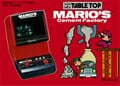 Table Top box
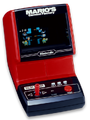 Table Top version
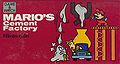 Box art for the New Wide Screen version
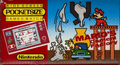 Alternate box art for the New Wide Screen version
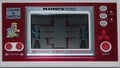 Mitubishi version
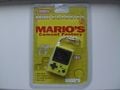 Mini Classics version
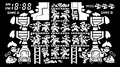 LCD pattern
 Alarm man (Table Top)
 Alarm bell (New Wide Screen)
 Mario in the Table Top version's TV commercial
 A sprite of the drivers


Modern version[edit]
 Mario
Mario Switch


Game Boy Gallery (Cement Factory)[edit]
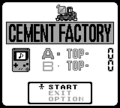 Mode select
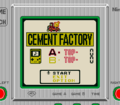 Mode select (Super Game Boy)
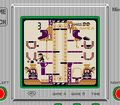 Gameplay (Super Game Boy)


References in later games[edit]
- Super Smash Bros. series
- Mr. Game & Watch has an attack that involves him grabbing opponents with a similar pose to how Mario grabs levers in this game.
- Mr. Game & Watch appears in Working Dough, where he is posed similarly to the lever-grabbing animation from this game.
- While cutting through a work site in Brooklyn, Mario and Luigi pass by a sign that depicts a construction worker stylized after the drivers in this game.
Names in other languages[edit]
| Language | Name | Meaning | Note(s) | Ref. |
|---|---|---|---|---|
| Japanese | マリオズ・セメントファクトリー Mariozu Semento Fakutorī | Mario's Cement Factory | [3] | |
| German | Cement Factory | - | [4] | |
| Italian | Mario nella Fabbrica di Cemento | Mario in the Cement Factory | [5] |
Notes[edit]
- Early models of the Table Top version of Mario's Cement Factory used a slightly faster rearrangement of the bass riff from "Another One Bites the Dust", a song released in 1980 by the British rock band Queen, for the game start jingle.[6] This was replaced in a later revision with an original jingle.[7] An update of this jingle reappears in the Game Boy Gallery version.[8]
References[edit]
- ^ a b Mario's Cement Factory. In The Attic (British English). (Archived September 28, 2021, 07:15:07 UTC via Wayback Machine.)
- ^ a b Mario's Cement Factory. In The Attic (British English). (Archived February 19, 2020, 13:28:35 UTC via Wayback Machine.)
- ^ Nintendo Game & Watch History
- ^ WorldOfSuperNintendo (October 28, 2012). Game Boy Gallery Commercial GER. YouTube. Retrieved August 11, 2025.
- ^ Game&Watch OTO and Giochi Preziosi FAQ, list of Italian Game & Watch games. gameandwatch.ch, retrieved on January 22, 2024.
- ^ Old80s: Retro Stuff And More (January 15, 2020). Game & Watch: Mario's Cement Factory (Table Top, CM-72) (Another One Bites The Dust) (1983 Nintendo). YouTube (English). Retrieved May 14, 2022. (Archived June 6, 2024, 15:52:33 UTC via Wayback Machine.)
- ^ Old80s: Retro Stuff And More (January 21, 2022). Game & Watch: Mario's Cement Factory (Table Top, CM-72A) (Alternate) (1983 Nintendo). YouTube (English). Retrieved May 14, 2022. (Archived August 10, 2024, 00:46:19 UTC via Wayback Machine.)
- ^ All Nintendo Music (November 18, 2019). GameBoy Gallery Complete Soundtrack. YouTube (English). Retrieved May 14, 2022. (Archived March 30, 2023, 22:47:20 UTC via Wayback Machine.)
External links[edit]


- Info page for the Table Top version of Mario's Cement Factory on In the Attic, a website dedicated to classic videogames (Internet Archive: Wayback Machine)
- Info page for the New Wide Screen version of Mario's Cement Factory on In the Attic (Internet Archive: Wayback Machine)