Wii
This article needs console improvement. Specifically:
- Document the Wii Fun Center by Starlight
- Not to be confused with Wii U.
| Wii | |
|---|---|
 Official logo  The original model of the Wii | |
| Generation | Seventh generation |
| Release dates | Wii: November 19, 2006[1] November 19, 2006[1] December 2, 2006[2] December 2, 2006[2] December 6, 2006[3] December 6, 2006[3] December 7, 2006[4] December 7, 2006[4] December 8, 2006[5] December 8, 2006[5] December 8, 2006[6] December 8, 2006[6] September 20, 2007[7] September 20, 2007[7] September 28, 2007[8] September 28, 2007[8] March 26, 2008[9] March 26, 2008[9] April 26, 2008[10] April 26, 2008[10] July 12, 2008[11] July 12, 2008[11]Wii Family Edition: October 23, 2011[12] November 4, 2011[13] November 11, 2011[?]Wii mini:  December 7, 2012[14][15] March 22, 2013[16][17] November 17, 2013[18][19] December 7, 2012[14][15] March 22, 2013[16][17] November 17, 2013[18][19] |
| Discontinued | Wii (original): October 23, 2011[?] November 4, 2011[?] November 11, 2011[?] Wii (overall): October 20, 2013[20]Wii Family Edition: October 21, 2013[21] October 21, 2013[?] October 21, 2013[?]Wii mini:  2017[?] 2017[?] |
| Predecessor | Nintendo GameCube |
| Successor | Wii U |
- “Wii would like to play”
- —Advertisement slogan for the Wii
The Wii is a home video game console created by Nintendo as the successor to the Nintendo GameCube. It was released in North America on November 19, 2006, for $249.99. It was then released in Japan on December 2, 2006; Brazil on December 6, 2006; Oceania on December 7, 2006; and Turkey and Europe on December 8, 2006. Nintendo planned to release the system in China under the iQue name, but this ultimately did not happen. This is one of three Nintendo game consoles sold in North America before Japan, the others being the original Nintendo DS and the Wii U. Before the Wii's final name was announced on April 27, 2006, the console was codenamed "Revolution".
Like the Nintendo GameCube, the Wii uses proprietary optical discs based on the DVD format. Unlike with its predecessor, however, Wii game discs are a standard 12 cm (approx. 4.72 in.) in diameter rather than 8 cm (approx. 3.15 in.), which allows them to hold more memory than the GameCube discs: up to 4.37 GB for single-layered discs, and up to 7.92 GB for dual-layered discs. However, the Wii is backwards compatible with most Nintendo GameCube games, featuring four GameCube controller ports and two GameCube memory card slots on the top of the unit, making it the first Nintendo home console to be backwards compatible with its predecessor. The Wii lacks the GameCube's support for digital audio & video output, but it retains progressive scan support over component cables with compatible games (including all games related to the Super Mario franchise other than NBA Street V3 and WarioWare, Inc.: Mega Party Game$!). Under this configuration, the prompt to enable progressive scan automatically appears on startup (unlike with the GameCube, which required the player to hold  during boot-up).
The system had integrated Nintendo Wi-Fi Connection functionality, enabling players to interact with other players around the world while playing certain games, such as Mario Kart Wii.
Although the Nintendo GameCube was the first Nintendo home console since the Family Computer not to have a game from the Super Mario series at launch, the Wii is the first home console not to have a game from the Super Mario franchise as a launch title (except in Japan). The Wii's first Super Mario-related game is WarioWare: Smooth Moves, which came out on December 2, 2006, in Japan as a launch title; January 12, 2007, in Europe; January 15, 2007, in North America; and January 25, 2007, in Oceania. The first Super Mario game for the Wii starring Mario is Super Paper Mario, except in Europe and Oceania, where Mario Strikers Charged was the first game instead.
In 2012, the Wii was succeeded by the Wii U, which can still play Wii games and utilizes controllers with backwards compatibility.
Since May 20, 2014, the Nintendo Wi-Fi Connection service has shut down, discontinuing online play for games that used it.[22]
Revisions[edit]
Wii Family Edition[edit]


The Wii Family Edition (RVL-101) was announced on August 17, 2011. This model is designed to only sit horizontally (with the buttons changed accordingly) and is incompatible with the Nintendo GameCube's software and its accessories. This model was released in North America on October 23, 2011 and in Europe on November 4, 2011 in order to replace the older model and stop its production. The Wii Family Edition includes a black console, the game New Super Mario Bros. Wii, and the Super Mario Galaxy Original Soundtrack. The Wii Family Edition's release in North America was not originally intended to replace the older version of the Wii.[23]
Wii mini[edit]

The Wii mini (RVL-201)[24] was announced on November 27, 2012. As its name suggests, the Wii mini is the smallest model of the Wii. Like the Wii Family Edition, it is missing some features such as the backward compatibility with Nintendo GameCube and its accessories. It also lacks online features and several built-in channels, such as the Photo Channel and the Weather Channel, similar to the Wii Mode on the Wii U. It also can only sit horizontally. The main feature is its notable redesign. Unlike the original Wii or the Wii Family Edition which are mostly white, the Wii mini is black with a red framing. All the buttons are located on the top of the console, there are no SD card slots, and it lacks online support for Wii games. Additionally, the Wii mini has a manually operated top-loading disc drive (similar to the GameCube) instead of the slots that former models have. The console launched in Canada on December 7, 2012 for $99.99.[14][15] It was then released in Europe on March 22, 2013 at a cost of at least £79.99.[16][17] It was launched in North America on November 17, 2013 bundled with a red Wii Remote Plus and a red Nunchuk for $99.99.[18][19] The Wii mini is the third home Nintendo console since the SNES and NES to receive a redesign right after its respective successors launched though the NES 101 model launched 2 years after the SNES launched. The N64 received no redesigns of any kind, and the GameCube had a small revision that lacked the unused Serial Port 2 (though the cover still remains) and the unpopular Digital AV Out port.
Peripherals[edit]
Wii Remote[edit]
- NintendoWiki article: Wii Remote

The Wii Remote (also known as the Wiimote) is the standard game controller for the Wii. It has a rectangular shape, resembling a television remote, making it unique from other consoles' controllers. It consists of several buttons (one behind ( )) and a directional pad (
 ) as well. The Wii Remote also has a power button (
 ), which can be used as a remote to either turn the Wii console on or off, rather than pressing the power button on the machine itself. When held horizontally, its button layout is similar to that of an NES controller, with the
  ,
,  ,
,  and
and  buttons taking the functions of
  ,
,  ,
,  and
and  , respectively; an example of this is New Super Mario Bros. Wii, mimicking the control scheme of the NES Super Mario platformers with the Wii Remote held sideways. The Wii Remote can be used for NES Virtual Console games but not for SNES and N64 Virtual Console games because the Wii Remote cannot be mapped to emulate an SNES or N64 controller properly.
Buttons[edit]

- Names in other languages
| Language | Name | Meaning | Note(s) | Ref. |
|---|---|---|---|---|
| Japanese | Wiiリモコン Wii Rimokon | Wii Remote Control | [25] | |
| Dutch | Wii-afstandbediening | Wii Remote | [26] | |
| French (Canada) | Wii Remote | - | [27] | |
| Télécommande Wii | Wii Remote | [28] | ||
| French (Europe) | Télécommande Wii | Wii Remote | [26] | |
| German | Wii-Fernbedienung | Wii Remote | [26] | |
| Italian | Telecomando Wii | Wii Remote | [29] | |
| Portuguese | Comando Remoto Wii | Wii Remote Control | [29] | |
| Spanish (Latin America) | Wii Remote | - | [30] | |
| Control Remoto Wii | Wii Remote Control | [28] | ||
| Spanish (Europe) | Mando de Wii | Wii Remote | [29] |
Wii Remote Plus[edit]


The Wii Remote Plus is an upgraded version of the Wii Remote, which includes the Wii MotionPlus attachment's system incorporated in the controller. The Wii Remote Plus was shown in the Nintendo's conference of September 2010, and is available in white, black, pink, cyan, and red colors. It was released in Europe on November 5, 2010, in North America on November 7, 2010, and in Japan on November 11, 2010.[citation needed]
Mario & Sonic at the Sochi 2014 Olympic Winter Games for the Wii U was the only game of the Super Mario franchise to ever use the Wii MotionPlus.
- Names in other languages
| Language | Name | Meaning | Note(s) | Ref. |
|---|---|---|---|---|
| Japanese | Wiiリモコンプラス Wii Rimokon Purasu | Wii Remote Control Plus | [25] | |
| Dutch | Wii-afstandbediening Plus | Wii Remote Plus | [26] | |
| French (Canada) | Wii Remote Plus | - | [27] | |
| French (Europe) | Télécommande Wii Plus | Wii Remote Plus | [26] | |
| German | Wii-Fernbedienung Plus | Wii Remote Plus | [26] | |
| Italian | Telecomando Wii Plus | Wii Remote Plus | [29] | |
| Portuguese | Comando Remoto Wii Plus | Wii Remote Control Plus | [29] | |
| Russian | Пульт Wii Plus Pul't Wii Plus | Wii Remote Plus | [31] | |
| Spanish (Latin America) | Wii Remote Plus | - | [30] | |
| Spanish (Europe) | Mando de Wii Plus | Wii Remote Plus | [29] |
Nunchuk[edit]
- NintendoWiki article: Nunchuk

The Nunchuk is the main attachment to the Wii Remote. Upon buying a Wii, one Wii Remote and one Nunchuk are included. It consists of two buttons ( and
and  ) along with an analog stick (
 ). Like the Wii Remote, the Nunchuk also includes motion sensors. It is named as such because of the similarity in appearance to nunchaku when being used together with the Wii Remote.
- Names in other languages
| Language | Name | Meaning | Note(s) | Ref. |
|---|---|---|---|---|
| Japanese | ヌンチャク Nunchaku | Nunchuk | [25] | |
| Chinese (Simplified) | 拿趣酷 Náqùkù (Mandarin) Nàhcheui'houh (Cantonese) | Transliteration of "Nunchuk"; also means "To hold Fun and Cool" | [32] | |
| Chinese (Traditional) | 雙截棍控制器 Shuāngjiégùn Kòngzhìqì (Mandarin) Sēungjihtgwan Hungjai'hei (Cantonese) | Nunchuk Controller | [33] |
Buttons and Stick[edit]
- C ()
- Z ()
- Control Stick ()
Classic Controller[edit]
- NintendoWiki article: Classic Controller

The Classic Controller is an extension or accessory for the Wii Remote. Besides the two analog sticks, the button layout resembles that of the Super Nintendo Entertainment System's controller. The Classic Controller must be used to play SNES and N64 Virtual Console games such as Super Mario World and Super Mario 64. Some Wii games, such as Super Smash Bros. Brawl and Mario Kart Wii are compatible as well.
Just as the Nintendo GameCube was codenamed Dolphin and the Wii was codenamed Revolution, the Classic Controller was codenamed Shell.[34]
- Names in other languages
| Language | Name | Meaning | Note(s) | Ref. |
|---|---|---|---|---|
| Japanese | クラシックコントローラ Kurashikku Kontorōra | Classic Controller | [25] |
Classic Controller Pro[edit]
- NintendoWiki article: Classic Controller Pro


The Classic Controller Pro is an enhanced version of the Classic Controller, listed on Nintendo's Japanese website on February 26, 2009. This revision features the  and
and  buttons as full-fledged shoulder buttons, like the
  and
and  buttons on the Nintendo GameCube controller, as well as added controller grips. However, the
  and
and  buttons are no longer pressure-sensitive, unlike with the original Classic Controller. The controller is also slightly bigger than its old revision. The Classic Controller Pro was released in Japan on August 1, 2009 in both black and white colors. It was subsequently released in Europe and North America in November 2009[35] and April 2010[36] respectively (though only in black in Europe).
- Names in other languages
| Language | Name | Meaning | Note(s) | Ref. |
|---|---|---|---|---|
| Japanese | クラシックコントローラ PRO Kurashikku Kontorōra PRO | Classic Controller PRO | [25] |
Buttons and Sticks[edit]
- a (
 )
) - b (
 )
) - y (
 )
) - x (
 )
) - +Control Pad ()
- Left Control Stick (
 )
) - Right Control Stick (
 )
) - L ()
- R ()
- ZL ()
- ZR ()
- + ()
- - ()
- Home (
 )
)
Wii Balance Board[edit]
- NintendoWiki article: Wii Balance Board
- This section is about the peripheral. For the character from the Wii Fit series, see Crossovers with Wii § Wii Balance Board.


The Wii Balance Board is a controller for the Wii that is used for various games, most prominently in Wii Fit. The Balance Board, unlike the Nunchuk or Classic Controller, acts as a separate controller and does not need to be connected to the Wii Remote. The Board is capable of measuring the weight, balance, and movement of the player that is using it. The only Super Mario game that ever used the Wii Balance Board was Mario & Sonic at the Olympic Winter Games. A costume of a Wii Balance Board appears in Super Mario Maker.
- Names in other languages
| Language | Name | Meaning | Note(s) | Ref. |
|---|---|---|---|---|
| Japanese | バランスWiiボード Baransu Wii Bōdo | Balance Wii Board | [37] |
Wii Wheel[edit]

The Wii Wheel is an accessory for the Wii that resembles a car steering wheel and is designed for Mario Kart Wii. One Wii Wheel is packaged with Mario Kart Wii, but more can be bought separately. The Wii Wheel is used to assist in holding the remote and may help players control the game more easily. The Wii Wheel does not connect to the Wii or Remote in any way and is used to only hold the Remote. Because of this, if only the Wii Remote is held sideways (without the Wheel) on Mario Kart Wii, it still shows that a wheel is being used.
- Names in other languages
| Language | Name | Meaning | Note(s) | Ref. |
|---|---|---|---|---|
| Japanese | Wiiハンドル Wii Handoru | Wii Steering Wheel | [38] |
Prototypes[edit]
The first prototype was made when Nintendo was trying to discover the best position to put the Wii Remote. Since Nintendo could not decide where the button would be used, there was nothing on the back. For the second prototype, Nintendo examined real go-kart wheels, and the company discovered that they are usually more square than round. The third prototype was the basis for the final Wii Wheel. This prototype had a window for using the Wii Menu and a hole for the button. The fourth prototype had a button in the Wii Wheel itself, so a child’s finger could reach. Finally, the fifth prototype had a two-tone color scheme. A pure white color scheme was eventually decided on to match the Wii Zapper and the Wii Balance Board. Kenichiro Ashida made two Wii Wheels to show at the "Iwata Asks" interview on Mario Kart Wii.
Gallery[edit]
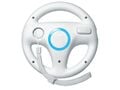 Back of Wii Wheel
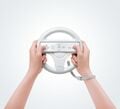 Wii Wheel being held by a pair of hands
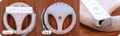 First prototype
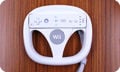 Second prototype
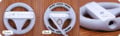 Third prototype
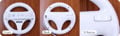 Fourth prototype
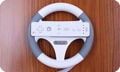 Fifth prototype
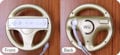 Gold
Gold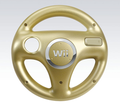 Gold
Gold


