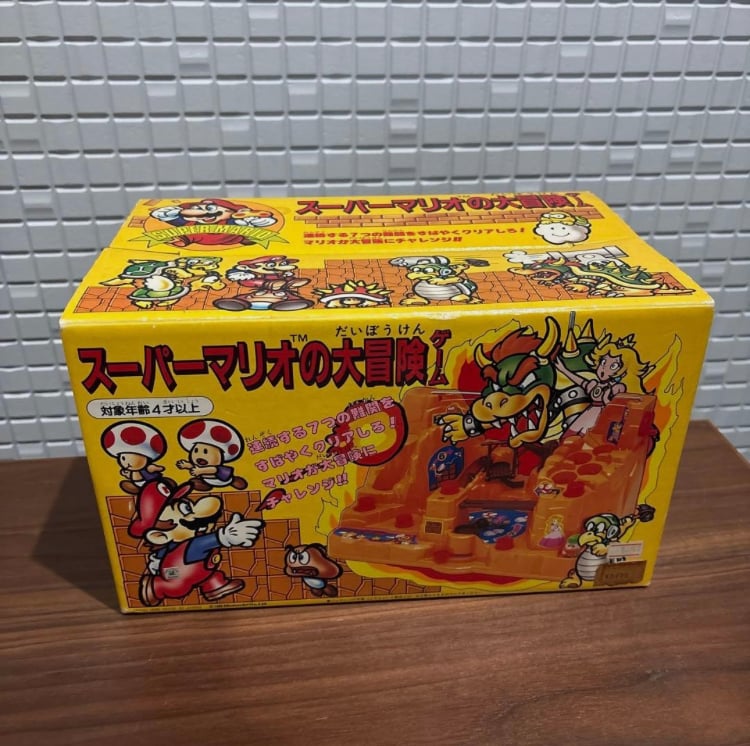
Super Mario no Daibōken Game
The title of this article is official, but it comes from a Japanese source.
If an acceptable English name is found, then the article should be moved to the new title.
| Super Mario no Daibōken Game | |
|---|---|

| |
| Manufacturer | Bandai |
| Publisher | Bandai |
| Release date |  1986[1] 1986[1] |
| Language | Japanese |
| Number of players | One player |
Super Mario no Daibōken Game is a board game released by Bandai in 1986.[1] The game comes with Mario and Luigi playing pieces with magnets on top of them.
Gameplay[2][edit]
The player moves the Bowser piece to the top of the flagpole and moves it, slowly reaching the bottom. The player then places Mario or Luigi on the left of the gameboard represented by a Goomba with the number "1" below it. The player must push the button with the corresponding number on it hard enough to guide the playing piece to the second area, which is represented by a Lakitu. The player presses the same button to connect the player to the magnet. The magnet moves on a metal pole connected to string by turning the crank on the right. The player has to move it slowly so the playing piece does not fall. This leads to the third area represented by a Hammer Bro. The player must push the number 3 button to have the playing piece hop from one hole to the next. The fourth area is represented by a Cheep Cheep. Here, the player has to turn the number 4 knob to make the logs role and the playing piece to move, while making sure the piece does not fall until it reaches the end. The fifth area is represented by Bloobers. The player has to move the number 5 key to turn the basket the playing piece is on to the sixth area. The player has to make sure the playing piece does not fall out during this process. The sixth area is represented by a Koopa Paratroopa. Here, the player has to turn the number 6 knob to turn the spiral (mimicking the staircases near the Goal Poles in Super Mario Bros.) which causes the playing piece to elevate to the final area, represented by a Buzzy Beetle. The player turns the number 7 knob to move the chair towards the slide before Bowser reaches the bottom of the flagpole and blocks the entrance. The slide leads to the finish, where Princess Toadstool is.
Game contents[edit]
- 1 gameboard
- 2 playing pieces
- 1 flagpole
Gallery[edit]
 Back of the box

Names in other languages[edit]
| Language | Name | Meaning | Note(s) | Ref. |
|---|---|---|---|---|
| Japanese | スーパーマリオの Sūpā Mario no Daibōken Gēmu | Super Mario's Great Adventure Game | [3] |
Notes[edit]
- There exists a similar Adventure Island–themed board game also made by Bandai with identical gameplay.[4]
- In the fifth area, there are coins with a unique design on them, with a mushroom and text reading "Kinoko".