Mask Gate (boss)
| Mask Gate | |
|---|---|
 Artwork from Super Mario-kun volume 8 | |
| Species | Living Mask Gate |
| First appearance | Yume Kojo: Doki Doki Panic (1987, overall) Super Mario Bros. 2 (1988, Super Mario franchise) |
| Latest appearance | Nintendo World Championships: NES Edition (player icon cameo) (2024) |
| Member of | 8 bits |
The Mask Gate is a boss appearing in Yume Kojo: Doki Doki Panic and Super Mario Bros. 2. It is a living Mask Gate that guards the entrance to the room where Wart and the Dream Machine are. The Mask Gate initially disguises itself as a common Mask Gate, but it begins to attack the player character after they try to enter on it.
History[edit]
Super Mario Bros. 2 / Yume Kojo: Doki Doki Panic[edit]

The Mask Gate first appears in Yume Kojo: Doki Doki Panic where, like the common Mask Gates, it resembles a kabuki theater mask instead of the bird-like head. In Super Mario Bros. 2, its design was altered to that of a bird's along with normal Mask Gates. The Mask Gate appears in Wart's Castle, more specifically World 7-2, where it appears in the penultimate room, pretending to be a normal Mask Gate. By picking up the Crystal Ball present in the room, the Mask Gate detaches itself from the wall and then starts chasing the player around in a similar manner to Phanto. It takes away a small heart from the player upon contact. The player must attack the Mask Gate by throwing Mushroom Blocks (masks in Yume Kojo: Doki Doki Panic) in the vicinity; after the player throws three Mushroom Blocks at it, the Mask Gate is temporarily stunned, allowing entry into Wart's throne room. However, if the player does not enter into the Mask Gate while it is stunned, it eventually reanimates itself and resumes attacking, forcing the player to throw three more Mushroom Blocks at it.
Super Mario-kun[edit]

In stage 5 of volume 8 of Super Mario-kun, the Mask Gate appears in Wart's Castle. When Mario tries to enter it, the Mask Gate starts attacking by flying and plunging at the heroes. Yoshi is eaten by the Mask Gate and, while struggling to not get chewed, Mario tosses a Mushroom Block found in the room at him. The Mushroom Block lands right in Yoshi's mouth, transforming him into Kinoko Block Yoshi, who becomes thick enough to block the Mask Gate's beak. The heroes then enter the Mask Gate without the risk of being chewed.
Gallery[edit]
 Sprite from Yume Kojo: Doki Doki Panic
 Sprite from Super Mario Bros. 2
 Sprite from Super Mario All-Stars
 Sprite from Super Mario Advance
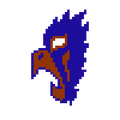 Player icon sprite from Nintendo World Championships: NES Edition
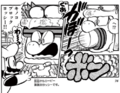 Super Mario-kun volume 8


Names in other languages[edit]
| Language | Name | Meaning | Note(s) | Ref. |
|---|---|---|---|---|
| Japanese | マスクゲート Masuku Gēto | Mask Gate | [1][2] | |
| ゲート Gēto | Gate | [3] | ||
| Italian | Mask Gate | - | Super Mario Bros. Encyclopedia (first edition) | [4] |
| Testa di Falco | Falcon Head | Super Mario Bros. Encyclopedia (second edition) | [5] | |
| Spanish | Mask Gate | - | [6] |
References[edit]
- ^ 「スーパーマリオコレクション任天堂公式ガイドブック」 (Super Mario Collection Nintendo Kōshiki Guidebook). Shogakukan (Japanese). Page 154. Retrieved from Imgur.
- ^ Sakai, Kazuya (Ambit), kikai, Akinori Sao, Junko Fukuda, Kunio Takayama, and Ko Nakahara (Shogakukan), editors. (October 19, 2015). 『スーパーマリオブラザーズ百科: 任天堂公式ガイドブック』. Tokyo: Shogakukan (Japanese). ISBN 978-4-09-106569-8. Page 68.
- ^ 1994. Perfect Ban Mario Character Daijiten (Japanese). Page 225.
- ^ Sakai, Kazuya (ambit), kikai, Akinori Sao, Junko Fukuda, Kunio Takayama, Ko Nakahara (Shogakukan), and Marco Figini, editors (2018). Super Mario Bros. Enciclopedia. Translated by Marco Amerighi. Milan: Magazzini Salani (Italian). ISBN 889367436X. Page 68.
- ^ Sakai, Kazuya (ambit), kikai, Akinori Sao, Junko Fukuda, Kunio Takayama, Ko Nakahara (Shogakukan), and Marco Figini, editors (2025). "Super Mario Bros. 2" in Super Mario Bros. Enciclopedia (2nd ed.). Translated by Alessandro Apreda. Milan: Magazzini Salani (Italian). ISBN 979-1259575760. Page 68.
- ^ Sakai, Kazuya (ambit), kikai, Akinori Sao, Junko Fukuda, Kunio Takayama, and Ko Nakahara (Shogakukan), editors (2017). Enciclopedia Super Mario Bros. 30ª Aniversario. Translated by Gemma Tarrés. Barcelona: Editorial Planeta, S.A. (European Spanish). ISBN 978-84-9146-223-1. Page 68.

