Game Boy
- This article is about the handheld video game system. For other uses, see Game Boy (disambiguation).
- "GB" redirects here. For the character in WarioWare, Inc.: Mega Microgame$!, see GB (character).
| Game Boy | |
|---|---|
 Official logo  Original model of the Game Boy | |
| Generation | Fourth generation |
| Release dates |  April 21, 1989[1] April 21, 1989[1] July 31, 1989[1] July 31, 1989[1] September 28, 1990[2] September 28, 1990[2] 1991[3] 1991[3] May 2, 1991[4] May 2, 1991[4] 1992[5] 1992[5] 1994[3] 1994[3] 1994[3] 1994[3] 1994[3] 1994[3] 1994[3] 1994[3] 1994[3] 1994[3] April 14, 1994[6] April 14, 1994[6] November 14, 1994[3] November 14, 1994[3] |
| Discontinued |  March 23, 2003[7] March 23, 2003[7] |
| Predecessor | Game & Watch |
| Successors | Virtual Boy Game Boy Color |
- “Now you're playing with power. Portable power.”
- —The Game Boy slogan
The Game Boy (officially abbreviated as GB, and rebranded as the Hyundai Mini Comboy in South Korea) is an 8-bit portable video game system by Nintendo, first released in 1989 in Japan and North America, and in 1990 in most of Europe, succeeding the Game & Watch line of handhelds. It was developed by Nintendo Research & Development 1, under the leadership of Gunpei Yokoi and Satoru Okada. Codenamed "Dot Matrix Game" (abbreviated as DMG in internal names and serial codes),[8] the Game Boy features a 4-color monochrome dot-matrix display, interchangeable ROM-based game cartridges, a speaker and headphone jack, and multiplayer functionality via the Game Link Cable accessory, setting it apart from the LCD-based visuals and simplistic gameplay of the Game & Watch line.
The Game Boy can be likened to a portable version of the Family Computer or Nintendo Entertainment System with its use of cartridges, tile-based graphics, and its identical control scheme of four buttons and a four-way directional pad. Several revisions of the Game Boy were introduced through its life, including various "Play It Loud!" color variants, the smaller Game Boy Pocket, and the Japan-exclusive backlit Game Boy Light. An official accessory called the Super Game Boy was also released for the Super Nintendo Entertainment System, allowing Game Boy games to be played on a TV. The system and its revisions were a great financial success for Nintendo, selling over 59.89 million units before the introduction of its successor, the Game Boy Color,[9] and would go on to become a cultural icon of the 1990s. The original Game Boy would not be discontinued until 2003.
Many games in the Super Mario franchise were released for the Game Boy. Notably, Super Mario Land was initially planned to be the system's pack-in game; however, Tetris was chosen instead, on the suggestion of Bullet-Proof Software's Henk Rogers to Minoru Arakawa, then-president of Nintendo of America, believing it would have wider appeal.[10] The Game Boy itself has also made numerous appearances and cameos in Super Mario games.
Various Game Boy software was made available digitally for the Nintendo 3DS's Virtual Console service from its launch in June 2011 until its discontinuation on March 27, 2023. Game Boy games have also been made available on the Nintendo Switch Online service for Nintendo Switch and Nintendo Switch 2 via the Game Boy – Nintendo Classics application, launched on February 8, 2023.
Hardware specifications[edit]
- CPU: Sharp SM83 (custom Intel 8080/Zilog Z80 hybrid, 8-bit CMOS) @ 4.194304 MHz
- Memory: 8 KB Work RAM, 8 KB Video RAM, 256 B "Bootstrap" ROM, 127 B High RAM
- Maximum Resolution: 160 x 144 pixels
- Colors: Grayscale (four shades of gray; olive green in some cases)
- Maximum sprite size: 8 x 16 pixels
- Maximum number of sprites on screen: 40 sprites, 10 per scanline
- Minimum/Maximum cart size: 256 Kbit - 16 Mbit
- Sound: 4 channels (2 pulse waves, 1 wave channel and 1 white noise channel)
Compatibility[edit]
The Game Boy is unique in that some games for the Game Boy Color are also playable on original Game Boy units; such games were released on black cartridges, such as Wario Land II and Game & Watch Gallery 3. Game Boy Color games released on clear cartridges, such as Super Mario Bros. Deluxe and Mario Tennis, cannot be played on original Game Boy units, and attempting to causes the game to display a message stating that it is playable only on the Game Boy Color.
| Example Cartridge | Usual Color | Game Boy mode | Compatible | |
|---|---|---|---|---|
| Original Game Boy cartridge | 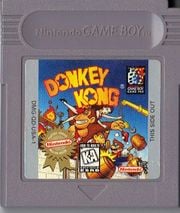
|
Gray |  |
|
| Game Boy Color cartridge (Black) | 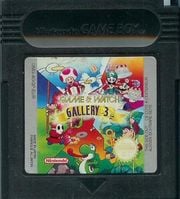
|
Black | |
|
| Game Boy Color cartridge (Clear) | 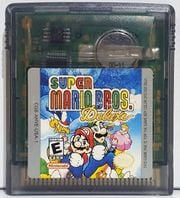
|
Clear |  |
|
Accessories[edit]
Game Link Cable[edit]
- NintendoWiki article: Game Link Cable

There is a Game Link Cable accessory that allows for two Game Boys to connect with each other. It is used by several Super Mario games, such as Dr. Mario and Super Mario Bros. Deluxe. A 4-player version of the accessory exists for games that can take advantage of this accessory. Not to be confused with Game Boy Advance's method of doing so. To communicate with later models, such as the Game Boy Pocket or Game Boy Color, a special adapter needs to be used (model MGB-004).
Game Boy Camera[edit]
- Main article: Game Boy Camera

This accessory transforms the Game Boy into a very primitive monochrome digital camera.
Game Boy Printer[edit]
- NintendoWiki article: Game Boy Printer
- Bulbapedia article: Game Boy Printer

This accessory allows the ability to make prints of images on special thermal paper. Game Boy Printer connects to the Game Boy via Game Link Cable. The main accessory to use this accessory, as well as the only cartridge for the original Game Boy models to use it that was related to the Super Mario franchise, was the Game Boy Camera. The only dedicated Super Mario games that used it, Super Mario Bros. Deluxe and Donkey Kong Country, were Game Boy Color games without support for older Game Boy models. Both Mario Artist: Paint Studio and Mario Artist: Communication Kit have hidden code that would allow images to be printed on the Game Boy Printer or unreleased Game Boy Printer Color when connected to them through the similarly unreleased 64GB Cable.[11]
GB Memory Cartridge[edit]
- Main article: Nintendo Power (cartridge)

Only in Japan, the GB Memory Cartridge is a rewritable version of regular cartridges, through kiosks at retail stores between 1997-2007.
Remodels[edit]
Super Game Boy[edit]
- Main article: Super Game Boy

The Super Game Boy is not an actual system; rather, it is a Super Nintendo cartridge that one could insert Game Boy cartridges into, thus enabling people to play Game Boy games on their television screens through the Super Nintendo. Certain games have additional colors that can only be seen while played on a Super Game Boy. Donkey Kong has a special color palette designed for the Super Game Boy, as well as a special border designed to resemble the original arcade cabinet. Game Boy Color games with black cartridges can be played on the Super Game Boy. These features are not available on the 3DS versions due to using a Game Boy emulator rather than a SNES emulator.
Game Boy Pocket[edit]

The Game Boy Pocket is the second system of the Game Boy line. As the name implies, it is a pocket-sized Game Boy with its same features, and it was lighter in weight, with a clearer, more monochrome screen and a longer battery life. It requires two AAA batteries rather than four AA batteries in order to play games. The first release had no battery light indicator and it was rapidly replaced with a second release with the battery light due to customer complaints. The second release made its way into markets in several different colors (red, blue, green, yellow, black, etc.). It was released on July 21, 1996.[1] This remodel was codenamed "Mini Game Boy" (abbreviated as "MGB" in internal names and serial codes).[12]
Game Boy Light[edit]

The Game Boy Light is the third system in the Game Boy line. It was released only in Japan on April 14, 1998, since Nintendo was more focused on releasing the Game Boy Color in other regions.[citation needed] The system is slightly bigger than a Game Boy Pocket and came only in two colors, gold and silver. Its main function, as the name implies, is the ability to produce a blue-tinted backlight in order to play games in low light conditions. There were several special editions such as the Astro Boy edition.
It was the only Game Boy system to have a proper backlight until the release of the Game Boy Advance SP.
Appearances in the Super Mario franchise[edit]
Game Boy comics[edit]
In the Game Boy comics mini-series by Valiant Comics, Game Boys acted as gateways between the Mushroom World and Earth.
Captain N: The Game Master[edit]

A sentient Game Boy, called Gameboy, is a supporting character in Captain N: The Game Master, who debuts in the episode "Gameboy". He is sent by the displaced king of Videoland as a new hero for the N Team and is depicted as a childish supercomputer that likes playing games who speaks in a robotic voice. Gameboy is voiced by Frank Welker in the series. Although he is part of the N Team and thus appears often with the main cast throughout season 2, his only central roles are in "Gameboy" and "Queen of the Apes". He last appeared as a non-speaking cameo role in "Battle of the Baseball Know-It-Alls", which was also his only appearance in a season 3 episode.
Club Nintendo comics[edit]

The Club Nintendo comic "Wart steht unter Strom" is about Wart (actually Bowser erroneously labeled as "Wart") who is playing a Game Boy. The power of the batteries expires, so Wart carelessly throws the batteries away. Mario reminds him that they should be properly disposed of in containers instead. One cover of Club Nintendo features artwork of Mario, Luigi, Princess Peach, and Bowser playing with Game Boys. It also featured Mario and Luigi playing together via the Game Link Cable on the editorial page.
Nintendo Adventure Books[edit]
In the Doors to Doom book from the Nintendo Adventure Books series, Mario and Luigi can encounter Wart, who is relaxing in his lair and playing a Game Boy, having mellowed out and become a skateboarder since his last encounter with the heroes.
Mario's Picross[edit]
In Mario's Picross, Level 1A of the Kinoko Course depicts a Game Boy.
Super Mario RPG: Legend of the Seven Stars[edit]
In Super Mario RPG: Legend of the Seven Stars, Mario is able to buy a game from a Game Boy Toad at the Mushroom Kingdom inn.
Luigi's Mansion[edit]
In Luigi's Mansion, there is a Boo called Game Boo.
WarioWare series[edit]
WarioWare, Inc.: Mega Microgame$![edit]
In WarioWare, Inc.: Mega Microgame$!, a large Game Boy called GB appears as a character in 9-Volt's story. There is also a microgame titled Game Boy in which the objective is to insert a Game Pak into a Game Boy.
WarioWare: Smooth Moves[edit]
In WarioWare: Smooth Moves, a Game Boy appears in Level 2 of the microgame Sifty Character.
WarioWare Gold[edit]
In WarioWare Gold, a Game Boy appears as a souvenir. It is accompanied by the description, "Unlike Game & Watch, the Game Boy used an idea from Famicom: changing games by swapping cartridges. It also used batteries—extras were handy!"
WarioWare: Get It Together![edit]
In WarioWare: Get It Together!, a Game Boy poster can be seen in 9-Volt's bedroom. In his level, Nintendo Classics, the boss that appears in the intermission before the boss microgame carries a shield with a Game Boy design.
Nintendo Puzzle Collection[edit]
The Game Boy's startup sound can be heard in Nintendo Puzzle Collection while playing Yoshi's Cookie. It is heard when a lightbulb appears over Mario's head.
Paper Mario: The Thousand-Year Door[edit]

In Paper Mario: The Thousand-Year Door, there is an oversized Game Boy as the scoreboard in the Pianta Parlor.
NES Remix series[edit]
In NES Remix and NES Remix 2, Some Remix and Bonus stages have the graphics switch between normal graphics and a filter with white background and black sprites, similar to the Game Boy. The sound will also be muffled when the filter is applied, similar to the Game Boy sound as well.
Super Smash Bros. series[edit]
A stage that takes place in a Game Boy system, Dream Land GB (based on Kirby's Dream Land), appears in Super Smash Bros. for Nintendo 3DS and Super Smash Bros. Ultimate. Additionally, during the Classic mode credits minigame, hitting the Nintendo logo towards the end plays the Game Boy start-up sound.
Super Mario Odyssey[edit]
Though the Game Boy itself does not appear in Super Mario Odyssey, one of the filters that is available for use in Snapshot Mode is the graphics style of the Game Boy.
Super Mario games[edit]
1989[edit]
1990[edit]
1991[edit]
1992[edit]
1994[edit]
1995[edit]
1996[edit]
1997[edit]
1998[edit]
Galleries[edit]
System gallery[edit]
 Original (thin) logo, used only in Japan and on the original console models
 Boot screen
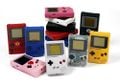 An official promotional screenshot showing a variety of Game Boys, including a red Game Boy with the Manchester United logo at the left
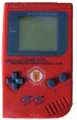 A red "Play It Loud!" Game Boy with the Manchester United logo at the center
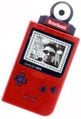 Pocket Camera played on the Game Boy Pocket
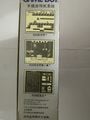 Side of Chinese packaging depicting Super Mario games
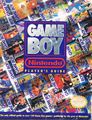 Game Boy Nintendo Player's Guide


.jpg)

Game gallery[edit]


Miscellaneous[edit]
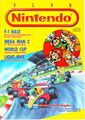 The cover for volume four of Club Nintendo from 1991
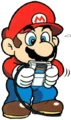 Artwork from Club Nintendo
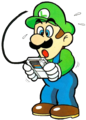 Artwork from Club Nintendo
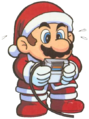 Artwork from Club Nintendo
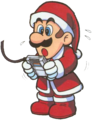 Artwork from Club Nintendo
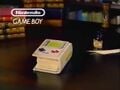 Japanese commercial for Super Mario Land 2 - 6 Golden Coins
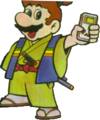 Artwork from the German Club Nintendo calendar for 1993
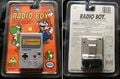 The Radio Boy, a portable radio in the shape of a Game Boy
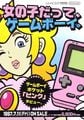 Print ad for the Japan-only pink Game Boy Pocket
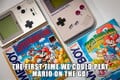 Image macro from the official NintendoAUNZ social media accounts, showing Super Mario games for the Game Boy
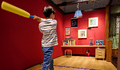 Photo of the "Ultra Machine SP" exhibit at the Nintendo Museum


Names in other languages[edit]
| Language | Name | Meaning | Note(s) | Ref. |
|---|---|---|---|---|
| Japanese | ゲームボーイ Gēmu Bōi | Game Boy | [13] | |
| Chinese (Traditional) | Game Boy | - | [14] |
References[edit]
- ^ a b c Mike Minotti (April 21, 2014). 25 years of the Game Boy: A timeline of the systems, accessories, and games. VentureBeat (English). Retrieved December 12, 2024. (Archived June 28, 2024, 14:06:26 UTC via Wayback Machine.)
- ^ Copetti, Rodrigo. Game Boy / Color Architecture | A Practical Analysis. Retrieved October 15, 2025 from copetti.org.
- ^ a b c d e f g Joshua Rogers (December 26, 2020). World of Nintendo: Exploring Nintendo in (Eastern) Europe. PAX (via YouTube) (English). Retrieved June 5, 2024. (Archived June 5, 2024, 20:16:14 UTC via Wayback Machine.)
- ^ [좌충우돌 4월 21일 - 게임보이, 세상에 나오다]. This is Game (Korean). Retrieved April 22, 2024.
- ^ Rogers, Joshua Alexander (April 16, 2020). Video Games around the World. LinkedIn. (Archived September 25, 2022, 15:36:58 UTC via Wayback Machine.)
- ^ March 30, 1994. Playtronic lança em abril Game Boy da Nintendo. Folha de S. Paulo (Portuguese). Retrieved December 12, 2024. (Archived July 30, 2023, 04:16:01 UTC via Wayback Machine.)
- ^ Consolidated Sales Transition by Region (PDF). Nintendo.com. Retrieved March 5, 2020.
- ^ Gavin Lane (December 25, 2020). Feature: Nintendo Console Codenames And Product Codes. Nintendo Life. Retrieved February 8, 2026. (Archived September 17, 2020, 06:10:39 UTC via Wayback Machine.)
- ^ December 26, 1997. 年末といったらこれ 最新出荷台数調査!. Weekly Famitsu (Vol. 379, no. 471) (Japanese). Page 8.
- ^ Moss, Richard (April 19, 2019). How Nintendo introduced the Game Boy, Tetris, and Pokémon to the West. Polygon. Retrieved February 8, 2026.
- ^ LuigiBlood (September 17, 2020). Mario Artist Communication Kit. Tumblr (English). Retrieved April 9, 2025.
- ^ Gavin Lane (December 25, 2020). Feature: Nintendo Console Codenames And Product Codes. Nintendo Life. Retrieved August 22, 2026. (Archived September 17, 2020, 06:10:39 UTC via Wayback Machine.)
- ^ ゲームボーイ. Nintendo Co., Ltd. (Japanese). Retrieved January 22, 2025.
- ^ Game Boy™ – Nintendo Classics
External links[edit]


| Game Boy games | |
|---|---|
| Super Mario franchise | Alleyway (1989) • Baseball (1989) • Super Mario Land (1989) • Golf (1989) • Dr. Mario (1990) • Super Mario Land 2 - 6 Golden Coins (1992) • Donkey Kong (1994) • Mario's Picross (1995) • Picross 2 (1996) |
| Donkey Kong franchise | Donkey Kong (1994) • Donkey Kong Land (1995) • Donkey Kong Land 2 (1996) • Donkey Kong Land III (1997) |
| Yoshi franchise | Yoshi (1991) • Yoshi's Cookie (1992) • Tetris Attack (1996) |
| Wario franchise | Wario Land: Super Mario Land 3 (1994) • Wario Blast: Featuring Bomberman! (1994) • Wario Land II (1998) |
| Miscellaneous | Tetris (1989) • The Legend of Zelda: Link's Awakening (1993) • Game & Watch Gallery (1997) • Game & Watch Gallery 2 (1997) • Game Boy Camera (1998) |

