Super Mario World (television series)
| Super Mario World | |||||||||||||||||
|---|---|---|---|---|---|---|---|---|---|---|---|---|---|---|---|---|---|
 | |||||||||||||||||
| General information | |||||||||||||||||
| Format | Children's television series | ||||||||||||||||
| Director | John Grusd | ||||||||||||||||
| Opening theme | "Super Mario World Main Title" | ||||||||||||||||
| Closing theme | "Super Mario World Main Title" (Instrumental) | ||||||||||||||||
| Composers | Michael Tavera Monroe Michaels | ||||||||||||||||
| Countries of origin | United States China Italy Spain | ||||||||||||||||
| Original language | English | ||||||||||||||||
| Translations | Albanian
Arabic Cantonese Croatian French (Europe) German Greek Hungarian Italian Korean Mandarin (China) Mandarin (Taiwan) Polish Portuguese (Brazil) Portuguese (Europe) Romanian Russian Spanish (Latin America) Spanish (Europe) Thai Turkish Ukrainian | ||||||||||||||||
| Ratings |
| ||||||||||||||||
| Number of seasons | 1 | ||||||||||||||||
| Number of episodes | 13 | ||||||||||||||||
| Production | |||||||||||||||||
| Production companies | DIC Entertainment Pacific Rim Productions, Inc. Reteitalia S.P.A. Telecinco | ||||||||||||||||
| Distributor | WildBrain[9] | ||||||||||||||||
| Runtime | 20–23 minutes | ||||||||||||||||
| Broadcast | |||||||||||||||||
| First aired |  September 14, 1991[10] September 14, 1991[10] 1991[11] 1991[11] 1992[12] 1992[12] 1992[13] 1992[13] March 27, 1993[14] March 27, 1993[14] 2005[?] 2005[?] 2005[?] 2005[?] May 1997[15] May 1997[15] 2001[16] 2001[16] 2005[17] 2005[17] 2005[18] 2005[18] 2006[19] 2006[19] June 2, 2012[20] June 2, 2012[20] 2011[21] 2011[21] 2011[22] 2011[22] | ||||||||||||||||
| Last aired | December 7, 1991[10] 1992[13] June 26, 1993[14] June 1997[15] 2005[17] 2005[18] August 25, 2012[23] 2013[19] | ||||||||||||||||
| Status | Ended | ||||||||||||||||
| Chronology | |||||||||||||||||
| Predecessor | The Adventures of Super Mario Bros. 3 (1990) | ||||||||||||||||
| Related programs | Captain N & The Video Game Masters Mario All Stars | ||||||||||||||||
 - Youth seven years and older
 - Guidance
 - General
 - Universal
 - Six years and older
 - All audiences
 - All ages
 - General
Super Mario World is an animated television series loosely based on the game of the same name, premiering a month after its North American release. The show originally aired from September 14 to December 7, 1991.[10] It is the third and final installment in DIC Entertainment's animated Super Mario trilogy. The cartoon chronicles the adventures of Mario, Luigi, and Princess Toadstool in Dinosaur World. Yoshi and several new characters, such as Oogtar, who is a blond-haired caveboy, make appearances as well. The series has only 13 episodes. The series is preceded by The Adventures of Super Mario Bros. 3, based on the then-recent Super Mario Bros. 3.
Overview[edit]
Sometime after the events of The Adventures of Super Mario Bros. 3, having banished King Koopa, the Koopalings, and their minions from the Mushroom Kingdom for good, Mario, Luigi, and Princess Toadstool decide to take a vacation in Dinosaur World. However, King Koopa and his minions manage to follow them there and kidnap the princess yet again. After adventuring and befriending Yoshi, Mario and Luigi manage to rescue Princess Toadstool from King Koopa's Neon Castle and subsequently decide to stay in Dinosaur Land's Dome City with the Cave People.
Several episodes of Super Mario World often have Mario, Luigi, Yoshi, Princess Toadstool, and occasionally Oogtar, a show-exclusive character, trying to stop the schemes of King Koopa and the Koopalings, as well as other villains such as Wizenheimer or the Dino Riders. Toad, who appears in The Super Mario Bros. Super Show! and The Adventures of Super Mario Bros. 3, does not appear in the series (nor does he appear in the game it is based on), making it the only Super Mario cartoon where he is absent. Because of his absence in the show, he is replaced by both Yoshi and Oogtar, the latter of whom has the same voice actor. Mario, Luigi, Princess Toadstool, King Koopa, and the Koopalings also retain their designs from The Adventures of Super Mario Bros. 3, although the "L" on Luigi's cap is black instead of green in early episodes, Princess Toadstool has lighter skin and blue eyes instead of black eyes, and Cheatsy's hair is light-green instead of dark-blue. Also, Mario and Luigi's Fire forms in the show are based on their Fire form sprites from the game. Walker Boone, Tony Rosato, Tracey Moore, and Harvey Atkin reprise their roles as Mario, Luigi, Princess Toadstool, and King Koopa respectively in the show.
Social issues[edit]

Due to the introduction of the Children's Television Act in 1990, some social commentary and edutainment was added into the series. Some episodes of Super Mario World can be seen as social commentary for controversial issues, such as street gangs ("Born to Ride"), television addiction ("Rock TV"), bullying in school ("A Little Learning"), and obesity and capitalism ("King Scoopa Koopa"). Additionally, several episodes such as "The Wheel Thing" and "Party Line" deal with the introduction and consequences of introducing new concepts and technologies to others without thinking ahead—in these cases, the Cave People of Dome City. One of the more noticeable changes made to the series in light of the CTA is the change made to Princess Toadstool's personality, where she is now more of a role model and parental figure for Mario, Luigi, and Yoshi.
Broadcast history[edit]
This section needs additional citations for verification. Unsourced material may be challenged and removed. Specifics: Information on the show's airing history needs to be corroborated with external sources
Please help improve this section by adding citations from reliable sources.

Super Mario World originally aired alongside Captain N: The Game Master on NBC, where it was referred to as Super Mario Bros. 4 in end credit promos and Super Mario Bros. World in commercial bumpers.[24] Super Mario World is also the only Super Mario cartoon to air in Australia on Network Ten and Cheez TV, though only on Mondays to Wednesdays on the latter. In both the United Kingdom and Australia, the episode "King Scoopa Koopa" aired before "The Night Before Cave Christmas", due to a mistake involving the show's production order and the production order of Captain N: The Game Master.[25]
Along with Captain N, Super Mario World was one of the last cartoons to air on NBC as that network began to gradually phase out cartoons on Saturdays. Both were canceled by the fall of 1992 and replaced with a Saturday version of Today, along with their TNBC block, which included such shows as Saved by the Bell and California Dreams. In the mid-nineties, the Super Mario World episodes aired on USA Network, without the Captain N episodes.
Due to the nature of its production, Super Mario World is actually one half of a series entitled Captain N and the New Super Mario World, which also consists of the third season of Captain N: The Game Master. Although the "New" suffix was used to promote the Super Mario World game when the show first aired, it is part of the series' proper title, and was never dropped. An episode of this half hour series consists of a Super Mario World episode and either a Captain N episode or a second Super Mario World episode. Due to legal issues, the third season episodes of Captain N and the Super Mario World episodes are inseparable, and have to be released on DVD in the same set. This also explains why only the first two seasons of Captain N: The Game Master were released in a "complete series" set; the third season is part of a separate show. The show can also be seen on Starz Encore's Kids and Family channel on weekday afternoons since 2019, as well as on Paramount+, The Roku Channel and NCircle TV in the US.
From 1998 to 1999, the show, along with The Adventures of Super Mario Bros. 3 aired reruns on the PAX Kids block of the PAX TV channel.[26] These airings had a lower audio pitch than the original episodes, and ended with a safety tip scene from DIC's Inspector Gadget series.[27]
In Australia, New Zealand, the Philippines, Singapore, the United States, the United Kingdom, and Thailand, the series airs on the Super Mario Bros. FAST channel on LG Channels, The Roku Channel, and Samsung TV Plus alongside The Super Mario Bros. Super Show! and The Adventures of Super Mario Bros. 3.
Worldwide, the show has aired in 25 countries and two regions. The countries and regions, grouped by continent, as well as their respective channels, are listed below:
North America[edit]
- United States
- NBC (1991)[24]
- KVBC (1992)[28]
- USA Network (1990s)
- PAX TV (1998–1999)[26]
- Super Mario Bros. (FAST channel)
- Mexico
South America[edit]
- Chile
Europe[edit]
- United Kingdom and Ireland
- Albania
- Croatia
- France
- KidsCo (2006–2013)[19]
- Germany
- Greece
- Italy
- Portugal
- Romania
- KidsCo (2009–2013)[40]
- Russia
- KidsCo (2012)[20]
- Spain
- Ukraine
Asia[edit]
- Brunei
- RTB Perdana (2001)[16]
- Hong Kong
- Middle East
- Myanmar
- Philippines
- Super Mario Bros. (FAST channel)
- Singapore
- Super Mario Bros. (FAST channel)
- Taiwan
- KidsCo (2011)[22]
- Thailand
- Super Mario Bros. (FAST channel)
Africa[edit]
- North Africa
Oceania[edit]
- Australia
- Network Ten
- Cheez TV
- KidsCo (2009–2013)[33]
- Super Mario Bros. (FAST channel)
- New Zealand
- Super Mario Bros. (FAST channel)
Characters[edit]
Main protagonists[edit]


Main antagonists[edit]


King Koopa's army[edit]


Cast[edit]
The voice acting was recorded in Canada.
- Walker Boone — Mario
- Tony Rosato — Luigi
- Tracey Moore — Princess Toadstool
- Andrew Sabiston — Yoshi
- Harvey Atkin — King Bowser Koopa
- Tara Strong — Hop
- John Stocker — Gophers, Koopa wizard, Oogtar, Wizenheimer
- Tabitha St. Germain — Kootie Pie Koopa
- James Rankin — Cheatsy Koopa
- Dan Hennessey — Bully Koopa, evil dinosaur, Rockman
- Michael Stark — Kooky von Koopa
- Gordon Masten — Big Mouth Koopa
- Judy Marshak — Additional voices
- Catherine Gallant — Mama Fireplant
- Stuart Stone — Hip
Episodes[edit]
| Premiere date | Episode |
|---|---|
| September 14, 1991 | "Fire Sale" |
| September 21, 1991 | "The Wheel Thing" |
| September 28, 1991 | "Send in the Clown" |
| October 5, 1991 | "Ghosts 'R' Us" |
| October 12, 1991 | "The Night Before Cave Christmas" |
| October 19, 1991 | "King Scoopa Koopa" |
| October 26, 1991 | "Born to Ride" |
| November 2, 1991 | "Party Line" |
| November 9, 1991 | "Gopher Bash" |
| November 16, 1991 | "Rock TV" |
| November 23, 1991 | "The Yoshi Shuffle" |
| November 30, 1991 | "A Little Learning" |
| December 7, 1991 | "Mama Luigi" |
Songs[edit]
Super Mario World features a total of fifteen songs, one for each episode plus the theme song and the Korean dub exclusive song "Super Mario". Each song corresponds to the theme of the episode. For example, in "The Yoshi Shuffle", the theme for the episode is football, so the song that corresponds to that episode is about fighting to the finish. Unlike the predecessors, which featured covers of licensed music, no songs on the Super Mario World cartoon were changed or removed due to copyright restrictions, since they were all written (and some parodied) exclusively for the show. All songs were composed by Michael Tavera and Monroe Michaels.[45] This show's songs are noticeably much shorter and, in some episodes such as "Send in the Clown", loop a section of the song in order to satisfy the length of the music sequence.
The Italian dub uses instrumentals of all of the songs except "Kootie Pie Rap" and "Cheatsy's Life", which are translated; the Brazilian Portuguese dub translates all songs with the exception of the intro theme, "Tail of the Dinosaur", the second part of "Rah-Rah", and "Looking for You"; the Hungarian dub uses the instrumental versions for "Motor City", "At the Circus", "Time to Run", and "Time to Get Wild"; the Turkish dub[46] uses the instrumentals for "Kootie Pie Rap", "Motor City", "At the Circus", and "Wizard", and the Romanian and Latin American Spanish dubs[40] translate "Kootie Pie Rap", while all other dubs leave the songs in English. The Korean dub, while still leaving the songs in English except for "Motor City" and the second part of "Rah-Rah", the latter of which uses the instrumental, has Korean subtitles on-screen; this is also true for the Albanian dub, which also includes "Motor City".
Home releases[edit]

The Super Mario World episode "The Night Before Cave Christmas" was released sometime in 1993 for a VHS tape entitled Super Mario Bros. Super Christmas Adventures!, along with "Koopa Klaus".
Currently, DVDs of every single Super Mario World episode are available in Australia; the episode "A Little Learning" was also available on a VHS tape for a time in the UK.
Due to complications involving the use of Yoshi, it was originally thought that DVD box sets of Super Mario World were not going to be made. However, those issues were resolved, and Shout! Factory released a box set containing the complete series, along with the third season of Captain N: The Game Master. The DVD was discontinued in 2012, along with The Adventures of Super Mario Bros. 3: The Complete Series and The Super Mario Bros. Super Show Volume 1 and 2, when Cookie Jar Entertainment merged with WildBrain (formerly DHX Media).
As of 2014, the episodes, along with the Captain N segments, have been streamed on WildBrain's YouTube Channel "WildBrain - Cartoon Super Heroes".
Production[edit]
During development, the show's working title was Super Mario Bros. 4, which was the subtitle and original title of the original Super Mario World game, and sported a logo that was edited from Super Mario Bros. 3.[47] Unlike previous Super Mario cartoons where scripts were produced in a three-step fashion (starting with the writer submitting an episode premise to the show's story editors, then a multi-page outline, then the full script), all of the episode premises for Super Mario World were written by the show's story editor Phil Harnage and then assigned to various writers of the previous series for the full script, skipping the outline stage - something that writer Perry Martin noted was "never a good idea".[48] There was also an episode premise pitched by Martin that did not make it into the show, titled "Yoshi's Big Adventure".[49][50]
Staff[edit]
- Main article: List of Super Mario World (television series) staff
As with the previous show, Super Mario World was produced and directed by John Grusd, with DIC president Andy Heyward acting as the executive producer and creative supervisor. Animation was done by the Chinese studio Pacific Rim Productions, Inc. rather than Sei Young Animation Co., Ltd. except for the opening, which was done by Canvas, Inc. The series was co-produced by Reteitalia S.P.A. and Telecinco.
Differences from the game[edit]
- The Cave People and Dome City are original locations created for the Super Mario World television series, and do not appear in the actual game.
- Characters retain their color differences from The Super Mario Bros. Super Show! despite Nintendo having redesigned the characters in the Super Mario franchise.
- Like in The Super Mario Bros. Super Show! and The Adventures of Super Mario Bros. 3, Bowser is referred to as King Koopa.
- The Koopalings retain their alternate names from The Adventures of Super Mario Bros. 3.
- Instead of only losing the power-up upon being damaged, both cape and fire power-ups run out after a certain amount of time passes (similar to invincibility).
- The circumstances under which Yoshi emerges from an egg are different. Instead of being trapped in an egg by Bowser in his attempts to rescue his friends, he is a newborn infant.
- The ? Block that activates the spotlight is the standard yellow instead of red.
- Many locations and enemies are referred to by different names, some of which are reminiscent of their Japanese names:
- A Banzai Bill is referred to as a "Magnum Bill".
- Boos are referred to as "ghosts".
- Bowser's Castle is referred to as "Neon Castle" and, in one episode, "Coney Island Disco Palace".
- Chargin' Chucks are referred to as "Koopa football players".
- What appears to be the Forest of Illusion is referred to as the "Enchanted Forest".
- Magikoopas are referred to as "Koopa wizards".
- Mechakoopas are referred to as "Mechkoopas" or "robots".
- Monty Moles are referred to as "Gophers".
- Power Balloons are referred to as "Magic Balloons".
- Rexes and Dino-Rhinos are collectively referred to as "dinosaurs".
- What appears to be either Spiny Cheep-Cheeps or Porcu-Puffers are referred to as "porcupinefish".
- Star World is referred to as the "Star Path", and the red course marks are depicted as Warp Pipes.
- A Sumo Brother is referred to as a "Fire Sumo".
- The Koopa Clown Car is referred to as the "Flying Clown Head", albeit only in a preview.
- Wigglers are referred to as "caterpillars" and, in one episode, "cave caterpillars".
Quotes[edit]
- Main article: List of Super Mario World (television series) quotes
Gallery[edit]
- For this subject's image gallery, see Gallery:Super Mario World (television series).
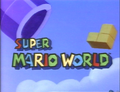 Title card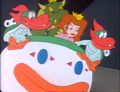
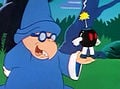 Wizenheimer with a Bob-omb