Nintendo 64
- This article is about the video game console. For other uses, see Nintendo 64 (disambiguation).
| Nintendo 64 | |
|---|---|
 Official logo  An original model of the Nintendo 64 | |
| Generation | Fifth generation |
| Release dates |  June 23, 1996[1] June 23, 1996[1] September 26, 1996[2] September 26, 1996[2] 1997[3] 1997[3] March 1, 1997[4] March 1, 1997[4] March 1, 1997[5] March 1, 1997[5] July 19, 1997[6] July 19, 1997[6] September 1, 1997[7] September 1, 1997[7] December 10, 1997[?] December 10, 1997[?] November 17, 2003 (iQue Player)[8] November 17, 2003 (iQue Player)[8] |
| Discontinued | April 30, 2002[?] May 11, 2003[?] May 16, 2003[?] November 30, 2003[?] December 31, 2016 (iQue Player)[?] |
| Predecessor | Super Nintendo Entertainment System |
| Successor | Nintendo GameCube |
- “Get N or get out!”
- —The Nintendo 64 slogan
The Nintendo 64 (stylized as NINTENDO64 in its logo and officially abbreviated as N64)[9] is a 64-bit home video game console created by Nintendo. The successor to the Super Nintendo Entertainment System, it was released in 1996 to compete with the PlayStation and Sega Saturn. It is the first Nintendo home console to feature the same name and hardware design in both Japan and international regions. In South Korea, it was rebranded as the Hyundai Comboy 64.
Development on the Nintendo 64 began in 1993 as a collaboration between Nintendo and Silicon Graphics, under the codename "Project Reality".[10] It was first revealed to the public as the "Ultra 64" at the 1994 Consumer Electronics Show.[11] The Nintendo 64 is Nintendo's first system to feature native 3D rendering, and was touted by the company for its advanced graphical capabilities of the time. The system was also the first of its kind to include a controller with an analog control stick, and had four controller ports built-in for multiplayer.
The system was launched in 1996 in Japan and North America and 1997 in other regions, alongside Super Mario 64, the first fully 3D game in the Super Mario franchise. The Nintendo 64 was praised for its technological innovations, but was criticized for its use of ROM-based cartridges rather than the high-capacity CD-ROMs that were common on other consoles. This, alongside frustrations with Nintendo's licensing policies, led to many third-party developers focusing on the PlayStation instead. Following this, Nintendo would opt for optical media on its home consoles starting with the Nintendo GameCube in 2001, only returning to cartridge-based media with the Nintendo Switch in 2017.
The Nintendo 64 ultimately saw lower sales compared to its predecessor and the PlayStation, and was described as "a step backwards for the company in terms of commercial success".[12] Despite this, it was not a true commercial failure; the console was popular enough in North America to offset its struggling sales in Japan and Europe, and it remained profitable overall for Nintendo. In the years since, the Nintendo 64 has been named by journalists one of Nintendo's most iconic systems, and several of its games are considered among the greatest and most influential video games of all time, including Super Mario 64, The Legend of Zelda: Ocarina of Time, and GoldenEye 007.
In 1999, Nintendo released the 64DD in Japan; similar to the Family Computer Disk System, it was an add-on that enabled support for games on proprietary magnetic disks. The add-on was intended as a cheaper alternative to optical disc-based competitors, but it was ultimately a commercial failure due to its belated and limited release, and plans for a North American release were canceled. In total, four games of the Super Mario franchise were released on the 64DD, all in the Mario Artist series.
Production of the Nintendo 64 ceased in 2002. The system sold 32.93 million units during its lifetime,[13] with around 20.63 million of those being sold in the Americas.[14] A special plug-and-play version of the console, the iQue Player, was released exclusively in China in 2003.
Many Nintendo 64 games have been made available on later Nintendo consoles via re-releases, beginning with the Virtual Console on the Wii in 2006 and Wii U in 2015. A library of Nintendo 64 games is available on the Nintendo Switch and Nintendo Switch 2 via the Nintendo 64 – Nintendo Classics application, released in 2021 exclusively for active Nintendo Switch Online + Expansion Pack subscribers.
Accessories[edit]
Nintendo 64 Controller[edit]


The Nintendo 64 Controller is the standard controller for the Nintendo 64. It is unique among video game controllers, as it has three grips instead of the more common two, resembling the letter M. There are many color variations of the controller, including solid and clear colors. This was a unique concept at the time.
The Nintendo 64 is not the first console to use analog control sticks; it is just the first successful console to use them. The Vectrex was the first home console to have an analog stick; it also had four controller ports, a feature that was not popularized until the Nintendo 64.
There was also a LodgeNet controller that was exclusive to hotels.[15]
Buttons[edit]
The Nintendo 64 Controller lost the  ,
,  , and
, and  Buttons from the SNES but instead features additional buttons:
- A Button

- B Button

- Camera Buttons/C Buttons
 *
*
- Camera Up/C Up Button
 *
* - Camera Right/C Right Button
 *
* - Camera Down/C Down Button
 *
* - Camera Left/C Left Button
 *
*
- Camera Up/C Up Button
- START

- Z Trigger
 *
* - L Trigger

- R Trigger

- Control Stick
 *
* - +Control Pad

* – Signifies new buttons
Controller Pak[edit]

Although this item was not required like for the Nintendo 64's competitor, the PlayStation, some games utilized external storage by the use of the Controller Pak. The only game in the Super Mario franchise to support it is Mario Kart 64, which can use it to save ghosts for Time Trials.
Transfer Pak[edit]
- Main article: Transfer Pak

The Transfer Pak allows Game Boy and Game Boy Color games to connect to select Nintendo 64 games. It was bundled with Pokémon Stadium, although Mario Golf (Nintendo 64) and Mario Tennis (Nintendo 64) can connect with Mario Golf (Game Boy Color) and Mario Tennis (Game Boy Color), respectively. The Game Boy Camera is the only Game Boy accessory to connect with a 64DD game: Mario Artist: Paint Studio and Mario Artist: Talent Studio.
Rumble Pak[edit]
- NintendoWiki article: Rumble (feature) § Nintendo 64


Bundled with Star Fox 64, the Rumble Pak is an accessory inserted into the controller's memory cartridge slot, although this prevents simultaneous use of the Controller Pak. The Rumble Pak made the Nintendo 64 the first home console to utilize force-feedback vibration and has since become standard in gaming.
The Super Mario–related games that support it are:
- Mario Golf
- Mario Tennis
- Mario Party
- Mario Party 2
- Mario Party 3
- Paper Mario
- Yoshi's Story
- Donkey Kong 64
- Diddy Kong Racing
- Super Smash Bros.
- Super Mario 64: Rumble Pak Compatible Version
Expansion Pak[edit]
- NintendoWiki article: Expansion Pak

The Expansion Pak is a RAM expansion that adds four additional megabytes of RAM to the console while in use, increasing the total amount of RAM accessible to eight megabytes. It is added to the console by removing the cover marked "Memory Expansion" in front of the cartridge slot and inserting it into the slot underneath, replacing the system's pre-installed Jumper Pak.
One game related to the Super Mario franchise requires the use of the Expansion Pak, Donkey Kong 64, and because of this, a free Expansion Pak was bundled with earlier copies of the game. A rumor states that Donkey Kong 64 required the Expansion Pak as the result of a memory leak or game-breaking bug, reinforced by a video created by former Rare employee Chris Marlow. However, this has been denied by Donkey Kong 64 developer Mark Stevenson, who suggested that the rumor was a byproduct of the conflation of two separate stories involving the Expansion Pak and a severe bug, respectively.
64DD[edit]
- Main article: 64DD

The 64DD accessory was commercially available only in Japan and was a failure, although it was planned for an international release. Only four Super Mario games were released for it, all of them being part of the Mario Artist series.
Appearances in the Super Mario franchise[edit]
- In Donkey Kong Country 3: Dixie Kong's Double Trouble!, there is a chance that Wrinkly Kong plays on a Nintendo 64 in Wrinkly's Save Cave.
- In Yoshi's Story, a Nintendo 64 can be seen in the backgrounds of a few levels.
- In Super Smash Bros. Melee in the background of the stand where all of the player's trophies are, a Nintendo 64 with the controller and the Super Smash Bros. game cartridge and box appear on a shelf, along with various other Nintendo systems.
- In Wario World, a Nintendo 64 appears as a treasure.
- In Super Paper Mario, in one of Francis's rooms, a Nintendo 64 can be seen alongside the other Nintendo platforms released by that time, as well as a Virtual Boy.
- In Super Smash Bros. Brawl, one of the names that can appear whenever a player presses the random button when they are naming their custom stage is "N64".
- In WarioWare Gold, the Nintendo 64 appears as a collectible Nintendo souvenir.
- In Super Smash Bros. Ultimate, there was a Spirit Board event focused on spirits from the Nintendo 64 era. The name of the event was the slogan of the Nintendo 64.
- In WarioWare: Get It Together! in 9-Volt's Nintendo Classics level, the boss that appears in the intermission before the boss microgame wears an upside-down Nintendo 64 Controller as a crown.
- In The Super Mario Bros. Movie, one of the islands surrounding the Mushroom Kingdom is in the shape of a Nintendo 64 controller with the left grip broken off.
- In The Super Mario Galaxy Movie, a hologram of the Nintendo 64 logo can be seen above the futuristic city.[16]:0:14


Super Mario games[edit]
1996[edit]
1997[edit]
1998[edit]
1999[edit]
2000[edit]
2001[edit]
Galleries[edit]
- For this subject's image gallery, see Gallery:Nintendo 64.
 Horizontal logo
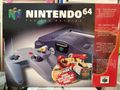 Super Mario 64 Player's Guide bundle
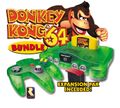 Donkey Kong 64 Bundle promo
 64DD Boot screen


Names in other languages[edit]
| Language | Name | Meaning | Note(s) | Ref. |
|---|---|---|---|---|
| Japanese | ニンテンドウ64 Nintendō 64 | - | The number "64" is read as 「六四」 (rokuyon, "six four") for the console[17] or 「六十四」 (rokujūyon, "sixty-four") for its games.[18] | [19] |
| Arabic | أن ٦٤ a-Na 64' | N64 | [20] | |
| Korean | 현대 컴보이 64 Hyeondae Keomboi 64 | Hyundai Comboy 64 | The number "64" is read "육십사" (yuksipsa) using the Sino-Korean number system instead "예순넷" (yesunnet) that comes from the native Korean system. | [21] |
Notes[edit]
- Guinness World Records 2011: Gamer's Edition falsely states that Super Mario Bros. was ported to the Nintendo 64.[22]
- Several Nintendo 64 games depict the cartridges with a different artwork than their corresponding box art (e.g., Super Mario 64, Mario Kart 64, Donkey Kong 64, etc.).
- In Japan, the Nintendo 64 was discontinued before the Famicom and Super Famicom.[23][24]
- Super Mario 64 helped to define the layout of the N64 Controller: the Control Stick and buttons respectively being incorporated for better movement in a 3D environment and better free-camera control.[25]
- The Nintendo 64 was Nintendo's last system to be distributed by Hyundai Electronics in South Korea. The Game Boy Advance, Nintendo GameCube, and Nintendo DS would be distributed in the region by Daewon Media,[26] while all later systems would be handled by Nintendo itself (due to South Korea lifting most of its bans on Japanese cultural imports between 1998 and 2004). As the Daewon and Nintendo of Korea-distributed systems retain their Japanese names, it is also Nintendo's last system to go under a different moniker in an international market, one generation after abandoning the practice in North America and PAL regions.
- The Nintendo 64 was originally showcased under the name "Ultra 64", with plans to brand it the "Ultra Famicom" in Japan.[27] The rename to "Nintendo 64", which initially covered the Japanese release[28] before being applied to the system internationally as well, stemmed from a desire for "a single product identity worldwide".[29] The new name was the suggestion of EarthBound creator and copywriter Shigesato Itoi.[30][31] The original name is reflected in the development of Super Mario 64, which began development as Ultra 64 Mario Brothers.[32]
References[edit]


- ^ June 24, 1996. Long-Awaited Nintendo 64 Machine Hits Stores. Santa Clarita: The Signal. Retrieved December 12, 2024.
- ^ Scott McCall (September 28, 1996). N64's U.S. Launch. Archive 64 (English). Retrieved September 7, 2024. (Archived October 12, 2015, 20:23:16 UTC via Wayback Machine.)
- ^ Joshua Rogers (December 26, 2020). World of Nintendo: Exploring Nintendo in (Eastern) Europe. PAX (via YouTube) (English). Retrieved June 5, 2024. (Archived June 5, 2024, 20:16:14 UTC via Wayback Machine.)
- ^ Curtis, Maree (March 2, 1997). Remember the Games of the Old School Yard. The Age.
- ^ Younge, Gary (March 1, 1997). Battle of the Giants Launched. The Guardian.
- ^ Sam Derboo (July 13, 2010). A History of Korean Gaming. Hardcore Gaming 101 (English). Retrieved September 7, 2024. (Archived March 2, 2024, 03:39:51 UTC via Wayback Machine.)
- ^ Frantz Durupt (September 29, 2015). Il y a 20 ans, la PlayStation sortait en France. Gamekult (French). Retrieved June 5, 2024. (Archived May 1, 2021, 00:02:17 UTC via Wayback Machine.)
- ^ November 2003. iQue PLAYER优惠套装上海试卖,五款精品游戏同步发售!. iQue (Simplified Chinese). Archived December 25, 2005, 02:11:32 UTC from the original via Wayback Machine. Retrieved September 7, 2024.
- ^ Prefix used for returning Mario Kart 64 courses in the Mario Kart series
- ^ Steve Shepard (1996). Project Reality: Making the Nintendo 64. Within Reason. Retrieved August 4, 2026.
- ^ 1994. 1994 Summer CES. Game Zero. Retrieved August 4, 2026.
- ^ https://www.goliath.com/gaming/10-reasons-why-the-nintendo-gamecube-failed/
- ^ December 31, 2020. Dedicated Video Game Sales Units. Nintendo. Retrieved March 31, 2021.
- ^ Consolidated Sales Transition by Region (PDF). Nintendo. Archived April 1, 2009, 13:18:30 UTC from the original via Wayback Machine. Retrieved August 1, 2026.
- ^ {{cite|author=Nintendrew|date=August 15, 2018|url=https://youtu.be/HK_EPiRkFew%7Ctitle=LodgeNet Game Controllers - Nintendo's Hotel Rental Service! {{!} Nintendrew|publisher=YouTube}}
- ^ Illumination and Universal Pictures (February 6, 2026). The Super Mario Galaxy Movie | Level Up. YouTube. Retrieved February 7, 2026.
- ^ https://youtu.be/kg0m_flXKhQ
- ^ https://youtu.be/1bf2kpeJnPw
- ^ Nintendo 64 Japanese box art
- ^ OldPSGamer (June 23, 2021). فقرة Retro Gaming : الحلقة 69 : Banjo-Kazooie (Xbox 360) (1:25). Arabic. Retrieved March 27, 2026 from YouTube.
- ^ https://youtu.be/66QEsdstP7M
- ^ Guinness World Records. (2011). Guinness World Records 2011: Gamer's Edition. BradyGames. p. 111.
- ^ Niizumi, Hirohiko. (May 30, 2003). Nintendo to end Famicom and Super Famicom production. GameSpot. Retrieved December 3, 2022.
- ^ Reisinger, Don. (June 23, 2016). That Was Quick: Nintendo 64 Is 20 Years Old. Fortune. Retrieved December 3, 2022.
- ^ DidYouKnowGaming? (September 29, 2012). Mario - Did You Know Gaming? Feat. Egoraptor. YouTube.
- ^ Gamecube : Korean Master-List !. Scanlines16.com. Retrieved January 5, 2024.
- ^ Ziff Davis (September 1995). Gaming Gossip. Electronic Gaming Monthly (Issue 74). Page 44. Retrieved June 7, 2024. (Archived via Wayback Machine.)
- ^ December 1995. Nintendo 64 Homes in on Japan. NEXT Generation (Issue 12). Page 19. Retrieved June 7, 2024. (Archived via Wayback Machine.)
- ^ Ziff Davis (April 1996). Say Goodbye to Ultra. Electronic Gaming Monthly (Issue 81). Page 16. Retrieved June 7, 2024. (Archived via Wayback Machine.)
- ^ Lindsay (November 5, 2011). The 64DREAM – November 1996. Yokuma!. Retrieved June 7, 2024. (Archived November 8, 2011, 23:11:05 UTC via Wayback Machine.)
- ^ Marcus Liedholm (January 1, 1998). The N64´s Long Way to completion. Nintendo Land. Retrieved June 7, 2024. (Archived March 4, 2008, 06:47:40 UTC via Wayback Machine.)
- ^ Prerelease:Super Mario 64 (Nintendo 64) § Development Timeline. The Cutting Room Floor. Retrieved June 7, 2024. (Archived May 16, 2024, 19:30:40 UTC via Wayback Machine.)
| Nintendo 64 games | |
|---|---|
| Super Mario franchise | Super Mario 64† (1996) • Mario Kart 64† (1996) • Mario no Photopi (1998) • Mario Party (1998) • Mario Golf (1999) • Mario Artist: Paint Studio* (1999) • Mario Party 2 (1999) • Mario Artist: Talent Studio* (2000) • Mario Artist: Communication Kit* (2000) • Mario Tennis (2000) • Paper Mario† (2000) • Mario Artist: Polygon Studio* (2000) • Mario Party 3 (2000) • Dr. Mario 64† (2001) |
| Donkey Kong franchise | Diddy Kong Racing (1997) • Donkey Kong 64 (1999) |
| Yoshi franchise | Yoshi's Story† (1997) |
| Crossovers | Super Smash Bros.† (1999) |

