
Super Mario Galaxy
- This article is about the Wii game. For other uses, see Super Mario Galaxy (disambiguation).
- "Super Mario Wii" redirects here. For the game released in 2009, see New Super Mario Bros. Wii.
| Super Mario Galaxy | |||||||||||||||||||
|---|---|---|---|---|---|---|---|---|---|---|---|---|---|---|---|---|---|---|---|
 For alternate box art, see the related gallery. | |||||||||||||||||||
| Developer | Nintendo EAD Tokyo | ||||||||||||||||||
| Publisher | Nintendo | ||||||||||||||||||
| Platforms | Wii, Wii U, Nvidia Shield TV[1] | ||||||||||||||||||
| Release dates | Wii (original release): November 1, 2007[2] November 1, 2007[2] November 12, 2007[3] November 12, 2007[3] November 12, 2007[4] November 12, 2007[4] November 16, 2007[5] November 16, 2007[5] November 29, 2007[6] November 29, 2007[6] July 12, 2008[7] July 12, 2008[7] July 12, 2008[8] July 12, 2008[8] September 4, 2008[9] September 4, 2008[9]Wii (Nintendo Selects): August 28, 2011[10] September 16, 2011[11] November 7, 2013[12] November 7, 2013[12] November 7, 2013[12] April 30, 2014[13] April 23, 2015[14] April 30, 2014[13] April 23, 2015[14]Wii U (digital download): May 31, 2015[15] December 24, 2015[16] February 4, 2016[17] February 5, 2016[18]Nvidia Shield TV:  March 22, 2018[19] March 22, 2018[19] | ||||||||||||||||||
| Languages | English (United States) English (United Kingdom) Japanese Chinese (Simplified)[A] French (Canada) French (Europe) German Italian Korean Spanish (Latin America) Spanish (Europe) | ||||||||||||||||||
| Genres | Platformer, action-adventure | ||||||||||||||||||
| Ratings | Wii (original release):
| ||||||||||||||||||
| Modes | Single player, two-player co-op | ||||||||||||||||||
| Format | Wii:  Optical disc Optical disc Digital download Digital download Digital download Digital download | ||||||||||||||||||
| Input | Wii:
| ||||||||||||||||||
| Serial code | RVL-RMGJ-JPN | ||||||||||||||||||
 - Everyone
 - All ages
 - Three years and older
 - Six years and older
 - All ages
 - All ages
 - General
 - General audience
 - Parental guidance

Super Mario Galaxy is a 3D action-adventure platform game for the Wii, first released in Japan on November 1, 2007. It is the eleventh entry in the Super Mario series,[20]:11–13
Upon its release, Super Mario Galaxy received critical acclaim and commercial success. It received various awards and accolades, including from the Academy of Interactive Arts & Sciences, the Computer Entertainment Supplier's Association, and the British Academy of Film and Television Arts, and has gone on to be considered one of the greatest video games of all time and a masterpiece.[24][25][26][27] It has sold 12.8 million copies, making it the ninth-best-selling Wii game.[28] A dedicated sequel, Super Mario Galaxy 2, was developed and released for the Wii on May 23, 2010.
Super Mario Galaxy was rereleased in 2011 under the Nintendo Selects branding after having sold well, and is one the few Wii titles to have been rereleased on the Nvidia Shield TV console in 2018. Another rerelease with upscaled graphics was included in the Nintendo Switch compilation Super Mario 3D All-Stars alongside Super Mario 64 and Super Mario Sunshine on September 18, 2020, to correspond with the 35th anniversary of Super Mario Bros. (1985).[29] A second reissue of Super Mario Galaxy for the Nintendo Switch, based on the Super Mario 3D All-Stars version, was released on October 2, 2025, as part of the Super Mario Galaxy + Super Mario Galaxy 2 bundle and as a standalone digital-only release, to coincide with the 40th anniversary of Super Mario Bros. A film inspired by this game and its sequel, titled The Super Mario Galaxy Movie, was released on April 1, 2026.
Story[edit]
From the instruction booklet
Every hundred years, a huge comet flies by in the skies above the Mushroom Kingdom. One year, that comet filled the entire sky, and from it fell a stream of shooting stars. The Toads scooped up the Star Bits and brought them to the castle, where they were reborn as a great Power Star. It was a happy time in the Mushroom Kingdom. Then one night Mario received a letter...
Dear Mario, I'll be waiting for you at the castle on the night of the Star Festival. There's something I'd like to give you. From Peach
With invitation in hand, Mario headed off to the castle just as the Star Festival was getting into full swing. Surrounded by Toads gleefully trying to catch falling Star Bits, Mario was looking forward to the night's festivities.
But then, something happened...

Every century, on the eve of the Star Festival, a comet passes over the Mushroom Kingdom and causes stars to fall to the planet below. Princess Peach invites Mario to her castle to join in the festivities and receive a special gift. As Mario arrives in the Castle Gardens, Bowser suddenly attacks the Toads with his airships and encases them in crystals. He "invites" Peach to the creation of his brand new galaxy and uses a UFO to lift the castle off the ground and carry it to the center of the universe, taking her and two Toads with it. Mario manages to reach the castle just before it is taken into outer space, but before he can get to Peach, Kamek suddenly appears and casts a spell at him, knocking him off the castle and deep into space. An apricot-colored Luma, whom Peach was carrying before her abduction, flees to look for Mario before Kamek uses another spell to warp the castle away.

Mario is awoken by the apricot-colored Luma on a small, grassy planet. Here, he meets other Lumas and Rosalina, a mysterious woman who acts as the protector of the galaxies and the mother of the Lumas. She tells Mario that her ship, the Comet Observatory, had its Power Stars stolen by Bowser. Without them, the Comet Observatory is unable to move through space. Rosalina asks him to reclaim her Power Stars and offers to help rescue Peach and defeat Bowser in exchange. To help him on his quest, Rosalina gives Mario the apricot Luma, who grants Mario the ability to spin and travel through space. Together, they travel to various galaxies in opened domes to obtain Power Stars. Once a mission is completed in one galaxy, Mario collects a Power Star and unlocks the next mission. Most domes contain five galaxies. Once Mario has collected enough Power Stars, the next galaxy in the current dome is one of Bowser's Strongholds[30], where the Grand Stars, which are larger and more powerful versions of Power Stars, would be in the possession of either Bowser or Bowser Jr. Rescuing a Grand Star unlocks the next dome, and when enough Power Stars are collected, the Comet Observatory is able to take Mario to the center of the universe.

After arriving at and traversing through Bowser's brand new galaxy, Mario defeats him, retrieves the last Grand Star, and rescues Peach. Just as they are about to leave, however, a large sun in Bowser's near-complete galaxy undergoes a supernova and becomes a supermassive black hole, which begins pulling in everything in sight. The Lumas from the Comet Observatory, including the apricot Luma, throw themselves into the black hole in order to neutralize it, and it soon evaporates in a massive explosion. Mario appears in front of Rosalina, who saves him from the cataclysm and tells him that this is not the end, but a new beginning for the universe, which repeats its cycle indefinitely and slightly different across each repetition.
Mario later awakens in the Mushroom Kingdom near Peach's Castle, where he witnesses the various friends and foes he met throughout his adventure celebrating together. He then notices Bowser and Peach lying next to him as they begin to stir. When he looks into the sky, he notices a newborn galaxy and hears Rosalina's words echoing in his mind. Mario stands up and exclaims, "Welcome! Welcome new galaxy!" as the camera pans out into space, revealing the reconstructed universe. After 120 Power Stars have been collected, a special cutscene plays after the staff roll: Rosalina thanks the player and says, "I will watch over you from beyond the stars", before flying off with the Comet Observatory. Alone in the rubble left by the supermassive black hole, an apricot Luma appears behind a decrepit starship. This alludes to the idea of how the universe repeats itself. The events of the past will carry out anew, with the lost apricot Luma searching for its mother.
Gameplay[edit]

The player controls Mario,[B] who mainly traverses across spherical planetoids and he levels by collecting Power Stars. His jumping actions allow him to hop between platforms and stomp enemies. Most enemies that cannot be stomped on can be taken out or dazed with a spin, a move new to the series. Rather than performed with button inputs, shaking the Wii Remote makes Mario spin. In addition to taking out enemies, spinning makes Mario engage switches, parry certain attacks, skate on ice, throw held items, and perform an extra small jump in the air. Several actions in Super Mario Galaxy are not strictly tied to button inputs and are instead performed by shaking, tilting, or rotating the remote. The game's camera organically pans across levels, but the player can manually angle it with  . Pressing
  centers the camera behind Mario and pressing
  enters a first-person perspective.
There are scenarios in the game that change what button inputs do. In some missions, Mario rides on top of a Rolling Ball, surfs on the back of a manta ray, or travels through the air in a giant bubble. Power-ups change his appearance and give him a unique set of abilities in place of his usual ones (see below). While in water, Mario can swim. Pressing  makes him dive. Pressing
  makes Mario perform a breaststroke, propelling him forward.
.png)
Pointing the Wii Remote at the screen makes an on-screen reticle appear called the Star Pointer. It gives the player a way to engage with the game that is not tied to Mario. Passively moving the Star Pointer over Star Bits, small colorful items, automatically collects them. Pressing  fires a Star Bit from the pointer. There are non-playable characters called Hungry Lumas that transform into new levels when shot at with Star Bits - their source of food. Most enemies become dazed when shot by a Star Bit. Mario kicks a stunned enemy just by making contact with it, defeating it and releasing collectible Star Bits.
Mario's health is represented by a three-segmented life meter. Receiving damage removes one section, and losing all makes him lose a life. Collecting a Life Mushroom replenishes any lost health and adds a second health meter, giving Mario a total of six bars. If Mario is reduced to three bars again, the second meter permanently disappears and the effect of the Life Mushroom is lost. He does not take damage by falling from high areas, a departure from proceeding 3D games. While underwater, he gains an air meter that decreases and starts to deplete Mario's normal life meter when it hits zero.
Most levels are clusters of small planetary bodies with their own centers of gravity, causing Mario to organically bend around them as he moves or jumps. Not all planetary bodies are spherical, but they at least have rounded edges to compliment the concept.[31]:12
Co-Star Mode[edit]
The game has a multiplayer mode called Co-Star Mode. Connecting a second Wii Remote allows another player (P2) to join in and assist the first one (P1) by controlling a second Star Pointer. There are a number of actions that are available only to the second player. When Co-Star Mode is active, "1P" appears below Player 1's Star Pointer, and "2P" appears below Player 2's Star Pointer to help differentiate between them. Like the first player, P2 can collect Star Bits and fire them at enemies to briefly stun them. When P2 directs their Star Pointer at Mario and presses , he performs a unique action called the Co-Star Super Jump. Combining both jump techniques can make Mario jump higher than when controlled with only one controller. This works in midair, but it can be done only once before the player touches a horizontal surface.[32]
Luigi[edit]

Completing "The Fate of the Universe" after 120 Power Stars have been collected allows the player to replay the entire game as Mario's brother, Luigi, who otherwise appears as a non-playable character that assists Mario. Luigi can jump higher than him but has worse traction, making him skid. He also runs slightly faster than Mario but takes longer to reach top speed. Luigi loses air faster while underwater and loses a chunk of air every time he spins underwater. Cosmic Luigi, one of the rival characters, is more challenging than Cosmic Mario, and Luigi receives twenty 1-Up Mushrooms from Princess Peach instead of Mario's usual five (although if Luigi's life counter is too high, he only receives five). Outside of these changes, the storyline is almost completely unchanged and even includes the original NPC Luigi, who will now react with confusion at seeing a copy of himself (although his height is marginally different). When the player collects 120 Power Stars and replays "The Fate of the Universe", Grand Finale Galaxy becomes available for both Mario and Luigi, allowing the 121st Power Star to be collected by each of them.
This mode is referred to by Rosalina as "another world". In the Japanese version, she describes it as the world where Mario may come across his alternate self who is not him.[33]
Controls[edit]
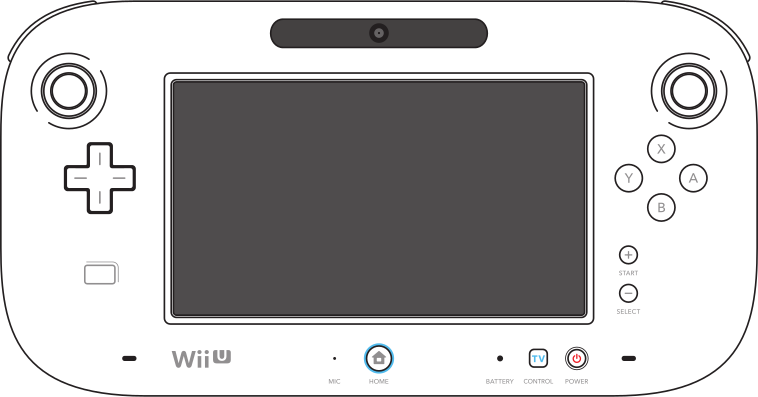
When playing on a Wii or Wii U console by oneself (P1), the game requires one to use the Wii Remote attached to the Nunchuk. If the player attempts to access the game without the Nunchuk attached, it will prompt the player to do so before proceeding. One will not be able to access the rest of the game unless they do so. In Co-Star Mode, the second player (P2) is not required to have the Nunchuk attached to their Wii Remote but it still must be held vertically.
The controller for the Nvidia Shield TV has a more conventional layout, cannot display a pointer on screen, and lacks the same motion-sensing capabilities of the Wii Remote. To compensate, actions that originally involved shaking the Wii Remote are performed by pressing the X button. Actions involving the Star Pointer are instead performed with the right analog stick. In Co-Star Mode, both analog sticks can be used to control the Star Pointer.[34] The original tilt controls in the game is also replaced by the regular left analog stick control.[35][36]
For the control scheme of the iteration included in Super Mario 3D All-Stars for Nintendo Switch systems, shared with the 2025 Nintendo Switch remaster, see Super Mario 3D All-Stars § Super Mario Galaxy.
| Action(s) | Input(s) | |||
|---|---|---|---|---|
| Wii Remote + Nunchuk | Nvidia Shield controller | |||
| Mario and Luigi controls | ||||
| Move | 
|

| ||
| Spin, engage object, throw item, skate, climb Sproutle Vine | Shake 
|

| ||
| Kick | Make contact with stunned enemy | |||
| Jump, speak, read, swim |
|

| ||
| Double jump | when making contact with the ground while moving (repeat twice) |
when making contact with the ground while moving (repeat twice) | ||
| Triple jump | when making contact with the ground while moving (repeat thrice) |
when making contact with the ground while moving (repeat thrice) | ||
| Backward somersault | +
|
 + +
| ||
| Wall jump | against a wall
|
against a wall
| ||
| Side somersault | (in reverse direction) +
|
(in reverse direction) +
| ||
| Long jump | + while running
|
+ while running
| ||
| Spin jump | Shake in midair
|
in midair
| ||
| Ground pound | in midair
|
in midair
| ||
| Homing ground pound | Shake + in midair
|
+ in midair
| ||
| Grab or release pole | alongside a pole
|
alongside a pole
| ||
| Crouch, dive underwater |
|
| ||
| Crawl | +
|
+
| ||
| Sweep kick | + shake
|
+
| ||
| Move camera |
|

| ||
| Enter first-person view |
|

| ||
| Reset camera |
|

| ||
| Rolling Ball | ||||
| Move | Tilt (upright)
|
| ||
| Jump |
|
| ||
| Ray surfing | ||||
| Accelerate |
|
| ||
| Turn | Tilt
|
| ||
| Jump | Shake
|
| ||
| Power-up controls | ||||
| Hover in Bee form | Hold
|
Hold
| ||
| Float in Boo form |
|
| ||
| Phase through walls in Boo form | Shake
|
| ||
| Toss fireball in Fire form | Shake | |||