List of Paper Mario: The Thousand-Year Door pre-release and unused content
This is a list of pre-release and unused content for the Gamecube release of Paper Mario: The Thousand-Year Door.
This article needs Paper Mario improvement. Specifically:
- Include more details (found on TCRF), including remnants of a removed Chuck Quizmo map
- Sprites of the various Goombas with detailed soles on their feet (Professor Frankly, Goombella, etc.)
- Sources for the names "Hyper Bob-omb" and "Ultra Bob-omb".
- Files names for the Green boots, "Fire Rod", unused Spinias, Coconut recipe, and early ability icons in the miscellaneous section.
- Princess Peach has an unused running animation.
- Lord Crump has various unused animations.
- Doopliss has an unused Poisoned animation.
- Bowser appears to have unused animations for his hair in motion. In the final game, his hair is generally a static, unchanging sprite, and in the all later games, including the remake, these unused hair sprites were completely removed altogether.
- The Spriters Resource contains assets for:
- An early variant of the title screen.
- An early, unused Koopa Troopa in a noticeably different artstyle, with a color scheme somewhat resembling the final game's KP Koopas.
- Assets for a Koopa Paratroopa variant of said unused Koopa Troopa.
Early builds[edit]
Reveal trailer[edit]
This game was initially titled Paper Mario 2 and featured a far different logo, one reminiscent of the original Paper Mario's logo.
Part of the original trailer shows an extra ledge above the pipe in the room directly east of the Thousand-Year Door, with an HP Plus badge on it. It could be accessed via a moving platform which had a wall over it halfway, which appeared to be passable with help from Vivian. Also, Beldam, Marilyn and Doopliss were originally going to be fought somewhere in Riverside Station.[citation needed] The trailer also showed that Item Shops would be labeled with Mushrooms, much as in Super Paper Mario, rather than the Fire Flowers seen in the final game. Red Bones was initially named "Red Koopa Skeleton". In the same trailer, one can see that "Tornado Jump" was initially called "Hurricane Jump". The status element Slow had a different icon, a snail instead of a sad purple face. The jumping and partner swapping sound effects resembling the ones from the previous game are used. In the final version, the jumping sound can still be heard when jumping in Tube Mode.
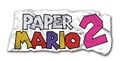 The game's original logo before the final version of the game.
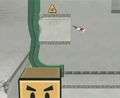 An early location of the HP Plus Badge.
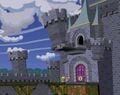 Hooktail Castle, with the door locked. In the final game, the door is open from the start.
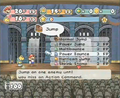 A battle in Hooktail Castle. "Hurricane Jump" is misspelled as "Hurrican Jump".
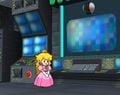 Early TEC
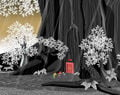 Early Great Tree. The ground has more of a gradient rainbow effect in the final version.


Interactive Multi-Game Demo Disc Version 18 Demo[edit]
A demo version released on a GameCube promotional disc includes various scriptual differences. Though the demo only allows for fifteen minutes of play at a time, the files inside of the game reveal several early concepts and placeholders.[1]
- If tattle is used outside of battle, Goombella will say "I usually would have something witty to say here, but I'm waiting for the final version!", which would imply that the actual tattles for areas had not yet been written.
- X-Nauts are called "Boomer Gangers", the Red Bones boss is called "Red Koopa Skeleton", and Dull Bones are called "Koopa Skeletons."
- In addition to the above, Pale Piranhas were simply called "Piranha Plants" and Poison Puffs were called "Poision Foggs."
- Petal Meadows is called "Star Crystal Field" by the menu and "Petal Fields" by Goombella.
- Glitzville is referred to as its Japanese name, "Oolong Town", implying it had not been localized yet. In addition, Twilight Town is called "Spectralia" several times in the script - a completely original name.
- All instances of Rogueport being used are instead spelled "Roqueport."
- Hooktail is said to be weak to frogs instead of crickets. Her weakness to frogs was restored in the Nintendo Switch remake.
- Goombella's description on the partner menu also mentions "Goomelda, wisest of female Goombas", a reference to the character Zelda from The Legend of Zelda series.
- Niff T. is named "Toodle" in the demo, Bub-ulber is named "Bub-ulbo", Toce T. is named "Dain T", Merlee is named "Sando", Ms. Mowz is named "Miss Mowz", and Pungent is named "Punto."
- Dried Bouquets are named "Dried Flowers", Life Shrooms are named "Emergency Shrooms", and Courage Shells are called "Courage Colas."
- The Spin-Jump is called a "Ground Pound" in the demo.
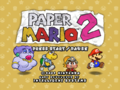 The title screen of the demo.
 An earlier version of the W Emblem, only found in the demo.
 An early design of the Champ's Belt, only found in the demo.
 An early design of the Strange Sack, only found in the demo.


Unused data[edit]
Debug mode[edit]
By pressing  ,
,  ,
,  , ,
, ,  , and
, and  on the title screen, debug mode is enabled. Subsequently, pressing
  on the title screen displays the game's build date, and crashes now display a crash report. This works on all versions.[2]
Graphics[edit]
Mario[edit]
Mario has various unused graphics an animations in his data, some of which being redrawn from the previous game.
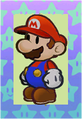 Placeholder texture used for when Mario assumes Plane Mode or Boat Mode. In this image, Mario's sprite bares multiple differences from its final counterpart, including slightly different gloves, and more Koopa Troopa-like shoes.
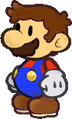 Unused hatless sprite of Mario. The graphic for the head also exists in the files for Super Paper Mario, and this game's Nintendo Switch remake.
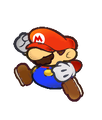 A graphic which presumably would have been used when striking blocks, or low ceilings. In the final release, this animation never plays. Similar graphics also go unused in Paper Mario, Super Paper Mario, and this game's Nintendo Switch remake.
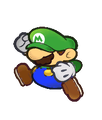 Another variant of the unused graphic
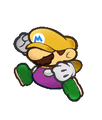 Another variant of the unused graphic
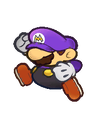 Another variant of the unused graphic


Party members[edit]
Early sprites of Vivian and Admiral Bobbery exist in the files. Concept art detailing the two designs is included as unlockable extras in the Nintendo Switch remake, additionally revealing that Beldam and Marilyn were respectively going to have ice and lightning at the end of their own hats (though no graphics for these are present in the game's data).
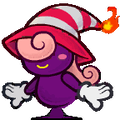 An early sprite of Vivian, called tst_vivi in the coding.
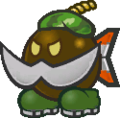 An early sprite of Admiral Bobbery, called c_bom_t in the coding.


Princess Peach[edit]
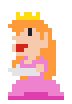 Unused Sprite for Peach when transforming via the curtain in X-Naut Fortress. In the final game, Peach can never achieve this state, as it involves slipping through the vent from above, which she is not able to do.

Enemies and Bosses[edit]
A Dark version of Atomic Boo exists in the files, presumably intended as a more powerful variant of the Atomic Boo fought at the Creepy Steeple. Dark Atomic Boo also went unused in Super Paper Mario, but was fully coded instead of only having graphics.
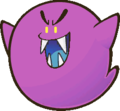 Idle sprite of the Dark Atomic Boo.
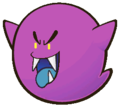 Dark Atomic Boo glares
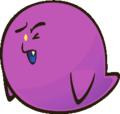 Dark Atomic Boo's "confused" pose.


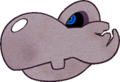 An early design of Bonetail's head. In the final game, their head does not include eyes anywhere on the model.

In the files for the Shadow Queen is an alternate version of the sprite used when possessing Princess Peach. Compared to the final version, the version has slightly different proportions, and her clothes bear a more visibly purple coloration.
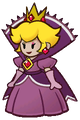 The early sprite of the Shadow Queen.

There are unused Red variants of Buzzy Beetles, Parabuzzies, and Spiky Parabuzzies in the files, but the only version used in the final game are the pair of Glitz Pit Red Spike Tops.
 A Red Buzzy Beetle
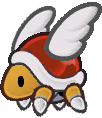 A Red Parabuzzy
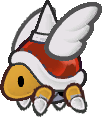 A Red Spiky Parabuzzy


Early graphics for the Smorgs use a design resembling the appearance of Screamy. In the files, it is named c_moa_a, which is actually similar to the final name of the Smorg, c_n_moa_a.
 An enemy similar to Screamy-like version of Smorg.
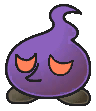 Another enemy similar to Screamy-like Smorg, called c_moa_b.
 A Screamy-like enemy running.
 An later unused design of a black Smorg, which more closely resembles its final counterpart. The final black Smorg is called c_n_moa_a, while this early version is called test_bom.


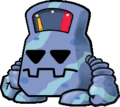 Okōru, an incomplete robot enemy. It was cut at the beginning of development, and therefore did not have any animations made.
![A Ultra Bob-omb.[citation needed]](https://mario.wiki.gallery/images/0/02/Ultra_Bob-omb_TTYD_unused.png) A Ultra Bob-omb.[citation needed]
A Ultra Bob-omb.[citation needed]![A Hyper Bob-omb. [citation needed]](https://mario.wiki.gallery/images/a/ac/Hyper_Bob-omb_TTYD_unused.png) A Hyper Bob-omb. [citation needed]
A Hyper Bob-omb. [citation needed]

![A Ultra Bob-omb.[citation needed]](/File:Ultra_Bob-omb_TTYD_unused.png)
![A Hyper Bob-omb. [citation needed]](/File:Hyper_Bob-omb_TTYD_unused.png)
NPCS[edit]
Graphics for the party members from Paper Mario exist in the files, but only Lady Bow and Parakarry appear in the final game. These graphics were later repurposed for their appearances as Catch Cards in Super Paper Mario.
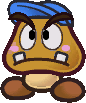 Unused sprite of Goombario
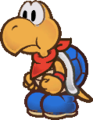 Unused sprite of Kooper
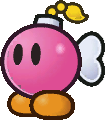 Unused sprite of Bombette
 Unused sprite of Watt
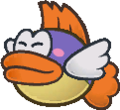 Unused sprite of Sushie
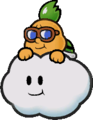 Unused sprite of Lakilester


 Audience member sprite of Luigi wearing the Poltergust 3000. This graphic never appears in the final release.
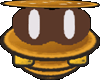 An earlier unfinished sprite of Spinia
 A later unfinished sprite of the hamburger Spinia. It and its rainbow counterpart, Spania, are named c_lp_hannya in the coding.
 Another early partner of Luigi. It appears to be a rainbow Spania.
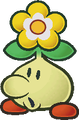 A yellow recolor of a Bub-ulb, called c_flower_y in the game's code.
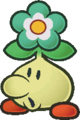 A green recolor of a Bub-ulb.
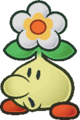 A white recolor of a Bub-ulb with a yellow center.
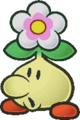 A white recolor of a Bub-ulb with a pink center.
 A businessman Cheep Cheep, called c_puku in the coding.
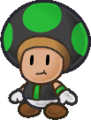 A green recolor of a Toad conductor.


Items and Badges[edit]
 An unused coconut recipe.
 An early version of a rock thrown from the Audience.
 An early version of a can thrown by the Audience.
 An early Star Key
 An unused item resembling a Fire Flower with a candy cane-like stick.
 An early version of the Item Shop signs.
 A pillow, it was likely an early version of the Blanket on the Excess Express.
 A Badge called Super Charge.
 The Star Rod, called c_koopa in the coding.


Miscellaneous[edit]
 Early icon for the plane ability
 Early icon for the paper ability.
 Early Jump icon
 Early Hammer icon
 Early Item icon of a Fire Flower
 Early Special icon
 Early Tactics icon
 Unused half star icon
 Unused Green Boots


Unused status effect[edit]

An unused POW-Down status exists in the game's coding under the name "battle_common". When hacked into the game, it displays the message "Attack has dropped!"[3]
Unused Glitz Pit battle conditions[edit]
A total of 70 different special conditions are coded for battles in the Glitz Pit, but only a very small subset of 15 are actually used in-game.[4] Many of the unused conditions are split to apply specifically to Mario or his partner. The game's script has multiple duplicate strings for some used conditions, suggesting they may have originally been unused ones before being overwritten. It is unclear how some conditions were expected to function, such as Mario having to attack the audience, which is not an action that can be performed freely in-game. All but one condition has a variable that can be configured, though many of the used conditions set this variable to 0. Therefore, it is possible that multiple variants of those conditions were also planned.
| ID | Conditions in code | As presented in-game |
|---|---|---|
| 0 | Succeeds automatically | |
| 1 | Do not jump n times | Don't use your jump! |
| 2 | Jump n times | |
| 3 | Do not hammer n times | Don't use your hammer! |
| 4 | Hammer n times | |
| 5 | Do not use special moves n times | Don't use special moves! |
| 6 | Use special moves n times | Don't use special moves! |
| 7 | Do not let Mario take n damage | |
| 8 | Have Mario take n damage | |
| 9 | Do not let partners take n damage | |
| 0A | Have partners take n damage | |
| 0B | Do not take n damage total | Win before taking 20 HP of damage! |
| 0C | Take n damage total | |
| 0D | Do not let Mario take n hits | |
| 0E | Have Mario take n hits | |
| 0F | Do not let partners take n hits | |
| 10 | Have partners take n hits | |
| 11 | Do not take n hits in total | |
| 12 | Take n hits in total | Take damage from your opponent three times! Take damage from your opponent at least five times! |
| 13 | Mario must win battle with at least n HP (fails if Mario dies) | |
| 14 | Mario must win battle with less than n HP (fails if Mario dies) | Win after your HP drops to 5! |
| 15 | Must get a Power Bounce combo of least n | |
| 16 | Mario must use fewer than n items | |
| 17 | Mario must use at least n items | |
| 18 | Partners must use fewer than n items | |
| 19 | Partners must use at least n items | |
| 1A | Use fewer than n items | Don't use items! Don't use any items! |
| 1B | Use at least n items | |
| 1C | Mario must not swap partners n times | |
| 1D | Mario must swap partners n times | |
| 1E | Partners must not swap partners n times | |
| 1F | Partners must swap partners n times | |
| 20 | Must not swap partners n times | Don't change partners! |
| 21 | Must swap partners n times | |
| 22 | Mario must not attack audience n times | |
| 23 | Mario must attack audience n times | |
| 24 | Partners must not attack audience n times | |
| 25 | Partners must attack audience n times | |
| 26 | Mario must not appeal n times | |
| 27 | Mario must appeal n times | |
| 28 | Partners must not appeal n times | |
| 29 | Partners must appeal n times | |
| 2A | Must not appeal n times | |
| 2B | Must appeal n times | Appeal to the crowd at least once. Appeal to the crowd at least three times! |
| 2C | Mario must not spend n FP | |
| 2D | Mario must spend n FP | |
| 2E | Partners must not spend n FP | |
| 2F | Partners must spend n FP | |
| 30 | Must not spend n FP | Don't use any FP! |
| 31 | Must spend n FP | |
| 32 | Mario must not use n moves (jump/hammer/SP + Charge/Defend/Dip actions) | Only let your partner attack! |
| 33 | Mario must use n moves | |
| 34 | Partner must not use n moves (partner moves + Charge/Defend/Dip actions) | Don't ever let your partner attack! |
| 35 | Partner must use n moves | |
| 36 | Same as 0x30 | |
| 37 | Same as 0x31 | |
| 38 | Party must not use n moves | |
| 39 | Party must use n moves | |
| 3A | Must take more than n turns | |
| 3B | Must not take more than n turns | Defeat your opponent in five turns or less! |
| 3C | Wait n turns before Mario actions (jump/hammer/SP/item/switch/Charge/SuperCharge/Run) | |
| 3D | Wait n turns before Partner actions (move/item/switch/Charge/SuperCharge/Run) | |
| 3E | Wait n turns before Party actions (0x3c + 0x3d conditions combined) | |
| 3F | Wait n turns before Mario attacks (jump/hammer/SP attack/item attack) | |
| 40 | Wait n turns before partner attacks (partner attack/item attack) | |
| 41 | Wait n turns before party attacks (0x3f + 0x40 conditions combined) | Don't attack in the first three turns! |
| 42 | Mario can only jump or Defend | |
| 43 | Mario can only hammer or Defend |
Music[edit]
 Unused theme 1 - This song was supposed to be played at Riverside Station. The Nintendo Switch remake uses a reworked version of this song in the back entrance and underground portions of the Riverside Station. Unused theme 1 - This song was supposed to be played at Riverside Station. The Nintendo Switch remake uses a reworked version of this song in the back entrance and underground portions of the Riverside Station. | File info 0:29 |
| Unused theme 2 - This song was originally heard in the demo version's starting screen, but goes unused in the final version. | File info 0:26 |
Dialogue[edit]
Fully translated[edit]
Presumably for the sake of completeness, all of Mario's partners he has in the Glitz Pit have dialogue for when he gets promoted to the major league there. However, only Yoshi's is used, as he was required to beat the Iron Clefts and there is no opportunity to change partners in the ensuing cutscene.
| Partner | Dialogue |
|---|---|
| Goombella | Uh, yeah... What, no hellos? These guys are totally freezing us out, Mario.
What? What's wrong, Mario? WHAAAAT? Are you saying the champ's belt... |
| Koops | Ummm... Judging by the dead silence, I'd say these guys don't like us much.
Ummm... What's up, Mario? What? Are you serious? The champ's belt? |
| Flurrie | Oh, dear... These fellows don't seem quite as friendly as the minor-leaguers...
Mario, darling, what is it? Come again? The champ's belt, you say? |
Similarly, in Twilight Town, all then-five partners have dialogue for when the Mayor sends Mario off and wishes him well. Only Vivian's is used because, at the last opportunity to change partners, Mario had no choice but to use Vivian as Doopliss had turned the others against him.
| Partner | Dialogue |
|---|---|
| Goombella | All right, Mario! Let's get back to Rogueport, OK? |
| Koops | Well, Mario... Let's head back to Rogueport, huh? |
| Flurrie | Are you quite ready, Mario? Let's get back to Rogueport. |
| Yoshi | Okeydokey, Gonzales! Let's kick it back to Rogueport! |
Apparently, at one point, the Pit of 100 Trials was going to have traps on some floors:
| The devices on this level are now active. You can no longer change allies during battle! | The device on this level is now active. You can no longer use your hammer in battle! |
| The device on this level is now active. You can no longer use your jump in battle! | The device on this level is now active. You now receive double coins after battle! |
At one point, upon defeating the Shadow Queen, saving, and restarting, Mario would begin the game by himself and would have to manually get his partners back together again. Only Koops, Flurrie, and Yoshi have completed dialogue, the latter saying something about how he "registered us for the Glitz Pit again". Vivian has untranslated Japanese dialogue.
Other dialogue[edit]
Inside the game data, dialogue files are stored in the directory "root/msg/$C", where "$C" is an appropriate language or country code, such as "US". The Japanese version is simply stored in "root/msg" without the language or country code. The dialogue is split between 1 global file (game-wide) and 259 local files (for the separate locations). English and other Latin languages are stored in raw ASCII format. Japanese version is stored in the Japanese variant of ANSI format (Shift-JIS), with a few modifications to save space.
Names in parenthesis in the table headers (e.g. "hom_00" below) are the names of the text files in which the dialogue can be found. Names in the first column of the table are identifier strings used for specific dialogue scenes within those files.
The dialogue uses several XML-like tags to alter the presentation of the text. These are enclosed between "<>".
- <wait> causes the text to pause.
- <dynamic> causes the dialog to be rendered as "falling" onto the screen.
- <wave> causes the letters of the dialog to move in small circles.
- <k> pauses the text until the player presses

- <p> scrolls the text upwards to make room for more.
- <icon> renders a small image into the text. Typically, this is a button used in explaining controls.
- <col> changes the text to a color in RGBA format.
- <NUM> represents a number of coins.
- <ITEM> represents an item name.
- <s> has an unknown use.
- <AN> represents either "a" or "an" depending on which is appropriate grammatically.
- <system> renders the text box in blue and plays a short