Donkey Kong (game)

|
It has been suggested that this article be split into Donkey Kong (Arcade), Donkey Kong (Atari), Donkey Kong (Coleco), Donkey Kong (Ocean Software), Donkey Kong (Nintendo Entertainment System). (discuss) |
This article needs Donkey Kong improvement. Specifically:
- Famicom Box release date and version
- Add development and lawsuit information from the Gaming Historian documentation release
- This article is about the arcade game. For other games titled "Donkey Kong", see Donkey Kong (disambiguation).
- "Donkey Kong 1" redirects here. For other uses, see Donkey Kong 1 (disambiguation).
| Donkey Kong | |||||||||||||||
|---|---|---|---|---|---|---|---|---|---|---|---|---|---|---|---|
 Art of the arcade cabinet For alternate box art, see the related gallery. | |||||||||||||||
| Developers | Nintendo R&D1 Nintendo R&D2 (Famicom / NES port)[1] Ikegami Tsushinki[2][3] Coleco (ColecoVision and Coleco Adam ports) Imaginative Systems Software (Atari 2600 port)[4] Roklan (Intellivision port) Atari, Inc. (Atari 8-bit port) K-Byte (TI-99/4A and NTSC Commodore 64 ports)[5][6] TMQ Software (MS-DOS port)[7] Human Engineered Software (Apple II port)[8] Syndein Systems (VIC-20 port)[9] Sentient Software Ltd (ZX Spectrum and MSX ports) Arcana Software Design (Amstrad CPC and PAL Commodore 64 ports) ITDC (Atari 7800 port) HAMSTER (Arcade Archives) | ||||||||||||||
| Publishers | Nintendo Coleco (ColecoVision, Atari 2600, Intellivision, and Coleco Adam ports) Atari, Inc. (Atari 8-bit, Apple II, TI-99/4A, MS-DOS, VIC-20, and NTSC Commodore 64 ports) Ocean Software (Amstrad CPC, ZX Spectrum, MSX, and PAL Commodore 64 ports) Atari Corporation (Atari 7800 port) HAMSTER (Arcade Archives) | ||||||||||||||
| Platform | Arcade
Atari 2600, ColecoVision, Intellivision, Atari 8-bit computers, Family Computer, Nintendo Entertainment System, TI-99/4A, MS-DOS, Apple II, VIC-20, Commodore 64, Coleco Adam, MSX, ZX Spectrum, Amstrad CPC, Family Computer Disk System, Famicom Box, Atari 7800, e-Reader, Game Boy Advance, Virtual Console (Wii, Nintendo 3DS, Wii U), Nintendo Classic Mini: Family Edition, NES Classic Edition, Nintendo Switch (Arcade Archives), Nintendo Entertainment System – Nintendo Classics
| ||||||||||||||
| Release dates | Arcade: July 9, 1981[10] July 9, 1981[10] August 1981[11] August 1981[11] 1981[12] 1981[12]
Atari 2600:
July 1982[13] 1983[?] 1983[?] 1983[?]ColecoVision: July 1982[14] July 1983[?] 1983[?]Intellivision: October 1982[15] 1983[?] 1983[?] 1983[16] 1983[16]Atari 8-bit computers: June 1983[17] 1983[?]Family Computer: July 15, 1983[18]Nintendo Entertainment System: June 15, 1986[?] October 15, 1986[?]TI-99/4A: November 1983[19]MS-DOS: November 1983[?]Apple II: December 1983[?]VIC-20: February 1984[20]Commodore 64: February 1984 (Atarisoft)[20] 1986 (Ocean Software)[?] 1987 (Ocean Software)[21] 1987 (Ocean Software)[21]Coleco Adam: June 1984[?]MSX: 1986[?] 1987[22]ZX Spectrum: 1986[?] 1987[23]Amstrad CPC: 1986[?] 1987[24]Family Computer Disk System: April 8, 1988[25]Atari 7800: November 1988[?] 1988[?]e-Reader: November 11, 2002[26]Game Boy Advance: February 14, 2004[27] June 7, 2004[28] July 9, 2004[29]Virtual Console (Wii): November 19, 2006[30] December 2, 2006[?] December 7, 2006[?] December 8, 2006[?] April 26, 2008[31] April 26, 2008[31]Virtual Console (Nintendo 3DS): October 17, 2012[?] August 15, 2013[?] November 21, 2013[?] November 21, 2013[32] March 2, 2016[?]Virtual Console (Wii U): July 15, 2013[?] July 15, 2013[?] July 15, 2013[?] July 15, 2013[?]Nintendo Classic Mini: Family Computer: November 10, 2016[?]NES Classic Edition: November 10, 2016[?] November 11, 2016[?] November 11, 2016[?]Nintendo Switch (Arcade Archives): June 14, 2018[?] June 15, 2018[?] June 15, 2018[?] June 15, 2018[?]Nintendo Entertainment System – Nintendo Classics: September 18, 2018[?] September 19, 2018[?] September 19, 2018[?] September 19, 2018[?] April 23, 2019[?] April 23, 2019[?] April 23, 2019[?] April 23, 2019[?] | ||||||||||||||
| Language | English | ||||||||||||||
| Genre | Platformer | ||||||||||||||
| Ratings |
| ||||||||||||||
| Mode | Up to two players (alternating turns) | ||||||||||||||
| Format |
 Cartridge CartridgeNES:
 Game Pak Game PakFCDS:
 Disk Card Disk CardWii:  Digital download Digital download Digital download Digital download Digital download Digital download Game Pak Game Pak e-Reader card Digital download e-Reader card Digital download | ||||||||||||||
| Cabinet | Upright, cabaret, and cocktail | ||||||||||||||
| Monitor | Raster, standard resolution 224 x 256 (Vertical) 256 Colors | ||||||||||||||
| Input | Joystick
NES:
Wii:  Wii Remote (horizontal) Wii Remote (horizontal) Wii Remote (horizontal) Wii Remote (horizontal) Joy-Con (horizontal) Joy-Con (horizontal) | ||||||||||||||
| Serial codes | Famicom: HVC-DK FCDS: FMC-DKDGame Boy Advance: AGB-FDKE-USA AGB-FDKJ-JPN AGB-FDKP-EUR AGB-FDKP-AUS | ||||||||||||||
 - Everyone
 - All ages
 - Three years and older
 - All ages
 - General audience
 - All ages
 - General







- “How high can you get?”
- —Pre-level text
Donkey Kong (also known as The Original Donkey Kong)[33] is an arcade game that was Nintendo's first major success in North America. It marked the beginning of the Super Mario and Donkey Kong franchises and introduced several of their earliest characters, including Mario himself (a carpenter rather than a plumber), the original Donkey Kong (who, in later games, would become Cranky Kong, the current Donkey Kong's grandfather[34]), and Lady (later renamed Pauline). A port of this game was one of the three launch titles for the Family Computer in 1983. This port was released on the Nintendo Entertainment System as part of the Arcade Classics Series in 1986. The game sold very well in the United States, becoming one of four games to be inducted into the Nintendo Hall of Fame. The original arcade version had four screen levels, but the Nintendo Entertainment System version has only three, with the stage 50 m cut. This game was also the first title to be released on Virtual Console. Donkey Kong was the second platform game ever made; the 1980 game Space Panic was the first, and like Donkey Kong, it features climbing up ladders. However, Donkey Kong was the first to include jumping as an ability, and it also features a power-up to defeat enemies similar to the Power Pellets in PAC-MAN.
Story[edit]
Donkey Kong has kidnapped the beautiful Lady and taken her to a dangerous construction site somewhere in New York.[35] Mario must climb to the top of the construction site and rescue her from the Kong.
Official story quoted from Nintendo of America[edit]
“HELP! HELP!” cries the beautiful maiden as she is dragged up a labyrinth of structural beams by the ominous Donkey Kong. “SNORT. SNORT.” Foreboding music warns of the eventual doom that awaits the poor girl, lest she somehow be miraculously rescued. “But wait! Fear not, fair maiden. Little Mario, the carpenter, is in hot pursuit of you this very moment.”
Throwing fate to the wind, risking life and limb, or worse, little Mario tries desperately to climb the mighty fortress of steel, to save the lovely lady from the evil Mr. Kong. Little Mario must dodge all manner of obstacles—fireballs, plummeting beams and a barrage of exploding barrels fired at him by Donkey Kong. Amidst the beautiful girl’s constant pleas for help, your challenge is to maneuver little Mario up the steel structure, while helping him to avoid the rapid-fire succession of hazards that come his way.
As little Mario gallantly battles his way up the barriers, he is taunted and teased by Donkey Kong, who brazenly struts back and forth, beating his chest in joyful exuberance at the prospect of having the beautiful girl all to himself. It is your job to get little Mario to the top. For it is there, and only there, that he can send the mighty Donkey Kong to his mortal doom. Leaving little Mario and the beautiful girl to live happily ever after. “SIGH. SIGH.”
So, if you want the most exciting, most fun-filled, most talked about family video game on the market, don’t monkey around with anything but the original Donkey Kong.
Gameplay[edit]

Donkey Kong stars Mario, who attempts to reach the top of a construction site where Lady is held captive. He is able to walk along platforms, jump, and climb ladders. In the process, Donkey Kong may attempt to hinder Mario from a higher location by sending obstacles towards him. Mario has the ability to jump over these obstacles or obliterate them using a Hammer; in both cases, he obtains several points that are added to a score. However, if Mario ends up falling off the side of a platform and lands on one below him (or lands on the bottom of the screen), and the height difference is greater than Mario's, he loses a life. Each time Mario reaches Lady, Donkey Kong will carry her away on a pair of ladders to the next level until the fourth stage, where he is defeated upon the level's completion.
Characters[edit]
| Character | Name | Debut | Information |
|---|---|---|---|

|
Little Mario | 25 m | A carpenter, little Mario serves as the protagonist of the game, possessing the ability to jump over obstacles and wield hammers. Certain materials for the arcade version use the alternate name Jumpman.[36][37][38][39] The Arcade Archives release revives the Jumpman name in its manual.[40] |

|
Lady | 25 m | The damsel in distress, held by Donkey Kong at the end of every level. The MS-DOS and Apple II ports were the first to change her name to Pauline, followed by the Coleco Adam and then the Western NES release. Prior to these, she was named in licensed media and merchandise. |

|
Donkey Kong | 25 m | The eponymous antagonist, Donkey Kong appears in every level at the end of each stage, hurling obstacles at Mario or guarding Lady. |
Enemies[edit]
| Enemy | Name | Debut | Information |
|---|---|---|---|
 
|
Barrel | 25 m | Barrels are tossed by Donkey Kong throughout 25 m. Mario can jump over these barrels or destroy them with a Hammer. Certain barrels appear to be blue, which will spawn a Fireball if they reach the oil drum at the beginning of the stage. |

|
Fireball | 25 m | Sentient flames that follow Mario, even climbing up ladders. They spawn from oil drums located amongst each stage and can be defeated with a Hammer. |

|
Fire | 100 m | Fires are larger than Fireballs, making them harder to jump over. Multiple Fires spawn from the sides of the screen and can be fended off using a Hammer. |

|
Cement tub | 50 m | Cement contained in blue tubs. They are moved along conveyor belts and kill Mario if he touches them. |

|
Jack | 75 m | Spring-like obstacles that appear in 75 m. They bound from where Donkey Kong stands before falling straight down when it reaches an edge. |
Items[edit]
| Item | Name | Effect |
|---|---|---|

|
Hammer | Hammers can be used to defeat all enemies in the game. As soon as Mario grabs a hammer, he starts swinging the hammer back and forth repeatedly and strikes anything in his path. While holding the hammer, Mario cannot jump. After a certain time, the hammer disappears and cannot be used again until another one is picked up. |
  
|
Parasol, Hat & Bag | For each one of these items that Mario collects, he gains bonus points. |
Levels[edit]
In the Japanese arcade versions, each of the 22 playable levels consist of these four screens:
After completing the fourth screen, 100 m, the player has reached the next level, which starts at 25 m again, but with increased difficulty like more frequent barrels and faster fireballs.
In the international arcade versions, the order of the screens is more complicated with the middle screens revealed in later levels and up to six screens per level from level 5 onward.
Kill screen on Level 22[edit]
Although the game is intended to be playable indefinitely by not having a level cap, it is not normally possible to complete the first screen of level 22, due to a glitch within the calculation of the level's time limit. This is the 85th screen in the later Japanese versions (since there are 4 screens per level in these versions) and the 117th screen in the international versions.
The time limit for each level is shown as the remaining bonus, which is displayed in the top-right corner of the screen in the bonus counter; once the bonus counter hits 0, Mario dies. The initial bonus is calculated as multiplied by 100, and decreases by 100 at a time. The base value (before multiplying by 100) is stored as an 8-bit integer (which can only store values up to 255). At level 22, the bonus would be 260, but because this number is too large for one byte, it overflows modulo 256, which means the base value becomes 4, corresponding to an initial bonus of just 400. As a result, Mario dies a few seconds after starting level 22, being unable to finish it.[41]
In the first Japanese version, it is possible to get past the kill screen by exploiting another glitch which lets Mario warp to the top of the screen by jumping off the first girder and through the floor. However, the 88th screen cannot be beaten as there is not enough time to remove all the bolts. In the international versions, it is possible to get past the kill screen by exploiting a glitch which allows Mario to climb to the top of the screen by using a broken ladder. It also requires Donkey Kong to delay his fourth barrel throw for a second time after the initial delay (since the time limit is tied to his throws), which has a 1 in 32 chance of happening. It is also possible to beat the kill screen without the ladder glitch if Donkey Kong delays his fourth throw for an additional nineteen times, although this is a 1 in 3219 or 39.6 octillion chance. It is impossible to beat the 122nd screen as there is not enough time to remove all the bolts, like in the Japanese version.[42]
Development[edit]

Development of Donkey Kong began in March 1981 when Shigeru Miyamoto, under the supervision of the late Gunpei Yokoi, was assigned by Nintendo to convert Radar Scope, a poorly selling arcade game in North America, into a game that would have more appeal to more gamers. Shigeru Miyamoto later admitted that he did not focus on the story of the game, instead creating a basic plot with colorful characters and music that he himself penned.[43] He said that Mario and Lady were not intended to have a relationship, and he did not know where the idea came from, but he thought that it did not matter much.[citation needed] The game was also originally designed to have Mario escape from a maze, and jumping was not yet implemented, making platforming too difficult.[44] Originally, the four screens were supposed to be a single long stage, but this idea was scrapped due to the inability to implement vertical scrolling.[45] In a time where arcade games took around two to three months to build, Donkey Kong was built in four or five months and Shigeru Miyamoto was focused on developing it for a global market rather than just for Japan.[46] The working title during development was Table Kong Game until export manager Shinichi Todori came up with the name for both the game and the antagonist at the end of May.[47][48] Due to the late name change, the printed circuit boards (PCB) retain the "TKG" part numbering. The final version of the game was a major breakthrough for Nintendo and the video game industry, becoming one of the best selling arcade machines of its time. Its platforming gameplay also distinguished it from most other arcade games at the time.
Donkey Kong was heavily inspired by 1930s American media. It was originally conceived as a Popeye game, based on the 1930s comic and animation, with Bluto being in the role of Donkey Kong, Popeye being Mario, and Olive Oyl being Lady. The particular Popeye short that inspired Yokoi is A Dream Walking, which is set in a construction site.[49] Although Nintendo held the license to produce Popeye-branded products,[45] the characters ended up being changed for technical reasons.[48] A Popeye Game & Watch game was developed at the same time and was released only a few weeks after Donkey Kong. The Popeye arcade game came out a year later in 1982 and was followed by two more Popeye Game & Watch releases in 1983. The 1930s film King Kong would serve as another inspiration[50] and the setting of the game was New York City.[35] Coleco's American live-action commercials for Donkey Kong portrayed Mario in 1930s clothing with a fedora, and Lady was given a period appropriate hairstyle to match.

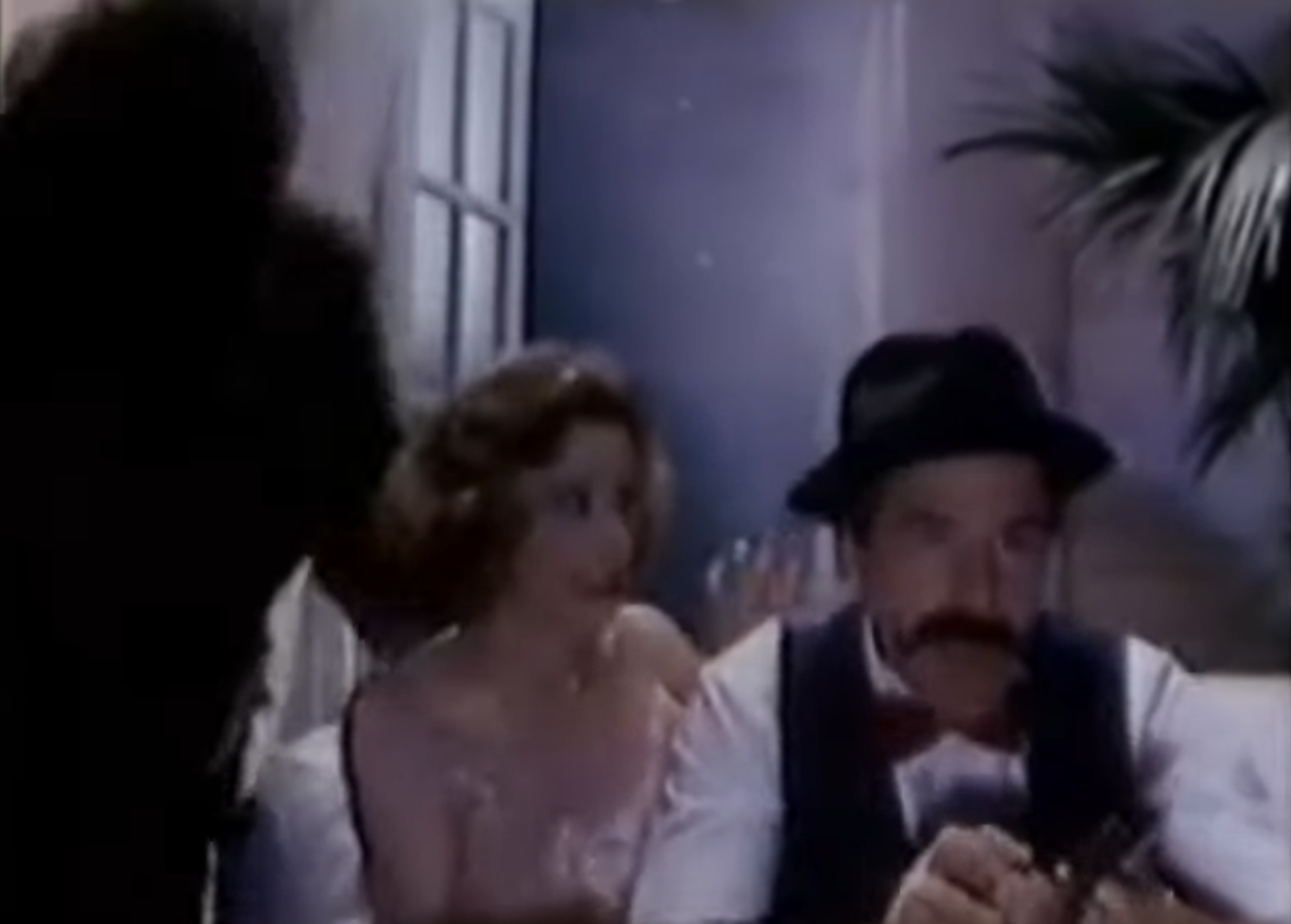
Nintendo Research & Development 1 worked on Donkey Kong, multiple Game & Watch titles, and the arcade game Sky Skipper simultaneously. Like Donkey Kong, Sky Skipper is also about rescuing captives from gorilla creatures. Miyamoto did cabinet artwork for both games.
Despite Mario originally being given the name Ossan (the Japanese term for "middle-aged man"),[51] Miyamoto envisioned Mario as a young man at around 24 or 26 years old, describing Donkey Kong as Mario's pet who escaped and kidnapped his girlfriend.[46]
Lawsuits[edit]
Universal Studios lawsuit[edit]
In 1982, around a year after the game's release, Universal Studios sued Nintendo, claiming that Donkey Kong infringed on Universal Studios's intellectual property rights to the film King Kong. Howard Lincoln, attorney and future president of Nintendo of America, decided to fight the case and hired seasoned attorney John Kirby to represent Nintendo. When Kirby showed that not only was Nintendo not likely in violation of any trademarks but also that Universal Studios themselves had sued RKO Pictures in 1975 to prove that the plot of King Kong was in fact in the public domain, Judge Robert W. Sweet ruled in Nintendo's favor, ordering Universal to pay Nintendo $1.8 million in legal fees. In an ironic twist, Judge Sweet also ruled that Tiger's King Kong video game, licensed by Universal, infringed on Donkey Kong. After the victory, Nintendo awarded John Kirby with a $30,000 sailboat, christened the Donkey Kong, and gave him "exclusive worldwide rights to use the name for sailboats."[52][53]
Crazy Kong[edit]
To meet the unexpectedly high demand for arcade machines, Nintendo licensed production to other companies.[54] Crazy Kong was an officially-licensed clone of Donkey Kong manufactured by Falcon. They were allowed to produce a certain amount of printed circuit boards (PCB) and were banned from exporting them. Falcon breached this agreement by producing more than 9000 excess units and also by exporting them to the US. On January 29, 1982, Nintendo terminated their license agreement. On June 1, Nintendo Japan filed for an injunction against Falcon in Kyoto District Court, which was granted on June 5. A countersuit by Falcon was won by Nintendo.[55] On October 13, Nintendo launched a lawsuit seeking damages against Falcon.[56] This experience led Nintendo to decide to produce all Donkey Kong Jr. machines by themselves.[57] Falcon's president was later arrested for unauthorized copying of Donkey Kong Jr. PCBs.[58]
On June 30, 1982, Nintendo of America filed a complaint toward Elcon Industries Inc., an arcade hardware manufacturer based in Michigan that sold Crazy Kong boards. The complaint alleged that the licensing agreement with Falcon explicitly forbade the manufacturing or export of Crazy Kong outside Japan. The case was taken to the United States District Court for the Eastern District of Michigan, which quickly ruled in favor of Nintendo.[59]
Ikegami Tsushinki[edit]
As Nintendo's newly established video game division lacked programming manpower, the arcade version of Donkey Kong was programmed by Ikegami Tsushinki, a contractor that had worked for Nintendo for several of its arcade releases.[2][3] For Donkey Kong's development, the two companies signed a contract which gave Ikegami Tsushinki exclusive rights to the manufacturing of Donkey Kong arcade boards.[2][3]
In 1983, Ikegami Tsushinki sued Nintendo on the ground that the comp