The 'Shroom:Issue 226/Strategy Wing

Director's Notes
Written by: Hooded Pitohui (talk)

Hello, all you readers of The 'Shroom, and welcome to the new year! I know you've been in the new year for half a month already, but, look, I'm bound to publication schedules. Anyhoo, I have exciting news to kick off the year. We have two guest sections this month. Maybe you've already read about them in the Sub-Director's notes? In case you haven't, firstly we have a fresh edition of Rising From Obscurity from Waluigi Time (talk). If you're a fan of classic Mario enemies returning, or recently got into the series and want to know the origins of some of the Mushroom World's resident species, you won't want to miss it. Secondly, we have the first-ever Strategy Wing appearance of hit indie game Deltarune, with Sparks (talk) covering a battle with a [Specil Appearance] by a [Celebrity Guest Star]. Whether you want to complete the battle [[playing on peaceful mode]] or [[violence is the answer]], BE A BIG SHOT! will point you in the right direction!
Aside from those, many of our regular features have some fresh coats of paint. You'll find a tweak to how counterattack methods are indicated in Brothership Boss Battle Guide, expanded details in the moveset tables of Pokémon Academy, and a new subsection for this edition of Killing the Killing Game Roles. Of course, with Mega Man 4 finished, your usual walkthroughs are now covering Mega Man 5, and with Yuan Shao in retreat, Lord Kong Rong is expanding his officer corps and territory this month.
That's all I have as news goes, but I'll have more for you as the year continues on! If you'd like to join our team this year, well, let me be the first to say we'd be thrilled. From hugely popular games like Super Mario and Deltarune to more niche titles like Romance of the Three Kingdoms, we cover all kinds of games. Have an obscure childhood favorite you want to write about? You'll fit right in! Give us your read on a character's history like Rising From/Fading Into Obscurity, give us a walkthrough covering multiple stages or even a single battle if you're more comfortable with a limited scope, give us short-and-sweet tips and tricks like in The Tattle Log, or break down and analyze a game mechanic or design choice. Your options are broad! If you're interested, take a peek at the red box on the sign-up page for instructions and send an application to MightyMario. I'd be happy to give you advice or input if you have questions, too!
Section of the Month
SPARKS (talk), YOU [[NUMBER 1 RATED WRITER2025]], YOU [[TWO FOR THE PRICE OF ONE]]'D FIRST PLACE! Congratulations on taking the gold for your quest to battle the Wily Capsule and for guiding everyone through the trials of the Great Conductor. Fittingly for a stage with four different game titles ending in "2", Zange (talk) takes a solid second for guiding us through tempo changes and devious rhythm-disrupting electric fish. Congratulations to Sparks and Zange alike for finishing off 2025 strong! I hope all of you readers will continue to support our writers with your votes throughout 2026!
| STRATEGY WING SECTION OF THE MONTH | ||||
|---|---|---|---|---|
| Place | Section | Votes | % | Writer |
| 1st | Brothership Boss Battle Guide | 3 | 23.08% | Sparks (talk) |
| 1st | An Overly Detailed and Funny Walkthrough of Mega Man 4 | 3 | 23.08% | Sparks (talk) |
| 2nd | Rhythm Review | 2 | 15.38% | Zange (talk) |
| 2nd | Pitohui's Pokémon Academy | 2 | 15.38% | Hooded Pitohui (talk) |
BE A BIG SHOT!

Hey there! Sparks here with a [[unique]] Strategy Wing section! If you haven't read Staff Notes, I mentioned that I recently played Deltarune and loved it very much. I'm currently in the midst of excitement, so I thought of making a short section about something from the game. Sadly, it's not a section about Ralsei (my favorite character, by the way), but ONE DAY! One day I'll write a history section about him in Pipe Plaza. That won't be for a while though... gotta wait until all the chapters release!
Instead, I'm writing a section about an encounter with a [[miniboss]]. If you haven't guessed by the few instances of bracketed text, it's about Spamton G. Spamton! A fan favorite character and one of the most interesting and funniest characters in the game, let alone chapter 2.
While progressing through chapter 2, Kris, Queen, and Noelle all enter a car to travel through Cyber City. They encounter a traffic jam that hinders progression, so Kris alone exits the car to find a solution. They enter a back alley with a dumpster. As Kris approaches, the dumpster opens up and reveals Spamton G. Spamton, everybody's favorite [[Number 1 Rated Salesman1997]]! He offers Kris a deal to become a [[BIG SHOT]], and all he needs is to see Kris's [[HeartShapedObject]]. That means a battle ensues!
Thankfully, you don't need [[Hyperlink Blocked]] to win this battle! I'll provide you with everything you need to know for the price of [[free]]!
The battle!
Time to battle against Spamton! He has three attacks at his disposal, all of which involve [[ENL4RGING]] his head:
- Deals: Spamton moves up and down outside of the box your SOUL is in, spewing out random deals out of his mouth. The deals travel in curved trajectories, some moving more along the y-axis (that's vertically!) and faster than others. The best way to avoid this attack is to stay on the left side of the screen, but make sure you don't get trapped in a corner. You may have to move to the middle of the screen to avoid such a scenario, but stay away from the right because that's where Spamton is!
- Vacuuming KROMER: Spamton begins to inhale, stretching out the box your SOUL is in a little to the right and deforming it into a trapezoid shape for the attack's duration. Like his first attack, Spamton moves up and down along the right side of the box - er, trapezoid, as he vacuums. Your SOUL also gets drawn towards the right as a result, so you have less control than you typically have. Dollar signs (KROMER) float in from the left side of the screen, all of them being drawn to Spamton. These are the obstacles you must avoid! All KROMER move slow initially, but speed up the closer they get to Spamton. You'll want to stay in the middle/right section of the trapezoid to have enough time to avoid the KROMER.
- Mini Spamtons: Spamton's toughest attack in my opinion. He sends out mini versions of himself that walk on the floor and ceiling of the box. Some of them crouch and flash white before jumping high into the air. Upside-down ones have reversed gravity. Staying in the middle will help you to avoid most of the mini Spamtons, but you'll have to move along the x-axis (horizontally) to dodge the jumping ones. I noticed the ones that leap won't do so until they get close to you, so it may help to be at the middle so that you won't get cornered by surprise. It's a tricky attack!
Here are images of all three of Spamton's attacks, in the same order I went over them in!
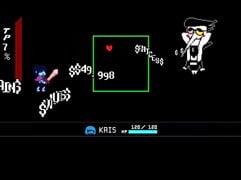 Deals so good, they hurt!
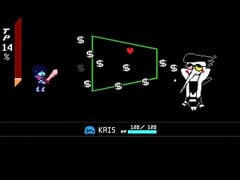 Eating all that KROMER can't be good for you.
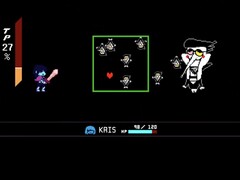 The world isn't ready for more Spamtons.


This is not an attack, but before Spamton's turn, he might say "[Press F1 For] HELP". If you do press F1 on the keyboard, an angel Spamton will fly down and heal you! This secret is also available in the console versions of the game! On Nintendo Switch and Nintendo Switch 2, press the right stick. For the PlayStation 4 and PlayStation 5 versions, press R3.
You can go about this battle two ways: by fighting, or showing mercy.
The quicker (and morally wrong) option is to battle Spamton. If you choose this route, make sure to equip your strongest weapon before entering this battle, but even if you don't, Spamton isn't much of a threat. He'll go down in about five turns. Just make sure to time your attacks well!
But if you're a pacifist like me, then you'll instead have to make choices to win this fight! Your ACT menu has three options: CHECK, DEAL, and HEALDEAL.
- CHECK involves just checking Spamton's stats. That'll all!
- DEAL allows you to make a deal with Spamton, where you'll have to select from two choices given to you. More on that later.
- HEALDEAL heals you 60 HP and has the same effects as DEAL, so it's very helpful if your HP is low. This move costs 50% TP, so you'll have to graze Spamton's attacks to get some. His deal and vacuum attacks are great ways to grind TP thanks to their many projectiles. The deal attack is especially helpful as the deals count as several projectiles, all of which are close to each other.
Correct Choices

If you want to be a [[nice guy]], you'll have to make deals with Spamton to make it through this battle. There are five main deals you must get through, and each one (except the last one) provides 20% mercy if answered correctly. Choosing the incorrect option will do nothing... and maybe cause a loss of cash.
- First deal: Spamton tells Kris about a special deal. The options are "TELL ME MORE" and "NOT INTERESTED". TELL ME MORE is the correct option here!
- Second deal: Spamton asks for a little bit of [[Generosity]]. Your two options are "GIVE MONEY" and "DON'T GIVE". DON'T GIVE is the correct option. Choosing "GIVE MONEY" will result in some of your [[KROMER]] being drained (you lose money)!
- Third deal: Spamton asks if Kris wants to be just like him and encourages Kris to take the deal. The choices are "DON'T TAKE DEAL" and "TAKE DEAL". TAKE DEAL is the correct option.
- Fourth deal: Spamton offers deal insurance for the low, low price of 1000 KROMER. The options are "BUY INSURANCE" and "DON'T BUY". DON'T BUY is the correct choice. Choosing "BUY INSURANCE" will result in a loss of KROMER.
- Fifth deal: Spamton offers 1000 Fr3e KROmer, but first he needs to see your [Account Details] and the [[Number on theB4ck]]. Your two choices here are "GIVE ACCOUNT ACCESS" and "REFUSE". REFUSE is the correct option. Choosing "GIVE ACCOUNT ACCESS" will - you guessed it - drain KROMER!
The fifth deal only adds 19% more mercy instead of the usual 20%, so Spamton will be left at 99% mercy. He then offers one last deal: the options here are "NO DEAL" and "YES DEAL". YES DEAL is the correct option. Choosing "NO DEAL" will cause Spamton to say "WRONG" before giving you a choice again. After accepting this final deal, Spamton will reach maximum mercy, and the fight ends.

Regardless of how you fought him, Spamton doesn't die. He leaves the scene in a short cutscene afterwards; however his dialogue varies depending on how you fought him. If you actively attacked him, Spamton criticizes your actions. If you spared him, Spamton instead encourages Kris to visit his [[Home-made Storefront Site]] in the [[Trash Area Closed For Repairs]].
That was goofy, wasn't it? Nothin' wrong with a funny section from time to time. Thanks for reading, and always remember to be a [[BIG SHOT]]! HAEAHAEAHAEAHAEAH!!
Brothership Boss Battle Guide
Welcome back to Brothership Boss Battle Guide, a recurring Strategy Wing section where you can learn all the tips and tricks you need to defeat the bosses of Mario & Luigi: Brothership! To start off 2026, I'll be looking at the second optional Glohm boss - Glohm Sharpcask! Because it's a tougher version of a boss we already fought against, this will be on the shorter side.
To make this boss available to fight, you must defeat Glohm Gobblick and retrieve the Ampberries from Wayaway Island. Dewey Fightem will then inform you about Glohm Sharpcask at the Color-Full Sea, Great Lighthouse Island. You don't have to fight it, but you'll get a powerful hammer if you win!
Here are Glohm Sharpcask's stats!
Glohm Sharpcask's stats
| Image | Level | Location | HP | POW | DEF | SPD | Type | EXP | Coins | Item(s) |
|---|---|---|---|---|---|---|---|---|---|---|

|
39 | Color-Full Sea, Great Lighthouse Island | 7000 | 235 | 294 | 585 | Glohm | 4000 | 1400 | Platinum Medallion |
Glohm Sharpcask's abilities
Glohm Sharpcask uses the same moves as his normal counterpart, so I'll only list the changes from the original attacks. From here on out, I'll give each attack a name instead of "Jump/Hammer Defense"! That's what the icons are for.
 Barrel toss: Glohm Sharpcask throws barrels at a faster speed. He also might delay throwing them to mess up your timing. The charge at the end is also quicker.
 Crate slam: Glohm Sharpcask's motions are much faster, so it's more difficult to strike him when he leans back.
- Barrel roll: Glohm Sharpcask rolls around more quickly.
- Barrel crush: This mighty attack is also faster, leaving a smaller opportunity to counterattack. The boss only does this attack when at low HP.


It goes without saying, but these attacks are much stronger and may inflict the Glohm status effect, as well as other status effects from the original versions. Also, Glohm Sharpcask may gain a two-hit spiky Glohm barrier after any attack ends.
After dealing enough damage to the boss, Glohm Sharpcask will protect himself, greatly reducing all damage taken and healing by 210 HP whenever it's his turn. The only way to get him out of this stance is to perform a successful Luigi Logic.
Unlike the original Sharpcask, Ecks doesn't show up to increase the boss's POW and DEF. That's good! He still gets angry at low HP though...
 Luigi Logic

The Luigi Logic is - for the most part - identical to the original Sharpcask's. The main difference is that bombs drop starting from the first use! The boss can't be too easy to defeat, no? Stack six crates on top of Glohm Sharpcask to dizzy him, allowing for all attacks against him to be critical hits temporarily. Like the original, the first successful Luigi Logic will cause the boss to tumble down conveyor belts, dealing many hits of damage and changing the battlefield.
Tips and tricks
Recommended gear
Get ready, because there's A LOT of new gear to cover!
I fought this boss after retrieving the engine part for Shipshape Island. So, I'm listing the gear you can find at the Jellyfish Island gear shop:
- Boots: Astonishing Boots/Supersonic Boots
- Hammer: Astonishing Hammer/Steel Hammer
- Wear: Astonishing Wear/Hex Wear
Supersonic Boots is four points stronger than Astonishing Boots, and also has the bonus of increasing your damage depending on how much SPEED you have. Mario typically has lots of SPEED, so they're great for him! Conversely, Steel Hammer also has four more points than Astonishing Hammer, but the damage is increasing depending on DEF instead! That means Luigi will benefit more, as he usually has more DEF. Hex Wear is two points stronger than Astonishing Wear, and also has the bonus of reducing the POW and DEF of attacked foes by 10%. Nice!
I do not recommend the Double-Edged stuff anymore. The damage is similar to what the shops have to offer, and taking damage just by attacking is not fun.
However, Conductor Island has some new gear after the Great Conductor fight:
- Great Conductor Boots: Is 16 points stronger than Astonishing Boots, and also increases SPEED by 8 and STACHE by 5!
- Great Conductor Hammer: Is 16 points stronger in POW compared to Astonishing Hammer, and also grants 7 points to DEF and 5 points to STACHE as a bonus!
- Great Conductor Wear: Is 9 points stronger than Astonishing Wear, and increases STACHE by 12!
Of course, there are other cool items to find out there of similar strength:
- Gobblick Boots DX: Still viable at this part of the game! 4 points stronger than Astonishing Boots and increases STACHE by 5. Also allows its wearer to heal 10% of all damage dealt!
- Forge Boots DX: Awarded for clearing the Jellyfish Pizza minigame on hard mode. It is 23 points stronger than Astonishing Boots, and also has the passive ability of increasing damage dealt by 30% when the wearer's HP is low.
- Adaphnikki Boots and Adaphne Boots: They have the same POW as Great Conductor Boots, but both have unique properties. Adaphnikki Boots increases damage dealt with Jump-attack combos by 30%, while Adaphne Boots increases the strength of single Jump attacks by 30%. You likely won't use normal attacks against Glohm Sharpcask, so either are fine. You can only get one of these Boots, and they're both from the Dueling Geniuses side quest. If you let both Adaphne and Technikki work together, you'll get the Adaphnikki Boots. If Adaphne worked on her own, then you'll receive Adaphne Boots instead.
- Full-Belly Hammer DX: Is stronger than Astonishing Hammer by 4 points, and also increases damage dealt by 30% when HP is full! Found inside a ? Block on Conductor Island.
- Dodgy Jump Wear DX: Found inside a ? Block in the back door of Bowser's Castle on Wayaway Island. It's the same strength as Hex Wear (two points stronger than Astonishing Wear) but also reduces damage taken by 20% if you fail to dodge an attack.
- Repel Wear DX: Found after clearing a puzzle on Morsel Islet. It's 21 points stronger than Astonishing Wear. It also has the bonus of reducing damage taken. The more enemies there are, the less damage you'll take!
- Blocky Hammer Wear DX: Found inside a ? Block on Dropplet Islet, but you'll have to take down three Glohm Shower Fish to get it. It is 9 points stronger than Astonishing Wear, but it also increases SPEED by 4 and decreases damage taken by 20% if you miss countering an attack.
Use whatever gloves and accessories you wish! Bring ones that fit your playstyle.
 Recommended Battle Plugs

So many Battle Plugs, but which ones are great for this battle?
 Anti-Glohm Specialist: The boss is Glohmed, so why not have a Battle Plug that makes all normal attacks + counterattacks stronger? Admittedly not as effective as it was for the Glohm Bowser fight, as it doesn't affect Bros. Attacks.
 Easy-Peasy Counters: Dodging these fast and powerful attacks isn't easy. Let's make them easier with this Battle Plug!
 Notdroppin: Most attacks from Glohm Sharpcask are big, single hits of damage. No matter how strong they are, you'll still be standing!
 Protectus: Has only 3 uses before it has to recharge, but completely nullifies all damage taken, no matter how many hits there are in a single attack! Only one charge goes down per enemy turn (if you get hit).
 Auto Ampberry: Glohm attacks, huh? With this Battle Plug, you won't need to worry about using up turns to cure yourself!
 Boomerang Items: Use your best items to recover your stats!


 Auto Mushroom, Auto Syrup Jar, and Deluxe Auto: Any of the first two combined with Deluxe Auto ensures top notch recovery while not using up turns!
 Auto 1-Up: If a brother was to get KO'd in the battle, this Battle Plug will get them back in the fight without delay!
 Waitaminnit: This Battle Plug isn't available until the end of the game, but if you're past Jellyfish Island, then you might have this awesome Battle Plug. It allows an additional turn! However, it only has three uses. Make them count by equipping this when the boss is dizzy!

 Bros. Boost and Performance Bonus: Make your Bros. Attacks stronger while using the same BP price! As long as you get "EXCELLENTS!" that is. Combine them with Waitaminnit and unleash mayhem!


Other things
I recommend fighting this boss before you storm Fortress Zokket the second time. You'll be at the recommended level (39) and have stronger gear, so this fight will be a little easier, but still tough.
If you're feeling brave, you can test your might while you're in the middle of the Gulchrock Sea. If that's the case, use the recommended gear I provided for the Glohm Bowser fight:
- Boots: Masterpiece Boots, and Double-Edged Boots from the shop, but High-Heal Boots DX and Gobblick Boots DX are better
- Hammers: Masterpiece Hammer, Double-Edged Hammer from the shop, but Bros. Hammer DX is better
- Wear: Masterpiece Wear from the shops, but Full-Belly Wear is better

If Glohm Sharpcask has a spiky Glohm Barrier, you won't be able to jump on him until it's rid of. If he performs his barrel roll attack while he has one, you won't be able to counterattack him to end the attack early. You'll have to get through the entire attack without landing on him. Due to the boss's high damage and multiple hits, Notdroppin won't reliably save you from demise. I recommend equipping Easy-Peasy Counters just in case this scenario occurs, just to be safe.
Glohm Sharpcask's barrel crush attack (with the bomb) is by far his strongest attack; I've seen it deal 351 damage to Luigi! LUIGI! It's definitely wise to have Notdroppin equipped, especially if you're fighting this boss as soon as it's available to battle against.
Use Bros. Attacks with many hits to remove Glohm Sharpcask's shield and also deal lots of damage to the boss at the same time!
Out of Ampberries? Use Refreshing Herbs instead! They won't always work, but they're better than nothing.
You don't have to fight this boss! If you can't win, just continue the story. No big deal! If you ever do want to win this battle easily, just wait until the end of the game.
Another Glohm Boss down! I'll continue this section with the boss in February's issue. The Extension Corps will be next in line! Thank for reading, and have a great day!
Killing the Killing Game Roles
Welcome back, readers, to another edition of Killing the Killing Game Roles, the section where we analyze various player roles from past Mario Boards Killing Games in hope of answering the question, what makes for a good role? By analyzing what's come before, we can discover some tricks and tips that could even help you design your own roles!
Early last month, Hooded Pitohui (talk)'s Randomizer Killing Game 2 saw its conclusion, and it was a phenomenal, bombastic finale at that. RKG2 is a very commendable game from all angles, including its case design, introductory nature for new players, and stellar playerbase that collaborated to make a cast of stand-out characters. With its recent completion and this extensive praise, you might assume my next step would be to pick one of the player roles from the game to analyze. After all, this section's already covered two roles from Awards Randomizer Killing Game, so what's another randomized role for the docket?
Well, we won't be quite covering a role from RKG2 today, although it might crop up with some surprising relevance later. Instead, for this month, we'll be lending our analytical eyes to yet another role from the Awards Killing Game 3 lineup - one that I have gone on record to say was one of the strongest roles in the entire game. Does this scrutiny hold up today? What can we learn about design tenets for KG roles through it?
Try not to get too scared, dear readers, as this month's section becomes a little more... ghastly.
AKG3 - Ultimate Ghost
- You're Spooky, the young ghost girl from the mansion at the top of the hill. Tired of waiting for brave, curious, or stupid souls to wander into your mansion, you've come out to New Wikisville in hopes of convincing someone to come and explore your home. In a turn of events, you're the one who's been trapped, and now you need to put your otherworldly skills towards escaping.
- If there's one thing you excel at, it's manipulation of the geometric space behind doors. Each night, you can specify one doorway between two rooms to alter with your ghostly powers. You'll be able to specify another door on the map which your altered door will connect to. Anyone who passes through the altered door (yourself included) will step through it into the location you linked it to, rather than their intended destination.
- As if you weren't already able to cause enough chaos, while moving around the map, you aren't limited to taking stairs and elevators when moving between floors. As a ghost, you can simply ascend or descend at will and phase through the floor. There are certain areas you won't be able to enter with this ability, such as locked rooms requiring special keys, and you won't be able to take any physical objects with you.
- Finally, with the special talent you possess, you can proceed to an altar and select one player to curse. Your curse will reduce their stamina and speed stats by two points each for a night. Since you only use this power when you're desperate though, you'll have to survive two nights before you can use this power.
- As a ghost who excels in scaring people, you're exceptionally stealthy. As a child who's been shut away in an isolated house for years, though, you're neither very strong nor social.
- FA: You're scary, most definitely not cute, and it's important that people know that. Be sure to explicitly attempt to scare someone every night.
Stats
- Strength - 1
- Stealth - 5
- Stamina - 3
- Speed - 3
- Social - 2
The Ultimate Ghost is blatantly pulled from Spooky, the titular character from Spooky's Jump Scare Mansion. If you're unfamiliar, I'm sure you can guess the premise just from the title. Like last month's Memory Manipulation Specialist, this role was another one to see prominence in the Peach's Castle game; unlike last month's, it survived to the merge map, Eternal Star, though its owner died at the very start of the Eternal Star game. The Ultimate Ghost was possessed (haha) by Dupe Face, a user who's no longer around but is most recognizable for his portrayal of Skullgirls's Beowulf in Awards Killing Game 2. Given that he was routinely partnering with the guy who had the Baba is You role, it's probably a blessing he died during that first night of merge.
That's enough preamble! Let's hop in and discuss what made this role so strong at the time.
General Overview
Unlike a few other roles we've looked at over the course of this section's life, I'd argue that the Ultimate Ghost doesn't neatly fit into a particular niche seen in Killing Game role design. There isn't one exact strength or aim to the role; instead, it incorporates multiple separate design concepts into one: map manipulation, movement possibilities, and debuffing. All three areas of design are pretty standard KG staples at this point, but are rarely mashed together in such a way. This kind of versatility inherently makes for a fairly powerful role, especially when many other AKG3 roles were designed with a singular niche in mind.
Now, there is something that needs to be discussed about how the Ultimate Ghost ended up functioning in practice. What made the role so extremely powerful to rank among Baba? Over time, with host leniency, some aspects of the role abilities ended up... changing. Rather than phasing up and down through the floor, eventually the Ultimate Ghost was able to move through any wall on the map. This made even having a map layout with walls a moot point. I identify this without any pointed commentary at my cohost; on-the-spot calls need to be made about role abilities for any host, and especially for a first timer, the call may end up erring in a more disruptive direction. Still, this was a notable aspect of the Ultimate Ghost by the time the game had wrapped up, and this requires some discussion.
Because the power leniency happened separately from the rolecard's written language, I won't be treating the role that way in the ability application portion; as always, we'll discuss the role purely as written. However, this gives me the chance to highlight the importance of pathing in KG.
Pathing is how a player identifiably moves around the map at night. When a player goes from point A to point B, another player might spot them, or they might leave some evidence behind, such as a specific smell or footprints. These markers are vital to the construction of a case, because you need to know vaguely where your other players were and when to ultimately build out a timeline. With how the Ultimate Ghost eventually turned out, they were able to move seamlessly between rooms, without concerns about doors, and without leaving any visible evidence behind. In essence, pathing them became much, much harder. They could still leave evidence somewhere or have an eyewitness spot them, but the standard hallway pathing no longer applied, nor did the timelining that typically comes with it.
Ultimately, when constructing a potent role ability, an important question is this: does this role ability act in such a way that it disrupts my hosting responsibility to build a solvable case? To be clear, this doesn't mean a player's role can't throw a large wrench into the solving efforts; rather, it's worth saying that KG case balancing between culprit and investigators is a tricky one, and a role that completely negates a key case component like pathing can cause that balanced scale to become unevenly weighted.
Are there ways to rebalance this kind of role ability overall? Absolutely, which will be discussed later on.
Ability Application
Right, yes, onto the rolecard proper. Firstly, we have the ability to swap two doorways on the map, causing one room to lead to another unexpectedly. There's quite a good number of use cases for this ability. For instance, if you want someone to walk into a surprise trap kill you've set, you could link one door to that trapped room. Or if you feel compelled to disrupt the nights of several players, you could intentionally guide people away from a room where an event was set to take place. My favorite utilization of this I can think of is purely benefitting yourself; let's say a magic MacGuffin was found in a room all the way in the basement, and you want to get there first. Just turn the nearest door into a warp down there, and the item's all yours. There's a ton of versatility with how to handle this.
The one aspect I would say needs better clarity is how the door works as a two-way entrance point. If you step back out that door, do you find yourself back where you started, in front of the false door? Or do you enter the hallway outside of the new room? The answer would change your strategy for interacting with the door. Minus World's Killing Game 9 actually had a role with a very similar ability, and the door warp worked in both directions, alongside some extra time consumption. That's not really important, other than to say that I should pull in a KG9 role eventually.
Next up, there's the ability to move between floors seamlessly. With this being an unlimited resource during the night, this grants the Ultimate Ghost the boon of very expedient map travel. While some other players might have to go through the hall, go down the stairs, and then go through the hall again to get to a room, the Ultimate Ghost can just drop right in! This also comes with the element of surprise; if you'd prepped a kill attempt in one room, you could phase in whenever you wanted to enact it, and then dip just as quickly. Even with the intended limitations of just being between floors, this is still a markedly potent trait.
Lastly, there's the ability to curse a player at an altar, thereby lowering their speed and stamina. This is probably the weakest component of the Ultimate Ghost's toolkit, for a few reasons. The power itself isn't instantaneous like the rather two; instead, you need to "proceed to an altar" first. What an altar is isn't really specified by the rolecard. Is it something found on the map, or something the player needs to build themselves? Or is it just in there for flavor, which would honestly be more confusing? Then there's the fact that it impacts speed and stamina stats specifically. As I've mentioned briefly before, stats have always sat in an odd place in KG, where they can be critical for some interactions if the host really cares, but more often than not they're a nonfactor. In KG3 specifically, the speed debuff would cause someone to start their night later, which I guess is a fair enough debuff? If the curse more explicitly made the player sluggish or weak, though, I think this role ability would see more purpose.
Environmental Functionality
What environmental considerations are there for the Ultimate Ghost? For this role to function as intended, the map absolutely needs two things: floors and doorways. This might seem like a "well duh", but some KG maps have been flatter and much more open in their design. For instance, Awards Killing Game Odyssey's Circitus Island was primarily played on level ground, with plenty of areas near the shore and jungle that weren't technically rooms with doorways. The Ultimate Ghost would struggle with its key strengths there, compared to a map like, say, Awards Killing Game 4's Deimos Matrix Corp, which had multiple floors and was more densely packed with rooms.
The other aspect is the altars, which again, go without clarification on the rolecard. I think it'd be cool if your map had an altar hidden somewhere though, or some clear components stashed somewhere to make an altar yourself. Make something more diegetic that way.
Drawbacks & Balances
What is there to keep the Ultimate Ghost in check for some of these more powerful traits? When it comes to the door swapping, there is the natural limitation of one door per night, but there is also the fact that it impacts the Ultimate Ghost themself. This isn't inherently a drawback, as I mentioned in its practicality previously - but it could still bar the Ghost from wanting to get to a room of interest to them, and they might have to bite that bullet for the sake of laying a good trap.
The movement between floors has some more inherent limitations to it. Not being able to get into special areas or specific locked rooms is for sure significant. Really, this caveat was added to dissuade a player from accessing something narratively important ahead of time, or otherwise cheesing their way into a room with an important item. I'd be curious to know if this applied to any locked room on the map, or just the ones the host deemed too important to give access to early.
There's also not being able to take physical objects between floors. Now, I would assume this to mean items such as weapons or large pieces of furniture cannot be smuggled between floors, which is a very important balancing tool. Imagine if someone could instantaneously phase in and out of the Gun Room to get as many guns as they wanted, whenever they wanted, with bizarre pathing. This limitation is vital in ensuring this role isn't already more busted than it is. I do wonder what else counts as physical items, though. What about clothes? Lore notes? Smaller, "insignificant" items like jewelry? There isn't an obvious exact line, though the intentionally still remains clear.
The altar ability has the unique edge of only being accessible from Night 3 onwards. Do I think the power is strong enough on its own to justify this? Likely not, but it does mean an already-stacked role needs to wait a little longer to have additional benefits, so I won't complain too much.
Lastly, there's the Forbidden Action, and it's... I mean, it's not really a factor at all. Once upon a time, there used to be many more "you must do [x] thing once per night" FA's, and they've honestly fallen out of favor for me. Many of them are tacked onto the role to give the player something extra to think about, as opposed to something that tactfully restricts the role abilities themselves. This FA of "you must scare someone once per night" is hardly anything. Just yell "BOO" at some point to finish your chore and move along.
Player Responsibility
For a player's responsibility with this role, there isn't a ton of intricacy that they need to navigate. They'll have to keep their FA in mind, and they should reasonably remember the restrictions on their floor-to-floor movement, unless they want to be disappointed when their newly-acquired knife doesn't come with them. If the altars mentioned by the third power are meant to be created by the player, they'll also have to navigate setting up an altar of some kind on the map. This responsibility could be heightened if the altar was intentionally hidden and needed to be found, or if making an altar had specific qualifications that needed to be upheld. Still, there are not any resources to keep track of, or any other obligation to play the game in a particular way.
Host Responsibility
The host does have a bit more responsibility with this role, but honestly, not too much more than the player has. The host will need to make sure that the restrictions on the floor movement are being honored, and will have to ensure that the warp door functions correctly for all players who attempt to access the room. Arguably, the greatest responsibility for a host managing the Ultimate Ghost is ensuring that the case is still solvable if they end up landing a kill - which is certainly easier as-written, rather than how the role ultimately played out.
Future Iteration
Appearing for the first time in Killing the Killing Game Roles, we'll be looking at a different role from later on that essentially reiterated this role's core concepts, in a way that feels helpful for discussion. You'll remember paragraphs ago when I mentioned that Randomizer Killing Game 2 would have shocking relevancy to our analysis today. As it turns out, both myself and Cloudwalker (talk) started out the game with the following role trait:
- +You can freely pass through walls. This will leave ectoplasm on the wall where you passed through, though it will not discernibly be yours specifically.
What's this? Passing through walls with a ghostly flair? Why, that sounds awfully familiar!
In sincerity, I doubt this specific submission was made in memory of the Ultimate Ghost, a role that is, by this point, six years old. The parallels still remain, though, and I want to highlight this new iteration on the role concept because of an issue it helps to correct. See, this trait allows its user to move through any wall they encounter, without limitations on even locked rooms - a truly powerful ability, if earlier discussion is to be believed. So what makes this role much more reasonable balancing-wise?
Simply put, it's the visibility of the role. The Ultimate Ghost's wall slipping was invisible, leaving no trace that the movement ever happened. With this role trait, though, ectoplasm is left behind, allowing for somebody to investigate the role use during the day. Even if a player encounters ectoplasm on the wall and has no idea what it could be about, they might investigate the next room over, discover matching ectoplasm on the opposite wall, and then deduce what the nature of the ectoplasm was. Additionally, though the tell is there, a clever ghost might find a way to disguise the ectoplasm after moving through the wall, or warp from an unexpected nook or cranny where the ectoplasm isn't easily seen. The nature of this rolepower can be obscured with the right actions. Still, the evidence left behind allows for more certainty when trying to path the player who used it.
I would argue this is altogether an improvement on what the Ultimate Ghost's movement between rooms came to be in AKG3. This certainly isn't the only way to recalibrate the role, but for my money, this is one of the best ways to go about it. KG is, first and foremost, a game about solving murder mysteries. An adjustment like this allows you to incorporate satisfying, tangible clues into your case writing.
Overall Thoughts
In conclusion, the Ultimate Ghost is a role with a myriad of different strengths, though its legacy remains mostly for what the role became through circumstance. As RKG2 demonstrates, oftentimes these big ideas just need a little tweak to make them stand out as well-crafted and balanced while still retaining their uniqueness. If you're looking to create a role with special mobility traits, remember that a restriction or a tell are a surefire way to maintain a sturdier role balance overall - and that a KG player will almost always enjoy a little challenge in how to use their roles in clever ways.
That’s all for this month. Tune in next month for more Killing Game goodness!
Rhythm Review
Hello and welcome back to Rhythm Review! This is Zange, and I am eagerly awaiting the announcement of a release date for Rhythm Heaven Groove!! Very thrilled for the new game, y’all. Anyways, last month we covered Stage 7 of the original Rhythm Tengoku for the GBA and all of its tricky sequel glory. This month we are putting a nice little bow on this chapter of Rhythm Review with Stage 8, which happens to be the final stage of the game! I’m a little sad that we’re already here but that means we’re about to move to rhythm minigames that all have official English titles so I can’t complain too much.
As a reminder: In most Rhythm Heaven games, a stage consists of four rhythm minigames, followed by one remix, in which all the other minigames in the stage are put together in a new way to new music. However, Rhythm Tengoku is weird and has five minigames in each stage instead of four, and there is still a remix. Let’s jump in!
Bouncy Road 2

We’re starting off the set with Bouncy Road 2! Those balls just keep bouncing, dang it! Much like the original Bouncy Road, you hit the D-pad and A buttons to help balls complete their travels down a path once the balls get to the respective poles.
Gimmicks
In the original, there were only two speeds a ball could travel: fast and medium. This sequel adds the very slow balls in, meaning you really have to pay attention to the speeds at which they’re travelling down the path. Additionally, there are now more clusters of two and three balls travelling down at a time.
How to Get That Superb
The criteria for getting a Superb here is pretty similar to the original: You need to have good timing when it comes to the clusters of multiple balls, and just have good timing overall so that a majority of the balls make it to the end of the path. The clusters might throw you off your timing a little bit, so getting the Superb might take a bit here.
Difficulty Rating
Hooo boy I forgot how tricky this one is… We’ll call this one a 3/5.
Toss Boys 2

Up next, we have Toss Boys 2! Those cute, color-coded tossers are back and ready to train for the Toss Championship! Like in the original Toss Boys, you’ll hit either the A button, the B button, or the D-pad to toss the ball between these three friends depending on whose name is called out. Train your way to tossing excellence!!
Gimmicks
Nothing new is introduced gameplay-wise, however, the toss patterns are a bit more complicated here than they were in the original, with the toss techniques appearing more frequently. Stay sharp out there!
How to Get That Superb
The Superb criteria here is exactly the same as it is in the original: have good timing on the normal tosses, as well as all of the toss techniques. If the toss techniques were giving you trouble in the original, it may take you a few extra tries to get the Superb here, but otherwise this one is fairly simple.
Difficulty Rating
This really isn’t that much harder than the original, so we’ll give it a 1.8/5.
Polyrhythm 2

Moving on, we have Polyrhythm 2! We’re back in the Widget factory, and there’s more objects that need to be transported! Like in the original, you’ll hit either the A button of the D-pad to repeat the rhythm presented to you to help these red rods get to their destination. This one starts out easy, but very quickly devolves into rhythmic madness!
Gimmicks
You will immediately notice that the song tempo is considerably faster in this sequel. Additionally, there is much more of an emphasis on hitting the offbeats here. This is also one of the few rhythm minigames that builds on itself: in the beginning, you are making inputs only with the A button. By the end, you will be required to hit different rhythms with the A button and the D-pad.
How to Get That Superb
Full disclosure: unless you either: a. Have an EXTREMELY good sense of rhythm, or b. Have prior experience as a drummer, pianist, or something else that requires you to do different things with both hands at once, you are nooooot getting the Superb on this for a while. One of the criteria is literally that both of your hands need to be able to work independently of each other when it comes to the different rhythms. (The other is that you need to be consistent in hitting the offbeats.) It may take you a lot of practice, but getting a Superb here is doable.
Difficulty Rating
This one’s definitely a doozy… Dare I say, it’s worthy of a 3.7/5.
Spaceball 2

We now go to Spaceball 2! We’re back out in space hitting baseballs for funsies! Like in the original, you’ll hit the A button to hit baseballs in rhythm, while paying mind to the highballs. Steel drums and baseball have never been cooler…
Gimmicks
Remember how in the original the camera would zoom in and out at various points? Well now the camera is zoomed out for a majority of the time! Additionally, the second part of this rhythm minigame involves you constantly hitting balls at high speed, as the tempo changes to be very fast and only continues to get faster until the end.
How to Get That Superb
Okay, pretty straightforward Superb criteria this time as well: You need to have good timing on your hits during the zoomed out portions, as well as during the second half when it’s extremely fast. It might take a few tries, especially because the speed in the second half is likely to throw people off, but getting the Superb is very doable here.
Difficulty Rating
This is a really weird one to rank because on one hand, it is quite a bit harder than the original but on the other, the grading for a Superb feels really lenient… We’ll give this one a 2.8/5.
Sneaky Spirits 2

The last normal rhythm minigame in the set is Sneaky Spirits 2! Time to go ghost hunting again! Like in the original, you will hit the A button on the 8th beat of a set in order to shoot an arrow at a ghost to capture it. However, beware of tempo shenanigans and ghosts who like to hide!!
Gimmicks
Ooo boy, things really get fun here. So, there are ghosts that won’t show up until the last few beats, as well as ghosts who will disappear for the last few beats before you need to shoot them. The tempo changes also get real fun, as there are a few rounds of reeeealllyy slow ghosts as well as some really speedy ghosts. Having a good internal sense of rhythm has never been more important.
How to Get That Superb
So, fairly straightforward Superb criteria: You need to be able to have a good sense of internal rhythm, which includes being able to accurately hit the ghosts that disappear in the last few beats before you’re supposed to hit them. You also need to be able to adapt to the tempo changes, especially the very slow parts. It might take some practice, but getting a Superb here is very doable.
Difficulty Rating
Another weird one to rank because it doesn’t feel all that different from the original… We’ll give it a 2.3/5 because some of those fade-outs are on the tricky side.
Remix 8

At last, we’ve reached the final remix in Rhythm Tengoku! This is meant to be a true test of your rhythmic skills, and it really does feel like it from the moment you start playing. In a way, everything up until now has been leading up to this!
Gimmicks
For once, there’s gimmicks here that weren’t previously featured in a rhythm minigame! Two very important things to go over here. So you remember the Flow gauge from Karate Man? At one point during this remix, it goes away entirely, and there’s a visual change with the rest of the screen as well, and you’re able to hit anything at any time from that point forward! Additionally there’s a few segments of Rhythm Tweezers where the hairs are covered up by a special sign, and you have to rely on your own memory in order to repeat the rhythm back. Why they didn’t just put that gimmick in Rhythm Tweezers 2 and then bring it back for this remix, I couldn’t tell you…
How to Get That Superb
Saying the same thing I always say, every time a remix shows up: Because this is a remix, it’s a lot harder to determine where the line lies between a Superb and an OK rating. I will not sugarcoat this: Remix 8 is a very difficult remix, and it took me many tries to be able to get a Superb on it myself. The best thing I can say here is practice this remix, as well as the rhythm minigames and their sequels that appear here, and you will get the Superb with enough time.
Difficulty Rating
Woof. Certainly a doozy of a final remix we have on our hands here… I believe this challenge is worthy of a 4/5. Pretty sure there’s triplet beats in some of those Rhythm Tweezers sections and honestly, the Rhythm Tweezers segments alone justify the score here.
Final Remarks
Man, Nintendo and Tsunku really gave us a challenge of a final set in the game, huh… But, we did it! It’s over! We’ve gone through an entire game in the Rhythm Heaven series, and that’s something to celebrate in and of itself. If you’ve been playing along with this guide, give yourself a pat on the back! If you’ve just been reading along, give yourself a pat on the back too because that means you read through all my yapping which is its own achievement!
This section will be taking a break next month in order to give myself time to adjust to new hardware and mechanics for the next game, but we’ll be back in March for Stage 1 of Rhythm Heaven for the Nintendo DS!
Rising From Obscurity
Written by: Waluigi Time (talk)
Hello there 'Shroom readers, and welcome to Rising From Obscurity, the section where I very occasionally look at Mario characters that disappeared and then came back. The Super Bowl is coming up in a few weeks for those of you are interested in that, so I was inspired to take a look at one of my favorite Mario enemies, Chargin' Chuck!

Chargin' Chuck was introduced in Super Mario World in 1990 as a pretty prominent enemy, appearing in 23 of the game's 70ish levels (there's a whole thing on the wiki's page with different numbers depending on what you actually count and I'm not going to go into all that). They're pretty interesting there as more durable enemies than what had appeared in the platformers to date, and with a number of different behaviors throughout the game. With the 90s arguably being the peak of other forms of Mario media, Chargin' Chuck made a number of appearances outside the games in Super Mario-kun, the Nintendo Adventure Books, Super Mario Adventures, and of course the Super Mario World cartoon. Inside the games, though? Aside from showing up as a boss in Yoshi's Safari, not really anything! They later appeared in a single level in World-e of Super Mario Advance 4: Super Mario Bros. 3 in 2003, one which actually did manage to make it out of Japan, but after that, they faded into obscurity like so many of the other enemies introduced in World...

Until ten years later, when they went from a 2D world to a 3D world - Super Mario 3D World, that is! Chargin' Chuck's transition to 3D was pretty smooth, only losing a little bit of durability (going down in two hits rather than three). The various behaviors they had in their debut game disappeared, leaving them only to charge at the player, per their namesake. I'm assuming Nintendo didn't want to potentially confuse players by having one enemy design behave differently in different levels. Also, we got to see what they look like without their helmet on! They returned as enemies in Captain Toad: Treasure Tracker, and jumping ahead a little bit, Super Mario Odyssey, but we like variation in this section so how about getting into other roles?
Chargin' Chuck made the jump to spinoffs fairly quick from there, following up their Treasure Tracker appearance with a boss role in Mario & Luigi: Paper Jam in 2015, going on to appear in both of the AlphaDream remakes. They also got a couple of Mario Party appearances up their sleeves, primarily as obstacles in minigames in Super Mario Party and Jamboree. And not content to just show up in Mario & Luigi, they were also enemies in Paper Mario: The Origami King, although sadly they only appeared as Folded Soldiers, so we don't know what paper Chucks look like yet. You know, if they wanted to bring back partners in the next game, a Chargin' Chuck partner would be really cool... Just saying...

And that's all well and good, but in 2021, Chargin' Chuck became playable for the first time (unless you count Odyssey's capture) in Mario Golf: Super Rush! You know, the sport that Chargin' Chuck is famous for playing! It's such a weird pick but I'm not complaining at all, it's funny. If they can throw baseballs in 1990 they can play golf in 2021. The Chargin' Chuck quest to dominate all Mario sports continued with being added as a driver in a 2022 update to Mario Kart Tour, and returning in Mario Kart World as well! Aside from a playable role, Chargin' Chucks are also obstacles in the latter game, bringing back some of the alternate behaviors from Super Mario World which is pretty cool. As far as I can tell, that's the first reference to any of them since Advance 4.
And that brings us to today, because there haven't really been any brand new Mario games since then (what, did you expect Chargin' Chucks in Bananza?). I'd say going from being a pretty forgotten enemy to being playable multiple times in recent years is pretty good, wouldn't you? And who knows, maybe Chargin' Chuck's quest to play all the sports will continue with Mario Tennis Fever in about a month! They still haven't revealed all the playable characters yet, it could happen! (P.S. Nintendo, please don't embarrass me by releasing a Direct with the rest of the roster between the time that I wrote this and the release of this issue, thanks.) [EDIT: Dang it.] I don't expect Chargin' Chuck to be a constant roster mainstay, but hopefully the funny football guys continue to stick around.
Pitohui's Pokémon Academy
Written by: Hooded Pitohui (talk)
Welcome, welcome. I trust you've kept well over the turning of the year? Consider this your reminder to check any dates you write today. Don't allow the lingering specter of 2025 to haunt you throughout 2026! It is best that you dispense with your day-to-day grudges and regrets from last year, lest you attract spirits other than those lingering in your cabinets after those New Year's Eve celebrations. You see where this is leading, yes? For this session, the subject of our discussions shall be a Ghost-type. As suggested to me by an octopus of some sort I met at the seaside, I have brought a Cursola, the freed spirit of a deceased Corsola.

|
The following information applies specifically to Pokémon Sword and Pokémon Shield V 1.3.0+, the latest games in which Cursola is available. | 
|
The standard glossary follows below, should you need to consult it. If you are familiar with our terminology, please do skip it and we will get on with the lecture promptly!
Base Stats: Base stats are the values associated with a particular Pokémon species, and are the same across every individual Pokémon of a given species. You have no influence on them. You can think of them as traits tied to a species. A chimp isn't ever going to be able to get as good as digging as a mole will be, and, likewise, an Abra is never going to have the defensive prowess a Shuckle has.
Individual Values (IVs): Individual values, as their name implies, are associated with individual Pokémon. They range from 0 to 31 in each stat, with 31 being considered a "perfect" IV and higher numbers corresponding to different stats. Magikarp A and Magikarp B will have the same base stats, but they may very well have different IVs. To stick with the animal analogy, one mole may be born with larger claws than another mole, and that first mole is probably going to have an easier time digging through dirt than the latter. Individual values are set in stone, strictly speaking, but you can use Hyper Training (from Generation VII onwards) to functionally get a perfect IV in a stat.
Effort Values (EVs): Effort values are the one thing you can easily change. A Pokémon can earn, primarily through battling, but also through means like the use of certain items or mechanics like Super Training, up to a total of 510 effort values, with up to 252 in any given stat. To finish off the animal analogy, no matter what kind of claws a mole is born with, moles who have more experience digging are probably going to be better at digging than moles which have never dug.
Nature: A Pokémon's nature is, more or a less, a stat modifier with a name meant to make it sound like a Pokémon has some personality. Natures will raise one stat by ten percent and lower another stat by ten percent. Some natures raise and lower the same stat, canceling out the effect and leaving stats unchanged. Natures can be functionally changed with the use of special mint items from Generation VIII onwards.
STAB: STAB stands for Same-Type Attack Bonus, and refers to the boosted power of moves that match the type of the move's user. To illustrate this, consider the case of a Lombre, a dual-type Pokémon which is both a Water-type and a Grass-type. Any Water-type moves Lombre uses will have their power boosted by 1.5x, and any Grass-type moves Lombre uses will, likewise, have their power boosted by 1.5x. (There are circumstances where this does not apply, and, while the 1.5x multiplier is typical, some games use other multipliers.)
Bulbagarden Archives: Not a term to be defined, but the source of many of the images used in this section. I thank those who maintain it as a resource.
For more information on the terms defined here and how you can raise Pokémon, feel free to consult this guide. It is written with Pokémon Scarlet and Violet in mind, but its broad principles are applicable through many of the main series games beginning with Ruby