Dino Roar
| Dino Roar | |||
|---|---|---|---|
 Screenshot from Mario Kart Live: Home Circuit | |||
| Appears in | Mario Kart Live: Home Circuit (version 1.1.0) (2021) | ||
| |||
| |||
- “The dino fossil lets out a big roar and slows down any kart that drives into its path”
- —In-game description, Mario Kart Live: Home Circuit

Dino Roars are obstacles in Mario Kart Live: Home Circuit. They are fossilized dinosaurs that appear embedded in the gates, with only the front half of their bodies visible. They appear one per gate and can be found on the left or right sides. Dino Roars at first appear still, but periodically they will lift their heads and make a big roar that slows down the racers driving through their path. Dino Roars appear in the final track of the Mario Cup, Fossil Fields, where only two of them are present. After fulfilling certain conditions in the Mario Cup, one of the unlockable gate features that can appear is Dino Roars. Dino Roars are very similar to Piranha Plants from the same game, as both appear embedded in the gates, and their positions change from right to left. In the same gates where Dino Roars appear, fossilized Fish Bones also appear.
Gallery[edit]
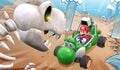 A Dino Roar on the Fossil Fields course icon
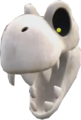 Gate feature menu icon
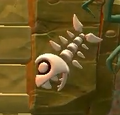 The Fish Bone present in the gate


Names in other languages[edit]
| Language | Name | Meaning | Note(s) | Ref. |
|---|---|---|---|---|
| Japanese | ほえるかせき Hoeru Kaseki | Roaring Fossil | [1] | |
| Chinese (Simplified) | 恐龙咆哮 Kǒnglóng Páoxiào (Mandarin) Húnglùhng Pàauhāau (Cantonese) | Dinosaur Roar | [1] | |
| Chinese (Traditional) | 恐龍咆哮 Kǒnglóng Páoxiào (Mandarin) Húnglùhng Pàauhāau (Cantonese) | Dinosaur Roar | [1] | |
| Dutch | Dinobrul | From dinosauriër ("dinosaur") and brullen ("to roar") | [1] | |
| French | Portique fossile | Fossil Gate | [1] | |
| German | Dino-Tor | Portmanteau between Dinosaurier ("dinosaur") and Tor ("gate") | [1] | |
| Italian | Dino | - | [1] | |
| Korean | 포효하는 화석 Pohyohaneun Hwaseog | Roaring Fossil | [1] | |
| Spanish | Dinobramido | From dinosaurio ("dinosaur") and bramido ("bellow") | [1] |

