Monster (Wario's Woods)
| Monster | |||
|---|---|---|---|

| |||
| First appearance | Wario's Woods (1994) | ||
| Latest appearance | NES Remix Pack (2014) | ||
| |||
| |||
The monsters[1] are Wario's minions and main enemies of both the NES and SNES versions of Wario's Woods. They are a band of monsters composed of seven variants, each distinguished by their colors.
History[edit]
Wario's Woods[edit]
Monsters are the main obstacle to clear in a level: by aligning at least two monsters with a bomb by the same color, they are eliminated. By clearing the screen of all monsters, the level is cleared and Toad proceed to the next one. Monsters, however, have a way to be regenerated: during "Monster Time", the Black Bat will drop both bombs and monsters, while in the SNES versions, an egg will also be dropped by the Black Bat, from which a random monster will hatch and a row of that monster species will be dropped. Another way to quickly clear the monsters is by using a diamond, which appears by clearing a row of five elements in one hit: by using the jewel as a bomb, all the monsters of that color will disappear. By defeating a specific species in a certain direction, the Sprite will drop more bombs on the field.
Super Mario Kodansha manga[edit]
In Super Mario: Wario no Mori volume of the Super Mario Kodansha manga, the monsters are Fauster's minions and the demon allows Wario to use them to grant his wishes as a reward for setting him free. Wario uses them to kidnap Peach and marry her, but his plan is thwarted by Mario, who eliminates the monsters with Wanda's bombs. When Fauster first fuses with Wario and later with Luigi, he can summon a sea of monsters to take over the Peaceful Woods and later the world. In this manga, monsters are normal underlings, but a Dovo is able to speak as the priest at the wedding.
Some monsters appear in Uribō's chapter in Super Mario 4-koma Daikōshin. They are depicted as inpet minions, on account of them being unable to move. Two Spuds and a Spook get a center stage role in two skits: the first two are spared from Toad's bombs, only to discover they are about to become his dinner due to their turnip-shaped bodies; while a Spook pleads for his life arguing that, due to his mushroom nature, he is related to Toad, but he does not fold. In the end, Wario ends up selling them as vegetables at the market, which are then bought by Toad for dinner.
Super Mario-kun[edit]
In Super Mario-kun, the monsters are Wario's minions in volumes 11 through 13 (with a Fuzz having a higher role in command) and help him by sending their best soldiers against Mario and the others, but rarely do they jump into battle. Fauster uses them in his chapter, then some monsters are seen corrupting Mad to their side by polluting the waters, Seizer is followed by some monsters that died with him and now have skulls motifs instead of faces, and the monsters build Drago and copy Wario's personality into it. Lastly, the last remaining five monsters disguise themselves as Wario, then fuse together to stop the heroes, but are ultimately defeated, leaving Wario without minions for the last chapter of the story arc.
Monster species[edit]


Gallery[edit]
Artwork[edit]
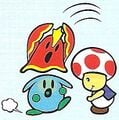 Toad placing down a Dovo and a Fuzz
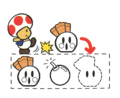 Toad kicking a Spud
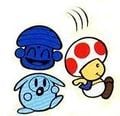 Toad falling off a stack of monsters
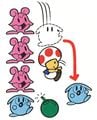 Toad throwing a Fuzz in midair
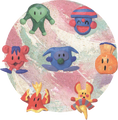 Super Mario: Wario no Mori (back cover)


Sprites[edit]
NES[edit]
 Beaker
 Dovo
Dovo Fuzz
Fuzz Scram
Scram Spook
Spook Spud
Spud Squeak


SNES[edit]
 Beaker
 Dovo
Dovo Fuzz
Fuzz Scram
Scram Spook
Spook Spud
Spud Squeak


Scans[edit]
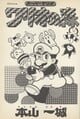 Super Mario: Wario no Mori story arc cover
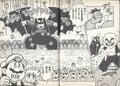 Satan Wario releasing monsters
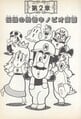 Super Mario: Wario no Mori Chapter 2 cover
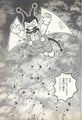 Debiruīji releasing monsters
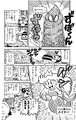 Wario and a Spook corrupting Mad
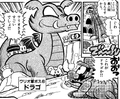 The monsters finish building Drago


Names in other languages[edit]
| Language | Name | Meaning | Note(s) | Ref. |
|---|---|---|---|---|
| Japanese | モンスター Monsutā | Monster | [2] | |
| Italian | Mostro | Monster | [3] |
References[edit]
- ^ "Since the invasion of Wario and his band of monsters, though, this quiet community has been turned upside-down." – Nintendo (1994). Wario's Woods instruction booklet. Nintendo of America (English). Page 13 (NES)/2 (SNES). Retrieved April 6, 2025.
- ^ Wario no Mori Famicom instruction booklet, fold-out.
- ^ «Dopo l'invasione di Wario e della sua banda di mostri, questa tranquilla comunità è stata messa sottosopra.» – Nintendo of Europe (1994). Wario's Woods (NES) libretto di istruzioni. Nintendo (Italian). Page 13.
| Wario's Woods (NES version, SNES version) | |
|---|---|
| Protagonists | Toad • Birdo • Sprite • Abataa • Satebôa |
| NES bosses | Fauster • Boom • Mad • Goro • Seizer • Drago • Fake Wario • Wario |
| SNES bosses | Katsini • Galrog • Harley Q • SamSpook • Sven • Parrotor • Mssr Boo • Aqualea • Razor • Tad Rock • Thak • Lizardon • Sarissa • Mangylox • Dedar • Carlton • Harry H • Wario |
| Enemies | Monster (Fuzz • Spud • Squeak • Beaker • Scram • Spook • Dovo) • Thwomp • Pidgit |
| Items | Bomb • Coin • Diamond • Egg |
| Locations | Wario Castle • Wario's Woods |
| Satellaview versions | Wario no Mori Bakushō Version • Wario no Mori Event Version • Wario no Mori Futatabi |
| Adaptations | Super Mario (Super Mario: Wario no Mori · Super Mario 4-koma Daikōshin) • Super Mario-kun (Volumes: 11 · 12 · 13) |
| Miscellaneous | Gallery • Power Challenge Trading Cards • Quotes • Staff |

