
Super Smash Bros. Brawl
- This article is about the Wii game. For the Adobe Flash game, see Super Smash Bros. Brawl (Flash game).
| Super Smash Bros. Brawl | |||||||||||||||||
|---|---|---|---|---|---|---|---|---|---|---|---|---|---|---|---|---|---|
 For alternate box art, see the related gallery. | |||||||||||||||||
| Developers | Sora Ltd. HAL Laboratory Game Arts Monolith Soft Paon Intelligent Systems | ||||||||||||||||
| Publisher | Nintendo | ||||||||||||||||
| Platform | Wii | ||||||||||||||||
| Release dates | Original release: January 31, 2008[1] January 31, 2008[1] January 31, 2008[2] January 31, 2008[2] March 9, 2008[3] March 9, 2008[3] March 9, 2008[4] March 9, 2008[4] June 26, 2008[5] June 26, 2008[5] June 27, 2008[6] June 27, 2008[6] July 12, 2008[7] July 12, 2008[7] August 21, 2008[8] August 21, 2008[8] April 29, 2010[9] April 29, 2010[9]Nintendo Selects: October 18, 2013[10] November 7, 2013[11] November 6, 2014[9] | ||||||||||||||||
| Languages | English Japanese French (Europe) German Italian Korean Spanish (Europe) | ||||||||||||||||
| Genre | Platform fighter | ||||||||||||||||
| Ratings |
| ||||||||||||||||
| Modes | Single player, multiplayer (up to four players simultaneously), multiplayer online | ||||||||||||||||
| Format | Wii:  Dual-layer optical disc Dual-layer optical disc | ||||||||||||||||
| Input | Wii:  Wii Remote (horizontal) Wii Remote (horizontal) | ||||||||||||||||
| Serial code | RVL-RSBJ-JPN | ||||||||||||||||
 - Teen
 - All ages
 - Twelve years and older
 - Twelve years and older
 - Twelve years and older
 - Ten years and older
 - All ages
 - Parental guidance


Super Smash Bros. Brawl is a platform fighting game for the Wii. It is the third game within the Super Smash Bros. series, following Super Smash Bros. Melee. The game was designed by Masahiro Sakurai and developed by a team that was specifically created for it, rather than the team that developed previous Super Smash Bros. games.[14] The game engine is titled Havok, provided by the Irish company of the same name, and it focuses mainly on the game physics.[15] At E3 2007, the game's initial release date in North America was announced as December 3, 2007;[16] however, in October 2007, the release date was pushed back for all regions due to the game needing more development time.[17] It was then slated for release on January 24, 2008 in Japan[18] and on February 10, 2008 in North America.[3] On January 15, 2008, the game was delayed a second time in these regions, to January 31, 2008 for Japan[18] and March 9, 2008 for North America.[3] Finally, the game was released in Oceania on June 26, 2008, and in Europe on June 27, 2008.[6]
Gameplay[edit]

The basic controls are essentially the same as in the previous two games. Fighters have to attack their opponents to increase their percentage. The amount of damage affects how far the players can be knocked back. The objective is to knock opponents off the blast line to score a KO. The  involves basic moves while the
  has the character perform special moves. Players can do several moves depending on where
  is tilted. If players are knocked from the stage, they can use their midair jump and special moves, typically and tilting up on to recover. Most attacks can be blocked by shielding, though it shrinks the longer from either the player holding the button or the shield blocking attacks. If the shield is too small, the player is vulnerable to shield stabs. If the shield breaks, the player is temporarily stunned. Grabbing allows the player to either pummel the opponent with the attack button or throw them with . An opponent can be released from a grab by moving the control stick and mashing buttons, though opponents at higher percentages struggle to release more. Characters can use one of three taunts, two more than in previous games. The tether recovery allows fighters to grab onto ledges using chain-like items, such as a Plasma Whip or a Hookshot. Even Natural combos are simpler, since holding it down is enough for the character to start a combo attack.
The game introduces a variety of moves and abilities. There is Footstool Jump technique, reminiscent of the different varieties of jumping within the Super Mario franchise, and it allows fighters to jump onto another fighter up to five times and spring up by pressing the jump button at the right time. Another added technique is gliding, available only to winged characters, as well as crawling for certain fighters. Gliding fighters can direct themselves upwards or downwards, depending on which direction the  or the
  is held. All fighters can slip, which has no benefit besides the invincibility frames given to them while getting up. Slipping occurs when players either try to run suddenly, go down slopes, turn around, or walk on a Banana Peel. Players are now able to walk and jump while using projectile-shooting items.
The most major addition is the Final Smash, a powerful special move involving either a strong attack, character transformation, or stage hazard that most likely results in an opponent being KO'd.
Like previous games, items appear randomly. In Brawl mode only, the player can set certain items to not appear and adjust how commonly each type of item appears. Items are more common on stages representing the same franchise, such as Super Mushrooms in Super Mario stages.
Players can make customizable button configurations and save them on the Wii Remote's internal memory. They can insert names with up to five letters, as in Super Smash Bros. Melee, though names can now have custom button configurations applied to them by default. If the player is using a Nintendo GameCube Controller or a Classic Controller, tilting  or
or  respectively while on the main menu will change the camera angle. There are four controller options, listed below with their default control configurations:
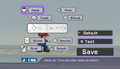 Wii Remote (Sideways)


Playable characters[edit]


- Main article: List of fighters debuting in Super Smash Bros. Brawl
Super Smash Bros. Brawl has 35 playable characters (39, if Sheik, Zero Suit Samus, and the Pokémon Trainer's three Pokémon are counted, each), ten more than in Super Smash Bros. Melee. 21 characters (25 if counting the four aforementioned characters) are playable directly from the start, while the other fourteen have to be unlocked to become playable; as new characters are unlocked, they can be seen amongst the fighters in the opening scene. Only five fighters from the previous game were not added to the roster: Roy, Dr. Mario, Young Link, Pichu, and Mewtwo. The game adds fifteen newcomers (18 counting Zero Suit Samus and the Pokémon Trainer's Pokémon). Super Smash Bros. Brawl is the first game with fighters from third-party franchises, particularly Sonic and Snake.
Of the roster, eight characters are from the Super Mario and related franchises: Mario, Luigi, Princess Peach, Bowser, Donkey Kong, Diddy Kong, Yoshi, and Wario.
| Character | Series | Description | How to unlock | Special moves | Costumes | ||||
|---|---|---|---|---|---|---|---|---|---|
| Standard | Side | Up | Down | Final Smash | |||||
 Mario |
 Super Mario |
Mario is a balanced character armed with a projectile, a fireball, a cape that reflects opposing projectiles and flips opponents, and F.L.U.D.D., which can spray water at targets. Mario is one of the characters who can wall jump. For his Final Smash, Mario blasts a giant fireball that moves slowly and horizontally. | Available by default |  Fireball |
 Cape |
 Super Jump Punch |
 F.L.U.D.D. |
 Mario Finale |
     
|
 Luigi |
Super Mario |
Luigi is similar to Mario, but compared to him, Luigi can jump higher, move faster, and has higher strength. He cannot wall jump, unlike Mario. |
|
 Fireball |
 Green Missile |
 Super Jump Punch |
 Luigi Cyclone |
 Negative Zone |
     
|
 Peach |
Super Mario |
Peach specializes in aerial techniques, she has a good horizontal recovery, and her attacks have high priority. However, Peach is vulnerable to knockback and lacks strength. | Available by default |  Toad |
 Peach Bomber |
 Peach Parasol |
 Vegetable |
 Peach Blossom |
     
|
 Bowser |
Super Mario |
Bowser is both heavier and larger than any other fighter. His attacks are powerful, but slow to use. Bowser's speed is slightly higher than in Super Smash Bros. Melee. | Available by default |  Fire Breath |
 Flying Slam |
 Whirling Fortress |
 Bowser Bomb |
 Giga Bowser |
     
|
 Donkey Kong |
 Donkey Kong |
Donkey Kong is heavy and strong. He can not only grab enemies, but also carry them. His speed is high compared to other heavy characters, but his recovery lacks vertical distance. | Available by default |  Giant Punch |
 Headbutt |
 Spinning Kong |
 Hand Slap |
 Konga Beat |
     
|
 Diddy Kong (newcomer) |
Donkey Kong |
Diddy Kong is both light and agile. He can use the Peanut Popgun as a weapon and his rocketbarrel to launch upward, like in Donkey Kong 64. Diddy has the ability to latch on opponents, either to attack or jump off of them. Diddy can use banana peels on his own. Diddy's Final Smash involves using both his Rocketbarrel and Peanut Popgun to shoot several peanuts below rapidly. | Available by default |  Peanut Popgun |
 Monkey Flip |
 Rocketbarrel Boost |
 Banana Peel |
 Rocketbarrel Barrage |
     
|
 Yoshi |
 Yoshi |
Yoshi is both fast and heavy, although he is weak. Yoshi's Egg Throw can be used as a third jump, unlike before. | Available by default |  Egg Lay |
 Egg Roll |
 Egg Throw |
 Yoshi Bomb |
 Super Dragon |
     
|
 Wario (newcomer) |
 Wario |
Wario is a small heavyweight skilled in aerial and recovery moves. His range is poor, and his attacks are somewhat slow. Despite being a heavyweight, Wario has average strength. Either his WarioWare series and usual outfit can be worn, each with color varieties of their own. Wario's Chomp involves him biting an opponent while keeping them trapped in his mouth. The potency of his Wario Waft depends on when it was last used, to the point of also functioning like an added jump. Wario can drive on his Wario Bike and ram into opponents with it. Wario's Final Smash transforms him into his superhero form, Wario-Man, who has greater movement and much stronger attacks. | Available by default |  Chomp |
 Wario Bike |
||||
