Time Machine (KC Mario)
The title of this article is official, but it comes from a Japanese source.
If an acceptable English name is found, then the article should be moved to the new title.
| Time Machine | |
|---|---|

| |
| First appearance | Super Mario Kodansha manga ("It's the nostalgic Dr. Mario. But he looks a little older, doesn't he?!") (1992) |
| Latest appearance | Super Mario Kodansha manga ("Mario faces off against the evil president Bowser in the future in a final showdown!") (1992) |
| Effect | Travel through time |
| Variant of | Time Machine 2-gō |
- See also: Time Machine
Dr. Mario Nakamatsu's Time Machine is Bowser's main method of transportation in the "Time Traveler" storyline of the Super Mario Kodansha manga. It is shaped like a gacha ball, with the upper half being made of glass.
Dr. Nakamatsu creates the Time Machine but soon grows worried that his creation might be use for evil intention. Right on cue, Bowser breaks in his lab and steals it to go back to the past to Mario's childhood and ruin his reputation so that Luigi abandons him and Peach no longer sees him as a potential partner. Bowser then uses the Time Machine to escape Mario, Luigi, and Princess Peach, who followed him with the Time Machine prototype, taking young Peach as a hostage, traveling through the Jurassic Era, the cowboy era, the Edo Period, and finally in the far future, in his own space colony.
At one point Mario uses a lasso to catch the Time Machine only to travel in the time tunnel with it.
In chapter 4, following the destruction of the prototype, Mario steals the Time Machine to return back to the present, then passes through Edo Period Japan to hit the machine by the 20-bai Spray to enlarge it and guest all the Marios from all the eras and use their help to defeat Bowser and rescue Peach. After sending everyone to their own era, Mario and his friends return to the present, moment before the Time Machine's theft, and destroy both Time Machines, preventing the entire adventure and any alterations to history.
Gallery[edit]
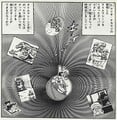 Mario hijacks the Time Machine
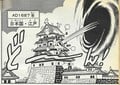 The Time Machine crashes in Tokugawa Tsunayoshi's palace.


Names in other languages[edit]
| Language | Name | Meaning | Note(s) | Ref. |
|---|---|---|---|---|
| Japanese | タイムマシーン Taimu Mashīn | Time Machine | [1] |
References[edit]
- ^ Motoyama, Kazuki (September 1, 1992). Deluxe BomBom. Japan: Kodansha (Japanese). ISBN T1016531090389. Page 238.

